- 368 pages
- English
- ePUB (mobile friendly)
- Available on iOS & Android
eBook - ePub
About this book
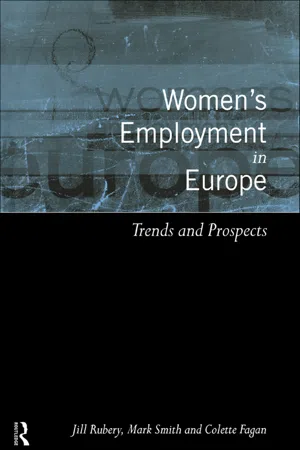
Based on extensive original research, this volume examines contemporary patterns of womens employment in Europe in the context of the profound economic, social and cultural changes that have taken place in recent years. It considers the progress made towards equal treatment in the labour market in the light of European Union action programmes, and
Information
Part I
Women’s employment in a changing Europe
Introduction
The integration of women into the wage economy over the past decades has represented one of the most profound social and economic changes within European economy and society. This integration has been associated with a restructuring of employment and a reorganisation of work, involving the growth of service employment, more diversified working-time arrangements and new patterns of industrial relations. At the same time women’s integration into wage work has involved a restructuring of household and family life, based on different and more complex patterns of household formation, fertility and social reproduction and with changing patterns of consumption and lifestyles. Too often the study of women’s employment is treated as an area of marginal interest to the core issues of European employment and European social policy, and the linkages between changes in gender relations and changes in economic and social structures are not made. These relationships are two-way: the integration of women into employment shapes the wider economy and society, and changes in women’s employment position is contingent upon the evolving patterns of economic and social conditions.
This two-way relationship can be considered to have both a long-term and a short-term dimension; the long-term considers the evolving role of women in the economy and society, which may develop a dynamic that is relatively independent or autonomous from short-term disruptions or changes in economic conditions (Humphries and Rubery 1984). Thus changes in women’s role in the labour market might initially have been instigated by changing patterns of labour demand, but over time the dynamic towards women’s integration has become less dependent upon the level of labour demand or on the prevalence of state policies designed to help women into the labour market. High levels of unemployment and even the dismantling of childcare provision would not be sufficient to send women back to the home. From the short-term perspective, changes to policies and to economic conditions may accelerate or stall these longer-term trends or transformations, but may not affect the underlying direction or shape of the trajectory of transformation.
The analysis presented in this section spans both the short and the long term; on the one hand we are concerned with a relatively short-term perspective, namely the trends and developments in the political and economic (Chapter 1), organisational (Chapter 2) and household (Chapter 3) environments during the first half of the 1990s. These developments had clear impacts upon the short-term prospects for women within European economies and both reinforced and, in some cases, even partially reversed the changes to women’s employment evident in previous decades. The longer-term transformation of gender roles has still been evident, however, as women have taken action to protect and reinforce their position in the labour market and have failed to respond to recessionary conditions by giving way in favour of the young or the long-term unemployed. Women participated more in education, married later or not at all, reduced their fertility and became more continuous participants in the labour market, almost in spite of changes to the economic and social climate that were reducing employment opportunities and putting pressure on childcare provision and social welfare.
Yet before we can conclude that the long-term trends are triumphing over the short-term setbacks we also have to consider whether the 1990s marked the beginning of a transformation in the organisation of European societies and economies which may place under threat some of the gains that women have made over recent decades and which we now almost take for granted. Short-term trends or cycles can only be separated from the longer-term transformation if the short-term variations do not become prolonged and deep, involving new transformations of underlying institutions and structures (see Rubery 1988 for a discussion of the link between cycles and trends in the development of women’s employment). For some the recessionary experiences of the early 1990s were not simply a phase of a business cycle but symptoms of the instability in and changes to the global economy and, in particular, of the incompatibility between the emerging economic conditions and the system of strong welfare states and regulated labour markets characteristic of many parts of Europe. This recession, in short, could be considered as marking the death knell for the European model, a sentence reaffirmed by the decision of all European states to adopt conservative macroeconomic policies to meet the Maastricht convergence criteria. If these developments were to spell the end of the welfare state as we know it and to herald the full adoption of a deregulated approach to labour market organisation, these changes might be sufficiently significant to mark a new phase in women’s relationship to the labour market. They might mean, for example, that the conditions under which women will become more fully integrated into the labour market might be based even more on unstable jobs within a deregulated environment than has been the case over past decades and that progress towards gender equality, where this is made, might be achieved more by a levelling down of men’s employment opportunities and position than through a levelling up of women’s position.
As to the verdict on the longer-term consequences of the changes to both economic conditions and economic and social policy identified in the 1990s, the jury is still out. There is little evidence from women’s own behaviour of any major change or rupture to their continued integration into wage work and their conversion into more permanent and continuously committed employees. Yet this continuity of behaviour is to some extent at odds with the major shocks experienced within some key economies in Europe, from Sweden with its new-found doubts over its capacity to maintain its welfare state system, to Germany, yet to come fully to terms with the implications of unification for the German model. A lagged adjustment may still be possible, but on the balance of probabilities the next phase of European employment development will still be based around an increasing share of women within the labour market.
However, whatever the eventual pattern of development, it is clear that gender will continue to play an important role in shaping the future European evolution. Women’s employment trends and prospects need to be situated within the context of a changing Europe, but changes in Europe will continue to be shaped on the one hand by the influence of gender on the organisation of labour markets and economic and social institutions more generally and, on the other hand, by the actions of both women and men in changing and shaping these gender roles.
1 Political and economic change
At the end of the 1980s Europe was preparing for 1992 and the creation of the single European market; the forecasts were upbeat (Cecchini 1988) with predictions of large-scale job creation, enhanced international competitiveness and a smooth development towards monetary union based upon the European Exchange Rate Mechanism (ERM). The changes in regimes in Eastern Europe and the former USSR were already underway but the impact on the world economy and on specific countries and regions of the EU was not yet apparent. The Community seemed poised on the brink of a major push to extend the benefits of the market to European citizens through the implementation of the European charter of fundamental social rights. With the commitment to equal treatment firmly established in the 1959 Treaty of Rome and reaffirmed in the 1992 Maastricht Treaty, the prospects for equality appeared propitious. However, the 1990s did not live up to their anticipated promise. At the beginning of the decade the European Union experienced one of its worst recessionary periods, and faced crisis within the ERM. The record unemployment levels led to a change in priority, in principle towards more employment-intensive growth, but this objective was adopted against a prospect of yet higher unemployment as the economies struggled to meet the conditions for the next stage of European integration. The Union expanded to absorb three new member states, two of them—Finland and Sweden—having faced major problems of restructuring to meet changing internal and external conditions from the start of the decade. Further expansion plans, this time towards Eastern European countries, provided a backcloth to debates on prospects for political, monetary and economic integration. By the late 1990s, the turbulence in the exchange rates had settled down and most countries had been deemed to have met the Maastricht conditions for European monetary union, perhaps in some cases revealing the greater importance of political will and political agendas over bureaucratic rules in determining the development of Europe. However, the problems of unemployment appeared to be even more intractable as the two economies that are perhaps most central to the European project, France and Germany, have continued to face record levels of unemployment. These problems led to the agreement in the 1997 Amsterdam Treaty to establish employment as an area of common concern, for member states to develop employment action plans according to an agreed set of guidelines, and for the action plans to be monitored and evaluated at a European Union level.
While the macroeconomic and political conditions for progress towards equality have deteriorated, the equality agenda has apparently moved more to centre stage within the Community, accorded equal priority with employment, and bolstered by the adoption, following on from the 1995 Beijing UN World Conference on Women, of a Communication on mainstreaming. Yet while there is a greater public recognition of the need for equality policy, at least at European level, the early 1990s perhaps saw the reemergence of a view that equality had perhaps been taken not only far enough, but even perhaps too far (National reports, Italy: Bettio and Villa 1996), such that it was now men who faced the most severe problems of coming to terms with their changing economic and social roles. This potential backlash against equality has coincided with a general disenchantment with social legislation. There thus now seems little prospect that the implementation of the European charter of fundamental social rights through the social chapter to the Maastricht Treaty will lead to a major expansion of new social legislation. While in the 1970s and 1980s the Commission played a leading role in initiating and developing major areas of social legislation, such as the equality directives, the 1990s saw a shift in practice, supported by the member states and the social protocol of the 1992 Maastricht Treaty, towards an increased role for the social partners in negotiating social policy through framework agreements (see Box 1.1 for a summary of the main measures taken by the European Union in the area of social policy directly or indirectly relevant to gender equality). That procedure necessarily limits the likely development of social legislation to that felt appropriate by European employers and clearly places a limit on the extent to which the social chapter could be used to develop a new platform of rights for citizens of Europe.
How have these changing economic and political conditions impacted on the development of women’s position in the labour market in Europe and in the individual member states? To consider these issues further we look first in more detail at the changing world and European economic conditions, followed by an analysis of recent trends in growth, productivity, employment and unemployment. This provides the background for an assessment, from a gender perspective, of the current policy agendas within the EU at European and national level, towards the macroeconomy, the labour market and the welfare state.
Box 1.1 EC directives, memoranda, recommendations, resolutions and programmes to promote equality of opportunity
Council Directives
Directive 75/117/EEC. Equal pay for men and women for the same work or for work of equal value.
Directive 76/207/EEC. Equal treatment for men and women in relation to access to employment, vocational training, promotion, and working conditions.
Directive 79/7/EEC. Equal treatment for men and women in matters of statutory social security.
Directive 86/378/EEC. Equal treatment for men and women in occupational social security schemes.
Directive 86/613/EEC. Equal treatment between men and women engaged in a self-employed capacity, including agriculture, and on the protection of self-employed women during pregnancy and motherhood.
Directive 92/85/EEC. The protection of pregnant workers and workers who have recently given birth or are breastfeeding.
Directive 93/104/EC. The Working Time Directive establishes limits to weekly hours, night work and provides basic entitlements to rest periods and annual leave.
Directive 96/34/EC. Grants male and female workers the right to unpaid parental leave of at least three months.
Directive 96/97/EC. Amends Directive 86/378/EEC (Post-Barber Directive)
Directive 97/80/EC. Shifts burden of proof in sex discrimination cases except in social security cases. Plaintiff no longer bears the full burden of proving her case and a clear definition of indirect discrimination is also provided.
Directive 97/81/EC. To remove discrimination against part-time workers, to improve the quality of part-time work, to facilitate part-time work on a voluntary basis to contribute to flexible working-time arrangements which take into account employer and worker needs.
Memoranda
Memorandum of 23.6.1994 on equal pay for work of equal value COM(94). Defined the scope and concept of equal pay for work of equal value and provided guidance on the criteria to be taken into account in job evaluation and job classification.
Follow-up Code of Practice for use by employers, employees and trade unions adopted by the Commission on 17.7.1996.
Council recommendations
Recommendation of 13.12.1984 on the promotion of positive action for women (84/635/EEC).
Recommendations of 27.11.91 on the protection of the dignity of women and men at work (92/131/EEC). Supported by a Code of Practice on measures to combat sexual harassment in 1991.
Council recommendation of 31.3.1992 on childcare (92/241/EEC).
Commission recommendation of 27.5.1998 on the ratification of ILO Convention no. 177 on homework of 20.6.1998.
Council resolutions
Resolution of 12.7.1982 on the promotion of equal opportunities for women.
Resolution of 7.6.1984 on action to combat unemployment amongst women.
Resolution of the Council and of the Ministers of Education, meeting within the Council of 3.6.1985, containing an action programme on equal opportunities for girls and boys in education.
Second Council resolution of 24.7.1986 on the promotion of equal opportunities for women.
Resolution of 16.12.1988 on the reintegration and late integration of women into working life.
Resolution of 22.6.1994 on the promotion of equal opportunities for women and men through action by the European structural funds.
Resolution of 27.3.1995 on the balanced participation of women and men in decision making.
The equality action programmes
The First Community Programme on the Promotion of Equal Opportunities for Women (1982–1985) recognised that while legal measures were important, there was a need for additional and complementary measures in the form of ‘positive action’ in various fields.
The Second Medium-Term Community Programme for Women (1986– 1990) continued to develop the implementation of the directives in an enlarged Community of 12 member states. It widened the scope of equal opportunities to new spheres of positive action in training, in new technology, in the reconciliation of working and family life and in local development.
The Third Medium-Term Community Action Programme on Equal Opportunities for Women and Men (1991–1995) proposed a new, more comprehensive, strategy for action.
The Fourth Medium-Term Community Action Programme on Equal Opportunities for Women and Men (1996–2000) focuses on the principle of mainstreaming. It proposes that methods, strategies, models and studies aimed at integrating the equal opportunities dimension into policies and activities be developed and promoted in the member states.
The first three programmes were implemented on the initiative of the Commission via Council resolutions. The fourth programme was proposed by the Commission to the Council and established by Council decision.
A changing world and a changing European economy: the implications for women and men in the European Union
There are two main competing perspectives on the changes in the world economy in the 1990s. For some it marked a watershed when the impossibility of regaining full employment or maintaining a strong welfare state within an integrated and globalised world economy became clear even to the most interventionist nation states. These beliefs have been bolstered by the collapse of the Communist bloc which for so long tried, but eventually failed, to buck the need to succumb to the discipline of the market. For others the increasing debate over globalisation hides instead a political change, whereby governments have effectively abdicated their responsibility for policy and for ameliorating the imp...
Table of contents
- Cover Page
- Title Page
- Copyright Page
- Figures
- Tables
- Boxes
- Acknowledgements
- Abbreviations
- Introduction
- Part I: Women’s employment in a changing Europe
- Part II: Indicators of women’s employment in the 1990s
- Part III: Reflections on trends and future prospects
- Appendix
- Notes
- Bibliography
Trusted by 375,005 students
Access to over 1.5 million titles for a fair monthly price.
Study more efficiently using our study tools.
Frequently asked questions
Yes, you can cancel anytime from the Subscription tab in your account settings on the Perlego website. Your subscription will stay active until the end of your current billing period. Learn how to cancel your subscription
No, books cannot be downloaded as external files, such as PDFs, for use outside of Perlego. However, you can download books within the Perlego app for offline reading on mobile or tablet. Learn how to download books offline
Perlego offers two plans: Essential and Complete
- Essential is ideal for learners and professionals who enjoy exploring a wide range of subjects. Access the Essential Library with 800,000+ trusted titles and best-sellers across business, personal growth, and the humanities. Includes unlimited reading time and Standard Read Aloud voice.
- Complete: Perfect for advanced learners and researchers needing full, unrestricted access. Unlock 1.5M+ books across hundreds of subjects, including academic and specialized titles. The Complete Plan also includes advanced features like Premium Read Aloud and Research Assistant.
We are an online textbook subscription service, where you can get access to an entire online library for less than the price of a single book per month. With over 1.5 million books across 990+ topics, we’ve got you covered! Learn about our mission
Look out for the read-aloud symbol on your next book to see if you can listen to it. The read-aloud tool reads text aloud for you, highlighting the text as it is being read. You can pause it, speed it up and slow it down. Learn more about Read Aloud
Yes! You can use the Perlego app on both iOS and Android devices to read anytime, anywhere — even offline. Perfect for commutes or when you’re on the go.
Please note we cannot support devices running on iOS 13 and Android 7 or earlier. Learn more about using the app
Please note we cannot support devices running on iOS 13 and Android 7 or earlier. Learn more about using the app
Yes, you can access Women's Employment in Europe by Colette Fagan,Jill Rubery,Mark Smith in PDF and/or ePUB format, as well as other popular books in Social Sciences & Business General. We have over 1.5 million books available in our catalogue for you to explore.