eBook - ePub
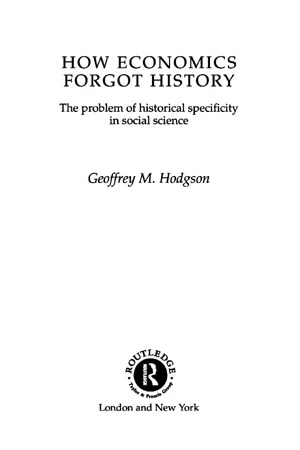
How Economics Forgot History
The Problem of Historical Specificity in Social Science
- 448 pages
- English
- ePUB (mobile friendly)
- Available on iOS & Android
eBook - ePub
How Economics Forgot History
The Problem of Historical Specificity in Social Science
About this book
In arguably his most important book to date, Hodgson calls into question the tendency of economic method to try and explain all economic phenomena by using the same catch-all theories and dealing in universal truths. He argues that you need different theories to analyze different economic phenomena and systems and that historical context must be ta
Part I
INTRODUCTION
1
THE LIMITATIONS OF GENERAL THEORY
Science must begin with myths, and with the criticism of myths.
(Sir Karl Popper, ‘The Philosophy of Science’ (1957))
History is important, partly because every complex organism, every human being and every society carries the baggage of its past. Evolution builds on past survivals that encumber actions in the present. Choices made by our ancestors can be difficult to undo. For example, the standard railway gauge used by modern high-speed trains has its origins in the axle dimensions of horse-drawn carts of over two thousand years ago. We travel on railways that were designed with some dimensions inherited from an ancient and inappropriate means of transport. Other examples of lock-in and path dependence in the evolution of technology and conventions are well known in the social sciences.1
If history matters – at least in the sense of social development being path dependent – then our analyses must explore the particularities of the past. While we may retain general principles or guidelines, detailed analyses of particular events, structures and circumstances are required. If history matters in this sense, then general theories have their limits. That is one reason why some of the quoted examples of technological lock-in have been controversial: path dependence dulls the lure of a general theory.2
In contrast, if we were to possess an adequate general theory of socio-economic structure and change, then we would use it to understand every kind of circumstance within its broad domain of application. Specific circumstances would enter the theory merely as data. Particular theories would no longer be required. The achievement of a general theory of economic behaviour would make the construction of a historically delimited theory redundant. A single theoretical framework would encompass all possibilities. That is the lure of a general theory.3
Nevertheless, it is argued here that such a goal is impossible, at least in the social sciences. The desire for a general theory obliges scientists to simplify and to overturn the very generality for which they strive. The lure of a general theory is in part responsible for a degree of neglect of history in contemporary economics and sociology. This chapter considers the basis of this lure. It argues that general theories can be only of limited use in social science. A place for historically specific theories must remain.
For centuries, however, scientists have admired general theories. The Ancient Greeks sought common patterns and symmetries in nature. Pythagoras observed a blacksmith at work and noticed that iron bars of different lengths gave out sounds of different pitch under the strokes of the hammer. Conceptions of sound and length, of music and measure, were amalgamated. Centuries later, at the beginning of the modern world, Isaac Newton formulated his general laws of motion, explaining both the motion of earthly projectiles and the movements of the planets. In 1820 Hans Christian Oersted saw that an electric current flowing through a wire deflected a nearby compass. He thus discovered the hitherto unrecognised link between magnetism and electricity and inspired the development of the electric motor. Michael Faraday set himself the problem of finding the connections between light, heat, magnetism and electricity, and developed a unified theory of electromagnetic radiation. Energy and matter became later unified in Albert Einstein’s theory of relativity. Physics still struggles to capture diverse phenomena within a common explanatory framework. Science tries to unify: it strives for general theories. The goal of unification has endured in the history of science and has inspired many of its achievements.
Much innovation in science comes from combining different phenomena in a more general scientific framework. Philosophers of science have rightly identified the power and value of explanatory unification. For example, Paul Thagard (1978) and Philip Kitcher (1981, 1989) have correctly pointed out that explanatory unification has played a significant role in the development of the natural sciences. Likewise, Clark Glymour (1980, p. 31) has argued that successful explanations in science have the feature that they ‘eliminate contingency and they unify’. The importance and possible value of explanatory unifications should not be underestimated.
However, the quest for explanatory unification should not be pushed to the point where the nature and value of the particular explanation adopted are given weak scrutiny. Some explanations may unify, but be of little worth. A theory that every event is caused by the gods is an explanatory unification, but it is of little scientific significance. Likewise, as discussed in chapter 16 below, a non-falsifiable general theory such as ‘everyone is a utility maximiser’ is also of little explanatory value. This book addresses the limits of explanatory unification in the social sciences.
Some claims of explanatory unification are defective in their failure to consider their ontological presuppositions. Others fail, similarly, to question what is meant by ‘explanation’, being merely satisfied to point to a theory that seemingly ‘fits’ every eventuality. The ideas that everyone maximises their utility, or that every event is caused by gods, come into this category. However, once we attempt to build more careful and meaningful explanations, then we are faced with the problem that economic reality changes in a way that physical reality does not. Yet the lure of a general theory has often overcome such critical reflections.
The lure of a general theory pervades the social as well as the natural sciences. Again it is believed that a general theory is always better than one with a narrower domain of analysis. Consequently, it is upheld that to become respectable, economics, sociology and anthropology must also uncover general principles or laws – much in the manner of the natural sciences. The aim is for one theory that fits all circumstances.4
This notion emerged in the heyday of classical economics. While Adam Smith attempted judiciously to blend induction with deduction, at the same time he sought general principles and laws. However, his classical successors such as David Ricardo and especially Nassau Senior went much further. They pursued more and more an axiomatic and deductivist method, attempting to derive universal conclusions from a few professedly general and fundamental propositions. Ranged against this Ricardian tendency was Thomas Robert Malthus. Malthus criticised the over-emphasis on deduction and generalisation. He wrote in 1819: ‘The principal cause of error, and of the differences which prevail at present among the scientific writers on political economy, appears to me to be a precipitate attempt to simplify and generalize’ (Malthus, 1836, p. 4).
Significantly, John Maynard Keynes (1972, pp. 100–1) wrote in his 1933 essay on Malthus: ‘If only Malthus, instead of Ricardo, had been the parent stem from which nineteenth-century economics proceeded, what a much wiser and richer place the world would be today!’ However, Keynes himself made two crucial mistakes. Both helped the Ricardian rather than the Malthusian stem to triumph and spread across the world. One error was to neglect the German historical school and its alternative to Ricardian deductivism. The other mistake was to recommend a ‘general theory’ of his own. The General Theory of Employment, Interest and Money (1936) is one of the most famous cases of an attempted general theory in economics. Keynes’s perceptions in his Malthus essay were right, but – as argued in chapter 15 of this work – he did not do enough to prevent a strain of deductivist general theorising that dominated economics for forty years after his death. The case of Keynes is an object lesson. The search for a general theory is not confined to mainstream or neoclassical economics. All sorts of economists have revered a ‘general theory’.5
For much of the postwar period, ‘general equilibrium analysis’ has been in vogue in economics. It has attempted to elaborate the general conditions for the existence and stability of market equilibria (Debreu, 1959; Arrow and Hahn, 1971). This work was at the cutting edge of theoretical economics until it ran into analytical difficulties in the 1970s. It was eclipsed by the rising interest in game theory in the 1980s.
Likewise, in sociology, there has been a similar reverence for general theory of social action, interaction and structure. Twentieth-century milestones in sociological theory – such as Talcott Parsons (1937a), Robert Merton (1949), George Homans (1961), Peter Blau (1964), Jeffrey Alexander (1982–3), Anthony Giddens (1984), James Coleman (1990), Harrison White (1992) and Niklas Luhmann (1995) – are all general attempts to understand ‘society’, largely unconfined to any historically specific epoch or type of social structure.6
Overall, general theories have pervaded economics and sociology for the second half of the twentieth century. General principles are assumed and their logical consequences are explored. In this respect, at least, the social sciences look to physics and other natural sciences as their role models. The more general and inclusive the theory, the greater its prestige. Universalisations take the accolade.
What characterises a general theory in the social sciences? Here we shall take the term ‘general theory’ to mean the following: It is any substantial explanation or model of the principal characteristics and behaviour of human economies or societies, largely or wholly in terms of features that are assumed to be common to most conceivable social or economic systems.
It is true that modern mainstream economists attempt to tailor their theories to specific situations. There are theories of perfect competition, theories of monopoly, theories of oligopoly, theories of labour markets and so on. Such theories may claim to apply to a specific set of circumstances. In some of their assumptions, these theories differ from one another. Nevertheless, some of their features are like those of a general theory. First, some presumptions – such as rationality, scarcity and fixed preferences – are common to all these theories. These core assumptions are held to apply to all socio-economic systems. Second, it is rarely claimed that the theory involved applies to a specific type of socioeconomic system or a limited historical period. In these two senses, ahistorical and acultural generalities pervade even specific modes of theorising in modern mainstream economics.
The goal of a general theory has been pursued to the greatest extent in the type of general equilibrium theory developed by Léon Walras, Kenneth Arrow, Gerard Debreu and others. Significantly, from the 1930s to the 1980s, general equilibrium was one of the most prestigious areas of research in economic theory. Of course, the word ‘general’ in ‘general equilibrium theory’ applies to the word ‘equilibrium’ rather than ‘theory’. General equilibrium is thereby distinguished from partial equilibrium. Nevertheless, general equilibrium theorists have used the rhetoric and appeal of general theorising as well, often using the term ‘general theory of economic equilibrium’. Attempts have been made to apply this general equilibrium approach to feudalism and socialism, as well as to capitalism (Lange and Taylor, 1938; Rader, 1971). In particular, both Oskar Lange and Joseph Schumpeter lauded Walras as the architect of a ‘truly general theory’ in economics.7
Abstraction and simplification are necessary for any theory. General theorists, however, build upon features that are taken as common or universal, rather than historically or culturally specific. Their guiding examples in this respect are the successful explanatory unifications and general theories that are found in the natural sciences. For example, in economics, general equilibrium theorists have made ostensibly general assumptions concerning human agents, their endowments and their interactions. With these they attempt to deduce some general results concerning economic equilibria. Likewise, in social theory, general assumptions are made about social agents, their ‘exchanges’ and the social structures that they inhabit.
GENERAL THEORISTS, NIHILISTS AND EMPIRICISTS
Nevertheless, general theorising is not universally popular. Ranged against the proponents of general theory, in both economics and sociology, are those that are critical of its operational usefulness, explanatory adequacy and universal claims.
For instance, ‘post-modernism’ is a major assault on general theorising in the social sciences. Post-modernists emphatically reject grand narratives and totalising theory (Lyotard, 1984). The problem is that they can do this only by means of a totalising, meta-narrative of their own. There is no means by which to dispense with a grand narrative other than by an even grander, universal story. Hence the post-modernists fall into a paradox of their own making. As Andrew Sayer (1995, p. 223) puts it: ‘Those who are sceptical of meta-narratives should turn their suspicions on “modernism” and “postmodernism” first.’ There is no way of avoiding this paradox: grand theory cannot be dismissed by yet another grand, general discourse, whatever its rhetorical appeal. Post-modernism is further weakened by its abandonment of the search for truth. Post-modernism is a symptomatic but nihilistic reaction against the excessive claims for general theorising in social science.
Logically, any argument against general theories must involve general statements or narratives. Although these statements are not necessarily general theories, in the sense defined above, they are nevertheless general in their scope. The rejection of general theories must itself involve generalities. There is no escape.
Post-modernism rightly detects some of the limits of general theorising but veers off in a largely unwarranted and unacceptable direction. These mistakes might have been avoided if post-modernists had some awareness of past debates concerning the limits of general theory in the social sciences. We shall briefly discuss post-modernism again in the next chapter, after the problem of historical specificity has been introduced in more detail.
Other critics of general theories take refuge in empirical work. Empiricism is defined as the broad notion that knowledge is based primarily on experience rather than on any body of theory.8 Empiricists hold that reality can be understood only by detailed, empirical engagement. It is believed that the search for truth is an empirical matter; it involves the gathering of data rather than the unsupported erection of theoretical postulates. If any theoretical generalisation is possible, empiricists believe that it must emerge on the basis of extensive empirical enquiry.
Today, we find both empiricists and general theorists in university social science departments. For centuries, a version of empiricism has been a haven for critics of general theorising. This type of empiricism is antithetical to all theory. We also find empiricist hybrids, who accept some universal propositions, but also believe that further truths are established on the basis of data alone. These hybrids accept the desirability of universal assumptions and then immerse themselves in empirical work, believing that universal truths can eventually be established by induction.9
Over time, the balance of debate has shifted back and forth between these various positions. Intellectual fashions come and go. As both economics and sociology go through periods of theoretical crisis, empiricism is seen as the salvation. Even further, the inadequacies of general theorising sometimes create a reaction against all theory. Theory is abandoned in search of the facts. The anti-theoretical empiricists march forth with their clipboards and computers. But as some cohorts of these empiricists get lost in the analytical swamplands of questionnaires and statistics, new groups of general theorists emerge, promising order and deliverance. And so it goes on, each group ascending then descending.
The truth is that both empiricism and general theorising have their intellectual limitations, as does any hybrid combination of the two. Both empiricists and general theorists place their conceptual weight on universal assumptions, placing less emphasis on concepts and theories that are more appropriate to the specific situation at hand. Although empiricists may sometimes fail to champion an explicit general theory, empiricism always has a hidden general theory of its own. This is because, in attempting to measure any quantity, or trying to establish any empirical regularity, acts of classification or taxonomy are unavoidable. For empirical enquiry, entities are placed into groups. The most important properties and relations are identified. Connections are made. Accordingly, all empirical investigation involves prior judgements of sameness and difference. For example, we cannot examine transaction costs in firms without first having a notion of what is, and what is not, a transaction cost and a firm. Classification, by bringing together entities in discrete groups, must refer to common qualities. These qualities themselves have generality: they must be assumed to endure through space and time.
All empirical work thus relies on the principle known as ‘the uniformity of nature’. For some types, entities or qualities, it has to be assumed that the type, entity or quality in one place in space and time remains the same type, entity or quality at another place in space and time. Otherwise we are faced with an immense collection of disconnected entities and qualities, and no meaningful empirical or other scientific investigation is possible. This supposition of the uniformity of nature is a highly general theoretical principle. Although empirical work depends upon it, the principle cannot be proven or disproven by the data. It must be assumed at the outset.
The idea that empirical data are sufficient for all knowledge thus founders. The empirical researcher must classify, and classification depends on the metaphysical principle of the uniformity of nature. Any empirical investigation depends on the assumptions of identity, continuity and measurability. These assumptions cannot themselves be derived from empirical data. Pure empiricism is thus incoherent.
In addition, a principal goal of any science is explanation. Explanation involves the suggestion of relationships of cause and effect. Without a presumption of causality, there can be no convincing scientific explanation of any phenomenon. However, no empirical enquiry can itself establish a causal relation. No cause can be perceived. Data cannot show us cause and effect. Correlations between sets of events are not necessarily indications of cause and effect. Correlation is not causation. Since David Hume’s discussion of this problem, it has been widely accepted by philosophers that causal relations cannot be discerned in the data themselves. Accordingly, any scientific explanation involves the assumption of causal relationships that are themselves absent in the empirical data: they must be assumed. Empirical data cannot on their own provide causal explanations.10
Theory has primacy over facts, because concepts and theories are required to formulate any factual statement. However, this does not mean that science always works by first formulating a theoretical explanation and then testing it. There are many cases in the history of science where facts have first emerged without a theory that explains them. Science may subsequently triumph by su...
Table of contents
- Cover Page
- Title Page
- Copyright Page
- Illustrations
- Preface
- Acknowledgements
- Part I: Introduction
- Part II: The Nineteenth Century
- Part III: The Twentieth Century
- Part IV: The Millennium
- Bibliography
Trusted by 375,005 students
Access to over 1.5 million titles for a fair monthly price.
Study more efficiently using our study tools.
Frequently asked questions
Yes, you can cancel anytime from the Subscription tab in your account settings on the Perlego website. Your subscription will stay active until the end of your current billing period. Learn how to cancel your subscription
No, books cannot be downloaded as external files, such as PDFs, for use outside of Perlego. However, you can download books within the Perlego app for offline reading on mobile or tablet. Learn how to download books offline
Perlego offers two plans: Essential and Complete
- Essential is ideal for learners and professionals who enjoy exploring a wide range of subjects. Access the Essential Library with 800,000+ trusted titles and best-sellers across business, personal growth, and the humanities. Includes unlimited reading time and Standard Read Aloud voice.
- Complete: Perfect for advanced learners and researchers needing full, unrestricted access. Unlock 1.5M+ books across hundreds of subjects, including academic and specialized titles. The Complete Plan also includes advanced features like Premium Read Aloud and Research Assistant.
We are an online textbook subscription service, where you can get access to an entire online library for less than the price of a single book per month. With over 1.5 million books across 990+ topics, we’ve got you covered! Learn about our mission
Look out for the read-aloud symbol on your next book to see if you can listen to it. The read-aloud tool reads text aloud for you, highlighting the text as it is being read. You can pause it, speed it up and slow it down. Learn more about Read Aloud
Yes! You can use the Perlego app on both iOS and Android devices to read anytime, anywhere — even offline. Perfect for commutes or when you’re on the go.
Please note we cannot support devices running on iOS 13 and Android 7 or earlier. Learn more about using the app
Please note we cannot support devices running on iOS 13 and Android 7 or earlier. Learn more about using the app
Yes, you can access How Economics Forgot History by Geoffrey M Hodgson in PDF and/or ePUB format, as well as other popular books in Economics & Business General. We have over 1.5 million books available in our catalogue for you to explore.