eBook - ePub
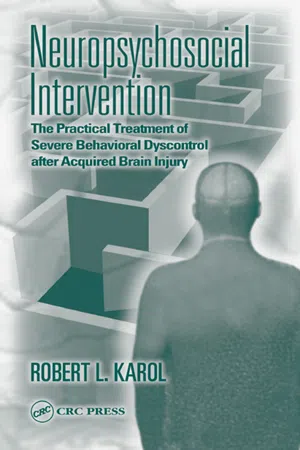
Neuropsychosocial Intervention
The Practical Treatment of Severe Behavioral Dyscontrol After Acquired Brain Injury
- 232 pages
- English
- ePUB (mobile friendly)
- Available on iOS & Android
eBook - ePub
Neuropsychosocial Intervention
The Practical Treatment of Severe Behavioral Dyscontrol After Acquired Brain Injury
About this book
Neuropsychosocial intervention is an innovative and clinically proven treatment approach to severe behavioral problems that can affect persons with acquired brain injury. This book outlines the nature and significance of behavioral dyscontrol, explains aggression, and details the neuropsychosocial treatment approach and the principles on which it i
Information
chapter one
The neuropsychosocial approach
Introduction
Severe behavioral problems after acquired brain injury can challenge the therapeutic skills of even experienced professional care providers. Too often, extreme behavioral dysfunction perplexes therapists, leading to treatment failure. Traditional behavioral treatment strategies often fail to successfully address severe behavioral difficulties in the brain injury population; however, an innovative treatment approach can overcome even severe behavioral problems.
Brain injury may be acquired in a multitude of ways. The most common include traumatic events, such as motor vehicle crashes, sports injuries, falls, and assaults.1 Gunshot injuries are also a frequent cause of traumatic brain injury. In children, shaken baby episodes may result in brain injury.2 Lack of oxygen to the brain from a near-drowning episode, carbon monoxide exposure (from sources such as heater malfunction in ice houses used for winter fishing, or suicide attempt by automobile engine fume exposure), breathing cessation post motor vehicle crash, suicide attempt by hanging, heart attack sequelae, untoward surgical events, cerebrovascular accidents, brain tumors, and drug overdose can all cause brain injury. Another source of brain injury is toxic chemical exposure.3 Finally, brain infection can lead to brain injury. Hence, the term “acquired brain injury” subsumes traumatic brain injury, anoxia, stroke, tumor, drug effects, and infection.
Other conditions that involve altered brain function include degenerative diseases such as Alzheimer’s disease, multiple sclerosis, Parkinson’s disease, and Pick’s disease. Further causes of damage to the brain include congenital factors, birth trauma, or even pre-birth events—fetal alcohol or cocaine exposure. Mental retardation involves cognitive sequelae of altered brain function. However, while the treatment approach proposed here may be of benefit to these populations, the primary intent of this book is to address the treatment challenges that people with acquired brain injury present to families and professionals.
The number of brain injuries in the United States is staggering. Hospital emergency departments treat and release one million people each year for brain injury,4 and many more people with brain injuries never seek care. The number of people needing care in hospitals and thereafter is large.5 Approximately 230,000 Americans are hospitalized each year due to traumatic brain injury. If even a small percentage of persons with brain injury experience behavioral problems, providers, families, friends, employers, and society face a daunting challenge. Furthermore, many persons with brain injury are young at onset. Hence, left untreated, behavioral dysfunction will exhibit itself for decades.
The National Institutes of Health Rehabilitation of Persons with Traumatic Brain Injury Consensus Statement describes the annual cost of acute care and rehabilitation for new cases of traumatic brain injury as $9 to $10 billion, with the average lifetime cost of care after severe injury as $600,000 to $1,875,000 per person.1 These enormous costs are an underestimate of overall costs because they fail to incorporate the economic impact of lost earnings, social services utilization, and lost economic contribution from family members. People with brain injury who exhibit severe dyscontrol are likely at the high end of the spectrum in regard to cost.
While severe behavioral problems are uncommon when one considers all persons with brain injury,6 for those who experience dyscontrol the consequences are significant. Such behavior causes significant disruption for persons with brain injury and the people who come into contact with them. Extreme behavior demands attention.
Severe behavioral dyscontrol after acquired brain injury takes many forms. Persons with brain injury may threaten to harm themselves or other people. They may verbalize an intent to destroy property. They may engage in self-injurious behavior, hurt others, or aggress against objects. They may threaten to run away, or may actually elope. They may put themselves at risk for being taken advantage of by other people.
There are many ways to threaten to or actually hurt oneself. Persons with brain injury may self-mutilate by poking themselves with pins, pens or pencils, forks, or jewelry, or by scratching themselves with paper clips, notebook binders, bed frame edges, doorframes, fingernails, or any surface with a corner or edge. They may use a knife to cut themselves. They may burn themselves with matches, cigarettes, or stove burners; they may bang their heads against walls, floors, or objects. Persons with brain injury are at higher risk than the general population for the most destructive type of self-injurious behavior: suicide attempt.7,8 Anunsuccessful suicide attempt can worsen brain injury: an unsuccessful gunshot wound, hanging, or carbon monoxide exposure most certainly will aggravate brain damage already present.
Persons with brain injury may also direct aggression against other people. They may grab, pull, pinch, or twist. They can come up from behind and attempt to choke someone or put a knee into someone’s back. They may grasp one’s clothing and pull. A man’s necktie is a particularly dangerous target, as it is essentially a slipknot or noose around the wearer’s neck. Long hair also makes a tempting target. Earrings are another dangerous item that can easily be pulled, sometimes resulting in ripping of the ear lobe.
More direct forms of assault also take place. Hitting and kicking are the most common, though one may also encounter head butting. Sometimes the aggression represents indiscriminate lashing out, but at other times there is a marked intention to do bodily damage to another person. Persons with brain injury may spit, which can be particularly harmful if aimed at someone’s eyes. Infrequently, a person with brain injury may propel other bodily fluids at another individual as well.
A frequent form of aggressive behavior is throwing things. The item thrown can range from ineffectual (crumpled up paper or clothes) to dangerous (a kitchen utensil, knife, or chair). A table can be flipped over towards another person, as can a bed. Unlikely objects can be turned into weapons. A notebook can be broken apart and a weapon created from the metal binder. A window can be broken and the sharp pieces used for weapons. Individuals can rip apart bathroom fixtures, making a weapon from faucet handles. Others may avail themselves of weapons which do not “require assembly,” such as guns or knives.
In addition to the creation of weapons, persons with brain injury may engage in property destruction. They may punch holes in walls or damage appliances. A frequent target appears to be the telephone, when the person becomes angry during a phone conversation. Frustration during automobile rides leads to wear on automobile interiors. A person may set fire to objects, furniture, or a building in an expression of anger.
There are additional types of behavioral dysfunction which may be more subtle, but are disruptive nonetheless. Persons with brain injury may demonstrate poor safety decisions. They may persist in transferring from a wheel-chair to a chair unassisted when they lack sufficient skill to do so, risking a fall. They may insist on driving before their therapists clear them to do so.
Persons with brain injury can become demanding or manipulative. They may pester with continual requests or pit one therapist against another. Noncompliance may be a problem—they may refuse treatment or medications, or they may use noncompliance as a bargaining tactic.
Social inappropriateness is a frequent problem. Persons with brain injury may have poor social skills. They may disregard or be unaware of social boundaries and appropriate behavior. They may make comments that are offensive to others or invade other people’s personal space. Sexual inappropriateness may also cause problems, as they can become too forward or target the wrong person. Sexual assault is possible. In contrast to this type of behavior, some persons with brain injury become isolated and socially withdrawn. They may refuse to leave their rooms, as the world may seem overwhelming. Because their attempts at interaction are ineffective and cognitive deficits lead to mistakes, they feel that isolation is safer.
The cognitive deficits of persons with brain injury can become a behavioral problem, too. “Innocent” behavioral dyscontrol can result from cognitive dysfunction. Individuals may be confused or disoriented. Many persons with brain injury show an unawareness of their deficits. Some may experience delusions or hallucinations. Somatic complaints can arise out of proportion to physical health condition. Persistent somatic complaints can sometimes dominate all discourse with persons with brain injury. Obsessiveness may be displayed in the form of theft or hoarding of food or objects: pencils, crayons, and straws are commonly hoarded objects in hospitals.
Finally, elopement is a serious problem. Some persons with brain injury may run away, often with nowhere to go. Those with significant cognitive impairment may just wander away. Some persons with brain injury get lost. Some may put themselves in vulnerable positions, in which they can be emotionally exploited and abused. Persons with brain injury may be at risk for physical assault, theft, and rape.
The array of ways in which persons with brain injury exhibit dyscontrol is endless. Treatment procedures have traditionally been unable to successfully address the wide range of behavioral dysfunction, particularly when the behaviors are severe.
Alternatives to treatment
The social penalty of severe behavior left untreated is harsh. The social service or health care system may lock away persons with brain injury in state hospitals.9 Institutionalization of this type can be expensive, and appropriate treatment may be lacking. Although therapists may develop appropriate treatment programs in some institutions, many persons with brain injury languish untreated or inappropriately diagnosed. Trends for deinstitutionalization are encouraging only insofar as government allocates sufficient funds for alternative, correctly designed treatment programs. Still, treatment for truly severe behavioral dyscontrol may require temporary, but perhaps extended removal from the environment to ensure the safety of persons with brain injury and that of others. Regardless, it is easier to close institutions than to guarantee an adequate, permanent funding stream for smaller and more diverse service vendors scattered across a geographic region. Furthermore, such smaller providers of deinstitutionalized care lack the time, political resources, and knowledge to successfully lobby for adequate funding as large institutions do. Hence, when the social service or health care system places persons with brain injuries in state institutions without correct diagnoses and available, appropriate treatment, or removes them from institutions without care and support commensurate with their severe behavioral dyscontrol, a successful long term outcome is highly unlikely. Parenthetically, persons with mental illness also face deinstitutionalization without adequate alternative services.10
The social penalty of untreated or mistreated severe behavioral dyscontrol after acquired brain injury may include incarceration by the criminal justice system. In fact, violence following a number of organic syndromes can lead to incarceration.11 Unfortunately, the authorities imposing incarceration may either be unaware of or not appreciate the etiological factor of brain injury as a contributing factor or primary cause of the offending behavior.12 Education regarding brain injury is lacking among health care providers. To suppose that it is greater among criminal justice workers is foolhardy.
Once a person with brain injury is incarcerated, the opportunity for treatment to ameliorate the behavioral dyscontrol is nil. Of course, the behavior may be suppressed in prison due to fear or lack of opportunity, as the person is in a cell under observation by armed guards. This is not treatment, and it will not generalize to the real world if brain injury was an important causal factor leading to the crime and incarceration. Punishment and fear can suppress behavior, but, as has been known for along time,13 they do not teach alternative behaviors that are necessary to support generalization across settings or maintenance over time. As will be seen shortly, contingencies often fail as an intervention strategy for severe behavioral dyscontrol after acquired brain injury, even when therapists apply them in a more therapeutic, sophisticated manner than do jailers or prison guards
Incarceration in prison may worsen behavioral dyscontrol. This venue presents unintended instruction in anti-social values and modeling of violence as a coping strategy. Thus, society is left with incarceration as a poor intervention strategy and one more likely to increase behavioral dyscontrol after acquired brain injury than to cure it.
Persons with brain injury also run the risk of falling through the cracks in the social service system, and receiving no attention. With behavioral dyscontrol as a symptom, receiving no attention is an infrequent occurrence, but it can happen. Persons with brain injury often find encounters with social service systems and program funding sources to be perplexing and incomprehensible, as do many professionals! Unable to avail themselves of the resources that do exist, they become invisible. Some live on the streets or in shelters, and with their cognitive and emotional limitations leading to a lack of inhibition they are vulnerable to abuse or further brain injury from assault or substance abuse.
Professionals must address behavioral problems. There is no choice. The available options of institutionalization, incarceration, or invisibility are unacceptable for an enlightened society. Unlike many other health conditions, perhaps congenital in nature, with symptoms that appear before one is of an age to vote on taxes which will pay for health care services, or which one might avoid with a healthy diet and lifestyle, we are all only one drunk driver away from needing appropriate brain injury treatment. Hence, the development of treatment services for behavioral dyscontrol after brain injury should be encouraged by all members of society to ensure adequate care for citizens who may suffer brain injury in the future.
If persons with brain injury persist in behavior that defeats the application of cognitive or emotional advances, the treatment of their other brain injury symptoms is pointless. Persons with brain injury with good behavioral control who achieve emotional adjustment can deal with cognitive deficits. Persons with brain injury with good behavioral control and who compensate for cognitive deficits can seek emotional adjustment. However, no one will tolerate persons with brain injury who demonstrate adequate emotional adjustment and satisfactory compensation for cognitive deficits but physically assault someone who irritates them. Behavioral control is essential to reintegrate back into society.14
Unfortunately, while there have been advances in medical care for brain injury, there has not been a parallel advance in addressing extreme behavioral problems. Medical advances include better emergency rescue teams and paramedic response services, emergency rooms, neurosurgery, intensive care units, and acute rehabilitation. Specialty services now include brain i...
Table of contents
- Cover Page
- Title Page
- Copyright Page
- Dedication
- Preface
- Acknowledgments
- About the Author
- Contributors
- Terminology
- A Special Note to Persons With Brain Injury
- This Book and Prevention of Brain Injury
- Notice
- Chapter One: The Neuropsychosocial Approach
- Chapter Two: The Implications of Cognitive Deficits for Behavioral Dyscontrol
- Chapter Three: The Contribution of Adjustment Issues to Behavioral Dyscontrol
- Chapter Four: The Phenomenology of Behavioral Dyscontrol
- Chapter Five: Behavior Plans: Application of the Neuropsychosocial Approach
- Chapter Six: The Role of Medications In Behavioral Management
- Chapter Seven: Community Placement Using the Neuropsychosocial Approach
- Chapter Eight: Clinical Vignettes: Demonstrations of the Neuropsychosocial Approach
Trusted by 375,005 students
Access to over 1.5 million titles for a fair monthly price.
Study more efficiently using our study tools.
Frequently asked questions
Yes, you can cancel anytime from the Subscription tab in your account settings on the Perlego website. Your subscription will stay active until the end of your current billing period. Learn how to cancel your subscription
No, books cannot be downloaded as external files, such as PDFs, for use outside of Perlego. However, you can download books within the Perlego app for offline reading on mobile or tablet. Learn how to download books offline
Perlego offers two plans: Essential and Complete
- Essential is ideal for learners and professionals who enjoy exploring a wide range of subjects. Access the Essential Library with 800,000+ trusted titles and best-sellers across business, personal growth, and the humanities. Includes unlimited reading time and Standard Read Aloud voice.
- Complete: Perfect for advanced learners and researchers needing full, unrestricted access. Unlock 1.5M+ books across hundreds of subjects, including academic and specialized titles. The Complete Plan also includes advanced features like Premium Read Aloud and Research Assistant.
We are an online textbook subscription service, where you can get access to an entire online library for less than the price of a single book per month. With over 1.5 million books across 990+ topics, we’ve got you covered! Learn about our mission
Look out for the read-aloud symbol on your next book to see if you can listen to it. The read-aloud tool reads text aloud for you, highlighting the text as it is being read. You can pause it, speed it up and slow it down. Learn more about Read Aloud
Yes! You can use the Perlego app on both iOS and Android devices to read anytime, anywhere — even offline. Perfect for commutes or when you’re on the go.
Please note we cannot support devices running on iOS 13 and Android 7 or earlier. Learn more about using the app
Please note we cannot support devices running on iOS 13 and Android 7 or earlier. Learn more about using the app
Yes, you can access Neuropsychosocial Intervention by Robert L. Karol in PDF and/or ePUB format, as well as other popular books in Psychology & Physiotherapy, Physical Medicine & Rehabilitation. We have over 1.5 million books available in our catalogue for you to explore.