eBook - ePub
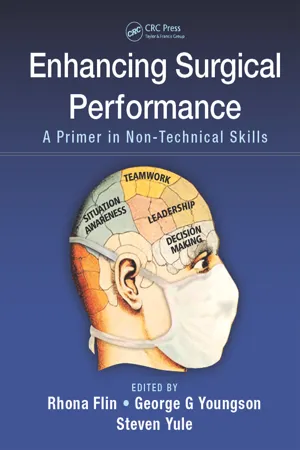
Enhancing Surgical Performance
A Primer in Non-technical Skills
- 223 pages
- English
- ePUB (mobile friendly)
- Available on iOS & Android
eBook - ePub
Enhancing Surgical Performance
A Primer in Non-technical Skills
About this book
Enhancing Surgical Performance: A Primer in Non-Technical Skills explains why non-technical skills are vital for safe and effective performance in the operating theatre. The book provides a full account, with supporting empirical evidence, of the Non-Technical Skills for Surgeons (NOTSS) system and behavioural rating framework, which helps identify
Information
PART I
Surgical performance: Recognition of the challenge
1 Intraoperative performance, non-technical skills and surgical safety
George G Youngson
2 Human factors: The science behind non-technical skills
Rhona Flin and Manoj Kumar
3 Non-technical skills for surgeons: The NOTSS behaviour marker system
Steven Yule and Douglas S Smink
1
Intraoperative performance, non-technical skills and surgical safety
1.1 Introduction
1.2 Surgical skills
1.2.1 Skills at outset
1.2.2 What good surgeons do well
1.3 Non-technical skills
1.3.1 NOTSS (non-technical skills for surgeons)
1.3.2 Non-technical skills in elective and emergency settings
1.3.3 Non-technical skills and the elective case
1.3.4 Non-technical skills and the emergency case
1.4 What non-technical skills are not
1.5 Factors influencing surgical performance
1.5.1 Surgical performance and equipment
1.5.2 Surgical performance and the team
1.5.3 Surgical performance and the operating theatre environment
1.6 Surgical error
1.6.1 Never (and other adverse) events
1.6.2 Error and checklists
1.6.3 Analysing error
1.6.4 Day-to-day performance
1.7 About this book
1.7.1 Using this book
References
1.1 INTRODUCTION
There are many factors which will influence and determine a surgeon’s intraoperative performance, but there is a traditional emphasis placed on the value of comprehensive knowledge, sound surgical technique and good manual dexterity. The importance of these elements of the surgical skill set is recognized by all; but they are, by themselves, insufficient to ensure the best patient outcome. There is another complementary set of skills termed ‘non-technical skills’ which needs to be integrated into the surgeon’s repertoire to optimize surgical performance. This book explores the area of non-technical skills and outlines why these are important in contributing to the understanding of what makes a good surgeon.
1.2 SURGICAL SKILLS
1.2.1 SKILLS AT OUTSET
You may or may not recall the first incision you made, but more than likely it was accompanied by a number of considerations, thoughts and emotions, including a strong sense of responsibility and accountability. Performing that action well so that recovery ensued was, and remains, a central tenet of surgical care. With increasing seniority and increasing responsibility for patient care, the surgeon’s actions necessarily become more complex and more demanding. The implications of the intervention made and decisions taken become more significant and potentially more hazardous. Therefore, the risk for the patient must be matched with the requisite level of skill from the surgeon. Acquisition of that skill occurs steadily with time, with repetition and ideally with tuition. This clearly applies to technical skills which are taught through illustration, observation, and learning by attempting to reproduce the actions of an expert. Some of these skills can be practised on simulators with different levels of fidelity, but there is usually a strong wish for those involved in surgical training to have hands-on practice and exposure to the real thing as much as possible.
Acquisition and development of the dexterity and technique needed in operative surgery therefore have primacy of place in the ambitions of every young doctor involved in surgical training. And yet – crucially – processes of thought, judgment, analysis and evaluation of risk and choice of manoeuvre or procedure are all of equal status to the craft aspect in determining the outcome of a surgical procedure. A keen mind and sharp thinking must accompany the precision of sound surgical technique, as does the ability to co-ordinate and collaborate with others and to lead the surgical team. These additional competencies also need to be acquired with time and supervised repetitive practice. In essence, these are the surgeon’s non-technical skills that need to be defined and recognized before their use can be taught, developed, evaluated and implemented.
Whereas there is a wealth of published literature dealing with surgical procedures and surgical technique, the same is not true for non-technical skills. This book is one of the few resources detailing and describing surgeons’ non-technical skills, and this first chapter outlines the skill set involved and provides examples of the types of challenges that are addressed and resolved by the application of non-technical skills.
The contribution of non-technical skills to surgical excellence is set out, and the factors that impact their development and use are discussed. This book highlights the different aspects of surgical performance and the variables (including those in the theatre environment, as well as the personal attributes of the surgeon) which will determine the acquisition, use and display of surgical skill.
1.2.2 WHAT GOOD SURGEONS DO WELL
Consider those attributes possessed by the surgeon whom you would choose to treat your family members – ‘the surgeon’s surgeon’. He or she will likely be an expert in many ways. The need for wise patient selection, good preoperative management and vigilant post-operative care are all essential, but the quality of operative skill and standard of performance during the operative procedure is a major determinant of outcome and it is the feature that will likely guide your choice. These attributes will also be accompanied by technical prowess, compassion and diligence, but these features alone will not always secure the best surgical outcome. Skills like composure, precision and attention to detail, high levels of knowledge and experience in treating the condition, knowing what to do and when and ability to get the best out of others as well as himself or herself are all needed. Further, it is during the intraoperative period that non-technical skills make their prime contribution to surgical performance and outcome, and they are therefore outlined here.
A well-exposed and tidy operative field along with gentle tissue handling, smooth and fluid movements, good co-ordination of the surgical team, sustained focus on the procedure with low-volume but relaxed interactions, communications and conversations all describe the surgical environment and practice of the surgeon who is in control of the operation. The tempo and flow of movement is smooth and unhurried, the dialogue is similarly relaxed and yet coherent and pertinent and there is a communal focus on the detail of the operation with attentive responses from all theatre staff involved. Rapid actions, when required, are still controlled and without alarm. This requires composure and competence and represents a situation where the patient is going to do well. It is thus usually quite obvious when a surgeon is in control of the operative procedure. The creation of these conditions is in large measure down to the concerted actions and the confidence of thought, movement and communication instilled by the surgeon in other team members. The good surgeon is thus in charge of self, team, circumstances and conditions within the operating theatre.
The absence of these conditions, by contradistinction, produces a disproportionately disruptive effect on the progress of the operation and creates a potentially hazardous intraoperative environment, which may predispose the patient to a higher risk of complications and adverse events during the surgery as well as in the post-operative period.
The way in which the individual surgeon acts, thinks and behaves therefore constitutes his or her non-technical skills and their deployment promotes high-quality and safe surgery, whereas deficiencies in these areas create problems and form the basis of adverse outcomes in the majority of cases involving surgical error.
1.3 NON-TECHNICAL SKILLS
1.3.1 NOTSS (NON-TECHNICAL SKILLS FOR SURGEONS)
Non-technical skills are defined as the cognitive and social skills that underpin knowledge and expertise in high demand workplaces.1 They include the thinking skills and personal interactions that are required to accompany the appropriate level of surgical knowledge and technical competence in pursuit of surgical excellence. Non-technical skills can be arranged according to a variety of classifications, but the Non-Technical Skills for Surgeons (NOTSS) taxonomy outlined in detail in this book consists of four major categories of skill that allow the definition and the rating of surgeons’ performance at the operating table.2 These are as follows:
1. Situation awareness
2. Decision making
3. Communication and teamwork
4. Leadership
These four categories all contain elements of performance which can be discretely and explicitly identified, thus allowing an evaluation of surgical performance to emerge which may form the basis of training, debriefing or assessment, particularly if used in a formative fashion.
Non-technical skills in surgery have to date been appreciated for their importance in an intuitive rather than an explicit fashion. Until recently, however, surgeons have lacked the benefit of a specific definition, vocabulary or classification which allows the identification of the elements and categories involved in successful operative surgery. NOTSS fills that gap.
NOTSS has to date been restricted to intraoperative performance and is now being evaluated to identify whether or not it can encompass the surgeon’s activities outside the operating room (OR). While cognitive, interpersonal and communication skills are, of course, recognized as essential ingredients of effective clinical practice outside the OR, non-technical skills as used in the context of this book exclusively relate to the performance of the surgeon carrying out an operative procedure. This book, therefore, looks at custom and practice in the OR; it describes and analyses many of the factors that influence the surgeon’s performance, ranging from the decisions made through to the management of the entire theatre team. The focus of the book is on the individual surgeon’s non-technical skills set; but there is also recognition of the impact of other influences which provoke variation in performance between...
Table of contents
- Cover
- Title Page
- Copyright Page
- Table of Contents
- Preface
- Acknowledgements
- Contributors
- PART I SURGICAL PERFORMANCE: Recognition of the challenge
- PART II UNDERPINNING CONCEPTS
- PART III IMPLEMENTATION AND IMPROVEMENT
Trusted by 375,005 students
Access to over 1.5 million titles for a fair monthly price.
Study more efficiently using our study tools.
Frequently asked questions
Yes, you can cancel anytime from the Subscription tab in your account settings on the Perlego website. Your subscription will stay active until the end of your current billing period. Learn how to cancel your subscription
No, books cannot be downloaded as external files, such as PDFs, for use outside of Perlego. However, you can download books within the Perlego app for offline reading on mobile or tablet. Learn how to download books offline
Perlego offers two plans: Essential and Complete
- Essential is ideal for learners and professionals who enjoy exploring a wide range of subjects. Access the Essential Library with 800,000+ trusted titles and best-sellers across business, personal growth, and the humanities. Includes unlimited reading time and Standard Read Aloud voice.
- Complete: Perfect for advanced learners and researchers needing full, unrestricted access. Unlock 1.5M+ books across hundreds of subjects, including academic and specialized titles. The Complete Plan also includes advanced features like Premium Read Aloud and Research Assistant.
We are an online textbook subscription service, where you can get access to an entire online library for less than the price of a single book per month. With over 1.5 million books across 990+ topics, we’ve got you covered! Learn about our mission
Look out for the read-aloud symbol on your next book to see if you can listen to it. The read-aloud tool reads text aloud for you, highlighting the text as it is being read. You can pause it, speed it up and slow it down. Learn more about Read Aloud
Yes! You can use the Perlego app on both iOS and Android devices to read anytime, anywhere — even offline. Perfect for commutes or when you’re on the go.
Please note we cannot support devices running on iOS 13 and Android 7 or earlier. Learn more about using the app
Please note we cannot support devices running on iOS 13 and Android 7 or earlier. Learn more about using the app
Yes, you can access Enhancing Surgical Performance by Rhona Flin, George G. Youngson, Steven Yule, Rhona Flin,George G. Youngson,Steven Yule in PDF and/or ePUB format, as well as other popular books in Medicine & Medical Education. We have over 1.5 million books available in our catalogue for you to explore.