German Grammar in Context
eBook - ePub

German Grammar in Context

  1. 256 pages
  2. English
  3. ePUB (mobile friendly)
  4. Available on iOS & Android
eBook - ePub

German Grammar in Context

About this book

German Grammar in Context, 3rd Edition includes updated textual examples which provide the basis for an accessible and engaging approach to learning grammar.

Using authentic texts from a variety of contemporary sources such as newspapers, magazines, poems, TV and film scripts, books or online sources, each chapter explores a key aspect of German grammar. Following each text, exercises are provided to reinforce understanding and build effective comprehension and communication skills. Helpful keyword boxes translate difficult vocabulary in the texts, and recommended reading sections offer advice on additional grammar resources and website links.

German Grammar in Context is an essential resource for students at CEFR level B1–C2 and Intermediate–Advanced High on the ACTFL scale. It is suitable for both classroom use and independent study.

Frequently asked questions

Yes, you can cancel anytime from the Subscription tab in your account settings on the Perlego website. Your subscription will stay active until the end of your current billing period. Learn how to cancel your subscription.
No, books cannot be downloaded as external files, such as PDFs, for use outside of Perlego. However, you can download books within the Perlego app for offline reading on mobile or tablet. Learn more here.
Perlego offers two plans: Essential and Complete
  • Essential is ideal for learners and professionals who enjoy exploring a wide range of subjects. Access the Essential Library with 800,000+ trusted titles and best-sellers across business, personal growth, and the humanities. Includes unlimited reading time and Standard Read Aloud voice.
  • Complete: Perfect for advanced learners and researchers needing full, unrestricted access. Unlock 1.4M+ books across hundreds of subjects, including academic and specialized titles. The Complete Plan also includes advanced features like Premium Read Aloud and Research Assistant.
Both plans are available with monthly, semester, or annual billing cycles.
We are an online textbook subscription service, where you can get access to an entire online library for less than the price of a single book per month. With over 1 million books across 1000+ topics, we’ve got you covered! Learn more here.
Look out for the read-aloud symbol on your next book to see if you can listen to it. The read-aloud tool reads text aloud for you, highlighting the text as it is being read. You can pause it, speed it up and slow it down. Learn more here.
Yes! You can use the Perlego app on both iOS or Android devices to read anytime, anywhere — even offline. Perfect for commutes or when you’re on the go.
Please note we cannot support devices running on iOS 13 and Android 7 or earlier. Learn more about using the app.
Yes, you can access German Grammar in Context by Carol Fehringer in PDF and/or ePUB format, as well as other popular books in Languages & Linguistics & Languages. We have over one million books available in our catalogue for you to explore.

Information

1
Gender

ifig0001.webp
TEXT

Sprache lenkt die Wahrnehmung von Menschen
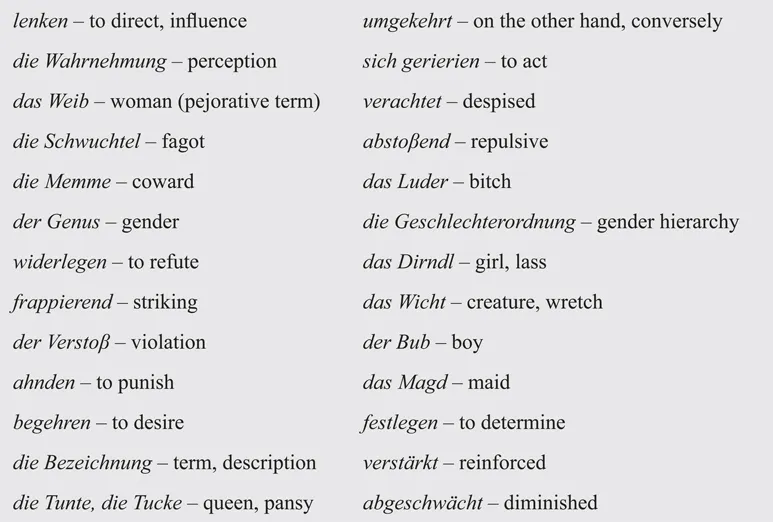
Nun gibt es hiervon berühmte Ausnahmen: das Mädchen, das Fräulein, das Weib, die Schwuchtel, die Memme, der Vamp. Sie werden oft bemüht, um diesen Genus-Sexus-Zusammenhang zu widerlegen. Schaut man jedoch genauer hin, dann bestätigen sie diesen Zusammenhang sogar auf geradezu frappierende Weise: Sie markieren nicht das Geschlecht, sondern Geschlechterrollen, also die sozialen Erwartungen daran, wie sich die Geschlechter zu verhalten haben. … Die betreffenden Personen werden aus ihrer „richtigen“ Genusklasse verbannt, weil sie sich „falsch“ verhalten, der soziale Verstoß wird durch einen grammatischen geahndet. Das betrifft zum einen homosexuelle Männer, die aus Sicht einer solchen Gesellschaft dasjenige Geschlecht begehren, das „normalerweise“ Frauen begehren. Deswegen stehen ihre Bezeichnungen häufig im Femininum (die Schwuchtel, die Tunte, die Tucke). … Umgekehrt geriert sich der Vamp im Maskulinum durch die Macht über Männer „wie ein Mann“.
Im Neutrum werden hingegen verachtete, abstoßende Frauen (das Weib, das Luder) bezeichnet, zum anderen noch nicht „voll entwickelte“, also in der alten Geschlechterordnung solche, die noch unverheiratet sind: das Dirndl, das Wicht, das Fräulein, das Girl. Jungen erscheinen von Anfang an, auch in den Dialekten, im maskulinen Genus: der Kerl, der Bub, der Junge. …
In einem Forschungsprojekt an der Universität Mainz wurde unter anderem ermittelt, dass es frßher die unter männlicher Familienherrschaft stehenden Frauen (vor allem Ehefrauen, TÜchter und Mägde) waren, die durch das Neutrum gebannt wurden, während fremde, selbständige und sozial hÜherstehende Frauen das Femininum erhielten. Diese und andere Forschungsergebnisse zeigen, dass Sprache die Wahrnehmung von Menschen zwar nicht festlegt, aber doch lenkt, und dass in der Sprache grundlegende soziale Verhältnisse kodiert sind. Deshalb kann durch Sprache auch eine bestimmte Weltwahrnehmung verstärkt, eine andere abgeschwächt werden.
Aus: www.sueddeutsche.de/kultur/genderdebatte-tief-in-der-sprache-lebt-die-alte-geschlechterordnung-fort-1.4003975-2, Š Henning Lobin, Damaris Nßbling. 7/6/18.
table0001

ifig0003.webp
GENDER IN THE TEXT

1.1 Gender on articles and pronouns

German nouns must have a gender, either masculine, feminine or neuter, which shows up on the articles and pronouns (and adjectives) used with the nouns in the singular. (Gender differences are not shown on the articles and pronouns in the plural.) 1.1a and 1.1b give the different gender forms of the definite and indefinite articles in the nominative case.

1.1a Definite article ‘the’: der Mann, die Frau, das Kind (pl: die for all genders)

Common words which follow the same pattern are the demonstratives dieser ‘this’, diese, dieses and jener ‘that’, jene, jenes; jeder ‘each/every’; jede, jedes; welcher? ‘which?’, welche?, welches? and the relative pronouns which are mostly identical to the definite articles (see Chapter 9).
Some examples from the text are masc. der Verstoß (line 9), der Kerl (19), der Bub (19), der Junge (19); fem. die Wahrnehmung (24–25); neut. das Geschlecht (6), das Neutrum (22), das Femininum (23).

1.1b Indefinite article ‘a’: ein Mann, eine Frau, ein Kind (no plural)

Here the masculine and neuter forms are identical. Common words which follow the same pattern are kein ‘not a/no’ and the possessives mein, dein, sein, unser, euer, ihr (see 7.3). These also have plural forms ending in -e, e.g. keine, meine. Some examples from the text are masc. ein Mann (14) and fem. eine Weltwahrnehmung (27).
Usually, when referring to people, grammatical gender reflects the sex of the person (e.g. der Mann, die Frau), but the text discusses examples where this is not the case. It argues, for example, that some words referring to men are given feminine gender to express the idea that they exhibit ‘feminine’ tendencies (e.g. derogatory words for gay men such as die Schwuchtel (3, 12), die Tunte (12), die Tucke (12) or words such as die Memme (3) meaning ‘cowardly man’). By contrast, der Vamp (2, 12) is given masculine gender to express the idea that vampish women are powerful, while many derogatory terms for women have been given neuter gender, which can be argued as objectifying the person, for example, das Wicht (17), das Girl (18), das Weib (2, 15), das Luder (15–16) and the diminutive forms das Mädchen (1), das Fräulein (2, 18), das Dirndl (17).
Other points to note in the text
  • Use of hier with preposition to mean ‘this’: hiervon berĂźhmte Ausnahmen (2) ‘famous exceptions to this’ (see 8.6)
  • Passive: Sie werden oft bemĂźht (3) ‘they are often consulted’; Die betreffenden Personen werden aus ihrer ‘richtigen’ Genusklasse verbannt (7–8) ‘the people concerned are banished from their “correct” gender class’; Der soziale Verstoß wird durch einen grammatis...

Table of contents

  1. Cover
  2. Half Title
  3. Series Page
  4. Title
  5. Copyright
  6. Contents
  7. Preface
  8. Acknowledgements
  9. Grammatical terms
  10. 1 Gender
  11. 2 Noun plurals
  12. 3 Case
  13. 4 Use of articles
  14. 5 Adjectives
  15. 6 Comparatives and superlatives
  16. 7 Personal pronouns and possessives
  17. 8 Demonstratives
  18. 9 Relative pronouns
  19. 10 Present tense
  20. 11 Imperative
  21. 12 Past tense
  22. 13 Perfect tense
  23. 14 Pluperfect tense
  24. 15 Future tense
  25. 16 Conditional
  26. 17 Subjunctive in reported speech
  27. 18 Passive
  28. 19 Separable verbs
  29. 20 Reflexive verbs
  30. 21 Infinitives and modal verbs
  31. 22 Negation
  32. 23 Questions
  33. 24 Prepositions
  34. 25 Conjunctions
  35. 26 Word order
  36. 27 Word formation
  37. 28 Punctuation and spelling
  38. Appendix 1: Common strong and irregular verbs
  39. Appendix 2: Article and adjective endings
  40. Appendix 3: Revision texts
  41. Appendix 4: Key to exercises
  42. Appendix 5: Key to revision texts – analysis questions
  43. Recommended reading
  44. Index