- 400 pages
- English
- ePUB (mobile friendly)
- Available on iOS & Android
eBook - ePub
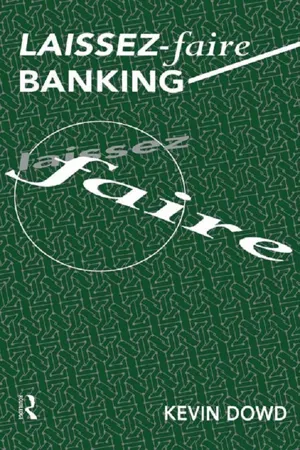
Laissez Faire Banking
About this book
The idea of free (or laissez-faire) banking has enjoyed a remarkable renaissance in recent years. It is a novel idea that challenges much of what many banking scholars still take for granted - that banking is inherently unstable, that the banking system needs a lender of last resort or deposit insurance to defend it in a crisis, and that the Govern
Chapter 1
Introduction
The idea of free (or laissez-faire) banking has enjoyed a remarkable renaissance in recent times, and there are few economists by now who are still unaware of it. Yet it was not so long ago that ‘respectable’ economists would have dismissed it as more or less obvious nonsense — many did — and most people today still seem to find the idea of free banking somewhat mystifying. It is a novel idea that challenges too much of what most people still take for granted — that banking is inherently unstable, that the banking system needs a lender of last resort or deposit insurance to defend it in a crisis, and that the government has to protect the value of the currency, to mention only the most obvious of such beliefs. Many economists have invested a great deal of human capital getting to grips with the theory that lies behind these claims, and they are understandably reluctant to throw that capital away and rethink their views on money and banking over again fi'om scratch. Yet, as Lawrence H. White has aptly observed, free banking itself is ‘an obvious and simple idea’ (1989: 1), and one would have thought it intuitively appealing to economists who believe that markets are better able to allocate scarce resources than politicians and government officials.1
The argument for free banking is also very simple. If markets are generally better at allocating resources than governments are, then what is ‘different’ about ‘money’ and the industry that provides it, the banking industry, to lead one to conclude that money and banking are an exception to the general rule? Each industry is different, of course, but the fact that the clothing industry differs in some ways from the footwear industry does not lead me to believe that a different public policy stance is appropriate to each, or that either is an exception to the general rule that free trade and laissez-faire are best. It may be, however, that the industries are ‘different’ in some ways because public policy has made them so, but that still does not tell us that the industries are intrinsically different, or that the intervention that makes them ‘different’ is justified. So it is, I believe, with money and banking. Banking is ‘different’ from other industries, but not in a way that is relevant to public policy, except perhaps in so far as the banking industry is itself the product of that policy.
FREE BANKING THEORY
This book contains a collection of essays on free banking and related subjects written between 1987 and 1991. Broadly speaking, the chapters fall into three categories, the first of which deals primarily with the theoretical issues raised in the free banking controversy. Chapter 2, ‘Automatic stabilizing mechanisms under free banking’, was originally published in the winter 1988 issue of the Cato Journal. It uses the Mengerian ‘invisible hand’ process to describe how a free banking system might evolve from a primitive economy, and argues that this free banking system would have three distinct features: (1) multiple note issuers who issued convertible currency, (2) a regular note exchange between those issuers, and (3) the insertion of ‘option clauses’ into banknote contracts that would give the issuer the right to postpone demands for redemption provided they later paid compensation to those whose redemption demands had been deferred. It argues that each of these features helps to stabilize the banking system — convertibility and the note exchange help to discipline over-issues, ensuring that excess notes are returned rapidly to their issuers, and the option clause helps ensure that banks can meet sudden large demands for redemption (and in the process makes such events less likely to occur anyway). The chapter goes on to compare the stability of the free banking system with that of the highly regulated, interventionist systems we have today. Generally speaking, governments first intervened to raise revenue by suppressing banking competition and forcing bank customers to accept a quality of service they would otherwise have rejected. The usual pattern was then to establish a monopoly bank of issue (and thus, incidentally, to eliminate the note-clearing process). With the currency monopolized, the link between the currency and gold was severed and the price level made a hostage of the political process. These interventions were associated with restrictions on banking activity that weakened the banks more, and the weakness of the banks in turn put pressure on the government to intervene further to ‘support’ the banking system (e.g. by deposit insurance), but in so doing the government weakened the banks even more. A vicious circle was set up in which bank weakness appeared to justify government intervention to cure it, but progressive doses of that medicine only made the underlying disease worse — and therefore apparently even more necessary — and the patient went from bad to worse.
Chapter 3, ‘Option clauses and the stability of a laissez-faire monetary system’, was originally published in the Journal of Financial Services Research in 1988 and develops the option clause idea further. It had two primary aims. First, it set out to explain why the insertion of option clauses into banknote contracts might be in the mutual interest of both banks and their customers — an important point which earlier work on the option clause tended to gloss over — and, second, it sought to examine further the stabilizing features of option clauses. The option clause would be invoked by a bank if market interest rates rose beyond a critical point, but we would expect this critical point to be well above normal interest rates. The prices of bills would consequently be well below normal, and a speculator in the bill market could expect to make a medium-term profit by buying bills. Speculative purchases would therefore tend to restore bill prices and interest rates to normal. They would also reward those who helped to reverse the rise in interest rates, and penalize those who ‘panicked’ and pushed interest rates up. Rational speculators would usually be able to anticipate the exercise of the option clause, however, so it would seldom if ever be the case that interest rates actually reached the trigger point. The threat of the exercise of the option clause would usually suffice to reverse the rise in interest rates, so option clauses could be stabilizing even if they were never actually exercised. The chapter ends with an examination of Scottish experience of option clauses over the period 1730–65 which suggests that the Scottish evidence was broadly consistent with what this theory would lead us to expect. The chapter suggests, therefore, that the option clause idea might be a useful direction for further free banking research.2
Chapter 4 was prepared for the seventh annual Cato monetary conference ‘Alternatives to Government Fiat Money’ in Washington in February 1989. The single most important argument under-pinning the modern apparatus of central banking is that it is there to counteract the alleged inherent instability of monetary laissez-faire, and the position of the central banking school collapses without it. If this argument were correct, a stable laissez-faire monetary system would be self-contradictory, and a viable example of such a monetary system would suffice to refute it. The chapter therefore sets out to provide such an example and explore its properties. Starting from an initial primitive state, the chapter uses the ‘invisible hand’ story to trace the development of an anarchic monetary system driven entirely by the self-interest of those who operate within it. The early part of the story is very familiar, but the later part is not. The exchange media issued by the banks are initially denominated and redeemable in gold dollars, but the banks eventually drop the pledge to redeem in gold and switch to redeeming with financial instruments instead, which are more efficient for the purpose and which, it turns out, also help to stabilize the banking system against shocks to the gold market. By this stage gold is no longer used as a medium of exchange or as the banks' medium of redemption, but the monetary system is still tied to gold by virtue of the nominal price of gold being fixed, and the price level is determined by the factors that determine the relative price of gold against goods and services in general. An increase in the supply of gold, for example, leads to a decrease in its relative price and therefore, since its nominal price is fixed, to a rise in the general price level. The price level is vulnerable to shocks from changes in the factors determining the demand and supply of gold. If agents demand price-level stability, as they presumably do, then the gold anchor is unlikely to provide them with the amount of price-level stability they desire, and the banks would be prompted by public demand (as well as their own interest) to change the gold anchor for one that would generate a more stable price level. The chapter suggests as an example that they should switch to bricks but, whatever it was they switched to, it would have to have a stable relative price against goods and services generally in order to generate a stable price level. This anarchic monetary system is thus both stable and efficient. It is stable because the agents operating in it demand stability and have the means to make those demands effective. It is efficient because there are no restrictions against mutually beneficial trades. It is driven purely by the self-interest of the private agents operating ‘within’ it, and it has no guardian — no government, no central bank or lender of last resort, and no deposit insurance corporation — to look after it. It has no need of such a guardian, however, and is perfectly capable of protecting itself
A secondary aim of the chapter was to explain how we got the much less desirable monetary systems we actually have. It turns out to be relatively straightforward, and all one needs to do is introduce a government into our hypothetical anarchy and see what happens. The new government is driven by its own ‘private’ interests, but it differs from other agents in having a legal monopoly of the use of force. The process of government intervention argument is then similar to that described in chapter 2, but described here in more detail. Governments intervene initially for revenue reasons — taxing the banks in politically less costly than other forms of taxation, and so on — but these interventions create problems of their own, and the political process then requires further intervention (supposedly) intended to straighten out the mess caused by earlier interventions. The first-best solution — removing the earlier intervention — is usually ruled out for political reasons, and we end up caught in a vicious circle in which one mess leads to another and the health of the monetary and banking system is weakened further at each stage. The only solution is to roll back the interventions and allow market forces free rein to establish the stable and efficient system that people want.
Chapter 5 considers a different issue. Many people still appear to believe that banking is a natural monopoly and, moreover, that the monopolization of the currency and other aspects of present-day central banking can be justified on natural monopoly grounds. There have been a number of good discussions of natural monopoly in recent free banking literature,3 but it seemed to me that all of them looked only at one or more aspect of natural monopoly, and no single treatment had examined the issue in each of its different guises. Natural monopoly occurs where there are economies of scale so large that the competitive equilibrium has room for only one firm. There are two main sources of economies of scale in banking — economies in reserve-holding and economies from diversification — but once one examines them closely there is no reason to expect any of these scale economies to be sufficiently strong to produce a natural monopoly. There are also some other arguments for natural monopoly, but they turn out to be spurious. There is the well known argument that competitive note issue leads to hyperinflation (e.g. Friedman 1960: 8), but this argument is an argument about externalities and not really a natural monopoly argument at all. Remember that a natural monopoly argument maintains that one firm can produce at less cost than two or more, and this particular argument makes no such claim. The competitive hyperinflation argument is also dubious as an externalities argument, but that is another issue. The second argument is that banking is a natural monopoly because everyone in the same economy (typically) uses the same unit of account, but this argument is invalid because it confuses economies of standardization (or economies in use) and economies of production. Economies of standardization arise because we find it convenient to use certain social conventions, but they do not involve production per se. The fact that I might use a particular unit of account implies nothing about the production of ‘money’ or anything else, but a natural monopoly argument is an argument about production and therefore cannot apply to a situation where production is absent. The third argument is that banking is a natural monopoly because of economies of scale in building public ‘confidence’. This type of argument usually maintains that there are certain fixed costs to building confidence, and that the government usually has an advantage providing currency because of its power to tax. This line of reasoning runs into various problems — it seems to presuppose that competitive banks would issue inconvertible notes, which they would not; it would appear to imply that deposit banking is a natural monopoly, which it does not appear to be; it is not clear why the power to tax should promote confidence; and it is very difficult to claim seriously that the history of banking supports the notion that governments have helped promote confidence. The chapter ends by taking a brief look at the evidence on economies of scale in banking, which comes from a large number of empirical studies and the experience of (relatively) free banking systems in the past. The evidence would appear to be clear — there are economies of scale in banking, but not a single empirical study or historical instance of free banking suggests that banking is a natural monopoly. The argument that banking is a natural monopoly is decisively rejected.
Chapter 6 tries to grapple with certain other issues raised in recent theoretical work. I had been deeply suspicious of the alleged ‘necessity’ for government deposit insurance (or, for that matter, a government-sponsored ‘lender of last resort’) for years, but my early attempts to argue against deposit insurance usually met with the response that Diamond and Dybvig (1983) had established a sound case for it, and, though I was not convinced, it embarrassed me that I had no adequate response. After a certain amount of work on the issue I eventually concluded that the basic problem with their model is that it ignores any role for equity capital. Their intermediary takes in deposits which it invests in projects in the ‘real’ economy, and depositors are issued with liabilities which they can redeem in either of two periods, but the intermediary's resources are limited to whatever the public deposit with it, and there is no outside (i.e. ‘equity’) capital. The Diamond-Dybvig intermediaries offer depositors who withdraw in the first period a greater return than that which the underlying ‘real’ investment process has yet generated — underlying investments have to be liquidated prematurely to meet such depositors' demands, and yet the intermediary had to make some such promise to early withdrawers in order to attract business — and the problem is that there is a limit to how many such demands it can meet without running out of assets. This weakness can lead depositors who do not have to withdraw for consumption purposes to lose confidence and run themselves, and Diamond and Dybvig argue that government deposit insurance is needed to reassure them and thereby prevent a run. The underlying theme of the chapter is that this sort of analysis of bank runs properly applies only to the peculiar intermediary that exists in Diamond and Dybvig's model, and it applies because it has no other capital to cushion its early withdrawal losses; but it does not apply to real-world banks, which can use such capital to guarantee the value of their deposits. This chapter was written over 1989 and 1990 and attempts to provide a perspective on the large literature that has followed the initial Diamond-Dybvig paper and demonstrate what I believe is wrong with it. It makes three main points:
Virtually all this literature follows Diamond and Dybvig in dealing with intermediaries that issue only one class of liability — a peculiar kind of debt-equity hybrid that looks like debt to those who redeem in the first period but which looks like equity to those who redeem afterwards. The fact that we do not observe such liabilities strikes me as a major problem with this work, but an even bigger problem is the fact that most real-world financial intermediaries issue more than one class of liability — they issue both claims that are fixed in value outside bankruptcy (i.e. debt, properly speaking) and residual claims which constitute ownership of the intermediary (i.e. equity). This distinction between different types of liability is very important, and corresponding to it is the difference between different types of institution — between mutual funds, which issue only one class of liability, and banks in the normal sense of the term, which issue both. Diamond and Dybvig explain the instability that can arise from a particular kind of mutual fund, but it is banking instability as such that we are really interested in.
The chapter develops further the point that whether an intermediary distinguishes between its liabilities or not has a critical bearing on its exposure to runs. A mutual fund is exposed to Diamond-Dybvig-type runs, but a bank need not be, provided that it keeps an adequate capital base. We thus arrive at a strong theoretical rationale for why capital adequacy matters, and it is reassuring to recall that the practical bankers at least have long understood its importance in shoring up confidence in a bank and discouraging depositors from running. The fact that the theoretical literature on banking instability seems to have little or no place for it simply suggests to me that that literature has little to say on the real-world problems that we wish to address.
Finally, it seems to me that the arguments for deposit insurance made in most of this literature come close to assuming what they set out to prove. In order to explain why there should be any financial intermediation in the first place, it is necessary to explain what is ‘wrong’ with an unintermediated market that the intermediary can improve. In the Diamond-Dybvig world this requirement translates into the existence of ‘frictions’ in the operation of a credit market between the first and second periods. (Wallace 1989, refers to agents being ‘isolated’ from each other in the first period.) The problem then arises that a government deposit insurance guarantee would violate this ‘isolation’ condition. In order to provide a credible guarantee, the government needs the means to be able to ‘find’ agents in the first period after they have made their withdrawals, and that implies that it must be able to overcome their ‘isolation’. The argument for deposit insurance thus runs into a dilemma: if the technology exists to overcome isolation, then that technology means that financial intermediation serves no purpose, and therefore financial intermediaries should not exist and there would be no need for deposit insurance to protect them; but if the technology does not exist, then the government cannot physically provide (credible) deposit insurance and it makes no sense for it to try. Arguments for deposit insurance must implicitly suppose that the government has access to a technology that the private sector lacks — and one, incidentally, that the private sector cannot (for some unspecified reason) ‘rent out’ from the government. As far as I can see, the argument for deposit insurance thus virtually assumes what it purports to prove.
HISTORICAL EXPERIENCE
We then turn to the second part of the book, which looks at the historical evidence on free banking. History can make an important contribution to our understanding of monetary and banking theory because it provides a kind of laboratory in which we can test some of the predictions of our theories, and the information that comes from these ‘tests’ is valuable even though none of the ‘experiments’ was conducted under ‘pure’ laboratory conditions. Chapter 7 examines one of the most interesting historical experiences of free banking — Australian free banking in the nineteenth century. The Australian episode is of unique interest because the Australian banking system experienced a major crisis in 1893 which many have blamed on free banking, and many Australian economists apparently still do. The chapter attempts to assess the overall Australian experience of free banking, but it focuses particularly on the exten...
Table of contents
- Cover
- Half Title
- Foundations of the market economy series
- Full Title
- Copyright
- Contents
- List of figures and tables
- Acknowledgements
- 1 Introduction
- Part I Free banking theory
- Part II Historical experience
- Part III Monetary and banking reform
- Notes
- Bibliography
- Index
Trusted by 375,005 students
Access to over 1.5 million titles for a fair monthly price.
Study more efficiently using our study tools.
Frequently asked questions
Yes, you can cancel anytime from the Subscription tab in your account settings on the Perlego website. Your subscription will stay active until the end of your current billing period. Learn how to cancel your subscription
No, books cannot be downloaded as external files, such as PDFs, for use outside of Perlego. However, you can download books within the Perlego app for offline reading on mobile or tablet. Learn how to download books offline
Perlego offers two plans: Essential and Complete
- Essential is ideal for learners and professionals who enjoy exploring a wide range of subjects. Access the Essential Library with 800,000+ trusted titles and best-sellers across business, personal growth, and the humanities. Includes unlimited reading time and Standard Read Aloud voice.
- Complete: Perfect for advanced learners and researchers needing full, unrestricted access. Unlock 1.5M+ books across hundreds of subjects, including academic and specialized titles. The Complete Plan also includes advanced features like Premium Read Aloud and Research Assistant.
We are an online textbook subscription service, where you can get access to an entire online library for less than the price of a single book per month. With over 1.5 million books across 990+ topics, we’ve got you covered! Learn about our mission
Look out for the read-aloud symbol on your next book to see if you can listen to it. The read-aloud tool reads text aloud for you, highlighting the text as it is being read. You can pause it, speed it up and slow it down. Learn more about Read Aloud
Yes! You can use the Perlego app on both iOS and Android devices to read anytime, anywhere — even offline. Perfect for commutes or when you’re on the go.
Please note we cannot support devices running on iOS 13 and Android 7 or earlier. Learn more about using the app
Please note we cannot support devices running on iOS 13 and Android 7 or earlier. Learn more about using the app
Yes, you can access Laissez Faire Banking by Kevin Dowd in PDF and/or ePUB format, as well as other popular books in Economics & Business General. We have over 1.5 million books available in our catalogue for you to explore.