This study moves from a history of the American-Israeli strategic relationship since 1967 to an assessment of the permanency of US-Israeli strategic ties, their purpose in the eyes of both partners, and their susceptibility to future pressures. It includes an examination of the relationship under the strain of the 1991 Gulf War.
eBook - ePub
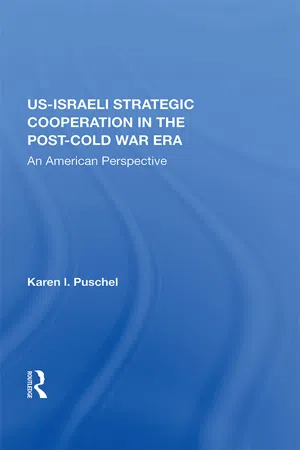
U.S. - Israeli Strategic Cooperation In The Post-cold War Era
An American Perspective
- 194 pages
- English
- ePUB (mobile friendly)
- Available on iOS & Android
eBook - ePub
About this book
Information
Part I
Chapter 1.
The Seeds are Planted
Early Attitudes and Perceptions
When the United States cast its vote in 1948 in support of the establishment of the State of Israel, neither Harry Truman nor any other key foreign policy figure in Washington believed that the tiny state would be of assistance in furthering American strategic objectives. Indeed, opposition to Israel from within the foreign policy community was intense. It was largely based on the belief that US support for Israel would be harmful to key US strategic and political interests in the region—particularly, preserving western access to oil, maintaining friendly relations with the Arab world, and countering the spread of communism.1
Concern about communism had taken on increasing urgency and importance for the United States as the tenuous wartime alliance with the Soviet Union gave way to hostility. The Korean War, the end of Stalinism, and the rise of a new communist menace on the Chinese mainland led Washington to fear the spread of Soviet and communist influence both at home and abroad. The Middle East with its vital resources, located practically in the Soviet Union’s backyard, was one area of concern.
President Eisenhower in particular was inclined to view the Middle East as a subset of the larger Soviet threat facing the United States. During his eight years in office, a key preoccupation was to build an anti-Soviet alliance with other states in the region. Far from being seen as an important state to woo, Israel was seen primarily as a problem. Asked in 1954 about granting military aid to the Israelis, Eisenhower responded that, “We are not rendering anyone assistance to start a war or to indulge in a conflict with others of our friends. When we give military assistance, that is for the common purpose of opposing communism.”2 From Eisenhower’s perspective, Israel was not part of the struggle against communism and was even potentially dangerous to American “friends” in the region.
Not only was a strategic rationale missing for improved relations with Israel during this period, there was also little domestic pressure on the administration to this end. Peter Grose notes that Israel faded from America’s public agenda in the early 1950s and that Eisenhower was able to address even Jewish audiences during this period “without once mentioning the State of Israel.”3 Steven Spiegel also notes that, perhaps because Israel was not facing any immediate threat to its existence, Jewish lobbying efforts in America were directed elsewhere.4
The net result was that, despite the critical diplomatic support given to Israel at its formation, the US was unwilling to be perceived as working with Israel, let alone as allied with it. Rather, just as Truman had been swayed by humanitarian concerns in 1948 to support Israel, so too was the general American view of Israel shaped by moral and religious underpinnings and an appreciation for the common cultural, political and ideological ties between the two nations. The 1952 Republican Party platform referred to a “friendly interest” in Israel which appealed to “our deepest humanitarian instincts.”5 This attitude was reflected in US aid policies at the time: while there was support for economic aid based on a principled commitment to Israel, such aid was controversial, hotly debated, and carefully balanced by similar aid for Arab states. Military aid to Israel was out of the question.
The one area where appreciation did exist for Israel was in the intelligence field. Here Israel could be seen as an asset, not just a liability, vis-a-vis the Soviet threat, and US intelligence officials were interested in Israel’s access to and connections in the Eastern Bloc. The first copy of Khrushchev’s secret speech denouncing Stalin reportedly arrived in the US via an Israeli source. What with the number of new emigres in Israel, the Eastern Bloc arms obtained by Israel in the late 1940s, and the combat experience against Soviet equipment gained during the Independence and Suez wars, Israel had much to offer the American intelligence effort against the Soviets.
The Winds of Change
The largely negative official American view of Israel gradually began to change both in response to domestic politics within the United States and to developments in the Middle East. In 1956, even as the Eisenhower Administration cut back economic aid to Israel and turned down any request for military aid, the Democratic Party pledged to redress the arms imbalance in the area by “selling or supplying defensive weapons to Israel, and will take such steps, including security guarantees, as may be required to deter aggression and war in the area.”6 When Democratic candidate John F. Kennedy won the 1960 presidential election on the narrowest of margins and with over 80 percent of the Jewish vote, it seemed clear that, at least in the White House, Israel would be given a more sympathetic hearing.
And, indeed, both rhetorical support for Israel and practical support in the form of weapons supply, changed significantly under President Kennedy and then President Johnson. Both men embraced Israel as a positive force consistent with American ideals and underscored, in vague terms, the US commitment to Israel’s security. In 1962 Israel received its first major weapons system from the United States when President Kennedy agreed to deliver HAWK anti-aircraft missiles. This was followed by the provision of $80 million in tanks, first through the FRG and then directly from the US. In February 1966, in what was a significant turning point, President Johnson agreed to sell 48 Skyhawk bombers to Israel.7
These changes should not, however, be seen as simply the result of a more sympathetic political setting in Washington. Even more important were the changes that were taking place in the Middle East region itself. These argued for a new US approach toward growing Soviet influence and Arab radicalism there. The Eisenhower years, despite the tough approach to Israel, had not resulted in an enhanced American position in the Arab world or in blocking Soviet advances. By the 1960s increasing amounts of Soviet arms were being provided to the region, leading to concern in Washington that the regional balance of power could tip toward the radical Arabs. It was this perceived need to find a counterbalance that provided the key impulse for the US to change its longstanding policy against providing arms to Israel.
However, in many important respects this change in policy fell short of what Israeli leaders saw as necessary or desirable for Israel’s security. David Ben-Gurion, Israel’s first prime minister, had tried to no avail to secure Israel’s strategic position through an alliance with the United States or NATO in the 1950s and 1960s. Despite a more sympathetic attitude toward Israel in the 1960s on the part of key individuals in Washington, it does not appear that the idea was seriously considered even then. Indeed, in the Kennedy-Johnson years, Washington remained concerned that any closer alliance with Israel would be at the expense of more strategically important American interests in the Arab world. Moreover, American preoccupation with Vietnam meant that there was little interest in courting further entanglements overseas.
The Six-Day War — a Watershed
The sweeping victory by Israeli forces during the Six-Day War in 1967 was a watershed in the evolving US-Israeli relationship. On the eve of war, US policy continued to be marked by hesitancy and a certain degree of ambivalence. The Johnson Administration deemed illegal Nasser’s closure of the Straits of Tiran to Israel’s shipping and sought, in the days leading up to war, a solution that would protect Israeli rights. But both President Johnson and the Congress were concerned that the US not become involved in another war. Israel’s request before the war for guarantees from the US went unanswered.8 And, once war began, Washington neither explicitly supported nor criticized Israel.
But by the end of the war, the powerful demonstration of force by Israel had completely altered strategic calculations in the region. US concern about being saddled with responsibility for a “loser” in the Middle East was alleviated. Not only could Israel clearly take care of itself, but it emerged from the war in a strong position to effect other events in the region. It is doubtful whether the closer US-Israeli relationship that developed thereafter would have occurred without this striking victory by Israeli forces.
The war also deeply affected the domestic situation within the United States; practically overnight, there was a tremendous surge of identification with the Israeli state. Immigration to Israel from the United States went up dramatically, as did the level of interest toward Israel within the United States.9 All in all, support for Israel grew to some four to five times greater than support for Arabs — a substantially higher margin than before the war.10 This not only gave an important boost to pro-Israel lobbying efforts, it created a political environment that was highly sympathetic to support for Israel.
This would have very important ramifications just a year later when the administration considered increased arms for Israel, specifically the sale of sophisticated F-4 Phantom jets. Though faced with widespread opposition to providing Israel with these combat aircraft on the part of the foreign policy bureaucracy in Washington, every presidential candidate would come out in favor of the sale, as would both the Republican and Democratic parties.11 Underscoring the growing politicization of the issue, Congress eventually added an amendment to the foreign aid bill pressing the president to sell the aircraft to Israel.12
Although no such dramatic swing in views occurred in the foreign policy institutions charged with conducting US policy in the region, even here the war ushered in a greater awareness of the positive possibilities that could result from cooperation with Israel. One immediate area of interest was once again intelligence, particularly that pertaining to the Soviet Union. The intelligence relationship between the two countries became formalized for the first time during this period, reflecting the greater legitimacy that US-Israel relations had assumed.
In particular, cooperation expanded significantly because of Israel’s combat experience dealing with Soviet weaponry and military doctrine. Israel had just emerged from a successful war fought against Soviet-supplied Arab states. Just 18 months later it would be involved in a protracted conflict with Egypt (the War of Attrition) which, in many ways, became a major proving ground for the military equipment of the two superpowers. One important example: the Soviet anti-aircraft system defending Egypt proved vulnerable to western-type combat aircraft flown by Israeli pilots.13 From the perspective of American military planners preoccupied with the Soviet threat, Israel had become a laboratory for developing countermeasures to Soviet weaponry and tactics.
But perhaps the most important effect of the newly demonstrated Israeli strength was in the area of US regional strategy. While the State Department tended to see the Israeli conquest of Arab territory as creating yet another problem for US policy, key individuals began to recognize that peace could not be based on a weak Israel, but rather on a balance of power in the region.
Moreover, given the growth of Soviet influence there, the radicalization of Arab politics, and the need to shoulder an ever-increasing burden of responsibility for the Middle East in the wake of the British pull-out, the United States was in need of new assets in the region. Practically overnight, Israel’s demonstrated military strength significantly improved American leverage in the Middle East.
So it was that by the time of Richard Nixon’s election as president in 1968 and his appointment of Henry Kissinger as National Security Advisor, the key pieces were in place for a new phase in the US-Israeli relationship. It would be founded principally on the common goal of countering the Soviets, and backed up by a domestic constituency largely sympathetic toward Israel. Arms supplies would be a key expression of the new US approach. Establishing a principle that continues to this day, candidate Richard Nixon stated that Israel needed a “technological military margin to more than offset her hostile neighbors’ numerical superiority.”14 While implementation of this policy would be neither smooth nor easy, domestic political support for Israel would ensure that it became an established aspect of US policy.15
Thwarting the Soviets
By the beginning of the 1970s, Soviet influence was growing throughout the Middle East, most importantly in Egypt. In the early months of 1970, 15,000 Soviet troops arrived in Egypt, operating some 150 aircraft and manning an extensive surface-to-air missile complex. The Soviets even participated in the War of Attrition between Egypt and Israel, as became clear when Israel shot down five Soviet-piloted MiGs in the summer of 1970. Moscow’s direct involvement added a new dimension to the Arab-Israel conflict and unquestionably had a tremendous effect on Washington’s perception of events in the Middle East.
Indeed, more than even President Eisenhower, Nixon’s foreign policy in the Middle East would be motivated by the desire to drive the Soviets out or at least balance the significant gains that Moscow had made in the region. Since Soviet influence rested primarily on Moscow’s military relationship with radical Arab states, an essential element of Nixon and Kissinger’s strategy would be to demonstrate that the Soviets could not bring the Arab world what it sought: the defeat of Israel and the regaining of territory lost to it during the Six-Day War. Flowing from this strategy was the need for a closer US-Israeli relationship, both to send the message to the Arabs that Israel’s strength was uncompromising, and to establish the basis for one day “bringing” Israel to the negotiating table.
Yet Washington did not move to embrace Israel as a strategic partner. Traditional skepticism about Israel continued to be strong in key institutions, such as the State Department, that saw Israel’s strength and regional policies as simply making the diplomat’s job that much tougher. As Kissinger notes in his memoirs, his belief that the primary US objective must first be to confront the growing Soviet presence in the region was definitely a minority view. “Most in the government” blamed Israel for the deteriorating conditions in the Middle East and were opposed to any new military assistance for Israel, which Kissinger saw as a crucial part of his broader strategy.16
Moreover, it is important to realize that even Nixon and Kissinger’s appreciation of Israel’s value was in the context of their strategic objectives at any given time: countering the Soviets, wooing the Arabs, and maintaining Israel’s security. The decade of the 1970s would show just how different Israel’s value could be perceived, depending on which of these strategic objectives was in the ascendancy.
The stage was thus set for events during the 1970s which would leave an indelible legacy for strategic cooperation. At three distinct junctures the nature of the US-Israeli relationship — including the nature of the role that Israel could play on behalf of US interests — would be tested and redefined. At the time, none of this was ever called strategic cooperation. Yet these were the beginnings of the conceptual process and debate from which the formal strategic cooperation program would eventually grow.
The “Golden Years” of Cooperation
In 1970, an event occurred that was tailor-made for testing the tentative new US-Israeli relationship, since it involved the intertwining of regional and superpower interests. In September of that year, King Hussein of Jordan found himself in fierce battle with Palestinians intent on toppling his regime. As the situation deteriorated, a Syrian tank division crossed into Jordan and advanced toward the northern Jordanian city of Irbid.
For Israel, the fall of the...
Table of contents
- Cover
- Half Title
- Title
- Copyright
- CONTENTS
- Dedication
- Acknowledgments
- Summary
- Introduction
- Part I
- Part II
- Part III
- Notes
- Appendix 1. Memorandum of Understanding Between the Government of the United States and the Government of Israel on Strategic Cooperation 30 November 1981
- Appendix 2. Memorandum of Agreement Between the United States of America and the State of Israel Regarding Joint Political, Security and Economic Cooperation
- About the Author
Trusted by 375,005 students
Access to over 1.5 million titles for a fair monthly price.
Study more efficiently using our study tools.
Frequently asked questions
Yes, you can cancel anytime from the Subscription tab in your account settings on the Perlego website. Your subscription will stay active until the end of your current billing period. Learn how to cancel your subscription
No, books cannot be downloaded as external files, such as PDFs, for use outside of Perlego. However, you can download books within the Perlego app for offline reading on mobile or tablet. Learn how to download books offline
Perlego offers two plans: Essential and Complete
- Essential is ideal for learners and professionals who enjoy exploring a wide range of subjects. Access the Essential Library with 800,000+ trusted titles and best-sellers across business, personal growth, and the humanities. Includes unlimited reading time and Standard Read Aloud voice.
- Complete: Perfect for advanced learners and researchers needing full, unrestricted access. Unlock 1.5M+ books across hundreds of subjects, including academic and specialized titles. The Complete Plan also includes advanced features like Premium Read Aloud and Research Assistant.
We are an online textbook subscription service, where you can get access to an entire online library for less than the price of a single book per month. With over 1.5 million books across 990+ topics, we’ve got you covered! Learn about our mission
Look out for the read-aloud symbol on your next book to see if you can listen to it. The read-aloud tool reads text aloud for you, highlighting the text as it is being read. You can pause it, speed it up and slow it down. Learn more about Read Aloud
Yes! You can use the Perlego app on both iOS and Android devices to read anytime, anywhere — even offline. Perfect for commutes or when you’re on the go.
Please note we cannot support devices running on iOS 13 and Android 7 or earlier. Learn more about using the app
Please note we cannot support devices running on iOS 13 and Android 7 or earlier. Learn more about using the app
Yes, you can access U.S. - Israeli Strategic Cooperation In The Post-cold War Era by Karen Puschel in PDF and/or ePUB format, as well as other popular books in Politics & International Relations & Middle Eastern Politics. We have over 1.5 million books available in our catalogue for you to explore.