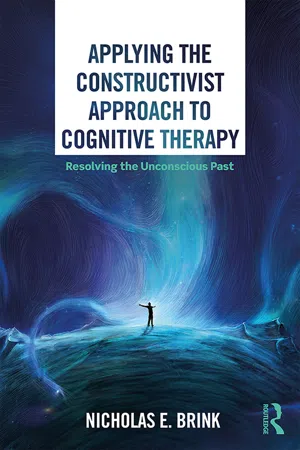
Applying the Constructivist Approach to Cognitive Therapy goes beyond the traditional objectivist approach of uncovering the what of a client's dysfunctional thinking by helping client and therapist understand why the client thinks in a dysfunctional manner. This unique work demonstrates how this thinking can be uncovered through dreamwork, analytic hypnotherapy, ecstatic trance, and other spontaneous trance experiences such as the use of imagination, free association, and guided imagery. Utilizing hypnotherapeutic techniques, the author shows how clients can reframe these thoughts to achieve a healthier, more functional way of thinking. Replete with case studies and practical guidance, this text will help therapists take clients beyond a simple resolution of their problems and offer an avenue to greater personal growth, maturity, and creativity.
eBook - ePub
Applying the Constructivist Approach to Cognitive Therapy
Resolving the Unconscious Past
- 130 pages
- English
- ePUB (mobile friendly)
- Available on iOS & Android
eBook - ePub
Applying the Constructivist Approach to Cognitive Therapy
Resolving the Unconscious Past
About this book
Information
1 Constructivist vs. Objectivist Cognitive Therapy
Among the myriad models and schools of psychotherapy that have emerged over the last century plus, the one that has most recently risen to the top is Cognitive Therapy, a school of therapy that considers itself scientifically developed as evident in the number of efficacy studies that demonstrate its effectiveness. According to Aaron Beck who has led in the development of cognitive therapy, among these many schools, three schools have traditionally dominated: Neuropsychiatry, psychoanalysis, and behavior therapy. Though these schools are strikingly different, one basic assumption is “the emotionally disturbed person is victimized by concealed forces over which he has no control” (Beck, 1979, p. 2). Beck goes on to succinctly summarize his approach:
This new approach – cognitive therapy – suggests that the individual’s problems are derived largely from certain distortions of reality, based on erroneous premises and assumptions. These incorrect conceptions originate in defective learning during the person’s cognitive development. Regardless of their origin, it is relatively simple to state the formula for treatment: The therapist helps a patient to unravel his distortions in thinking and to learn alternative, more realistic ways to formulate his experiences.1(p. 3)
In the process of learning the alternative ways of thinking, corrective emotional experiences are suggested to reinforce the new alternatives.
In spite of the effectiveness of cognitive therapy, an assumption I bring to this school is that there is always room for improvement, and that there is some good to be offered from the mentioned older traditional schools. Implied from this brief description of cognitive therapy are two concepts that have been depreciated or thrown out: One is the power of the concealed forces of the unconscious mind, and the other is the sustaining power of the origin of the dysfunctional conceptions. As we shall see, both of these concepts have something to offer for increasing the effectiveness of cognitive therapy.
The Automatic Thought
Beck, originally trained as a psychoanalyst, extensively used the psychoanalytic technique of free association. Once, while using free association, a patient whose presenting problem was the expression of anger, was asked what he was feeling. The patient’s response was that he was feeling guilty, and then he went down an unexpected stream of associations of being wrong in his criticism and that others would not like him for being critical. Yet, unlike this patient, Beck admits that many patients are not fully aware of such unreported thoughts until they are led to focus on them. Beck calls these unreported thoughts automatic thoughts. From the school of psychoanalysis these automatic thoughts might be considered unconscious in that the patient is not fully aware of such thoughts. With this discovery, Beck proposes that a stimulus first triggers a conscious thought that in turn triggers an emotion, and that the conscious thought when dysfunctional needs to be replaced with a more functional thought.
Contrary to this belief that these automatic thoughts are conscious, there are those who contend that many of these thoughts are subconscious if not unconscious and are only brought to consciousness by some therapeutic trigger such as may arise in free association. Consider an example of an abusive husband who while abusing his wife triggers fear within Amy their daughter and a possible intermediary thought that husbands/fathers, and more generally men, are abusive and cannot be trusted. Thus, in later years, Amy finds that when she is around men she feels fear and anxiety. When Amy repeatedly heard and saw these acts of abuse, her intermediary thought that a husband/father, and men in general, are abusive and cannot be trusted eventually dropped out and the feelings of fear and anxiety were automatically and instantly triggered, i.e. in later years when in the presence of a husband or man her feeling of fear and anxiety arises so quickly that she does not have the chance to recall the potential intermediary thoughts, thus the thoughts are forgotten.
This automatic emotional response to observed acts of violence is parallel to what happens when someone is learning how to type. At first, seeing and typing the letter “d” requires the intermediary thought that the middle finger of the right hand needs to strike the key directly below it on the home row of the keyboard, but then with sufficient practice, the finger immediately types the letter without the intermediary conscious thought. As I write this sentence I found that I was unable to remember which finger of which hand is needed to type the “d” without first examining the keyboard and which finger I used to type it. The intermediary thoughts with practice have become totally unconscious.
Another possibility for Amy is that if the acts of abuse occurred before she was verbal, i.e. it occurred pre-verbally, then the acts directly trigger the emotions of fear and anxiety without an intermediary conscious thought, and when she becomes verbal, the fear and anxiety are automatic and continue to be triggered without thinking.
Though Beck admits that some patients are not fully aware of such automatic thoughts (1979, p. 31), he is unwilling to go as far as to consider such thoughts as unconscious. Yet, there are many subconscious and unconscious thoughts that influence a person’s behavior, thoughts that may have been repressed because of their painful or traumatic nature, thoughts that were learned pre-verbally, thoughts that are not admitted because they come from what Carl Jung would call a person’s shadow (Campbell, 1971, pp. 144–148), or possibly thoughts that have simply been forgotten after much repetition.
Some of these dysfunctional thoughts may surface when the person is led to focus on or becomes mindful of the feelings or emotions, but others may be at such depth that it would take more than the focus of attention to bring them to the conscious mind. Though hypnosis has not been considered a primary tool used by cognitive therapists, focused attention is one aspect of hypnotic trance. In fact, in 1841when hypnosis was first described, or you might say “discovered” by James Braid, he defined it as “focused attention upon an expectant dominant idea or image” (Robertson, 2013, p. 3).
The term kindling, borrowed from neurology, well describes the process of learning a dysfunctional thought, i.e. each episode of an emotional response to some trigger makes later episodes of the emotional response both more likely and more severe. Initially, early in life, something happens to cause the person to experience anxiety, or experience some other emotion such as depression, of feeling down or blue. As time goes by, something else happens to again trigger the emotion. As the emotion is repeatedly triggered, it becomes more easily, quickly, and frequently triggered, with the strength of the emotion growing in intensity, i.e. the feeling of anxiety may become a severe panic attack, or the feeling of depression may become a major depression. The triggers likely vary, i.e. different anxiety-provoking or depression- provoking triggers occur, such that any intermediary thoughts are not the same, and eventually the emotion occurs without thought and seems to come from out of the blue. In this process of kindling, any intermediary thoughts have dropped out. Also, the trigger or stimulus may so quickly trigger the emotion that uncovering the intermediary thought, yet replacing it with an alternative more functional thought, becomes essentially impossible. Thus, I have at times recommended the use of a medication to slow down this triggering process in order to provide the needed respite or needed time to insert or learn the new healthier intermediary thought.
With this understanding of the kindling process, uncovering a dysfunctional thought and then replacing it with a more functional thought presents a significant limitation to cognitive therapy. From my experience with dream work and especially hypnosis, there are other effective ways to access the unconscious mind for uncovering the deep dysfunctional thoughts and for replacing them with thoughts that are more functional.
Constructivist vs. Objectivist
In considering the nature of the mind, as suggested by Jean Piaget (1970), the constructivist considers the mind as active, giving meaning and order to what is experienced as reality. In contrast, the objectivist considers the mind as passive, simply gathering its content from the environment. These two contrasting concepts suggest two different approaches to psychotherapy. The objectivist is concerned with what the patient thinks and does not consider or ask the question, “Why?” The objectivist is most concerned with, “What” the person thinks. The first step for the objectivist is to discover what the patient thinks that is dysfunctional and causes the dysfunctional behavior. With this discovery, cognitive therapy then suggests a behavioral learning approach to change the dysfunctional thinking to a more functional and healthy way of thinking.
In contrast, the constructivist considers the mind as active in giving meaning and order to reality, and thus asks the question, “Why?” “Why does the client give this meaning to what he or she experiences as reality?” Then with the understanding of “Why,” strategies are explored to change the way the client experiences reality.
For the purposes of this book, Beck’s Cognitive Therapy will be referred to as Objectivist Cognitive Therapy. For him, asking the question “Why?” is not considered important. What is important is asking, “What?” “What is the patient’s faulty or dysfunctional way of thinking?” The alternative model considers important the question “Why?” and the most efficient avenue to uncovering “Why” is through journeying into the unconscious mind, back to the source of when the faulty or dysfunctional way of thinking first took on a life of its own. This journey to the source of the dysfunctional automatic thought and developing strategies to change the client’s experience of reality is designated as the Constructivist Cognitive Therapy. Yet, dwelling upon the origin of the dysfunctional thought as is done in psychoanalysis is not necessary. In psychoanalysis dwelling upon the origin is considered cathartic and healing, but with the constructivist approach, understanding the origin of the dysfunctional thought is for opening a strategic door for hypnotically finding and learning a healthier, functional way of thinking and thus does not require dwelling upon its origin.
The Journey to Why
In pursuit of “Why?,” the most direct way of finding the answer is to journey into the unconscious or non-conscious mind, because the answers to why have generally been forgotten, repressed, or never put into word, thus they are not readily available to the conscious mind. Returning to Amy who is now 26 years old, she may have come to therapy because she realizes that she has the habit of sabotaging her relationships with men. In pursuing the why of this problem she soon uncovers the thought that after she has been in a relationship with a man for some time she begins to distrust his gentle love for her. This distrust of men has become a self-fulfilling prophesy in that in each relationship she pushes the man away. In pursuing why, we ask the question, “Why does she distrust men?”
Amy doesn’t have a direct or immediate answer. We may suspect or have a hunch that she repeatedly witnessed her mother being abused by her father, but she may have been too young to describe what happened in words, and when she became verbal her response to the abuse was so quick and automatic that an intermediary thought was never put into words. Or maybe the abuse was so traumatic that she has repressed it, afraid to tell anyone for fear of bringing on further abuse. Such speculations by a therapist are not sufficient or even helpful. Amy needs to discover and re-experience for herself the source of her distrust.
The procedure of objectivist cognitive therapy is first to identify the feelings or affect that is associated with dysfunction, and then ask, “What are the thoughts that preceded the feelings or affect?” With mindful focused attention these preceding dysfunctional automatic thoughts may possibly become available if they are not too deeply imbedded in the unconscious mind, possibly “Fathers abuse mothers.”
For the constructivist, to first uncover the why of the problem, in Amy’s case her distrust of men, journeying into the unconscious mind opens the door for her to access that which she has repressed or does not remember. This access to the unconscious is attained through going into an altered state of consciousness, whether through dreams, the use of guided imagery or free association, or through hypnosis, or as we will explore later, ecstatic trance. The answer for Amy in finding the source of her distrust of men can be most directly found by using hypnotic age regression, carrying her feeling of distrust back through time to its source, a technique referred to as the affect bridge (Chapter 5). Dream work can also give direction in identifying the source of the feeling of distrust (Chapter 2). Teaching how such tools as dream work and hypnosis are used for journeying into the unconscious mind is the core of this book.
Amy, who eventually marries, may have waited to begin therapy until then, because when her husband is the least bit critical or disagrees with her about something, she is overtaken with panic and runs to her bedroom to place a pillow over her head. Her husband is very patient and gentle in his occasional criticism or disagreement. For the objectivist, the dysfunctional automatic thought that may have been uncovered is, “I cannot trust a man. I cannot trust my husband to always be gentle.” Then her alternative more functional way of thinking may become, “My husband is very gentle and is not like other men. I can trust him.” But learning this new way of thinking would not work. Why? In considering the origin of her feelings, in childhood she would run to her bedroom and hide in fear with a pillow over her head when she heard her father physically beating on her mother when they disagree about something. Now, each time her husband is the least bit critical of her or they have some difference of opinion, as gentle as he may be in expressing it, the instruction of the objectivist is for her to say to herself “My husband has shown me that he is gentle.” Yet the feeling of distrusting a man comes flooding back so quickly and with such great intensity, that before she has the opportunity to bring to her conscious mind the alternative new way of thinking she is in a state of panic. The corrective emotional experience or the gentle presence of her husband is not effective. It might be recommended that he be part of the therapy process so that he can learn what he can do to help. His expression of frustration with his wife’s panics only adds to her fear and anxiety. What could be most beneficial is if he would just hold her with a sense of relaxed confidence. Yet, the quickness of her emotional response, an example of kindling, makes such an intervention ineffective.
As we will see in Chapter 5, in using analytic hypnotherapy, we will find new hypnotic strategies to overcome the barriers to experiencing the corrective emotional experience. As different from psychoanalysis that dwells upon the past, depending upon catharsis for healing, the constructivist’s approach briefly examines the origin of the dysfunctional thoughts and more direct hypnotic strategies become available to replace the dysfunctional thoughts with words that are more functional.
As mentioned above, the hypnotic technique of the affect bridge can offer a solution to avoid such barrie...
Table of contents
- Cover
- Half Title
- Title Page
- Copyright Page
- Table of Contents
- List of Illustrations
- Foreword
- Acknowledgements
- 1. Constructivist vs. Objectivist Cognitive Therapy
- 2. Nighttime Dreams
- 3. Spontaneous Trance
- 4. Hypnosis as an Avenue into the Unconscious
- 5. Analytic Hypnotherapy
- 6. Ecstatic Trance
- 7. Ecstatic Soul Retrieval and Analytic Hypnotherapy
- 8. Evidence for the Universal Mind
- 9. Evolution of Consciousness
- Index
Trusted by 375,005 students
Access to over 1.5 million titles for a fair monthly price.
Study more efficiently using our study tools.
Frequently asked questions
Yes, you can cancel anytime from the Subscription tab in your account settings on the Perlego website. Your subscription will stay active until the end of your current billing period. Learn how to cancel your subscription
No, books cannot be downloaded as external files, such as PDFs, for use outside of Perlego. However, you can download books within the Perlego app for offline reading on mobile or tablet. Learn how to download books offline
Perlego offers two plans: Essential and Complete
- Essential is ideal for learners and professionals who enjoy exploring a wide range of subjects. Access the Essential Library with 800,000+ trusted titles and best-sellers across business, personal growth, and the humanities. Includes unlimited reading time and Standard Read Aloud voice.
- Complete: Perfect for advanced learners and researchers needing full, unrestricted access. Unlock 1.5M+ books across hundreds of subjects, including academic and specialized titles. The Complete Plan also includes advanced features like Premium Read Aloud and Research Assistant.
We are an online textbook subscription service, where you can get access to an entire online library for less than the price of a single book per month. With over 1.5 million books across 990+ topics, we’ve got you covered! Learn about our mission
Look out for the read-aloud symbol on your next book to see if you can listen to it. The read-aloud tool reads text aloud for you, highlighting the text as it is being read. You can pause it, speed it up and slow it down. Learn more about Read Aloud
Yes! You can use the Perlego app on both iOS and Android devices to read anytime, anywhere — even offline. Perfect for commutes or when you’re on the go.
Please note we cannot support devices running on iOS 13 and Android 7 or earlier. Learn more about using the app
Please note we cannot support devices running on iOS 13 and Android 7 or earlier. Learn more about using the app
Yes, you can access Applying the Constructivist Approach to Cognitive Therapy by Nicholas E. Brink in PDF and/or ePUB format, as well as other popular books in Psicologia & Terapia cognitivo-comportamentale. We have over 1.5 million books available in our catalogue for you to explore.