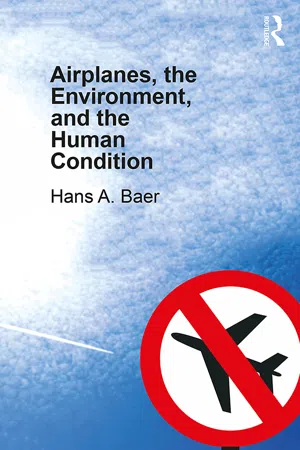
The number of airplane flights worldwide continues to grow and is one of the many drivers of climate change. This book examines the aviation industry from an anthropological perspective, focusing on the sector's environmental impact and the challenges facing attempts to shift to more sustainable solutions. Hans Baer outlines how airplanes have become a key component of modern cultural and social life, and how the world system has become increasingly dependent on them to function. He critically examines current efforts to mitigate the climatic impact of the air travel and argues for a significant move away from air transport, suggesting that such a shift may only be achieved through a more fundamental change in the world system.
- 204 pages
- English
- ePUB (mobile friendly)
- Available on iOS & Android
eBook - ePub
Airplanes, the Environment, and the Human Condition
About this book
Information
1
THE POLITICAL ECONOMY OF AIRCRAFT
Chapter 1 examines the following aspects of the political economy of aircraft: aircraft production, the rise and maturation of the airline industry, the nexus between the aviation industry and the state, and the liberalization of the airline industry. Airplane manufacturing of both commercial and military evolved over the course of the 20th century and into the 21st century as a highly profitable sector of the capitalist world system. Even post-revolutionary or socialist-oriented societies, in their awkward efforts to compete with capitalist societies and in their efforts to militarily defend themselves against them manufacturing numerous aircraft, often at the expense of the development of social and health services. Both in the West and East, commercial aircraft were spin-offs of military aircraft projects.
Aircraft manufacturing
The aircraft manufacturing industry produces both military aircraft and commercial aircraft. Commercial aircraft consist of commercial airplanes, business and private airplanes, and commercial helicopters. The aircraft manufacturing industry also produces parts and components, including aircraft engines, avionics equipment, flight simulators for pilot training and ejector seats for combat airplanes. In the United States, Europe, and various other countries, the typical aircraft manufacturing model entails research and design, testing, and manufacturing per se (Hartley 2014:2). The aircraft manufacturing industry historically has been one of “reorganizations, mergers, spin-offs, and diversification attempts, in many instances to acquire needed capital and to lessen vulnerability to the cyclical nature of the business” (Pattillo 2001:2). The main players in the industry have been corporations that produce airframes but the industry also includes a wide array of corporations which produce aircraft engines and other avionics components. Reportedly, the Voisin brothers in France created the world’s first aircraft manufacturing company and produced their first airplanes in 1907 but the Wright brothers began manufacturing aircraft in 1908 and delivered an airplane to the US Army in 1909 (Pattillo 2001:6–9). Despite early connections with the military, as Patillo reports:
The early aircraft market was primarily of wealthy sportsmen and adventurers attracted to the excitement ad novelty of flight. From 1909 flying was regarded as a spectator sport, as the public would pay for aerial contests and exhibitions. There was little of the airplane as a weapon of war or as a means of transportation.
(Pattillo 2001:10)
World War I did much to alter aircraft manufacturing from producing toys for the idle rich to contributing to air power as well as producing commercial airplanes that transported rich people hither and thither.
Boeing, an early US airplane manufacturer, also established its own airline and later merged with Pratt and Whitney to form the United Aircraft and Transportation Corporation in 1929 (Hartley 2014:15). UATC owned the Boeing Airplane Company, the Chance Vought Corporation, Hamilton Standard which manufactured propellers, Pratt and Whitney which manufactured aircraft engines, and later acquired Sikorsky, which manufactured helicopters, and it acquired more airlines. Hartley reports:
However, in 1934 following the Air Mail scandal, the US government concluded that such vertically owned firms were anti-competitive and new anti-trust laws prevent airframe or engine companies from owning airlines. As a result, UATC was broken into three companies, namely, Boeing, the United Aircraft Corporation (now United Technologies Corporation) and United Airlines.
(Hartley 2014:15)
After World War II, aircraft manufacturers engaged in an internal debate about whether to stick with turboprop commercial airplanes or to convert to commercial jet airplanes. US commercial aircraft manufacturers, namely Douglas and Lockheed, simply increased the size of their turboprop planes. Air passengers in the 1940s and the 1950s flew on large turboprop planes such as the Stratocruiser, the DC-4, and the DC-7C, which had the capability of flying across the Atlantic Ocean non-stop, beginning in 1956 (Kinney 2006:110). Both the Stratocruiser and DC-4 were designs converted from military cargo planes. The Stratocruiser had a bar and lounge situated below the passenger seating area and held up to 100 passengers.
Conversely, the British aircraft industry shifted to commercial jet plane manufacturing, resulting in the de Havilland DH-106 Comet which first took to the air on July 27, 1949 (Yenne 2002:10). The Comet became the first passenger jetliner, introduced for air service in May 1952 by the British Overseas Airways Corporation (BOAC) between London and Johannesburg (Kinney 2006:112). While the Comet flew up to 40,000 feet at nearly 480 miles per hour and was smoother than propeller-driven airplanes, it had to be taken out of service because it manifested a fatal design flaw in the susceptibility of the cabin windows to fatigue due to frequent pressurization and depressurization, resulting in several catastrophic accidents. BOAC replaced the Comet with an improved Comet 4 in 1958, but the lead in the airline market shifted to the United States with the advent of the Boeing 707, which drew upon the B-47 military cargo plane design.
Boeing entered the US commercial jetliner market by flying a prototype of the 707 on July 15, 1954 (Yenne 2002:13). Douglas Aircraft developed its own commercial jetliner, the DC-8, which entered service with both Delta Airlines and United Airlines in September 1959. Lockheed’s commercial jetliner, the L-1011, entered service in the early 1970s.
Today, four corporations, including Boeing and Airbus, control 56 percent of the market share in commercial airplane manufacturing (Ovodenko 2017:45). Rolls Royce, General Electric, and United Technologies Corporation dominate the manufacture of jet engines. China entered a joint venture in 2007 with Airbus for the final assembly of the A320 airplane in Tianjin, a city near Beijing (Levine 2015:835). Large aircraft companies, like Boeing and Airbus, often outsource portions of the manufacturing process, such as the manufacture of the wing or the fuselage to a subcontracter in another country, such as Japan or Italy; a practice that contributes to emissions miles, whether by ship or air cargo (Newhouse 2007:169). Four Chinese companies are manufacturing a wide array of wing components for Airbus aircraft (Newhouse 2007:176).
Details of the five leading major manufacturers of aircraft are delineated here:
- Boeing (est. 1916) is the largest manufacturer of commercial jet aircraft and military aircraft combined. It is headquartered in Chicago but most of its US manufacturing facilities are situated in the Seattle area. Boeing manufactures the 737, 747, 767, 777, and 787 Dreamliner and accounts for about 75 percent of the commercial jetliners in service. It also manufactures the Boeing Business Jet. In terms of military aircraft, Boeing manufactures fighter jets, bombers, transports, rotorcraft, aerial refuelers, missiles, and munitions. It also works with the US government on several programs, including NASA’s space shuttle and International Space Station programs, and the Missile Defense Agency Ground-Based Midcourse Defense program. In 2009 Boeing employed over 158,000 people in the United States and in 70 countries.
- Airbus (est. 1970) is situated in Europe with its headquarters in Toulouse, France and with 12 sites in France, Germany, Spain and the UK and subsidiaries in the US, Japan, and China. It manufactures 14 civilian jet aircraft models, seating between 100 to 525 passengers. Airbus also manufactures military aircraft, including the A400M multi-role military airlifter and various types of aerial tankers for in-flight refueling and transport missions. In 2009 Airbus employed some 52,000 people.
- Bombardier operates Bombardier Aerospace and Bombardier Rail Transportation. It is headquartered in Montreal and employs over 32,000 people in some 60 countries. Bombardier Aerospace manufactures the Learjet, the regional CRJ-100 commercial jet liner, and various amphibious aircraft.
- Embraer is based in São José dos Compos, Brazil, and focuses on specific market sectors in commercial, defense, and business aviation. In 2009 it employed over 17,000 people, with 87.5 percent of them based in Brazil.
- Tupolev,officially called Public Stock Company, is a Russian aerospace and defense company headquartered in Moscow. It manufactures civilian and military aircraft and weapons systems. Aeroflot is the main purchaser of a variety of Tupolev jetliners.
Source: AviationKnowledge website.
In 2014, Boeing had a revenue of $90.78 billion, Airbus a revenue of $67 billion, Tupolev a revenue of 55.982 billion, Bombardier a revenue of $10.5 billion, and Embraer a revenue of $20.9 billion (5 Biggest Aircraft Manufacturing Companies 2016).
The principal manufacturers of small aircraft are Beech, Cessna, Cirrus Design, Diamond, Mooney, and Pipe...
Table of contents
- Cover
- Half Title
- Title Page
- Copyright Page
- Table of Contents
- List of tables
- List of boxes
- Introduction
- 1. The political economy of aircraft
- 2. Airports: nodes or loci of economic development and sociality?
- 3. Cultural tropes associated with aeromobility
- 4. The impact of airplanes on the environment and climate change
- 5. Who is being transported by airplanes
- 6. Efforts to make airplanes and airports more environmentally sustainable
- 7. Alternatives to flying: individual and collective strategies
- 8. Airplanes, sustainable transportation, and the future of humanity
- References
- Index
Trusted by 375,005 students
Access to over 1.5 million titles for a fair monthly price.
Study more efficiently using our study tools.
Frequently asked questions
Yes, you can cancel anytime from the Subscription tab in your account settings on the Perlego website. Your subscription will stay active until the end of your current billing period. Learn how to cancel your subscription
No, books cannot be downloaded as external files, such as PDFs, for use outside of Perlego. However, you can download books within the Perlego app for offline reading on mobile or tablet. Learn how to download books offline
Perlego offers two plans: Essential and Complete
- Essential is ideal for learners and professionals who enjoy exploring a wide range of subjects. Access the Essential Library with 800,000+ trusted titles and best-sellers across business, personal growth, and the humanities. Includes unlimited reading time and Standard Read Aloud voice.
- Complete: Perfect for advanced learners and researchers needing full, unrestricted access. Unlock 1.5M+ books across hundreds of subjects, including academic and specialized titles. The Complete Plan also includes advanced features like Premium Read Aloud and Research Assistant.
We are an online textbook subscription service, where you can get access to an entire online library for less than the price of a single book per month. With over 1.5 million books across 990+ topics, we’ve got you covered! Learn about our mission
Look out for the read-aloud symbol on your next book to see if you can listen to it. The read-aloud tool reads text aloud for you, highlighting the text as it is being read. You can pause it, speed it up and slow it down. Learn more about Read Aloud
Yes! You can use the Perlego app on both iOS and Android devices to read anytime, anywhere — even offline. Perfect for commutes or when you’re on the go.
Please note we cannot support devices running on iOS 13 and Android 7 or earlier. Learn more about using the app
Please note we cannot support devices running on iOS 13 and Android 7 or earlier. Learn more about using the app
Yes, you can access Airplanes, the Environment, and the Human Condition by Hans A. Baer in PDF and/or ePUB format, as well as other popular books in Social Sciences & Political Economy. We have over 1.5 million books available in our catalogue for you to explore.