eBook - ePub
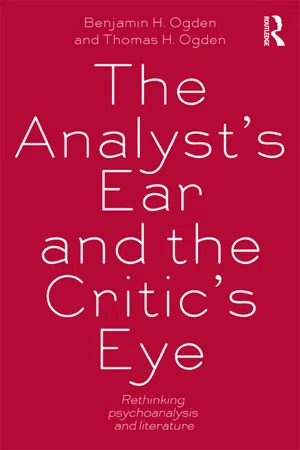
The Analyst's Ear and the Critic's Eye
Rethinking psychoanalysis and literature
- 112 pages
- English
- ePUB (mobile friendly)
- Available on iOS & Android
eBook - ePub
The Analyst's Ear and the Critic's Eye
Rethinking psychoanalysis and literature
About this book
The Analyst's Ear and the Critic's Eye is the first volume of literary criticism to be co-authored by a practicing psychoanalyst and a literary critic. The result of this unique collaboration is a lively conversation that not only demonstrates what is most fundamental to each discipline, but creates a joint perspective on reading literature that ne
Information
Chapter 1
The analyst's ear
The history of psychoanalytic literary criticism is as old as psychoanalysis, but it has undergone considerable change since Freud's famous readings of Hamlet (1900), the novels of Dostoevsky (1928), and the story of Moses (1939). The methodology of psychoanalytic literary criticism introduced by Freud and adopted by most psychoanalysts and non-analysts through the greater part of the twentieth century is founded on the idea that writers create stories and characters that reflect their own unconscious psychology. A text is a mirror of the unconscious mind of the writer, much as dreams are creations of the unconscious mind that are disguised in order to escape repression (“censorship”), thus gaining access to preconscious and conscious awareness (our remembered dreams). Through readings of this sort, psychoanalytic literary criticism brought established analytic formulations to bear on the text, for instance, constellations of feeling understandable in terms of the Oedipus complex, castration anxiety, the incest taboo, oral, anal, and phallic stages of psychosexual development, and the like.
The best known, and most widely studied, early examples of this type of formulaic Freudian reading are Ernest Jones's (1949) reading of Hamlet (in which he concludes that Hamlet is unable to fulfill his duty to kill his uncle because that murder is too closely linked in his repressed unconscious to his forbidden oedipal wishes to murder his father and marry his mother); and Marie Bonaparte's (1933/1949) study of Edgar Allan Poe, which owed much to Freud's (1908) “Creative Writers and Day-dreaming.”
As psychoanalytic theories of early childhood development grew more nuanced, so did the range of concepts that psychoanalysts used to decode literary texts. This resulted in readings that were no less formulaic in the way they made use of analytic concepts, but they did draw on a wider range of psychoanalytic ideas (for example, Phyllis Greenacre's [1955] “The Mutual Adventures of Jonathan Swift and Lemuel Gulliver: A Study of Pathography” and Ernst Kris's [1948] “Prince Hal's Conflict”). Literary critics with an interest in psychoanalysis, but with little, if any, analytic training, and no experience at all as practicing analysts, followed suit, producing intelligent, but reductive readings (for example, Edmund Wilson's [1948] reading of Ben Jonson's The Alchemist as a play that Wilson believed to be a reflection of Jonson's “anal erotic” personality).
This Freudian model of literary criticism may have peaked (among academic literary critics) with the work of Frederick Crews, who in his 1966 book on Nathanial Hawthorne, asserts: “All Hawthorne's serious fiction amounts to a version of the same unconscious challenge; not one of his characters stands apart from the endless and finally suffocating [internal] debate, about the gratification of forbidden wishes … We must admire the art and regret the life” (pp. 270–271) of Hawthorne, who Crews concludes was tormented by the same “forbidden wishes” that plagued his characters.
Despite the fact that these types of readings lost much of their luster after Crews (who himself later renounced the psychoanalytic perspective), contemporary psychoanalytic literary critics continue to produce readings of literature based on the supposition that literary characters behave and think like real human beings; that fictional characters have unconscious psychological problems that the reader may identify and diagnose; and that the author and his characters share the same unconscious dilemmas.
Alongside classic Freudian accounts of author and character psychology, there emerged a set of psychoanalytic theories that addressed different, but closely related, aspects of psychoanalysis and its bearing on literary analysis. In The Dynamics of Literary Response (1968), Norman Holland moves psychoanalytic literary criticism in the direction of “reader-response theory”—a field of literary theory that focuses on how readers respond to texts and the role readers play in investing texts with meaning. Holland makes use of a Freudian psychoanalytic perspective to understand the interpretive activity of readers. In a 1970 article, “The ‘Unconscious’ of Literature,” Holland reads Robert Frost's poem “Mending Wall” not as a reflection of the author's psychology, but as an appeal to the reader's psychology. He views the poem as activating the unconscious fantasies and wishes of the reader (in this case, the reader's unconscious fantasy of breaking down the wall between the self and the nursing mother).
Peter Brooks, in Psychoanalysis and Storytelling (1994), brings psychoanalytic concepts to bear on narrative theory, and Harold Bloom, in his seminal work The Anxiety of Influence (1973), links influence and authorial anxiety to the Oedipus complex. In response to Bloom's theory of psychological influence, Sandra Gilbert and Susan Gubar (in The Madwoman in the Attic [1979]) develop their own feminist psychoanalytic theory of author psychology, arguing that female writers suffer from an “anxiety of authorship” born of their socially marginal and conflicted status as women writers.
In the 1950s and 1960s, the Freudian framework became part of the fields of linguistics, structuralism, and semiotics, most prominently in the work of Jacques Lacan. Lacan's post-Freudian framework was appropriated by semiology, structuralism, and post-structuralism, for example in Barbara Johnson's (1977) well-known reading of Derrida's reading of Lacan's reading of Edgar Allan Poe's story “The Purloined Letter.” The result of this interpretive chain was, unfortunately, no less deterministic in its suppositions about the explanatory power of psychoanalytic ideas than the literary criticism derived from Freud's and Ernest Jones's application of psychoanalytic theory to the reading of literary works. Similar use of psychoanalytic concepts can be seen in the literary criticism and prose of several important twentieth-century poets and fiction writers, including Conrad Aiken (1919), Robert Graves (1924), W. H. Auden (1962/1969), and Randall Jarrell (1962/1966, 1969).
Regardless of the particular form they have taken, these types of literary criticism are all held to be psychoanalytic because they either use a psychoanalytic conceptual framework to “understand” literature or they use literature to illustrate, expand upon, or upend established psychoanalytic formulations. In such literary criticism, a discreet set of “answers” to the puzzle of literary texts pre-exist the reading of the text.
In this chapter we focus on a form of psychoanalytic literary criticism that is devoid of psychoanalytic formulations and the psychoanalytic jargon that often accompanies such psychoanalytic readings. The kind of psychoanalytic criticism we will discuss is unusual in that it makes no attempt to find or create a correspondence between literary form or content (for example, Hamlet's tortured soliloquies) and psychological operation (for example, Hamlet's unconscious attempts at resolution of parricidal and incestuous wishes and fears). It is a form of psychoanalytic literary thinking that is not psychologically explanatory, diagnostic, or therapeutic. Rather, it raises the possibility that one of the ways that a piece of literary criticism is psychoanalytic derives from its particular way of hearing and writing about literary voice. This way of hearing and writing has its origins, we believe, in how practicing psychoanalysts are attuned to the patient's voice, and their own, in a way that is unique to the practice of psychoanalysis.
In considering a form of psychoanalytic literary criticism divested of all the characteristics that have traditionally been taken as constitutive of psychoanalytic literary criticism, we will focus on a reading of a Robert Frost poem by Thomas Ogden (1998) (see Ogden, T., 1997b, 1997c, 1998, 1999, 2000, 2001, 2003, 2009a, 2009b for his readings of other literary works). In our discussion of the Psychoanalytic Literary Reader's (the PLR's) essay on Frost's “Never Again Would Birds’ Song Be the Same” (1942/1995a), we attempt to continue the ongoing (but unfinished) process of loosening the ties of analytic criticism to reductive psychoanalytic formulae, and to use what we know about psychoanalysis and literary studies to jointly consider how the analyst's lived experience of the practice of psychoanalysis is reflected in how he thinks and writes about literature. In doing so, we hope to bring literary criticism and the practice of psychoanalysis into conversation in such a way that each discipline takes from the other some of its most essential and less evident qualities, rather than limiting this conversation to the most manifest contributions of each discipline. This should give literary critics who are interested in psychoanalysis (as both a set of ideas and as a therapeutic process) a deeper and more nuanced sense of the forms of thinking that are integral to psychoanalysis; and it should give to psychoanalysts who are interested in literature a better feeling for the ways that academic literary critics attend to the demands of literature in their own unique ways.
We believe that the distinctively psychoanalytic dimension of psychoanalytic literary criticism resides as much in the experience of the practice of psychoanalysis (and the particular form of listening and conversing that are central to it) as it does in psychoanalytic theory. In the analytic setting, analyst and patient are engaged in an effort to speak to one another in a way that is adequate to the task of creating/conveying a sense of what it feels like for the patient to be alive, to the extent that he is capable of being alive, at a given moment. We believe that for this to occur, the analyst must be attuned to what the patient is doing with language, as well as all that he is unable to do. Language is not simply a medium for the expression of the self; it is integral to the creation of the self (which is a continuing, moment-to-moment process). In the analytic setting, with its focus on talking as the principal means of communication, voice and language usage are among the principal ways in which individuals bring themselves into being, “come to life.” Voice, for the patient, is a medium for intended and unintended experimentation with different forms of selfhood, and for the development of a larger, more vital sense of self.
In order not to leave completely open to the imagination of the reader (who may not be a practicing analyst) what we have in mind by the psychoanalyst's way of being with, listening to, thinking about, and responding to what is happening in the course of an analytic session, we will now present a selection from the analyst co-author's psychoanalytic writing in which he describes his work with one of his patients. (This description of analytic work is based on a previously published clinical discussion [Ogden, T., 2010].) He writes:
As a child, Mr. C, a patient with cerebral palsy, had been savaged by his mother. In adult life, he became possessed by a “love” for a woman, Ms. Z. Over a period of eight years, Ms. Z twice relocated to a different city; both times the patient followed. Again and again, she tried to make it clear to Mr. C that she liked him as a friend, but did not want a romantic relationship with him. He became increasingly desperate, angry and suicidal. From the outset of the analytic work, and frequently thereafter, the patient told me that he did not know why I “tolerated” him.
In our sessions, Mr. C would howl in pain as he spoke of the “unfairness” of Ms. Z's rejection of him. When upset, particularly when crying, the patient would lose muscular control of his mouth, which made it very difficult for him to speak. Frothy saliva gathered at the sides of his mouth, and mucus dripped from his nose while tears ran down his cheeks. Being with Mr. C at these times was heartbreaking. I have only rarely felt in such an immediate, physical way that I was the mother of a baby in distress.
I believe that it was very important to the analytic work that Mr. C experience for himself over a period of years the reality that I was not repulsed by him even when he bellowed in pain and could not control the release of tears, nasal mucus and saliva. It must have been apparent to Mr. C, though I never put it into words, that I loved him as I would one day love my own children in their infancy. For years, the patient had been too ashamed to tell me about some of the ways his mother had humiliated him as a child, for example, by repeatedly calling him “a repulsive, slobbering monster.”
Mr. C only gradually entrusted me with these deeply shamed aspects of himself. “She threw shoes at me from her clothes closet like I was an animal that she was trying to keep at a distance.” I said, “She was treating you like a rabid dog, and over time, you've come to experience yourself in that way.” In speaking and thinking these thoughts and feelings, the patient and I were trying out words and images to convey what had been to that point inarticulate emotional pain experienced primarily through feelings encrypted in bodily sensations, such as the sensations associated with his speech and gait. In trying to help Mr. C find words for his inarticulate feelings, I was not trying to help him rid himself of pain; I was trying to help him transform the medium in which he was experiencing his pain (from a bodily medium to a verbal one) in hopes that by doing so, he and I would be better able to think about his experience of himself, as opposed to his “showing it to me” or “dumping it into me” in order that I might experience some of his pain for him.
Several years into the work, Mr. C told me a dream: “Not much happened in the dream. I was myself with my cerebral palsy washing my car and enjoying listening to music on the car radio that I had turned up loud.” The dream was striking in a number of ways. It was the first time, in telling me a dream, that Mr. C specifically mentioned his cerebral palsy. Moreover, the way that he put it—“I was myself with my cerebral palsy”—conveyed a depth of recognition and an acceptance of himself that I had never before heard from him. How better could he have expressed a particular type of change in his relationship to himself—a psychological change that involved a loving self-recognition that contributed to freeing him from the need to perpetually attempt to wring love and acceptance from people disinclined to, or incapable of, loving him? In the dream, he was able to be a mother who took pleasure in bathing her baby (his car) while listening to and enjoying the music that was coming from inside the baby. This was not a dream of triumph; it was an ordinary dream of ordinary love: “nothing much happened.”
I was deeply moved by the patient's telling me his dream. I said to him, “What a wonderful dream that was.” How different it would have felt to me, and I think, to Mr. C, had I said, “In the dream, you were the mother you've always wished you had, taking great pleasure in giving you—you as you are, a person with cerebral palsy—a bath, while singing beautiful music to you, her beloved child.” To have said this would have been redundant—we had talked a great deal about his wish that he had had a mother who loved him as he was. It would also have had the effect of taking his dream—his experience of being both a loving mother (to himself and other people) and a well-loved baby—and making it something of my own by putting it into explanatory language. Instead, I simply appreciated the love and beauty that he had experienced, not only in dreaming the dream, but also in telling it to me.
Some years later, Mr. C moved to another part of the country to take a high level job in his field. He wrote to me periodically. In the last letter that I received from him (about five years after we stopped working together), he told me that he had married a woman he loved, a woman who had cerebral palsy. They had recently had a healthy baby girl.
We will return to this clinical vignette at various points in this chapter to discuss the analyst's particular ways of attending to language (both the patient's and his own), but for now it suffices to say that this vignette reflects a way of listening and responding that is distinctively psychoanalytic (it is immediately recognizable as being different from all other forms of human relatedness).
As we turn now to a discussion of the PLR's essay on “Never Again Would Birds’ Song Be the Same,” we hope that it becomes clear that the way in which the PLR listened to and spoke with Mr. C is continuous with the way in which he reads and writes about Frost's poem (the entirety of T. Ogden's [1998] critical reading of “Birds’ Song” is reprinted in the Appendix to Chapter 1). The vignette and the following discussion represent different expressions of the same psychoanalytic sensibility, a sensibility that gives the PLR's literary criticism its psychoanalytic identity.
Here is the Frost poem that the PLR discusses:
Never Again Would Birds’ Song Be the Same
He would declare and could himself believe
That the birds there in all the garden round
From having heard the daylong voice of Eve
Had added to their own an oversound,
Her tone of meaning but without the words.
Admittedly an eloquence so soft
Could only have had an influence on birds
When call or laughter carried it aloft.
Be that as may be, she was in their song.
Moreover her voice upon their voices crossed
Had now persisted in the woods so long
That probably it never would be lost.
Never again would birds’ song be the same.
And to do that to birds was why she came.
(Frost, 1942/1995a, p. 308)
Here is the first section of the psychoanalyst's response:
The poem opens with the sound of good-natured chiding as the speaker, with mock skepticism, talks of a man who professed a far-fetched notion about birds that he actually seemed to believe. There is a slightly disowned intimacy in the speaker's voice as he fondly, skeptically marvels at the capacity of the man to believe the unbelievable and speak these beliefs from a place in himself where there seemed to be no doubt. There is a feeling that what he believes he “believes … into existence” (Frost, quoted in Lathem, 1966, p. 271). One can hear in the voice the pleasure taken in knowing someone so well over the years that even his old stories and quirky beliefs have become signatures of his being.
(Ogden, T., 1998, pp. 430–431)
What is striking about this kind of psychoanalytic literary reading is the rapidity and intensity with which the PLR is drawn to a personal connection with the voice of the poem. The privileged portal for the PLR's efforts to get to know a piece of literature is the voice created in the writing. In the broadest sense, the PLR's relationship to voice is unusually (perhaps excessively) intimate. In his introductory comments, the PLR goes so far as to say of the Frost poem (an...
Table of contents
- Cover
- Title Information
- Title Page
- Copyright Page
- Dedication
- Tabel of Contents
- Acknowledgments
- Introduction
- 1 The analyst's ear
- 2 How the analyst thinks as clinician and as literary reader
- 3 The critic's eye
- Conclusion
- Appendix to Chapter 1: Thomas Ogden's (1998) Reading of Frost's “Never Again Would Birds’ Song Be the Same”
- Appendix to Chapter 2: Thomas Ogden's (2009a) Reading of Kafka's “A Hunger Artist”
- Appendix to Chapter 3: Benjamin Ogden's (2012) Reading of Roth's The Ghost Writer
- References
- Index
Trusted by 375,005 students
Access to over 1.5 million titles for a fair monthly price.
Study more efficiently using our study tools.
Frequently asked questions
Yes, you can cancel anytime from the Subscription tab in your account settings on the Perlego website. Your subscription will stay active until the end of your current billing period. Learn how to cancel your subscription
No, books cannot be downloaded as external files, such as PDFs, for use outside of Perlego. However, you can download books within the Perlego app for offline reading on mobile or tablet. Learn how to download books offline
Perlego offers two plans: Essential and Complete
- Essential is ideal for learners and professionals who enjoy exploring a wide range of subjects. Access the Essential Library with 800,000+ trusted titles and best-sellers across business, personal growth, and the humanities. Includes unlimited reading time and Standard Read Aloud voice.
- Complete: Perfect for advanced learners and researchers needing full, unrestricted access. Unlock 1.5M+ books across hundreds of subjects, including academic and specialized titles. The Complete Plan also includes advanced features like Premium Read Aloud and Research Assistant.
We are an online textbook subscription service, where you can get access to an entire online library for less than the price of a single book per month. With over 1.5 million books across 990+ topics, we’ve got you covered! Learn about our mission
Look out for the read-aloud symbol on your next book to see if you can listen to it. The read-aloud tool reads text aloud for you, highlighting the text as it is being read. You can pause it, speed it up and slow it down. Learn more about Read Aloud
Yes! You can use the Perlego app on both iOS and Android devices to read anytime, anywhere — even offline. Perfect for commutes or when you’re on the go.
Please note we cannot support devices running on iOS 13 and Android 7 or earlier. Learn more about using the app
Please note we cannot support devices running on iOS 13 and Android 7 or earlier. Learn more about using the app
Yes, you can access The Analyst's Ear and the Critic's Eye by Benjamin H. Ogden,Thomas H. Ogden in PDF and/or ePUB format, as well as other popular books in Literature & Literary Criticism. We have over 1.5 million books available in our catalogue for you to explore.