Academic Labor beyond the College Classroom initiates a scholarly and professional conversation, calling upon faculty to participate in, reimagine, and transform their institutional and professional work to look beyond just teaching and research. Chapters in this contributed volume offer case studies, strategies, and exemplars of how faculty can re-engage in institutional service, mentoring, governance, and administrative duties to advance equity efforts at all levels of the university, calling for what Dr. Nancy Chick names in the Foreword as a "scholarship of influence." This book draws from a diverse range of methodologies and disciplines, issuing an invitation to faculty "across the divide" of their specific college, school, or corner of the university into cross-conversations and partnerships for positive change.
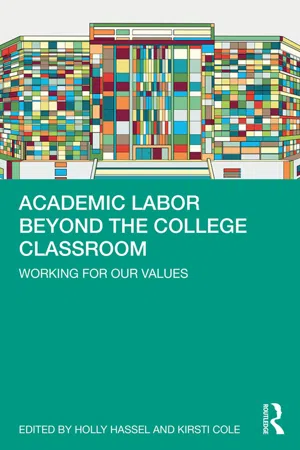
eBook - ePub
Academic Labor Beyond the College Classroom
Working for Our Values
- 216 pages
- English
- ePUB (mobile friendly)
- Available on iOS & Android
eBook - ePub
About this book
Information
1
INTRODUCTION
Effecting Change Through Service Activism: Redefining Faculty Work in Contemporary Higher Education
Holly Hassel and Kirsti Cole
Who among us as college faculty has not been pressed to create, use, or disseminate a practice or initiative that has been touted as “innovative”? In this collection, we are interested less here in questioning the value of innovation as we are in pinpointing (and arguing for) where and how effective change—innovative or not—gets done. We ask readers—who we hope include our faculty and staff colleagues from a wide range of disciplines, institutions, and employment types—to think with us about what sorts of changes matter to the day-to-day work of our classrooms and our students.
Those of us working on the ground—which we would characterize as working directly with college students—are well positioned to identify when structures, processes, or policies are not working for our students, or when inadequate resources inhibit our ability to perform our work well. Certainly, we can’t ignore the influence of what some have called a corporatization of higher ed, noted by Larry Gerber’s (2014) book chapter “Shared Governance and the Future of Liberal Education,” which argues that “a professional professoriate acting through the mechanisms of shared governance is potentially the last-line defense against the triumph of a narrowly utilitarian definition of the purposes of higher education that views students as customers and sees job training as the sole function of colleges and universities” (166). Recognizing the shifting orientation of public higher education, those of us working “on the ground” regularly experience the kinds of barriers identified by Gerber: barriers to fulfilling the goals of a professionalized professoriate who can actively advocate for academic quality, equitable working conditions, and a rich, full, and accessible version of post-secondary education in the U.S. To reword Gerber, unless what we would define as college workers (not solely faculty but all faculty—both tenure-line and contingent—staff, graduate students) embrace and advocate for their role and responsibilities as change-makers on the ground in the classrooms, on committees, and in their units, it will be very difficult to fulfill a vision of higher education that challenges the neoliberal and market-based ideologies that have prevailed in the last two decades. We aspire in this collection to share stories and strategies emerging from the efforts and achievements of such college workers to bring about change in their departments, campuses, and other professional spaces, change emerging from values of equity, inclusion, and social justice.

FIGURE 1.1The Results of a Publisher Search for “Faculty Leadership” = Zero
Much of the scholarship on change within higher education comes from and is aimed at traditionally defined leaders—high-level administrators, provosts and deans, system or campus presidents and chancellors, Boards of Trustees. Rowley and Sherman’s (2001) From Strategy to Change: Implementing the Plan in Higher Education, for example, takes as its task spelling out what “strategic choices that a college or university can make to help develop and sustain a competitive strategic advantage” (Rowley and Sherman 2001, xxiv). Like the 2005 Harvard Business Review article “The Hard Side of Change Management” (Sirkin, Keenan, and Jackson 2005), Rowley and Sherman dedicate a substantive part of their book to focusing on “The Hard Facts of Implementing Change.” They recognize the multiple models of doing change work—as well as the pros and cons of approaches such as top-down change, bottom-up change, consensus-based change, and “the use of an outside change agent” (aka consultants) —that prevail in any large organization, and highlight the importance of leadership, expansively defined, that can make or break the success of a new initiative or effort (Sirkin, Keenan, and Jackson 2005).
Likewise, texts that focus on academic change, academic leadership, and strategic planning situate responsibility for and power to create or influence change specifically within a traditional hierarchical leadership model. In 2007, Gappa, Austin, and Trice, in Rethinking Faculty Work: Higher Education’s Strategic Imperative, named four forces creating what they identify as challenges for colleges and universities: fiscal constraints, calls for accountability, growing enrollment and an increasingly diverse college-going population, and expanded use of technology. The authors, with formal academic credentials in higher education as well as experience working on higher education administration, write to other administrators, largely offering recommendations for attracting, retaining, and supporting (as well as managing) faculty and mid-level leaders such as academic department chairs (Gappa, Austin, and Trice 2007; Hecht et al. 1999). Zemsky’s (2013) Checklist for Change characterizes (perhaps not entirely wrongly) “most faculty members” as not believing that “change is either necessary or inevitable,” and concedes, “though faculty have increasingly come to see themselves as victims, most are not so much angry as they are doubtful—uncertain that the changes now being championed by that growing army of policy wonks and political operatives will do anything but lessen the academy’s value and independence” (Zemsky 2013, 20). No wonder that higher education thought leaders conceptualize “the faculty” as obstructionist, and proceed with “change management” strategies that nearly always include management of the distributed environments that characterize colleges and universities. Jeffrey Buller argues “many of the policies and procedures that govern the way in which an institution operates were developed by the members themselves,” and thus “many faculty members take proposals for change personally” (Buller 2015, 19). We can’t help but note, as well, with increasingly fewer colleges employing tenure-line faculty members, even the historical construction of who does what (and what level of autonomy, self-determination, and leverage they have to resist or act) is in flux.
Similar to the way that academic leadership is conceived of as a largely closed conversation among administrators, faculty leadership is often conceptualized as something that happens among and between other faculty. For example, the AAC&U (Association of American Colleges and Universities) report “Faculty Leadership for Integrative Learning” consistently frames faculty leadership as something that happens among colleagues: faculty who are “thought leaders” and whose primary claim to leadership is making other faculty do things. As the report authors write: “Faculty leaders need to help colleagues recognize and articulate how their work fits into the larger picture of integrative liberal learning” (Farren and Paris, 12). They expand their understanding of what it might mean to fit later: “faculty leaders take advantage of a variety of opportunities to increase faculty and staff awareness and understanding of integrative liberal learning” (14). A faculty leader, according to the AAC&U report, then, relegates the role of faculty to facilitation and integration, rather than change or policy work. They continue: “faculty leaders promote professional development to enhance faculty and staff capacity. In an open culture, faculty leaders have no need to be ‘in charge’ but instead build goodwill by engaging others across the institution, both formally and informally, in work that contributes to integrate liberal learning” (15). In this construct, not only is the role of a faculty leader simply to harness and marshal colleague labor in the service of an agenda that is set by AAC&U, by external stakeholders, and in all likelihood by campus administrators; it also suggests that faculty leadership is about “enhancing capacity,” a charge that seems to focus on extracting maximum surplus-value of faculty labor, time, and energy. The leadership of faculty in this construction seeks to serve interests that may or may not be aligned with the goals faculty bodies have for the work of the institution and in their classrooms or units. It’s true that many faculty would authentically have an investment in the principles spelled out in the liberal learning framework. However, these principles, as well as institutional agendas set by administrators, may not be at all reflective of classrooms or curricula, and may not serve the best interests of students. Simply being handed an educational framework and tasked with bringing colleagues into the new model becomes more an exercise in proselytizing than in leading and frames faculty leaders as administrators-in-training rather than intellectuals or change-makers.
The notion that faculty, staff, and students can have grassroots ideas that influence upward and not across is unreflected in the scholarship and maintains the artificial and dangerous duality between administration and faculty. For example, Scott’s How University Boards Work asserts: “Those most responsible for higher education’s educational and business practices are college and university presidents and boards of trustees” (2018, 1), revealing what we think is a gap between the on-the-ground work in our classrooms and in our departments, and the decision-making hierarchies and processes that shape that work. Buller’s Best Practices in Faculty Evaluation: A Practical Guide for Academic Leaders (2012) focuses on how to lead and how to manage change and is similarly aimed at specific groups within academia (i.e. not faculty), a focus that tells us a lot about who in this work environment is expected to take responsibility for bringing about (and potentially identifying and implementing) changes to institutions of higher education. Susan Resneck Pierce’s Governance Reconsidered (2014) rightly observes that “many of the conflicts about governance in recent years have been prompted by different views about who is responsible for the nature and pace of change, particularly when it comes to academic matters” (13–14). We propose in this volume a reimagination of change work, and leadership that is rooted in valuing teaching and learning, the work of governance groups and labor organizations, service activism, and professional, disciplinary conversations.
A Different Model of Leadership
When characterizing change within academia, we see metaphors like “steering a cruise ship” or “herding cats.” In other words, bringing about change to an institution—whether academia more broadly or a specific college or university—is both slow and difficult (or perhaps impossible, as those of us who own cats can attest). “Crisis rhetoric” about the turn to neoliberal values, corporate and philanthropic influence, legislatively imposed accountability measures, cuts to state funding, and declining public confidence in higher education pervades our hallways, local newspapers, and national trade dailies, compounding the feeling that change work is impossible.
News headlines, monographs, and higher education leadership series promise solutions and strategies for institutional thriving and, in the case of universities in cash-strapped states or unsustainable private school business models, surviving. Many of these publications ignore, or perhaps unsurprisingly critique, college faculty as being part of the problem. Though some scholarship and administrative advice books identify faculty as an important institutional resource—one that shapes the quality and value of the campus—other rhetorics in academic leadership (though varied) are as likely to frame faculty as a source of problems as they are the source of value within higher education organizations, or to leave out staff and students altogether. For example, consider the two snapshots in Figures 1.2 and 1.3 from the indices of two book-length discussions of academic leadership.

FIGURE 1.2Index Image for “Faculty” from Lucas (2000)

FIGURE 1.3Index Image for “Faculty” from Buller (2013)
A close reading of these index entries can tell us a lot about, at least within the literature on change management and leadership, the role of faculty. In the earlier book (Lucas 2000, focused on advice for department chairs), faculty are rhetorically positioned as needing persuasion to manage change through a “team effort,” to be part of a “climate of trust.’ An unnamed subject is involved in “establishing performance standards” and managing “resistance by” where a more specifically named chair needs to “motivate” and “review” them. Though topics like technology, providing resources, assessment, and student learning are also reflected, we can’t help but notice the management function here. Faculty require managing, motivating, and surveilling. This is equally illustrated by the only “see also” in the entry: “Post-tenure review” (304). Buller’s more recent book similarly situates the role of an academic leader as “establishing boundaries,” “handling angry” faculty, “overcoming resistance to change,” providing an “antidote to low morale,” “promoting maximum collegial flow,” and to “facilitate behavior change” (Buller 2013). In other words, faculty are part and parcel of institutional inertia; they are barriers to progress.
As mid-career faculty members who have worked in a range of institutions (two-year, regional comprehensive, doctoral and research-intensive), we are well aware of problem faculty and have no illusions that some faculty have low morale, are angry, and resist change, or are simply unwilling to think of themselves as laborers in an institutional system. However, we also work with and see, over and over again, faculty who are engaged, visionary, and invested in the institution regardless of rank or job security. We see faculty governance groups creating new and more just policies; we see faculty, staff, and students devising programs to support structurally disadvantaged or at-risk student populations; we see department units creating exciting and engaging professional development programs; we see activism springing up around key social and educational issues, activism resulting in positive changes for equity, justice, and inclusion for more people in academia.
In this book, we want to create a model that invites readers to reconceptualize leadership. In most historical models, academic leadership was framed around faculty governance, the history of which Thomas Heaney spells out in “Democracy, Shared Governance, and the University”:
Faculty governance has been a defining feature of most American colleges and universities for several generations. Faculties have organized independent deliberative bodies—a senate or an association, for example—outside the previously existing administrative structures where decisions had been and largely have continued to be made. Decisions, even in areas identified by faculty as its own “primary jurisdiction,” have been generally subject to subsequent approval by a dean, provost, or president, leaving faculty frequently in conflict with the administration. Shared governance was meant to change all that by bringing faculty, administration, and other stakeholders to the same planning table, but the addition of faculty to an already established governance structure relatively late in the history of the university, and almost as an afterthought, was problematic from the start.Heaney 2010, 69
While we don’t deny that governance bodies can do useful work (see Van Slooten, Giordano, and Hassel in this book), we also recognize that unions are under the same attack as K-12 teachers across educational levels. “In the United States, some 21% of all colleges and universities have faculty unions, while about 35% of public institutions have them” (Scott 2018, 59). We think that it is more important than ever to recognize and value the work of these groups and redefine leadership as non-hierarchical, and most importantly as collaborative.
Doing New Work: Academic Service, Activism, and Governance
We think the work that is more important than ever for faculty, staff, and students to do is to name our values, to strategize for change, and to do the work to realize those values. In this way, this collection rests on several key assumptions.
First, most faculty and staff, as “college workers,” were not formally trained to effectively perform the institutional service, mentoring, governance, and administrative duties that ultimately become a regular, substantive part of their work. The primary focus of graduate schools is training in the methodologies and epistemologies of our disciplines, with (in some places and disciplines) a secondary emphasis on teaching. In other words, the operational values and principles of the culture and structure of academia are not directly taught to future faculty (except in some specialized programs like Prep...
Table of contents
- Cover
- Half Title
- Title Page
- Copyright Page
- CONTENTS
- FOREWORD
- ACKNOWLEDGMENTS
- 1 INTRODUCTION: Effecting Change Through Service Activism: Redefining Faculty Work in Contemporary Higher Education
- PART I Looking Inward: Building Capacity
- PART II Looking Forward: Building Equity
- PART III Looking Outward: Building Community
- AFTERWORD
- NOTES ON CONTRIBUTORS
- INDEX
Trusted by 375,005 students
Access to over 1.5 million titles for a fair monthly price.
Study more efficiently using our study tools.
Frequently asked questions
Yes, you can cancel anytime from the Subscription tab in your account settings on the Perlego website. Your subscription will stay active until the end of your current billing period. Learn how to cancel your subscription
No, books cannot be downloaded as external files, such as PDFs, for use outside of Perlego. However, you can download books within the Perlego app for offline reading on mobile or tablet. Learn how to download books offline
Perlego offers two plans: Essential and Complete
- Essential is ideal for learners and professionals who enjoy exploring a wide range of subjects. Access the Essential Library with 800,000+ trusted titles and best-sellers across business, personal growth, and the humanities. Includes unlimited reading time and Standard Read Aloud voice.
- Complete: Perfect for advanced learners and researchers needing full, unrestricted access. Unlock 1.5M+ books across hundreds of subjects, including academic and specialized titles. The Complete Plan also includes advanced features like Premium Read Aloud and Research Assistant.
We are an online textbook subscription service, where you can get access to an entire online library for less than the price of a single book per month. With over 1.5 million books across 990+ topics, we’ve got you covered! Learn about our mission
Look out for the read-aloud symbol on your next book to see if you can listen to it. The read-aloud tool reads text aloud for you, highlighting the text as it is being read. You can pause it, speed it up and slow it down. Learn more about Read Aloud
Yes! You can use the Perlego app on both iOS and Android devices to read anytime, anywhere — even offline. Perfect for commutes or when you’re on the go.
Please note we cannot support devices running on iOS 13 and Android 7 or earlier. Learn more about using the app
Please note we cannot support devices running on iOS 13 and Android 7 or earlier. Learn more about using the app
Yes, you can access Academic Labor Beyond the College Classroom by Holly Hassel,Kirsti Cole in PDF and/or ePUB format, as well as other popular books in Education & Education General. We have over 1.5 million books available in our catalogue for you to explore.