- 384 pages
- English
- ePUB (mobile friendly)
- Available on iOS & Android
eBook - ePub
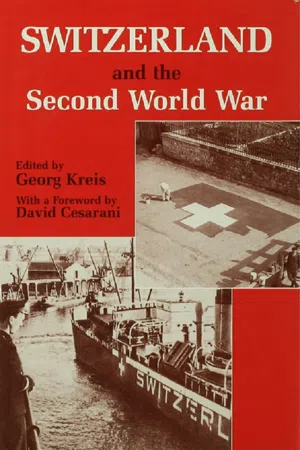
Switzerland and the Second World War
About this book
This collection of essays sheds light on the history of Switzerland during World War II, covering such topics as: trade; financial relations; gold; refugees; defence; and foreign relations. It also touches on official post-war measures to suppress Switzerland's involvement in the war.
1
Foreign Trade and Swiss Politics, 1939–45
Introduction: ‘The Swiss Malaise’
In the March 1946 issue of the Schweizerische Monatshefte Ernst Speiser published an article entitled ‘Swiss–German Trade Relations during the War’. From the first sentence he conjures up the atmosphere that prevailed in Switzerland at that time: ‘“the Swiss malaise” has recently entered the language, though it is much more often encountered in public debates and in the press than in private conversation or discussions around the table in the pub’. As a director of Brown Boveri & Cie, Baden, Speiser held high office: from 1941 he was head of the War Office for Industry and Labour, and was an influential member of the Radical Party and of the Swiss Parliament from 1943. He noted what he called the ‘Swiss malaise’, mentioning among other aspects a sense of isolation from the rest of the world and doubts about the trade relations with the Axis during the war. To justify the Confederation’s attitude, he recalled the legal, political and diplomatic conditions governing foreign relations during the hostilities. He used statistics to paint a reassuring picture of Switzerland, minimising the country’s contribution to the German war effort. Calculating that those involved in exports to Germany represented only 2 or 3 per cent of the active population, he concluded that Switzerland had put up a successful military and economic resistance to Nazi and fascist aggression: far from admitting a sense of guilt, Switzerland should be proud of the part it had played during the war.
The statistics provided by Speiser are open to question.1 However, this oft-quoted article says much about the climate that prevailed in Switzerland at the end of the war: having been spared the destruction and atrocities endured by other nations, Switzerland had to justify the activities and attitudes of which it was accused, both internally and, more especially, beyond its borders. As we know, the controversies prompted by these criticisms would rapidly give way to the tensions caused by the Cold War. However, the malaise described by Speiser did exist, and was probably responsible for a number of studies of foreign relations compiled by lawyers or economists.2 These works, with a wealth of significant statistical and administrative information, provide us with a better understanding of the legal and institutional traditions existing in Switzerland during the Second World War. In many cases, the authors of these works were, like Speiser, witnesses to or participants in the events.3 They describe and justify the measures prompted by the war economy, the effects of the Allied blockade and the Axis counter-blockade, and the rights and obligations of a neutral state in wartime economic relations.
Summary of Existing Knowledge
We know that the publication of documents taken from the German archives provoked reaction in Switzerland. At first, during the 1950s, it was the country’s attitude to refugees, and later the policy of neutrality, that prompted the writing of the historical studies now referred to as the Ludwig and Bonjour reports.4
During the 1970s, additional research and debate was prompted by foreign trade relations. In 1970 the former director of the Swiss Union of Trade and Industry (SUTI, Vorort), Heinrich Homberger, published a very interesting work containing explanations of the agreements negotiated and ‘summaries of the events that took place’.5
Swiss publications of the post-war period generally tend to offer explanations of the ‘Swiss miracle’, or to paint a picture of a small country at the mercy of the great powers, which nevertheless succeeds in resisting and defending its independence. These arguments can be understood insofar as these works were written by Swiss participants in the events of a dramatic period which left a deep mark on those who lived through it. However, after the 1970s, historical research both in Switzerland and abroad has tended to retouch this Swiss self-portrait. A degree of distance and a ‘longer-term’ perspective have tended to modify the image previously created, which shaped the national identity.
In 1970, in an article based on the German archives,6 Jean-Claude Favez wrote that in the ‘spring of 1943 Switzerland thus occupied a relatively important place in the concerns of the Nazi leaders, for strategic and, above all, economic reasons’. On two occasions Hitler himself intervened as a spokesman for moderation, damping the enthusiasm of those who advocated a trade war against Switzerland. The Führer took the side of those who recommended avoiding confrontation with a country that supplied specialised products essential to the war effort, financed its own exports and allowed goods exchanged between the Axis partners to pass through its territory.
From that time a different image of Switzerland began to become apparent, as something more than just a negligible factor at the mercy of an omnipotent dictatorship. Additional information was published in the thesis of Daniel Bourgeois, which was also based on German sources.7 Without claiming that economic factors alone determined the bilateral relationship, Bourgeois’ work is particularly notable for providing unpublished statistics and analyses; he shows that, in some cases, Switzerland was deliberately humoured by the Nazi leaders.8 Rather than resting on his laurels, Bourgeois continued as he had begun and followed up his thesis with a number of landmark articles.9 In 1974 he devoted a major article to the activities of business circles in the foreign policy arena, especially at the audience granted by Hitler to Schulthess in 1937, and at the time of the debates regarding recognition of Italian sovereignty over Abyssinia, the ‘Manifesto of the 200’, the meetings with Nazis with a view to moderating the tone of the Swiss press, and also at the time of the organisation of the mission to the eastern front in 1941. In all these cases, there were close links between political considerations and economic motivations.10 The debates triggered by these publications demonstrated the need for deeper research into the industrial and banking trump cards available to Switzerland.
Vogler’s thesis describes the development of negotiations between Germany and Switzerland in 1940 and 1941:
Admittedly, the shipments of raw materials to Germany were of central importance. They persuaded Germany to fall in with what the Swiss wanted. But it was only the large credits – a high proportion of which, in turn, was used to finance those very raw materials – that ultimately enabled Switzerland to supply the armaments required, keep Germany at arm’s length and assuage its hunger for goods and foreign currency.11
We know that at the end of the war Germany’s credit line exceeded 1 billion Swiss francs. This was a substantial sum for the Swiss economy (the domestic product at that time being estimated at about 10 billion) and for Nazi Germany.
Among the neutral trading partners, the completely uncompromising Switzerland always figured as Germany’s most important source of credit … At 31 December 1944, the clearing deficit to the neutral states of Europe amounted to RM 762.645 million. Of this sum, Switzerland accounted for RM 685.0 million, Spain RM 108.2 million, Sweden RM 38.1 million and Portugal RM 8.1 million.12
Research carried out in Germany shows the changes in various industrial and financial factors that prompted the Nazi leaders to handle Switzerland gently at various periods during the war.13 Thus, having studied German–Swiss economic relations from 1914 to 1945, Feldenkirchen reaches the following conclusion: ‘Germany, therefore, frequently endeavoured to use Switzerland as an instrument of its economic policy, a move against which Switzerland was able to defend itself only occasionally and with varying success. However, its industrial capacities and German dependence on Swiss capital enabled Switzerland – small as its share of German foreign trade was in statistical terms – to become a central focus of German foreign trade policy at critical periods.’14
Four Problematic Questions
Economic Neutrality
Research by historians such as Bourgeois and Urner15 has shown that Switzerland’s economic activities caused greater problems than contemporary publications might suggest: the decisions to prohibit exports of war material, then to allow them in September 1939 and then to prohibit them again in the autumn of 1944 can be understood in the light of arguments of national defence, experience of the previous war and diplomatic pressure or intervention. It must be conceded that the authorities acted more pragmatically than heroically. Despite the repeated assertion of the principle of do ut des (give and take), the hard facts of the relative strengths meant unequal concessions, to the detriment of the Confederation.16
Similarly, Urner soft-pedals the assertions of respect for economic neutrality. After all, the concept itself is a problematical one and not clearly characteristic of the activities of the various Swiss protagonists. As Georg Kreis noted in 1977, ‘Switzerland’s trade relations have hitherto been considered from the specifically Swiss standpoint of whether Switzerland could defend her sovereignty and her policy of neutrality. Consequently, the question of the effects of Swiss trade policy has been neglected.’17
Escape from Invasion
Debate has also focused on the conditions that enabled Switzerland to escape invasion. J. Tanner stresses the close conjunction between foreign trade relations and national defence:
The relatively high density of foreign trade networks in wartime and the military and economic defence of the country were related in two ways: first, exports to belligerent states, especially the Axis powers whose share of Swiss exports rose after 1939, were a factor liable to increase Germany’s interest in maintaining the status quo in its relations with Switzerland … Secondly, the implementation both of the Réduit concept and of the Wahlen plan was to a large extent dependent on the Swiss economy’s position in the foreign trade network. This situation was never analysed as a problem by the country’s political and military leaders. By contrast, authorities responsible for the war economy, who had to deal with the specific operational problems, made repeated references to it.18
Federal Government Intervention in Business
As Jean-François Bergier wrote, ‘The war compelled the Confederation to intervene in business life.’19 The organisation of the war economy tightened the close collaboration between senior officials and the employers. The management and day-to-day surveillance of foreign trade called for a number of administrative structures. For important negotiations, delegations representing the circles concerned were appointed by the Federal Council. As the months went by, the ‘permanent economic delegation’ became the critical nucleus: a triumvirate comprising the director of the Commercial Division of the Department of Public Economy, Jean Hotz; the director of the SUTI, Homberger; and the Political Department’s specialist in financial matters, Robert Kohli, supervised international negotiations. Exceptionally important decisions were discussed by them with the competent federal councillors. Within the government, a ‘delegation for economic and financial affairs’ brought together the three heads of the Political (Foreign Ministry), Public Economy, Finance and Customs Departments to study the problems.20
When the most far-reaching decisions had to be taken, these individuals met at crucial meetings, for which minutes rarely exist. It is all the more interesting, therefore, to study the minutes of the meeting of 21 June 1940, which adopted measures whose impact on industrial activities and federal finances would be considerable.21
Although the level of federal government intervention in business remained moderate, it did involve an overlap of activities. For historical researchers, therefore, inspection of the public archives makes it possible to acquire information on trade and on the discussions and activities that took place on both sides.
The Post-War Economy
From 1943 onwards the prospect of the post-war period gave rise to new ideas among the employers, who were preparing for crises of reconversion, whereas in fact they were on the verge of a long period of expansion.22 Inter...
Table of contents
- Cover
- Half Title
- Title Page
- Copyright
- Contents
- Foreword
- Preface
- Notes on Contributors
- Introduction: Four Debates and Little Dissent
- 1. Foreign Trade and Swiss Politics, 1939–45
- 2. Switzerland’s International Financial Relations, 1931–50
- 3. German Gold – Allied Gold, 1940–45
- 4. Unclaimed Assets of Nazi Victims in Switzerland: What People Knew and What Else They Ought to Know
- 5. Swiss Refugee Policy, 1933–45
- 6. Investigating ‘Anti-Semitism’?: On the Concept and Function of ‘Anti-Semitism’ and Problems Involved in Research
- 7. Pilet-Golaz and the Making of Swiss Foreign Policy: Some Remarks
- 8. ‘Neither this Way nor any Other’: Swiss Internationalism during the Second World War
- 9. The Military National Defence, 1939–45
- 10. Political and Humanitarian Resistance in Switzerland, 1939–45
- 11. ‘Spiritual National Defence’ in the 1930s: Swiss Political Culture between the Wars
- 12. Swiss Memory of the Second World War in the immediate Post-War Period, 1945–48
- 13. The 1946 National Public Opinion Survey as a Democratic Challenge
- 14. Governmental Malaise with History: From the White Paper to the Bonjour Report
- 15. Lest We Forget. Switzerland and the Second World War: The Sources
- 16. On the Role of the ‘Swiss Independent Expert Commission on the Second World War’
- Postscript
- Index
Trusted by 375,005 students
Access to over 1.5 million titles for a fair monthly price.
Study more efficiently using our study tools.
Frequently asked questions
Yes, you can cancel anytime from the Subscription tab in your account settings on the Perlego website. Your subscription will stay active until the end of your current billing period. Learn how to cancel your subscription
No, books cannot be downloaded as external files, such as PDFs, for use outside of Perlego. However, you can download books within the Perlego app for offline reading on mobile or tablet. Learn how to download books offline
Perlego offers two plans: Essential and Complete
- Essential is ideal for learners and professionals who enjoy exploring a wide range of subjects. Access the Essential Library with 800,000+ trusted titles and best-sellers across business, personal growth, and the humanities. Includes unlimited reading time and Standard Read Aloud voice.
- Complete: Perfect for advanced learners and researchers needing full, unrestricted access. Unlock 1.5M+ books across hundreds of subjects, including academic and specialized titles. The Complete Plan also includes advanced features like Premium Read Aloud and Research Assistant.
We are an online textbook subscription service, where you can get access to an entire online library for less than the price of a single book per month. With over 1.5 million books across 990+ topics, we’ve got you covered! Learn about our mission
Look out for the read-aloud symbol on your next book to see if you can listen to it. The read-aloud tool reads text aloud for you, highlighting the text as it is being read. You can pause it, speed it up and slow it down. Learn more about Read Aloud
Yes! You can use the Perlego app on both iOS and Android devices to read anytime, anywhere — even offline. Perfect for commutes or when you’re on the go.
Please note we cannot support devices running on iOS 13 and Android 7 or earlier. Learn more about using the app
Please note we cannot support devices running on iOS 13 and Android 7 or earlier. Learn more about using the app
Yes, you can access Switzerland and the Second World War by Georg Kreis in PDF and/or ePUB format, as well as other popular books in History & Economic History. We have over 1.5 million books available in our catalogue for you to explore.