- 320 pages
- English
- ePUB (mobile friendly)
- Available on iOS & Android
eBook - ePub
About this book
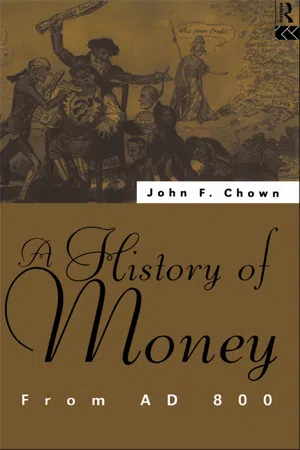
This book presents a detailed and surprising history of money from Charlemagne's reform in approximately AD800 to the end of the Silver Wars in 1896. It also summarizes twentieth century developments and places them in their historical context.
1
INTRODUCTION
Since 1914 the world has been bedevilled by inflation, depression, devaluation, unstable exchange rates and other ‘diseases of money’. In 1923–4 hyperinflation wiped out the currencies of Germany, Hungary, Poland and Russia. Greece went the same way in 1944, and Hungary (again) in 1946. The depression of the 1930s had, some would argue, led directly to the Second World War. In the 1970s, nearly all countries suffered from double digit inflation or worse.
The proposals for European Monetary Union produced some unexpected turns: this is a saga which will run and run. Proud and prosperous Germany ran into economic problems from which they thought they were exempt. Who would have thought that Germany’s inflation rate would exceed that of France? This happened because of a serious technical error in setting the terms of the monetary union between the two Germanies (in 1990, following the collapse of East Germany) which had its perhaps inevitable repercussions in 1992 with the expensive partial collapse of the Exchange Rate Mechanism (ERM). The president of the Bundesbank, asked to comment on the rate chosen, said ‘it was a political decision’, and he was not being polite. The ERM was again in serious difficulty in the summer of 1993.
It would be unfair, unrealistic and narrow to blame all our ills on, and give all the credit for our prosperous times to, the failure or success of monetary management. No one can really understand the history of this century, or hope to prescribe for the problems of the next, without some understanding of how money and its management can affect, and affect profoundly, broader, economic, political and social affairs. The successful statesman, businessman, investor or trader sees this crisis, that stock market boom, the other free fall or rise in the dollar or the oil price in perspective. He knows what has happened before and can better judge what can happen this time than those who, ignorant of the past, are condemned to repeat its mistakes.
Even those who make it their business to remember last time and who are familiar with what happened in 1929, are tempted to believe that there was, before 1914, a golden age of the gold standard when prices were stable, employment was full and the intending traveller could pull down from his father’s bookshelf a dusty but still accurate ready reckoner which told him how many francs, marks, or lire he would receive for his pounds or his dollars. There was such a golden age, but it had lasted for all of eighteen years, since 1896. Economists, and those whose business it is to comment on, or react to, economic affairs, have to understand money. History helps a great deal. This book is not so much a history for economists as an economist’s view of history. Rather to his surprise the author discovered how many of the world’s apparently modern problems have their precedents in the past.
THE PLAN OF THE BOOK
The book has been divided into three main sections, which to some extent overlap chronologically. Part I deals with coinage, and Part II with banking and credit as it developed to supplement what was basically a gold, silver or bimetallic standard. Part III deals with experiments, beginning (in the West) in 1720 with the type of inconvertible paper money we have today.
The main story in this book begins in about 800 AD when Charlemagne reintroduced silver money to the West with the concepts of pounds, shillings and pence. The history of coinage actually begins in about 800 BC when the first coins were struck from electrum, a naturally occurring alloy of silver and gold, bearing the sign of a half lion as a guarantee of their weight.
The history of money goes back even further. Primitive societies must soon have found the need to progress from simple barter such as ‘two horses for that field’ to finding the need for a standard item which could be used as a medium of exchange to facilitate triangular or more complex barters or in some cases, more subtly, simply as a unit of account by which values could be compared without the unit of money necessarily changing hands. Mrs Quiggin (1949) describes the wide range of expedients adopted by primitive societies in her book Primitive Money, a labour of love which she began to write when she was already 70 years old. Only one society, that of the Incas of Peru, appears to have developed an organised civilisation without the invention of money (Hemming: 1970).
Eventually, societies developed the idea of coined metal. Its natural advantages tended to supplant rival forms of money, and a sophisticated monetary economy developed in the ancient world. It is quite clear, from even a cursory reading of the sources, that many of the problems and events we shall discuss had their parallels in earlier centuries. I can offer only a tantalising glance at a few of these earlier events. There were certainly monetary crises under Solon of Athens, Cleopatra of Egypt and the Emperor Nero which seem, from a brief study, just as interesting as the later ones we shall be studying.
During the early period, money meant coins. Charlemagne divided a pound weight of silver into 240 deniers or pennies, and this efficient and sound system was imposed on the territories he conquered. Various English kingdoms (which were to be united in 973) were never conquered, but chose to adopt the system. Later, though, it was England alone who preserved the Carolingian system with only modest, but technically interesting, depreciations for many centuries. In the rest of Europe, the coinage became very sick indeed (not long after the death of Charlemagne) and soon all that circulated were grubby pieces of base metal with just a taint of silver. On the Continent, sound money had effectively to be reinvented to meet the needs of the dramatic revival of trade in the thirteenth century. At this stage, the Italian city states become the main centre of interest.
The whole mechanism of government-induced inflation, which we now associate with ‘turning on the printing press’, can be seen at work within the framework of a simple silver coinage. The Navy has always argued that even for those whose destiny is to navigate a nuclear submarine, there is no training like sail training. Get back to first principles, learn to face the elements with few mechanical aids and you really will understand the weather and what going to sea in ships is all about. Really understanding how money works in a ‘simple’ system with only one type of money—silver coins—is remarkably illuminating and greatly helps to put modern monetary theory into perspective. The principles are discussed in Chapter 2 and the history, to about 1250, in Chapter 3.
The reintroduction of gold coins alongside the silver created a new set of problems, those associated with foreign exchange and ‘money of account’. The sophistication of the money markets proves to have been quite remarkable: after the end of the fourteenth century no really original type of foreign exchange instrument or problem remained to be invented.
The commercial revolution of the thirteenth and fourteenth centuries also involved the development of credit instruments and the early beginnings of means of payment not involving metal coins. During this period there was a battle between the Church, which wanted to stamp out usury, and the merchants, who needed to borrow money on terms which gave both an acceptable rate of interest to the lender while leaving a margin of profit to the borrower. The story has many of the features of the battle between those who invent tax loopholes and those who draw up anti-avoidance legislation and has its modern applications in the concepts of Islamic banking. Fortunately, the Arabs could still exploit loopholes that the Christians closed centuries ago. This is discussed at the beginning of Part II.
Generally, though, the emphasis would still remain on coined money for a few more centuries. Henry VIII’s Great Debasement produced a rate of inflation in England which was to remain unsurpassed until the days of Harold Wilson. The idea that a gold standard ensures price stability was proven false at about this time. South American gold discoveries forced major price rises throughout Europe; and, incidentally, ruined the Spanish economy. Some of the problems of the coinage were settled, in what was by then the United Kingdom, in 1696 after a major public discussion involving men as eminent as the philosopher John Locke and the most distinguished Master the mint has ever had—Isaac Newton.
Banks and bank notes
By this time the role of gold and silver were already being supplemented by banks and bank notes, again discussed in Part II. These new inventions very soon had their own excesses, in parallel but rather different events. The South Sea Bubble in the United Kingdom and the activities of John Law in France both came to a head in 1720 and are, with the Dutch tulip mania, the original models of financial booms and busts. These events set back the development of paper money for half a century, although banks and financial instruments continued to grow apace. In some ways the mid-eighteenth century was perhaps another short golden age with few financial crises, but a lot of very intelligent philosophising about economic theory. Sound metal currencies caused few problems, while alternatives were quietly developing.
This period ended in 1776, the year of publication of The Wealth of Nations and of the American revolution. Much of the Part III material, on inconvertible paper currencies has its origins here. Both the American and the French revolutions were largely financed by the issue of paper money which subsequently became worthless. As a direct result of the Napoleonic wars and the ‘suspension of payments’ of 1797 the United Kingdom, too, developed a paper currency inconvertible into gold or silver, but, unlike the other two cases, eventually restored to its full value. These three parallel but very contrasting stories represent the birth of the system of paper money and banking as we know them. It is also a classic period of debate and pamphleteering on monetary theory, focused largely on the Bullion Report of 1810.
Nineteenth century developments
The United Kingdom then began the attempt to develop an adequate system of bank and credit regulation (back to Part II). The Bank Charter Act of 1844, was preceded and followed by a series of financial crises as the country learnt to master the system.
The United States was by now an economically important nation in its own right, and provides an excellent case study of the problems of creating a monetary system in a newly emerging independent country. It had its own financial crises which related to, but did not always parallel, those in the United Kingdom and the rest of Europe. There is the story of the attempts to set up a Bank of the United States and the conflict between its head, Nicholas Biddle, and President Andrew Jackson. The Bank Wars soured the American political attitude to banking, and explain what can seem to Europeans the parochialism and backwardness of American retail banking.
At this time, the 1830s, small private note issuing banks formed under State law were, to mix similes, springing up like mushrooms and dying off like flies. The concepts both of free banking and ‘deposit insurance’ in the form of the ‘safety fund’ have their origins in this period. These events proved to be inadequately covered in the general literature, and a study of contemporary sources has proved particularly rewarding.
During the American Civil War, there was another attempt at printing press finance in the form of the greenbacks: the different histories of the winning and losing sides both have their lessons. After that war, American monetary history is very well covered in the modern literature, and indeed the United States began to develop its role as the world’s leading financial power.
Silver, gold, exchange rates and monetary unions
Although the emphasis seemed by now to have switched to banking and paper money, the problems of gold and silver became a major monetary issue in the late nineteenth century: indeed the last few chapters of Part I cover this highly instructive period. The problems of bimetallism go back to medieval Italy. There is no law of nature that says an ounce of gold must at all times be worth exactly fifteen times as much as an ounce of silver although this was broadly true for a very long period, including much of the nineteenth century.
Early in the nineteenth century the United Kingdom had introduced a formal gold standard, using silver only as a subsidiary coinage, while British India operated a silver standard. Some countries, notably France and the United States, attempted a bi-metallic standard: both gold and silver were legal tender and were exchangeable into each other at a legally determined rate of exchange. This worked fine so long as the ratio did not vary too much.
Indeed, as with the Bretton Woods system of fixed exchange rates, the system could itself absorb and take in its stride quite substantial fluctuations. Neither system could, by its nature, deal with a material change in the fundamental equilibrium: in this case when the relative price of silver collapsed. It is a period of monetary history usually buried in obscurity, but has again become particularly topical. Bimetallism itself raises all the problems of fixed versus floating exchange rates. Whatever arguments, good and bad, which have come up in the post war period prove already to have been deployed, probably at far greater length, by some nineteenth century pamphleteer.
Even more topical was the closely related subject of the Latin Monetary Union and the abortive attempts to create a universal world currency in the mid- nineteenth century. This was preceded by more local monetary unions between the multitude of small states which now form Germany and Italy and between the cantons of Switzerland. There are good precedents both for European Monetary Union and for the problems of the Eastern European countries returning to a market economy.
A natural, although arbitrary ending to the main part of the book comes with William Jennings Bryan, his unsuccessful 1896 Presidential campaign and his famous ‘cross of gold’ speech. This was a final but doomed attempt to preserve the central monetary role of silver. There is a final chapter giving a quick overview of the twentieth century, a period already covered adequately in the literature.
Note Chapter 2 sets out some fairly abstract economic concepts in what is intended to be a reasonably digestible form. It is by way of being an introduction to Part I, and those reading the book as part of an economics course, or with some background knowledge of the subject, should certainly begin with it. Other readers may prefer to omit Chapter 2 for the moment, returning to it only when they have read the more narrative treatment in the rest of Part I.
Part I
MONEY AS COIN
2
SOME CONCEPTS OF MONEY
INTRODUCTION
Coin struck from precious metals such as gold or silver was the earliest form of organised money. Only much later was this to be supplemented or replaced by bank notes, bank deposits and other means of payment or stores of value. Part I of this book discusses the history of coin, and shows how many apparently modern problems of monetary theory have their roots in a simple coinage system. This chapter discusses the specific analytical points, which are then illustrated in later chapters in Part I.
It costs money to manufacture coins from silver or gold, and the mint authority charges a turn (usually including a profit) known as ‘seigniorage’. Issuers can cheat, and make an extra profit by debasing the coinage. If this is detected, as it usually is, the public may value coins ‘in specie’ (i.e. by their bullion content) rather than ‘in tale’ (their official legal value). The purchasing power of coins may change without any debasement; the value in trade of the coinage metal itself may change. The monetary system may be threatened by clipping and counterfeiting and, even if rulers and citizens are scrupulously honest, the coinage has to contend with fair wear and tear.
All these factors are relevant even with a simple coinage system based on a single metal, usually silver but sometimes gold, and are discussed in the first part of the chapter. There are further complications when two or three metals circulate side by side. Moneys of account and ghost moneys mean that the monetary historian must study the exact meaning of the data very carefully indeed. Bimetallism has been one of the great subjects for debate, persisting into the late nineteenth century long after the development of modern banking. There were corresponding small change problems, while Gresham’s Law, properly understood, helps make sense of it all.
Seigniorage
A coin was, in concept, simply a piece of precious metal (usually gold or silver) the weight and fineness of which was guaranteed by the ruler whose name, portrait or symbol was stamped on the coin. The ruler might have been be a king or queen as in England or Scotland, a duke or count of one of the many small independent states which made up Germany or Italy, an ecclesiastical authority, bishop or abbot, or an Italian city state. In France both the king himself and his feudal underlings had coinage rights.
In principle, and for a long period of history, a mint operated on the basis of a laundry. Private citizens would bring...
Table of contents
- COVER PAGE
- TITLE PAGE
- COPYRIGHT PAGE
- A HISTORY OF MONEY
- LIST OF TABLES
- FOREWORD
- 1: INTRODUCTION
- PART I: MONEY AS COIN
- PART II: THE DEVELOPMENT OF CREDIT AND BANKING
- PART III: INCONVERTIBLE PAPER MONEY
- NOTES
- BIBLIOGRAPHY AND BIBLIOGRAPHICAL NOTES
Trusted by 375,005 students
Access to over 1.5 million titles for a fair monthly price.
Study more efficiently using our study tools.
Frequently asked questions
Yes, you can cancel anytime from the Subscription tab in your account settings on the Perlego website. Your subscription will stay active until the end of your current billing period. Learn how to cancel your subscription
No, books cannot be downloaded as external files, such as PDFs, for use outside of Perlego. However, you can download books within the Perlego app for offline reading on mobile or tablet. Learn how to download books offline
Perlego offers two plans: Essential and Complete
- Essential is ideal for learners and professionals who enjoy exploring a wide range of subjects. Access the Essential Library with 800,000+ trusted titles and best-sellers across business, personal growth, and the humanities. Includes unlimited reading time and Standard Read Aloud voice.
- Complete: Perfect for advanced learners and researchers needing full, unrestricted access. Unlock 1.5M+ books across hundreds of subjects, including academic and specialized titles. The Complete Plan also includes advanced features like Premium Read Aloud and Research Assistant.
We are an online textbook subscription service, where you can get access to an entire online library for less than the price of a single book per month. With over 1.5 million books across 990+ topics, we’ve got you covered! Learn about our mission
Look out for the read-aloud symbol on your next book to see if you can listen to it. The read-aloud tool reads text aloud for you, highlighting the text as it is being read. You can pause it, speed it up and slow it down. Learn more about Read Aloud
Yes! You can use the Perlego app on both iOS and Android devices to read anytime, anywhere — even offline. Perfect for commutes or when you’re on the go.
Please note we cannot support devices running on iOS 13 and Android 7 or earlier. Learn more about using the app
Please note we cannot support devices running on iOS 13 and Android 7 or earlier. Learn more about using the app
Yes, you can access A History of Money by John F Chown in PDF and/or ePUB format, as well as other popular books in Economics & Business General. We have over 1.5 million books available in our catalogue for you to explore.