Demystifying the Law: An Introduction for Professionals explains unfamiliar legal concepts in interesting contexts, thus helping you to understand and remember them. It illustrates legal principles using simple examples that anyone can understand. No single book can turn you into a lawyer, but this one can help you decide when you need a lawyer's assistance and help you ask intelligent questions of your lawyer. It can even help keep you out of situations requiring a lawyer. Part I tells you where our laws come from and how they are applied in the court system. Part II explains the role in law of the executive branch of government, including quasi-legislative and quasi-judicial activities, judicial review, and technicalities and terms. Part III covers several specific legal issues, including civil procedure, criminal law concepts, burden of proof, the "reasonable person" concept, breach of duty, personal and product liability, and malpractice. It also gives brief introductions to contracts, insurance law, workers' compensation, property law, environmental law, water law, and other legal matters. Every professional should own this valuable resource! Ideal for both personal and business use. Appendices include how to find legal citations and extracts from the federal rules of civil procedure.
- 176 pages
- English
- ePUB (mobile friendly)
- Available on iOS & Android
eBook - ePub
PART I
The American Legal System
THE ROLE OF LAW IN SOCIETY
All societies and cultures that anthropologists have studied have laws. Obviously, then, laws do not have to be written; they can be merely understood and passed down from generation to generation as “tradition.” The classic example of this in our culture, of course, is the Ten Commandments.
Law, then, is nothing more than the system that is used for regulating the relationships between individuals or groups of individuals in a given culture. There is nothing in the term that implies that the rules that are used will be “fair,” “just,” or “equitable.” This concept can be illuminated by the analogy, “law is to justice as medicine is to health.” This means that if all people were healthy there would be no need for the profession of medicine, for doctors, or for anything to aid the sick, because there would be no sick people. Similarly, if we lived in an entirely just society, there would be no reason to have laws or lawyers. However, we do not live in a just society, any more than we are all healthy. Therefore there is a very major need for law and lawyers to organize the affairs of society so that we do not go out and kill one another randomly.
This is not to say, of course, that one cannot hope that, as time goes on, the laws in our society will not become more “just” or “equitable”; certainly we all hope that. Nevertheless, achieving justice or equity is not the aim or role of law. The aim and role of law is to regulate and order the relationships among people and organizations.
1
Sources of American Law
There are four major sources of U.S. law. These are the Constitution of the United States and, of course, of the individual states; treaties made by the U.S. government with foreign countries; statutes passed by Congress or the state legislatures; and court decisions.
1.1 THE CONSTITUTION
The Constitution of the United States is “the supreme law of the land.” It is on this basis that statutes, both federal and state, can be declared “unconstitutional” by the courts. If they contradict the Constitution and the Constitution is the “supreme law of the land,” then, obviously, the statutes are invalid because they are in violation of the supreme law. The Constitution, of course, like treaties and statutes, is nothing but a set of words on paper; the words have no intrinsic meaning, and we only learn how these words shall be interpreted when we look at court decisions, which tell us what the Constitution means in individual cases.
1.2 TREATIES
Treaties made between the United States and other countries are, according to the Constitution, also part of the law of the land. Treaties are negotiated between the executive branch (the President, Secretary of State, etc.) and foreign governments, and then ratified by the U.S. Senate.
Under the treaty power of the Constitution, the federal government can do things that it cannot do under other powers of the Constitution. For example, duck (and other migratory bird) hunting is regulated by the federal government pursuant to the treaty of 1916 between the United States and Great Britain (on behalf of Canada) called the Migratory Bird Treaty. This treaty was especially negotiated by the government in order to evade a ruling handed down several years earlier, which held that the federal government did not have the authority to control the hunting of migratory birds and that this was an exclusive power of the states.1 By negotiating a treaty regarding migratory birds, Congress managed to acquire the power to regulate their hunting or, at least, so said the Supreme Court when it decided the issue.2 In this way, the treaty power is, to some extent, superior to the normal legislative powers of the Congress.
1.3 STATUTES
Federal statutes, of course, are bills enacted by the House of Representatives and the Senate, and then signed by the President. State statutes work the same way, i.e., they are passed by the legislature of a state and signed by the governor thereof.
Under the Constitution the federal government has only “limited” statutory power. Limited in the last sentence was put in quotes because, although this is the theoretical statement, in practice the federal government’s power to pass statutes appears virtually unlimited. The broadest of the powers of the federal government is to “regulate commerce with foreign Nations and among the several States” the socalled commerce clause. Under this clause the powers of the federal government are extremely broad; it is pursuant to these powers, for example, that the Clean Air Act; the Water Pollution Act; the Food, Drug and Cosmetic Act; the pesticide laws; and all other environmental statutes were passed.
The full extent of the commerce clause today has never been delineated. The most expansive reading to date is in the Supreme Court’s decision upholding the equal accommodations section of the Civil Rights Act of 1964. In order to give this act the broadest possible reach, Congress passed it pursuant to the commerce clause, not pursuant to some other section, as one might expect. The case upholding this statute was Katzenbach v. McClung, which held that the United States could bring action against “Big Ollie” McClung’s Barbecue in Birmingham, Alabama, a very small business that had a minimal number of employees and, in fact, did not even buy its meat or vegetables in interstate commerce. The Supreme Court upheld the regulation of “Big Ollie’s” Barbecue on the grounds that (1) although Big Ollie had not bought the food in interstate commerce, his supplier had, and (2) the business was located 11 blocks off of a U.S. highway and therefore travelers who were in interstate travel might end up at “Big Ollie’s” seeking food. On this basis, the Supreme Court held that Big Ollie could not refuse to serve blacks.3
1.4 COURT DECISIONS
The Constitution, treaties, and statutes are all, as mentioned above, simply words on paper. The interpretation of these words in “real world” situations is the role of courts. One of the great non sequiturs of recent political discourse was a statement allegedly made by Barry Goldwater when he was running for President in 1964: “I do not want a Supreme Court which interprets the Constitution, I want a Supreme Court that simply reads what is there.”4 This is a meaningless statement. If you look in the dictionary you will find that read and interpret are synonymous; it is impossible to do one without doing the other. What Goldwater meant, of course, was something along the lines of “I want a Supreme Court that interprets the Constitution in the same way that I interpret the Constitution,” a perfectly valid and rational statement.
Another classic example of the need to consult court decisions in order to understand what words mean is presented by the First Amendment to the U.S. Constitution, which says, in part, “Congress shall make no law restricting … freedom of speech or of the press.” Notice that this says nothing about “except in cases of obscenity,” “except in cases of pornography,” “except in cases of national security,” or “except in cases of sedition”; it says “Congress shall make no law.” In fact, if one goes back and looks at Jefferson’s and Madison’s papers, letters, and diaries it becomes obvious that when they wrote “Congress shall make no law” they meant exactly that — Congress shall make no law. However, it has never been interpreted that way. As early as 1798, the courts upheld the Alien and Sedition Acts, which clearly, by any rational reading, put some limitations on freedom of speech and the press.5
Thus, in order to really understand what a statute, treaty, or the Constitution means, it is necessary to examine the court decisions that have interpreted that writing.
REFERENCES
- 1. U.S. v. McCullagh, 221 Fed. Rep. 288 (1912).
- 2. Missouri v. Holland, 252 U.S. 416 (1920).
- 3. 379 U.S. 294 (1964).
- 4. Allegedly, because Rovere, The Goldwater Caper, p. 50 (1965) is the closest to it I have ever found.
- 5. See Gobel, History of the Supreme Court of the U.S.: Antecedents and Beginnings to 1801, pp. 633—654 (1971).
2
The Structure of the Court System
Courts, as we discussed above, are very important, as they tell us what the words in the statute, treaty, or Constitution mean. Therefore, we shall now take a look at the basic outline of a court system.
Looking at Figures 2.1 and 2.2, one can see that the general outlines of the federal and state systems are very similar. Both, typically, have the four-tiered structure indicated. The federal system changed to the current form of this structure in 1924, and the states have, by now, almost all copied it.
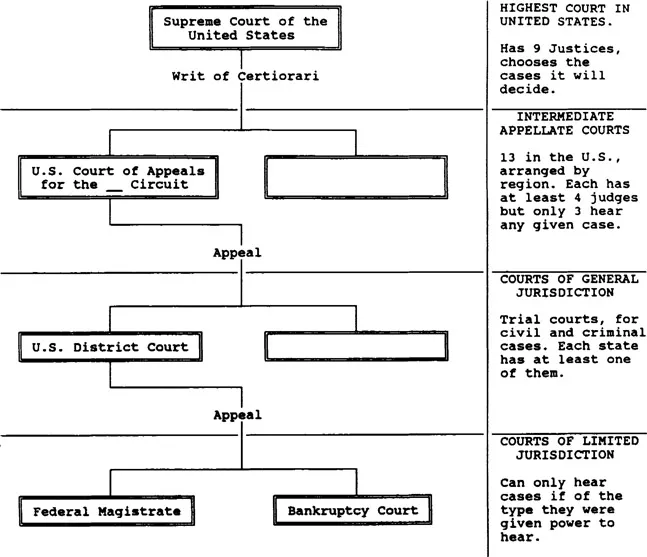
Figure 2.1 Federal courts.
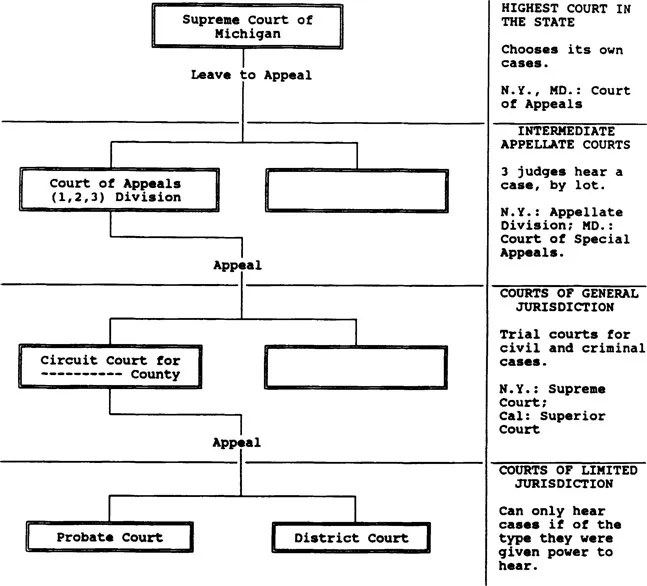
Figure 2.2 State courts (illustrated by Michigan).
2.1 COURTS OF LIMITED JURISDICTION
At the bottom of the ladder are the courts of limited jurisdiction. They are so called because they can only hear those cases that the legislature has given them power to hear. As they are at the bottom of the court structure, appeals are taken from them to the next level.
A bottom court in the federal system (Figure 2.1) is listed as the Federal Magistrate. Federal Magistrates can hear minor federal criminal cases, probable cause hearings in major federal criminal cases, and can sit in for federal district judges if the parties agree to the substitution. The Federal Magistrates are not the only limited-jurisdiction federal court; the best known limited-jurisdiction federal court is Bankruptcy Court, which, as the name implies, has power to hear only bankruptcy cases.
At the bottom of the state system, and here we are using Michigan as a typical system, is the District Court. District Court hears minor criminal cases and also has small claims jurisdiction in civil cases. It is not the only limited-jurisdiction state court; in the Michigan system, as in most states, there is also a court that has power only over estates and trusts, probate of wills, juvenile criminal cases, and the fate of people who are alleged to be mentally incompetent (Probate Court). Other states recognize their courts of limited jurisdiction by other titles.
2.2 COURTS OF GENERAL JURISDICTION
This is the next level of court above courts of limited jurisdiction. Courts of general jurisdiction are so called that because they have all the powers that a court may have. In other words, there are no limits placed on the types of cases they can hear, the amount of money they can award, or their right to issue injunctions.
In the vast majority of states, the court of general jurisdiction is called the Circuit Court. This goes back to the time in the early 1800s when judges, lawyers, and the court personnel literally rode the circuit. Those who have read Sandberg’s biography of Abraham Lincoln will remember long discussions about “riding the circuit.” What occurred was that lawyers, court personnel, and the judge would travel as a group to a county seat and decide all the cases that had arisen in that county since the court was last held there. Then they would move to the next county on the circuit and hold court there, etc.; and they would cover all the counties in a circuit in a certain amount of time. Thus this is the general jurisdiction court name in the vast ma...
Table of contents
- Cover
- Title Page
- Copyright Page
- Dedication Page
- Introduction
- Contents
- PART I The American Legal System The Role of Law in Society
- PART II Administrative Law and Judicial Review
- PART III Some Specific Legal Issues
- Appendix A How to Find It — The Basics of Legal Citation
- Appendix B Extracts from the Federal Rules of Civil Procedure
- Index
Trusted by 375,005 students
Access to over 1.5 million titles for a fair monthly price.
Study more efficiently using our study tools.
Frequently asked questions
Yes, you can cancel anytime from the Subscription tab in your account settings on the Perlego website. Your subscription will stay active until the end of your current billing period. Learn how to cancel your subscription
No, books cannot be downloaded as external files, such as PDFs, for use outside of Perlego. However, you can download books within the Perlego app for offline reading on mobile or tablet. Learn how to download books offline
Perlego offers two plans: Essential and Complete
- Essential is ideal for learners and professionals who enjoy exploring a wide range of subjects. Access the Essential Library with 800,000+ trusted titles and best-sellers across business, personal growth, and the humanities. Includes unlimited reading time and Standard Read Aloud voice.
- Complete: Perfect for advanced learners and researchers needing full, unrestricted access. Unlock 1.5M+ books across hundreds of subjects, including academic and specialized titles. The Complete Plan also includes advanced features like Premium Read Aloud and Research Assistant.
We are an online textbook subscription service, where you can get access to an entire online library for less than the price of a single book per month. With over 1.5 million books across 990+ topics, we’ve got you covered! Learn about our mission
Look out for the read-aloud symbol on your next book to see if you can listen to it. The read-aloud tool reads text aloud for you, highlighting the text as it is being read. You can pause it, speed it up and slow it down. Learn more about Read Aloud
Yes! You can use the Perlego app on both iOS and Android devices to read anytime, anywhere — even offline. Perfect for commutes or when you’re on the go.
Please note we cannot support devices running on iOS 13 and Android 7 or earlier. Learn more about using the app
Please note we cannot support devices running on iOS 13 and Android 7 or earlier. Learn more about using the app
Yes, you can access Demystifying the Law by Daniel A. Bronstein in PDF and/or ePUB format, as well as other popular books in Law & Administrative Law. We have over 1.5 million books available in our catalogue for you to explore.