- 256 pages
- English
- ePUB (mobile friendly)
- Available on iOS & Android
eBook - ePub
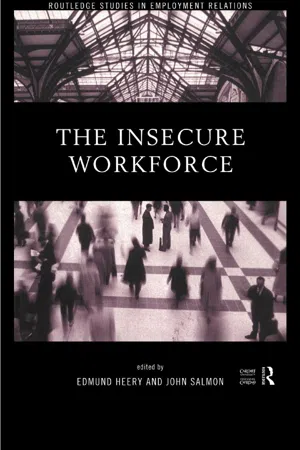
The Insecure Workforce
About this book
For the past two decades employment in Britain has been marked by a search for greater flexibility in the availability and use of labour. In recent years, however, there has been mounting concern at the costs of this trend and an appreciation that the consequence of a flexible labour market may be an insecure workforce, vulnerable to exploitation.
1 The Insecurity Thesis
Edmund Heery and John Salmon
Introduction
Unease about the direction of labour market change pervades a wide range of opinion today and it is now commonplace for the workforce of the developed economies to be described as increasingly insecure. This view is global in scope and embraces international agencies and commentators in a range of countries (Barker and Christensen 1998; OECD 1997; Standing 1997) and is apparent across a spectrum of interests which, in Britain, includes government (DTI 1998:13), policy makers (Fabian Society 1996; IER 1996), trade unions (TUC 1996) and management organisations (IPD 1996). For some, we live in an ‘age of insecurity’ (Elliott and Atkinson 1998; cf. Beck 1992) and risk and instability have become defining features of contemporary social life. Underlying this viewpoint is a coherent set of statements about the nature, causes and effects of recent change in employment relations which can be labelled the ‘insecurity thesis’. This thesis informs a great deal of contemporary debate and commentary and includes amongst its key propositions: that economic risk is being transferred increasingly from employers to employees, through shortened job tenure and contingent employment and remuneration; that insecurity is damaging to long-term economic performance, through its promotion of an employment relationship founded on opportunism, mistrust and low commitment; and that the emergence of an insecure workforce imposes severe costs on both individuals and the wider society. These and associated claims constitute a deeply critical assessment of current labour market change, and adherents of the thesis have proposed a variety of radical reforms to reverse or mitigate the perceived slide towards insecure employment.
The purpose of this collection is to interrogate the insecurity thesis. Contributors from a range of academic disciplines, economics, sociology, psychology, social policy, management and industrial relations, have been brought together and have been asked to review the question of the insecure workforce from the perspective of their own field. The contributors encompass a variety of opinion and, while some subscribe to the insecurity thesis, other reactions range from mild to marked scepticism. In each case, however, they have been asked to summarise available research evidence in order to shed light on a series of questions which are more commonly the subject of assertion than empirical review. Their essays deal largely with four such questions: first, how can insecurity be defined and the insecure workforce be measured; second, what evidence is there that the insecure workforce is growing both in Britain and in other developed economies; third, to the extent that insecurity has grown, what are its causes; and fourth, what are the consequences of insecurity in the workplace and beyond? There has been a rough division of labour between the essays with the earlier contributions focusing more on the first pair of questions and the later contributions concentrating on the second pair; the collection has been conceived as a progression which extends outwards from the employment relationship to embrace a wider range of social experience as it proceeds.
Thus, the early chapters by Robinson, Gregg et al. and Turnbull and Wass examine change in the structure of jobs, and address the question of whether there has been an ‘objective’ rise in insecurity in Britain over the past two decades. They are followed by chapters by Morgan et al. and Purcell which deal, respectively, with the specific experiences of public sector workers and gender differences with regard to insecure employment. Guest and Heery and Abbott then consider the responses of managers and trade unions to the issue of insecurity. The collection ends with contributions from Nolan et al. and Walker which move beyond the world of work and which look, in turn, at the impact of insecure employment on personal well-being and family relationships and patterns of housing consumption.
The purpose of this introductory essay is to provide a general framework for interpreting the more specialised chapters which follow. It seeks to do this, in the first instance, by providing a stylised account of the insecurity thesis and its key propositions, as set out principally in recent British and American texts on employment change. It then considers critical responses to the thesis, which tend either to dispute its empirical validity or to accept the latter but offer a competing evaluation under the rubric of labour market flexibility. Finally, it reviews the main issues which have arisen in the emerging debate between adherents and critics of the insecurity thesis.
The insecurity thesis
One attraction of the insecurity thesis as a social theory is its breadth of coverage and the fact that it seeks to connect developments in the world of work with changes beyond. At its heart, however, is a basic claim about the changing nature of employment in developed economies, as follows:
Proposition One: Employment in the developed economies has become more insecure or unstable in the sense that both continued employment and the level of remuneration have become less predictable and contingent on factors which lie beyond the employee’s control.
Cappelli et al. (1997:4) characterise this shift in terms of a movement from a dominant pattern in which internal labour markets shielded workers from market forces, to ‘a new employment relationship where pressures from product and labor markets are brought inside the organisation and used to mediate the relationship between workers and management’. At its most severe, this switch might be seen in the end of permanent, career-long employment and its replacement with contingent contracts and mobile workers. The measures of ‘insecurity (or job instability, as it is sometimes called) which have been adduced to support this first proposition are various but include: a decline in median job tenure for at least some categories of employee since the mid-1980s (Gregg et al., this volume): an increase in involuntary job separations due to greater resort by employers to redundancy (Turnbull and Wass, this volume); and a growth in the use of various forms of contingent labour, such as temporary workers, fixed-term contract stall, agency labour and freelancers (Appelbaum 1989; Allen and Henry 1997: Cappelli 1995; Purcell, this volume). Some have also remarked on the increased use of contingent remuneration and a trend towards greater use of ‘variable pay’, in which base salary is replaced by performance-linked cash payments which are neither consolidated nor pensionable (Cappelli et al. 1997:189 93: Heery 1996: Morgan et al. this volume).
While the insecurity thesis is rooted in a claim about the changing nature of jobs, it is also argued that changes beyond the workplace have served to compound insecurity:
Proposition Two: The trend towards insecure employment has been compounded by changes in the external labour market and national systems of employment regulation which serve to exacerbate insecurity.
These wider changes are believed to have assumed two forms. First, developments in labour markets have raised the costs of job loss and so not only have the risks of job separation increased but the impact of such an event has tended to become-more severe. Thus, the OECD (1997:147) presents an analysis for nine EU countries which reveals that the difficulty in finding replacement work has risen since the early 1980s, even when the effects of the economic cycle are taken into account. The OECD also notes that earnings when a new job is found may besubstantially lower than in the previous job, and there is evidence from both Britain and the USA that this difference is substantial and enduring (Farber 1993: Gregg et al., this volume) and may be increasing (OECD 1997:119). Second, the deregulation of the labour market and the weakening or removal of institutions designed to protect employees are believed to have further contributed to insecurity. Key developments in Britain include changes in the benefit system which have ‘increased the pressure on men, in particular, to accept flexible jobs’ (Dex and McCulloch 1997:9), the attenuation of individual employment rights under the Conservatives and most notably the increase in the qualifying period for the right not to be unfairly dismissed, from six months to two years (Robinson, this volume), and the severe and continuing decline in trade union density and coverage by collective bargaining (Cully and Woodland 1998; Milner 1995).
These ‘objective’ changes in the structure of jobs and pattern of labour market regulation are believed to have stimulated a ‘subjective’ response from employees and the development of the insecurity thesis has been based in part on longitudinal survey data which point to rising popular concern with job s ecurity:
Proposition Three: Employees increasingly regard themselves as insecure and the issue of job insecurity has become more salient in recent years.
Thus, the OECD (1997:131, 134–5) reports a threefold increase in media references to insecurity in the G7 economies between 1982 and 1996 and an increase in ‘perceived employee insecurity’ in the 1990s ‘in all OECD countries for which data are available’. Guest (this volume; see also Gallie et al. 1998:112) points out, however, that it is important to draw a distinction between the cognitive dimension of people’s attitudes, such as a perception of the probability of job loss, and the affective dimension, understood in terms of feelings of concern and anxiety. A strong statement of the insecurity thesis would suggest that along both dimensions employee attitudes are changing; that employees increasingly calculate that their jobs are insecure and that this is a source of concern.
A decline in the level of job security over time is the central claim of the insecurity thesis, but it is also argued that the distribution of insecure work is changing. In particular, adherents of the thesis have suggested that previously secure groups are either faced with greater job instability, or have come to regard their situation as more insecure:
Proposition Four: The incidence of both job instability and feelings of insecurity is changing and previously secure groups are now finding themselves in a precarious position.
Among the groups identified as in transition from a more to a less secure status are: middle managers under threat from corporate delayering (Cappelli et al. 1997:68–9; Hendry and Jenkins 1997); public service professionals, who have experienced an increase in the incidence of redundancy and contingent contracts (Keep and Sisson 1992; Morgan et al., this volume); older workers, who have suffered a particularly sharp decline in job tenure and a more acute penalty for job loss (Gregg et al., this volume); and male workers, for whom the rising incidence of part-time work is indicative of a more general threat to their breadwinner role (Gallie et al. 1998:151; Purcell, this volume; Rubery 1996:26). Each of these categories may on average continue to enjoy higher security than non-management employees, private sector workers, younger workers and women, but it is asserted that their relative position is becoming less favourable.
Supporters of the insecurity thesis have identified a number of causes, but are united in two claims: they regard the rise in insecurity as a secular trend and not a temporary or cyclical phenomenon, and they trace its origins to the actions of employers and governments, and downplay the free choices of employees. (Cappelli et al. (1997:206, 208–10), for instance, in their review of change in the American workplace, talk of a permanent shift in the nature of the employment relationship and state that this has been largely imposed on employees, who have borne the costs of structural adjustment. The explanations which are favoured by adherents of the insecurity thesis tend to fall into two categories, one of which places emphasis on the process of globalisation and the exposure of domestic markets to more intense competition (Standing 1997), while the other focuses on national institutions and identifies insecurity as a phenomenon of ‘Anglo-Saxon’ capitalism, with its active market for corporate control and systems of corporate financing and governance which accord priority to shareholder value in the shorter term (Dore 1997; Hutton 1995):
Proposition Five: The increase in workforce insecurity can be traced either to the globalisation of the world economy and resultant pressure for cost reduction within national economies, or to national systems of capitalism which promote the dominance of financial interests and the short-term management of company assets in the interest of ‘shareholder value’.
The globalisation argument is often linked to the claim that the international capitalist economy is entering a new stage of development Standing (1997:1 1) refers to the ‘era of market regulation’—at the heart of which is a new international model of management characterised by the identification of ‘core-competencies’ and the use of market relationships to provide all operations and services which fall outside of this narrowly defined circle (Cappelli et al. 1997:43 4). The argument from corporate financing and governance, in contrast, emphasises the differential experience across national capitalist economies and leaves room also for national systems of labour market regulation to either accentuate or moderate pressures for insecurity. A recent review of part-time work in Europe, for instance, has explained different national patterns in terms of variation in systems of corporate governance and the strategies of labour use which they engender and the strength of weakness of protective employment legislation (Wickham 1997).
With regard to the effects of insecurity adherents of the thesis tend to emphasise a series of perverse consequences which rebound againts employers.1 While acknowledging the immediate benefits which can accrue to companies in terms of reduced costs. greater flexibility and worker compliance. they argue that a more insecure worklorce is problematic for employers in several important respects. Indeed, this argument is encountered repeatedly and amongst sociologists and industrial relations specialists has become an almost routine accompaniment to discussion of workplace change. At its core is a belief that new forms of employment are altering the ‘psychological contract at work. such that the latter has come to resemble ‘a spot market where workers are encouraged to focus on their immediate self-interest and employers promise to do the same’ (Cappelli et al. 1997:11; see also Beynon 1997:38; Brown 1997:83).2 Specific disadvantages which are believed to How from this kind of employment relationship include: low levels of employee commitment and an unwillingness to work ‘beyond contract’; encouragement of opportumstic behaviour and the use In employes of their available bargaining power to maximise immediate wage returns; high transaction ...
Table of contents
- Cover Page
- Title Page
- Copyright Page
- List of Figures and Tables
- The Contributors
- Preface
- 1. The Insecurity Thesis
- 2. Insecurity and the Flexible Workforce: Measuring the Ill-Defined
- 3. Heaven Knows I’m Miserable Now: Job Insecurity In the British Labour Market
- 4. Redundancy and the Paradox of Job Insecurity
- 5. Employment Insecurity In the Public Services
- 6. Gendered Employment Insecurity?
- 7. Management and the Insecure Workforce: The Search for a New Psychological Contract
- 8. Trade Unions and the Insecure Workforce
- 9. Job Insecurity, Psychological Well-Being and Family Life
- 10. Insecurity and Housing Consumption
Trusted by 375,005 students
Access to over 1.5 million titles for a fair monthly price.
Study more efficiently using our study tools.
Frequently asked questions
Yes, you can cancel anytime from the Subscription tab in your account settings on the Perlego website. Your subscription will stay active until the end of your current billing period. Learn how to cancel your subscription
No, books cannot be downloaded as external files, such as PDFs, for use outside of Perlego. However, you can download books within the Perlego app for offline reading on mobile or tablet. Learn how to download books offline
Perlego offers two plans: Essential and Complete
- Essential is ideal for learners and professionals who enjoy exploring a wide range of subjects. Access the Essential Library with 800,000+ trusted titles and best-sellers across business, personal growth, and the humanities. Includes unlimited reading time and Standard Read Aloud voice.
- Complete: Perfect for advanced learners and researchers needing full, unrestricted access. Unlock 1.5M+ books across hundreds of subjects, including academic and specialized titles. The Complete Plan also includes advanced features like Premium Read Aloud and Research Assistant.
We are an online textbook subscription service, where you can get access to an entire online library for less than the price of a single book per month. With over 1.5 million books across 990+ topics, we’ve got you covered! Learn about our mission
Look out for the read-aloud symbol on your next book to see if you can listen to it. The read-aloud tool reads text aloud for you, highlighting the text as it is being read. You can pause it, speed it up and slow it down. Learn more about Read Aloud
Yes! You can use the Perlego app on both iOS and Android devices to read anytime, anywhere — even offline. Perfect for commutes or when you’re on the go.
Please note we cannot support devices running on iOS 13 and Android 7 or earlier. Learn more about using the app
Please note we cannot support devices running on iOS 13 and Android 7 or earlier. Learn more about using the app
Yes, you can access The Insecure Workforce by Edmund Heery,Professor Edmund Heery,John Salmon in PDF and/or ePUB format, as well as other popular books in Business & Business General. We have over 1.5 million books available in our catalogue for you to explore.