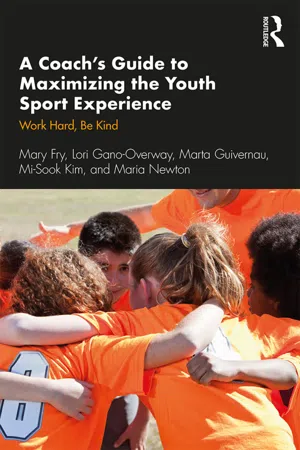
A Coach’s Guide to Maximizing the Youth Sport Experience
Work Hard, Be Kind
- 210 pages
- English
- ePUB (mobile friendly)
- Available on iOS & Android
A Coach’s Guide to Maximizing the Youth Sport Experience
Work Hard, Be Kind
About this book
This book guides sport coaches, parents and administrators in creating a caring and task-involving sport climate that helps athletes perform their best and have an enjoyable and meaningful sport experience. It introduces the concept of a caring and task-involving climate and provides a "how to" guide to creating this climate in sport.
Firstly, this guide introduces the caring and task-involving climate and summarizes research highlighting its many benefits. Secondly, the five features of this climate are presented along with the reflective exercises for developing them within a team. Coaches will see strategies in action, sample conversations, and a variety of ways to implement the features of a caring and task-involving experience. By describing how it may be implemented and methods for overcoming possible challenges, this book finally highlights how parents and sport administrators can support the creation and preservation of caring and task-involving climates.
By helping teams develop caring climates that optimize athletes' sport experience and performance, this book is essential reading for coaches, sport administrators, parents, and sport psychology practitioners. It will also be of great interest to those who have minimal training in sport psychology, but who are involved in sport at many levels, such as youth and high school.
Frequently asked questions
- Essential is ideal for learners and professionals who enjoy exploring a wide range of subjects. Access the Essential Library with 800,000+ trusted titles and best-sellers across business, personal growth, and the humanities. Includes unlimited reading time and Standard Read Aloud voice.
- Complete: Perfect for advanced learners and researchers needing full, unrestricted access. Unlock 1.4M+ books across hundreds of subjects, including academic and specialized titles. The Complete Plan also includes advanced features like Premium Read Aloud and Research Assistant.
Please note we cannot support devices running on iOS 13 and Android 7 or earlier. Learn more about using the app.
Information
1
A Caring and Task-Involving Climate
The Key to Maximizing Sport Performance and Experience
Highlights
- Coaches play a major role in helping their athletes reach their potential.
- When coaches help athletes define success based on their effort and improvement, athletes reap many physical, mental, and emotional benefits.
- Coaches are key players in creating a caring and task-involving climate on their teams that trickles down and sets the state for great sport experiences.
I was one of those kids that participated in every sport imaginable and as a result I’ve had many coaches over the years. It is interesting to realize, good or bad, all of them had a tremendous impact on me. I recall Chuck who coached my community softball team when I was 12. He was a ‘man’s man’ – a big muscular guy with a bushy mustache. I would ride my bike as fast as I could to practice because he treated us like we were the San Francisco Giants. For those 2 hours we were his universe. Practices were planned out to the minute and every single drill was focused on effort and improvement. Every dropped ball (and there were plenty) was an opportunity to learn and improve. Every player – both good and bad – got all of Chuck’s attention and expertise. All of us – a pretty ragged bunch I imagine – were his Giants and he treated us with so much respect that to this day I still stand a little straighter and am proud of that team. I went on to receive some of the ‘best’ coaching in the United States and I can say that nobody ever quite lived up to the caring and task-involving climate that Chuck created. I think it just goes to show that coaches matter at every level and at the heart of good coaching is the coaching climate.Maria Newton
My first career goal was to become a female coach that would express care for female runners, and understand how the body changes their experience during puberty. As a competitive runner, I had only experienced ego-involving coaches who were only focused on my performance. Then one day Coach Kim came into my life; he was a coach who cared about all athletes and had their best interests in mind. He tried to look at things from his athletes’ perspective and it made such a difference. He motivated the team to be the best student-athletes we could be, and he helped us thrive in both school and sport. He not only coached us in our sport but also helped us become the best people we could be.Mi-Sook Kim
My dad was the main force behind me being active and participating in sports. He taught me to ski when I was 6, took my sister and me skating, swimming but most of all, he got us into hiking in the Pyrenees. He taught me endurance, pacing myself, persistence and to keep going beyond what I thought I could do. It was never about how high we could go but about completing the journey together. In school, it is not my coaches I recall most but my teammates. Thinking back though, I know my experience was ingrained by the atmosphere those coaches infused. My days were full of gymnastics, relays, basketball but also hours of unstructured play, dodgeball, jump rope and improvising games. The connections we built with each other last to this day. It was not until college that I realized that not everyone had a positive experience in sport and that success was often defined by being the best instead of being our best together. I was lucky to land at the Sport Psych program at Purdue, with great people that became best friends and a mentor who taught us about task-involving climates. Since then, I have been fortunate to work and learn from athletes and coaches to focus on helping reflect sports as they were for me when I was young.Marta Guivernau Rojas
I really lucked out in middle school and high school in that I had coaches who cared about me as a person and motivated me to do my best. My Dad reinforced this notion that you always work hard and try to make yourself better. However, when I went to college, I learned that not all of my teammates and classmates had the same experience with coaches. They were yelled at for not performing well, pitted against one another, and did not have a good relationship with their coaches. These experiences made me realize that coaches really make a difference in the lives of athletes.Lori Gano-Overway
When I graduated from college I was fortunate to walk right into a premium job as a tennis coach at a large school district in Texas. Whew, what a learning experience that was as I (the lone coach) began coaching the boys and girls’ teams (over 50 athletes) with full fall and spring schedules. My goal was to help bring out the best in every athlete I coached, and I realized quickly that such an aim was tougher to deliver than I expected. As I look back now, I realize that I somehow instinctively knew that the keys to maximizing the sport experience for my athletes were directly tied to encouraging high effort; giving instructional feedback and noticing improvement; creating a team bond where all athletes felt connected; and deeply caring about each athlete on the team. I’m not sure how I knew this … maybe it was because I had parents and siblings who reinforced these concepts throughout my life, or some good coaches along the way that helped me internalize these views.Mary Fry
Introduction to Nicholls’ Motivation Theory Applied to Sport
| Nicholl’s Motivation Theory Applied to Sport |
| • Children’s Understanding of Sport Ability • Athletes’ Personal Definitions of Success (Goal Orientations) • Athletes’ Perceptions of Their Team Environment |
Young Athletes’ Understanding of Sport Ability
Athletes’ Development of Their Personal Definitions of Success
Table of contents
- Cover
- Half Title
- Title Page
- Copyright Page
- Dedication
- Contents
- Preface
- PART I Introduction
- PART II Features of a Caring and Task-Involving Climate in Sport
- PART III Special Considerations in Creating a Caring and Task-Involving Climate in Sport
- PART IV Conclusion
- Acknowledgments
- Index