eBook - ePub
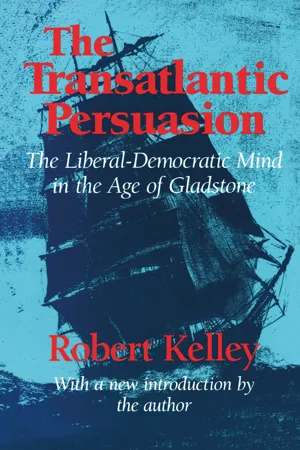
The Transatlantic Persuasion
Liberal-Democratic Mind in the Age of Gladstone
- 486 pages
- English
- ePUB (mobile friendly)
- Available on iOS & Android
eBook - ePub
About this book
This pioneering work is the basic and largely unmatched study of the single transatlantic community of thought shared by nineteenth century British and Canadian Liberals and American Democrats. The result of more than ten years of comparative research, The Transatlantic Persuasion explores the roots of those ideas that comprise a coherent Liberal-Democratic worldview: ideas about society, human relations, the economy, equality, liberty, the ethnocultural dimension of life, the proper role and nature of government and the world community.
PART I
Chapter 1
__________________
THE SETTING: ECONOMIC BOOM, MINORITY GROUPS, AND RELIGIOSITY
The Democratic Party in the United States, and the Liberal parties in Britain and Canada, were born in the Age of Jackson and Peel. This is the period, comprising the decades from the 1820’s to the 1850’s, when throughout the Anglo-Ameri-can world the first great surge of reform took place, and the outlines of subsequent politics began to appear. As the followers of Andrew Jackson formed the core of the emerging Democratic Party, so those inspired by Robert Peel became, somewhat later in the period, the leadership of the Liberal Party. These were the decades in which democracy fully emerged in the United States, and in which the struggle over the Reform Bill of 1832 ushered in middle-class voting in Britain and the power of public opinion over British governments. Humanitarian reforms in the prisons, the schools, and the factories were points of vigorous controversy, and two great domestic struggles—the Bank War in the United States and the Repeal of the Corn Laws in Britain—largely shaped the nature of politics for decades thereafter. Canada was similarly caught up in the beginning struggles over democratic reform in these years, highlighted by the Rebellion of 1837, which laid the basis for subsequent Canadian politics—despite the fact that this “first great democratic upheaval” in Canada, as Frank Underhill has written, was a failure. What followed thereafter grew as much out of this failure as it would have out of success.1
All of this took place within a remarkably interactive Anglo-American community. Men and ideas passed back and forth across the Atlantic with notable facility as reformers of many persuasions drew inspiration from one another.2 It also took place in the presence of a great economic boom after 1815, which persisted for many decades, despite periodic depressions. All relationships, institutions, and mental attitudes were reshaped as the rigid economic world inherited from the eighteenth century melted into the “fluid economics”—to use Vernon Parrington’s term—of these years. The prospect of swift rises in wealth and status unknown to former ages opened out before almost everyone. Men could achieve rapidly what would formerly have taken generations to accomplish. A risk psychology, buoyed up by optimism, suffused formerly conservative communities. Romanticism flourished in this effervescent atmosphere, stimulating the idea that common men were equal to the aristocracy. The great boom was in fact what gave substance to the ideals originally uttered in the Declaration of Independence.
The boom began in the swift growth in cotton production in the United States that followed the invention of the cotton gin in 1792. An explosive expansion took place in the British textile industry when these supplies of cheap raw cotton became available, and the whole process was stimulated by the cumulative influence of the transportation revolution of canals, railroads, and Atlantic steam vessels. This interchange rapidly swelled into a gigantic volume of commerce, so that there emerged, in place of the two separate economies, one British and the other American, a single, transatlantic economy. Enormous flows of capital, labor, enterprise, and technology moved westward from Britain to North America. Perhaps a third of the mining population of Cornwall, for example, emigrated to the United States to apply their legendary skills in hard-rock mining from Michigan to California and Arizona.
When I came to Cornwall just after the war I was astonished and excited by … the fact that almost every Cornish family had relatives in America. Cornish students … would reveal quite casually some surprising information; one, who was a bus conductor, had worked in Detroit; another, a housewife, had been to school in Michigan; a third apologised for being absent for a term as she was returning to Idaho to see the silver camp where she was born; and a fourth claimed that he was the cousin of Dead-wood Dick. To a Celt like myself from the other side of the border it was bewildering to live and work in a community that was half Cornish and half American in its outlook. One could talk to an old miner on a harbour wall and discover that he had never been to London but could describe quite clearly the streets and taverns of San Francisco. Some of the Cornish in the extreme west even spoke like Americans … [The Cornishmen had] pioneered the mining industry of America. No mine was ever without its Cornish captains and every mining company was keen to employ them, often to the disgust of their neighbouring Celts, the Irish … [In] every Cornish household for many years North America was an even more familiar name than England.3
For those people directly affected, the boom and the transportation revolution set the tone and shaped all the options of life, as shown in the experiences of William Gladstone, Samuel Tilden, and Alexander Mackenzie. Gladstone’s father prospered in the rising commerce of Liverpool, which flourished in the American trade. He had emigrated to the town as a poor Scotsman, made his first wealth in risky ventures in the American trade, and with unending energy rose to become one of the richest entrepreneurs in England. As a boy in the 1820’s, William Gladstone could look eastward a few miles from his father’s great home on the long sandy beach running out from Liverpool and see the thin halo of smoke drifting over the city.4 Soon the town was spreading, the Gladstone home was swallowed up by suburbs, and the thin wisp became a thick pall, joining the smoke rising from a thousand factory chimneys in Lancashire and the whole of the English North Country.5 The cotton boom and the later wheat boom sent hundreds of boats crowding into the Liverpool anchorages to discharge their bales and grain, and to take on finished textiles, iron and steel products, pottery, and a multitude of other goods to carry back to the States.
Across the Atlantic, in upstate New York, Samuel Tilden was spending his boyhood in a small village through which ran an emigrant road leading westward from New England. “I well remember in my childhood,” he later wrote, “seeing the endless procession of emigrants passing by day, and often encamping by night on the little green in front of the house where I was living.” He was always captivated by the vivid picture this early experience gave him of the great migration from Europe and the eastern states, passing westward through the Mohawk Valley to spread out in the far interior on the network of waterways, canals, and railroads that linked everything together.6 He was later to make millions in the railroad boom, rising to become perhaps the richest lawyer in the United States, and in the 1870’s the wealthiest man to run for the presidency since George Washington.
Alexander Mackenzie, also a boy in the 1820’s, grew up almost within sight of the North Sea in a quiet Highland Scottish town. He left his home during the depression of the 1840’s to find work building railroad bridges as a stonecutter in the busy west of Scotland—Glasgow and Liverpool shared much of the American trade—then took ship for Canada. He built stonework in the canals, and moved on with the tide to frontier western Ontario, where he prospered in the construction of public buildings in the new settlements.7 When he became Canada’s first Liberal Premier in the 1870’s, the transportation revolution was still underway. He was immediately caught up in the endless railroad problems that afflicted the Canadian government in these decades, for the railroads, in fact, made Canada possible.
During the transatlantic boom, Britain and America became much alike in certain respects. The kind of atmosphere traditionally remarked upon in the United States came into existence in the English North Country as well. Together with the factories and the large urban conglomerates—Manchester, Leeds, Birmingham, Sheffield—regarded with alarm by the landed aristocrats who governed the nation, there arose new attitudes as well. The North Country was industrial, bustling, aggressive, and oriented to the future in a way strange to British culture. It was also egalitarian and democratic. Walter Bagehot remarked in distaste that while Lancashire was sometimes called “America-and-water,” it was really “America and very little water…. [In] commerce, we question whether New York itself is more intensely eager than Liverpool—at any rate, it is difficult to conceive how it can be.” England at large was still not a businessman’s world, but in the North Country and in the west of Scotland the self-conscious new capitalist order of confident entrepreneurs was pushing itself forward. To the rural Tories, who disliked the new urban elements in British life, Manchester was almost an “alien colony, living on foreign produce, working up foreign materials, and exporting the produce of their labour to foreign parts.” They detested John Bright, the voice of the North Country. Looking to American equalitarianism in admiration —he lauded what he described as its free churches, free schools, free land, free votes, free careers open to all—and caustically attacking the rooted aristocracies that dominated British life, he was quite disrespectful of what Asa Briggs calls “the traditional deference structure of English society.” Even in personal style, North Countrymen and Scots seemed American. Justice Oliver Wendell Holmes met William Gladstone in 1866, and found him “to be … like an American. He came out to meet you and had gusto …” Walter Bagehot made the same point with disdain: “Underneath the scholastic polish of his Oxford education, [Mr. Gladstone] has the speculative hardihood, the eager industry of a Lancashire merchant.”8
The similarity between the United States and Britain went much beyond the introduction of a new openness and egalitarianism in British culture. It extended to the whole way of life. Long familiar has been Alexis de Tocqueville’s picture of the harried, terribly serious, rushing, dollar-conscious Jacksonian Americans with their inability to play, their indifference to learning and culture, and their impatience with anything that did not bear directly upon increasing profits. Common too is the description of the American who boasts about bigness, is in love with rising graphs, and forgets quality in a delirium of quantity. Fatal to his peace of mind, observers frequently have remarked, has been the American’s obsession with success,
But when the American intellectual, on his pilgrimage to the shrine, visited Britain, he was shocked to find there the same kind of world. The most recent researches into the life of the Victorians reveal that they lived a dynamic, free-wheeling life .9 A constant Victorian complaint was to remark wearily upon the ever increasing pace of things. The speed of transport and communication meant greater competition, more worry at missed opportunities. “If you want to see life,” one of Benjamin Disraeli’s characters in his novels remarks, “go to Staley-bridge or Bolton. There’s high pressure.” Only the Manchester bank, he said, had kept pace. “That’s a noble institution, full of commercial enterprises; understands the age, sire; high-pressure to the backbone.”
Victorians took great pride in themselves and in their material improvements. They had a simple delight in bigness and quantity—more people, longer railroads, more coal. There was a grueling pressure of work, pushed on not just by the opportunities of the boom but by a set of values that idealized work almost above all other virtues. People were grim, driven by care in the working classes, by a fear of failure in the business world. “The summum bonum for everyone not born into the aristocracy was success. To win the race of life, to outdistance your competitors, to reach the top and hold a position in which you gave the orders that others executed—this was the crowning glory.”1
In such an atmosphere, intellectual appetites, as in the United States, were dulled. Businessmen were proudly indifferent to education, advising their sons against going to Oxford or Cambridge and wasting their time. Speculation of any kind in matters not severely practical was frowned upon. Concrete action, the development of ent...
Table of contents
- Cover
- Half Title
- Title Page
- Copyright Page
- Dedication
- Table of Contents
- Introduction to the Transaction Edition
- Preface
- Introduction
- Part I
- Part II
- Part III
- Bibliography
- Index
Trusted by 375,005 students
Access to over 1.5 million titles for a fair monthly price.
Study more efficiently using our study tools.
Frequently asked questions
Yes, you can cancel anytime from the Subscription tab in your account settings on the Perlego website. Your subscription will stay active until the end of your current billing period. Learn how to cancel your subscription
No, books cannot be downloaded as external files, such as PDFs, for use outside of Perlego. However, you can download books within the Perlego app for offline reading on mobile or tablet. Learn how to download books offline
Perlego offers two plans: Essential and Complete
- Essential is ideal for learners and professionals who enjoy exploring a wide range of subjects. Access the Essential Library with 800,000+ trusted titles and best-sellers across business, personal growth, and the humanities. Includes unlimited reading time and Standard Read Aloud voice.
- Complete: Perfect for advanced learners and researchers needing full, unrestricted access. Unlock 1.5M+ books across hundreds of subjects, including academic and specialized titles. The Complete Plan also includes advanced features like Premium Read Aloud and Research Assistant.
We are an online textbook subscription service, where you can get access to an entire online library for less than the price of a single book per month. With over 1.5 million books across 990+ topics, we’ve got you covered! Learn about our mission
Look out for the read-aloud symbol on your next book to see if you can listen to it. The read-aloud tool reads text aloud for you, highlighting the text as it is being read. You can pause it, speed it up and slow it down. Learn more about Read Aloud
Yes! You can use the Perlego app on both iOS and Android devices to read anytime, anywhere — even offline. Perfect for commutes or when you’re on the go.
Please note we cannot support devices running on iOS 13 and Android 7 or earlier. Learn more about using the app
Please note we cannot support devices running on iOS 13 and Android 7 or earlier. Learn more about using the app
Yes, you can access The Transatlantic Persuasion by Robert Kelley in PDF and/or ePUB format, as well as other popular books in History & 19th Century History. We have over 1.5 million books available in our catalogue for you to explore.