- 240 pages
- English
- ePUB (mobile friendly)
- Available on iOS & Android
eBook - ePub
Gastroenterology
About this book
Combining the advantages of a color atlas with those of a short text, the authors provide systematic coverage of the diseases and disorders of the digestive tract. The book is filled with high quality color imaging and diagrams and includes the latest developments in investigation and management with special attention to refinements in endoscopy an
Information
CHAPTER 1
Gastroenterological problems
Elicit an accurate history Examine the patient
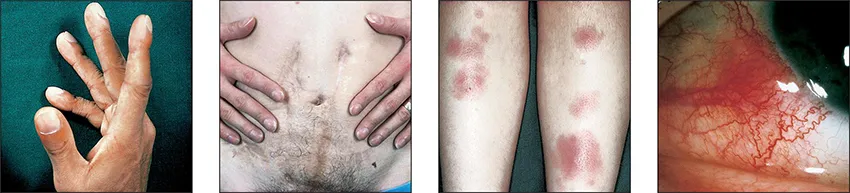
Gastroenterological disease can cause systemic symptoms
Systemic disease can cause gastroenterological symptoms
Introduction
Gastroenterological problems encompass the entire range of pathology, including neoplasm, infection, inflammation, immunological disorders, biochemical, metabolic and congenital conditions, and disorders of unknown cause. In addition, approximately one-third of the gastrointestinal symptoms of outpatients have no identifiable structural, infective, or biochemical disorder present – they appear as ‘functional disorders’. Within such disorders, psychological or social factors may be primarily responsible. Identification and correct management depends on accurate history taking, clinical examination, and specialist investigations.
Approach to the patient
Some cardinal symptoms focus attention on one particular organ, and dictate the most effective and economical investigational path. Be aware that some disease processes outside the abdomen may present with abdominal symptoms, and consider the patient as a whole.
Major presenting complaints
DIFFICULTY IN SWALLOWING (DYSPHAGIA)
Difficulty in transferring food from the mouth to the stomach is termed dysphagia. This is an important symptom and it is useful to distinguish between the two phases of the normal swallow. The initial oropharyngeal phase, during which a food bolus is moved from the mouth to the oesophagus, is under voluntary control. This is followed by the oesophageal phase, which is involuntary.
Difficulty in starting the swallow – oropharyngeal dysphagia
This relates to neurological or muscular diseases (bulbar, pseudobulbar palsy, motor neurone disease, myasthenia gravis). It is often associated with drooling due to difficulty in swallowing saliva, or aspiration of saliva and aspiration pneumonia. There may be associated problems with voice production.
Food sticking after swallowing has started – oesophageal dysphagia
This suggests the presence of a structural lesion in the oesophagus. Some patients can actually localize the level of food sticking, while others cannot.
The nature of food that elicits symptoms should be clarified. Dysphagia initially for liquids is more likely to reflect problems in muscular or neural control of swallowing. Dysphagia initially for solids is likely to reflect a structural lesion in the oesophagus. Progressive dysphagia, first for solids, then for sloppy food and liquids, is a sinister sign that is strongly suggestive of cancer of the oesophagus, although this can occur with peptic strictures from recurrent oesophagitis.
Nonprogressive dysphagia may suggest a benign structural lesion (e.g. mucosal web in upper oesophagus, benign ‘ring’ in lower oesophagus). Intermittent food sticking, affecting both solids and liquids, suggests disordered motility (achalasia, oesophageal spasm).
With any oesophageal obstruction, regurgitation of food and liquid into the mouth may occur. The fluid is bland and not bitter, as it does not contain gastric acid. Nocturnal regurgitation may be associated with choking, aspiration, pneumonia, or asthma.
Lump in throat (globus hystericus or globus sensation)
During stress, highly anxious individuals may complain of a sensation of a lump in the throat without having eaten or drunk, often with temporary inability to swallow. This is a temporary functional disorder associated with anxiety. It is more common in women and, although investigations are frequently normal, it is sometimes associated with other oesophageal conditions (reflux disease and motility disorders). Gastropharyngeal reflux accounts for the symptoms in some.
LOSS OF APPETITE
This is highly nonspecific, but may be functional if associated with anxiety or depression. When associated with weight loss, it suggests significant organic disease. A maintained appetite is a reassuring sign that serious disease is less likely to be found. Early satiety (initial hunger but a rapid feeling of fullness after commencing eating) may reflect a poorly distensible stomach or a motility disorder.
NAUSEA AND VOMITING
These are nonspecific symptoms. In young men, morning nausea and retching without vomiting strongly suggests alcoholism. In young women, morning nausea suggests pregnancy. Nausea occurs with many abdominal pains, particularly those reflecting spasm of smooth muscle. Examples include an obstructed biliary tract, or spasm of the colon in functional bowel disease. Vomiting is a more significant disturbance involving reverse peristalsis and expulsion of gastric contents. It is rare as a purely functional disorder, although in a few patients ‘hysterical vomiting’ is the final diagnosis, generally reflecting severe family stress. More often, vomiting reflects organic disease affecting the stomach, duodenum, or small intestine.
Short-lived vomiting with fever and diarrhoea suggests food poisoning (bacteria, bacterial toxins, viral gastroenteritis).
Prolonged vomiting over more than a few days needs further investigation. In the absence of pain, persistent vomiting suggests obstruction of the outflow tract of the stomach, as seen with antral carcinoma or narrowing of the pylorus due to long-standing duodenal ulceration.
The nature of vomitus may be significant. Vomiting food ingested many hours previously suggests obstruction of the gastric outlet, as the stomach normally empties within 4–6 hr of eating. Vomiting of blood is discussed below.
Vomiting must be distinguished from regurgitation (food returning to mouth from gullet without reverse peristalsis), and from waterbrash (the mouth filled with salty water due to excess saliva, sometimes a symptom of peptic ulceration).
Both vomiting and nausea can reflect events elsewhere in the body (e.g. raised intracranial pressure, severe metabolic complications such as renal failure, side effects of drugs). Prolonged vomiting can induce metabolic changes, for example hypokalaemic alkalosis and secondary potassium loss from the kidneys.
PAIN
This is the most common reason for referral to gastroenterologists. Classic symptom complexes are sometimes recognizable, but some pains are poorly characterized and localized. The site and radiation of pain should be defined, and its duration (minutes or hours) noted. Pain character should also be noted – is the pain sharp, dull, or intermittent? Periodicity details should be noted – whether pain occurs all day, occasionally but every day, or every day for some weeks and then not at all for some months, is important diagnosticall...
Table of contents
- Cover
- Title Page
- Copyright Page
- Table of Contents
- Preface
- Acknowledgements
- Contributors
- Abbreviations
- Chapter 1 Gastroenterological problems
- Chapter 2 Mouth and pharynx
- Chapter 3 Oesophagus
- Chapter 4 Stomach and duodenum
- Chapter 5 Jejunum and ileum
- Chapter 6 Pancreas
- Chapter 7 Biliary conditions
- Chapter 8 Colonic disease
- Chapter 9 Gastrointestinal bleeding
- Chapter 10 Miscellaneous conditions
- Appendix
- Index
Trusted by 375,005 students
Access to over 1.5 million titles for a fair monthly price.
Study more efficiently using our study tools.
Frequently asked questions
Yes, you can cancel anytime from the Subscription tab in your account settings on the Perlego website. Your subscription will stay active until the end of your current billing period. Learn how to cancel your subscription
No, books cannot be downloaded as external files, such as PDFs, for use outside of Perlego. However, you can download books within the Perlego app for offline reading on mobile or tablet. Learn how to download books offline
Perlego offers two plans: Essential and Complete
- Essential is ideal for learners and professionals who enjoy exploring a wide range of subjects. Access the Essential Library with 800,000+ trusted titles and best-sellers across business, personal growth, and the humanities. Includes unlimited reading time and Standard Read Aloud voice.
- Complete: Perfect for advanced learners and researchers needing full, unrestricted access. Unlock 1.5M+ books across hundreds of subjects, including academic and specialized titles. The Complete Plan also includes advanced features like Premium Read Aloud and Research Assistant.
We are an online textbook subscription service, where you can get access to an entire online library for less than the price of a single book per month. With over 1.5 million books across 990+ topics, we’ve got you covered! Learn about our mission
Look out for the read-aloud symbol on your next book to see if you can listen to it. The read-aloud tool reads text aloud for you, highlighting the text as it is being read. You can pause it, speed it up and slow it down. Learn more about Read Aloud
Yes! You can use the Perlego app on both iOS and Android devices to read anytime, anywhere — even offline. Perfect for commutes or when you’re on the go.
Please note we cannot support devices running on iOS 13 and Android 7 or earlier. Learn more about using the app
Please note we cannot support devices running on iOS 13 and Android 7 or earlier. Learn more about using the app
Yes, you can access Gastroenterology by Ralph Boulton,Claire Cousins,Sanjeev Gupta,Humphrey Hodgson in PDF and/or ePUB format, as well as other popular books in Medicine & Gastroenterology & Hepatology. We have over 1.5 million books available in our catalogue for you to explore.