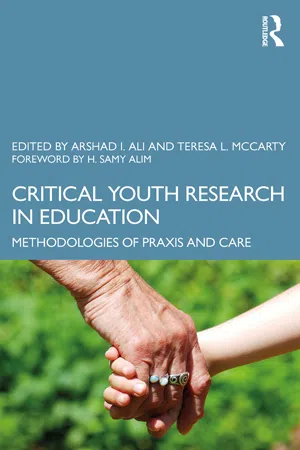
Critical studies of youth play an increasingly important role in educational research. This volume adds to that ongoing conversation by addressing the methodological lessons learned from key scholars in the field. With a focus on "the doing" of critical youth studies in ways that center praxis and relational care in work with youth and their communities, the volume showcases scholars discussing their research and reflecting on the practical strategies they have used to operationalize their conceptions of knowledge in youth-centered research projects. Each chapter addresses the research features, challenges, tensions, and debates of the project; engagement with communities; and relationality, reciprocity, and responsibility to participants. The focus throughout is on qualitative approaches that are humanizing, anti-colonial, and transformative.
eBook - ePub
Critical Youth Research in Education
Methodologies of Praxis and Care
- 280 pages
- English
- ePUB (mobile friendly)
- Available on iOS & Android
eBook - ePub
Critical Youth Research in Education
Methodologies of Praxis and Care
About this book
Information
PART I
Designing Critical Youth Research
1
Centering Critical Youth Research Methodologies of Praxis and Care
In 2014, youth researchers Awad Ibrahim and Shirley Steinberg set out to “name a new field in youth studies: Critical Youth Studies (CYS)” (Ibrahim, 2014, p. xvi). Although a significant body of scholarship under the CYS rubric existed in 2014, Ibrahim and Steinberg invited new conversations among youth workers, teachers, academics, and youth, reaching “across disciplines and contexts to bring out those who wish a critical voice” (Steinberg, 2014, p. xiii). Ibrahim and Steinberg’s Critical Youth Studies Reader built on a tradition of youth cultural research that has moved from constructions of youth as passive and troubled toward engagement with youth as active producers of selves and knowledges with their own desires, hopes, challenges, and ways of knowing and being. From this perspective “youth” is not an adult-organized age category en route to “fully-formed” personhood, nor is there a universalizing notion of youth culture. As we see in the chapters that follow, understandings of “youth” need to be deeply contextualized—attuned to individual circumstances, community settings and histories, and larger globalizing trends. Most importantly, youth studies is not something done to youth, but rather “something we can do with youth …, or something that youth can do themselves” (Ibrahim, 2014, p. xv). This is the approach taken in this book.
What makes CYS critical? According to Ibrahim and Steinberg, it is the “critical theoretical notion that the study of youth is political; the context of being a youth has everything to do with how agencies of power work” (Ibrahim, 2014, p. xvi). But we must also ask, as CYS scholar Mariana Souto-Manning (2014) points out, “Critical for whom?”—and for what? “In deeming research critical,” Souto-Manning maintains, it is important “to look closely and listen carefully in order to understand the perspectives and experiences of participants in their own terms rather than superimposing our own perspectives of what is problematic and needs to be transformed” (2014, p. 201). This kind of reflexive criticality is a central theme of this book. By refusing the entrenchment of centuries-long violence and inequalities, and new manifestations of social and physical violence abetted by neoliberal ideologies and practices, critical youth researchers ask how we can better learn from and work with youth on their own terms in ways that counter injustice and value the full person and the communities youth call home (Bucholtz, 2005; Cammarota & Fine, 2008; Paris & Winn, 2014; Tuck & Yang, 2014a).
As the body of CYS scholarship grows, it is imperative that our research not fall back upon methodologies and research practices developed out of epistemological and social foundations that no longer resonate with the work. The aim of this edited volume is to bring together scholar-activists working with youth across a wide range of social, cultural, linguistic, and educational settings to share and reflect on the practical strategies they have used to operationalize their research. Our orientation is to the “doing” of critical youth research and researcher reflexivity—systematic self-assessment of our researcher positionality vis-à-vis our work with youth and communities—and the implications for the knowledge we produce. We focus on education in and out of school as a highly salient domain, particularly for the youth whose lives profoundly shape and are shaped by the processes and institutions glossed as “educational.” In so doing we seek to carve out a necessary niche in the scholarly literature by organizing the methodological lessons learned within the field of education.
We use the term critical youth research (CYR) to refer to the processes and products of systematic knowledge generation in projects with, by, and for youth. We distinguish this from critical youth studies (CYS), which refers to the wider transdisciplinary field of scholarship. In practice, CYR and CYS are mutually constitutive. This interrelationship is illustrated through five sections of the book, in which the chapter authors take readers through the recursive processes of research design, including critical epistemic, moral, and ethical reasoning; issues of youth and community engagement; what it means to collect and analyze data from a CYR perspective (including what “counts” as data); issues of data reporting and (re)presentation; and the challenges and problematics of research “closure” and care for participants and self. The emphasis throughout is on critical qualitative approaches that are humanizing, decolonial, and transformative (cf. Paris & Winn, 2014).
We view this project as CYS/CYR praxis in several ways. First, each chapter offers pedagogical lessons, as the authors engage the concrete strategies they use to enact their understandings of research in their work with youth and communities. Second, in the tradition of Freirean praxis (Freire, 1970), this engagement is dialogical, as the chapter authors join in conversation with each other and with readers. In some chapters this occurs as coauthors share distinct yet complementary CYR experiences, as in Elizabeth Sumida Huaman and Laura Valdiviezo’s reflective narratives of living and working in Andean Quechua villages and schools (Chapter 5), and Sally Wesley Bonet and Thea Abu El-Haj’s account of individual research projects with Arab and Muslim youth and families in which their “insider-outsider” positionalities profoundly influence what and how they read, write, and make public their research (Chapter 11). In other cases, as in the concluding chapter by Ananda Marin, Theresa Stewart-Ambo, Nikki McDaid-Morgan, Renee White Eyes, and Megan Bang (Chapter 14), praxis takes the form of collaborative storying in which each author co-constructs “knowledge for use.”
As a final facet of praxis, each project discussed in the book is committed to the transformative possibilities of CYS/CYR through the bridging of research, theory, and practice. While critical youth research necessarily interrogates the operations of power, we believe our research should offer more than critique. The CYR work presented here also strives to create openings for youth and community self-empowerment and self-determination, such that the research itself “becomes a transformative act” (Steinberg, 2014, p. xiii). This is only possible, we argue, when praxis is paired with a fundamental commitment to relationality, reciprocity, responsibility, and genuine care in work with youth and their communities. Hence, we ground the book and our approach to CYS/CYR in the methodological symbiosis of praxis and care.
In the remainder of this chapter we place the work of this volume in conversation with CYS in education and related methodological work. We then preview the book’s narrative structure and content. We conclude with an offering from our own work with youth as an invitation to further CYS/CYR dialogue.
Who We Are and Who We Are in Conversation With
We come to this project as educational anthropologists, teachers, and researchers whose work has focused on minoritized youth, communities, and schools. Arshad Ali is a South Asian Muslim male whose parents migrated to the United States in the 1960s as a result of economic and political tribulations in India. He began his youth work with juvenile offenders in the California Youth Authority, and later worked with high school students in afterschool educational and political literacy programs in South and West Los Angeles. He continues to work with urban youth of color, and specifically Muslim youth, in developing educational and political literacies and tools of political mobilization. Teresa McCarty is a white woman of Irish settler heritage whose community-based work began as a youth counselor and community-school liaison for the Fort McDowell Yavapai Nation in central Arizona, and subsequently as a bilingual curriculum developer for the Rough Rock Community School within the Navajo Nation. She has worked for several decades with Indigenous communities on their bilingual-bicultural education and language and culture reclamation initiatives. Together, we have learned from each other’s CYR in education settings, as well as that of so many others, including the contributors to this volume.
In the course of this long-term work we have come to appreciate the increasingly important role of critical youth studies in education research and practice/praxis. Drawing from decolonial, anti-colonial, Indigenous, critical race, poststructural, and postmodern traditions, critical youth scholars have focused on understanding the texture of youth lives beyond what is typically seen on the surface of interaction. In some cases, these studies are largely youth-led, as in the youth participatory action research (YPAR) of the UCLA Council of Youth Research in Los Angeles described by Nicole Mirra, Antero Garcia, and Ernest Morrell (2016), the youth resistance research profiled by Eve Tuck and K. Wayne Yang (2014a), the Algebra Project Math Literacy Workers in Baltimore, Maryland, discussed by Jay Gillen (2019), and the youth participatory action research projects presented by Julio Cammarota and Michelle Fine (2008). In other cases, as in much of the work reported in this volume, CYS and CYR are carried out by multi-generational collectives of university-, community-, and school-based researchers. In addition to looking closely at moment-to-moment interactions, this research seeks to understand the contextualized history, meaning-making, and affective forms of engagement that mediate youths’ lives. Above all, the work engages with youth as active agents who “make sense of inequality and difference in their local situations” (Rampton, 2006, p. 19) across a range of race, class, language, gender, and generational contexts.
Although critical youth scholarship shares an intellectual lineage with broader critical social science scholarship, CYS/CYR has proliferated in the past generation. As scholarship in critical methodological and epistemological foundations of research developed, it provided a foundation for youth scholars to build research along these lines (see, e.g., Denzin, Lincoln, & Smith, 2008). For example, there is a generation of ethnographic studies of youth in the anthropology and sociology of education. The seminal text for contemporary ethnographic accounts in the field of CYS is Paul Willis’s (1977) Learning to Labor: How Working Class Kids Get Working Class Jobs, which explored youth working-class identity socialization in a British secondary school. Willis’s text inspired a generation of scholarship examining youth social and political practices that countered dominant school cultures. More recent examples of youth ethnographic studies include Eve Tuck’s (2012) Urban Youth and School Pushout, Carolyn Sattin-Bajaj’s (2014) Unaccompanied Minors, Donna Deyhle’s (2009) intergenerational narratives of Navajo girls and women in Reflections in Place, Sunaina Maira and Elisabeth Soep’s (2005) Youthscapes and Tuck and Yang’s (2014a) Youth Resistance Research and Theories of Change. These texts explore the contours of youth experiences in and out of schools, examining how social, political, linguistic, and educational policy decisions are taken up, responded to, and often resisted by youth who are the ostensible subjects of the policies. The present volume complements this body of ethnographic literature by clearly explicating how CYR practitioners engage in careful recursive research design, from conception and negotiation to ongoing work with youth and communities to elucidate youth meaning-making and to inspire social-educational change.
A significant stream of ethnographic CYS research focuses on youth language practices. Notable examples include Norma Mendoza-Denton’s (2008) Homegirls, which examines the innovative speech, stylistic performances, and multimedia literacies of young Latinas that signal gang affiliations and racial, ethnic, and gender identities. Django Paris (2011) explores youth language practices in a multi-ethnic high school in the Western U.S. Building on Ben Rampton’s (1995) classic ethnographic study of linguistic “crossing,” Paris highlights language sharing—“momentary and sustained uses of … the language traditionally ‘belonging’ to another group [and] ratified as appropriate by is traditional speakers” (2011, p. 14). Recognizing “school as a primary site of language ideological combat” between teachers and youth who speak diverse language varieties, H. Samy Alim (2009, p. 217) uses hiphopography—the ethnographic study of culture and communication in the context of Hip Hop Culture—to engage linguistically marginalized students in the sociolinguistic analysis of their own language use and that of their peer groups. As pedagogical praxis, hiphopography challenges raciolinguistic profiling of students of color, carrying “the potential of creating a deeper understanding of linguistic diversity” (Alim, 2009, p. 228; see also Alim, 2004, 2006, 2007; Alim, Ibrahim, & Pennycook, 2009).
Finally, a growing body of critical ethnographic research on Indigenous youth language practices shows the ways in which youth negotiate dynamic situations of heritage-language loss—the legacy of settler colonialism and punitive compulsory schooling in colonial languages. Tiffany Lee (2007, 2014) examines Navajo teens’ linguistic choices and demands for Navajo-language instruction, and the “critical language awareness” of Navajo, Pueblo, and Apache youth in New Mexico (Lee, 2014). Kuunux Territ Kroupa (2014) describes a group of Arikara young adults in North Dakota who established themselves “as social and cultural Ree-volutionaries” to revitalize the Arikara language (Ree-volutionaries counters a colonial term, Arikarees, used by French traders). Other examples of this critical ethnographic work include Sheilah Nicholas’s (2014, 2019) long-term research with Hopi youth; Brendan O’Connor and Gilbert Brown’s (2014) case study of a Navajo hip hop artist; Shelley Tulloch’s (2014) action research with Inuktitut and Innuit youth; Leisy Wyman’s (2012, 2014) long-term research with Yup’ik youth and communities in southwestern Alaska; and Teresa McCarty, Mary Eunice Romero-Little, and Ofelia Zepeda’s (2006, 2014) studies of Native American youth language ideologies and practices (for a wide-ranging collection of quali...
Table of contents
- Cover
- Half Title
- Title
- Copyright
- Dedication
- Contents
- Foreword
- Preface and Acknowledgments
- Part I Designing Critical Youth Research
- Part II Engaging and Honoring Communities
- Part III Gathering and Analyzing Data
- Part IV Reporting and (Re)presentation
- Part V (Re)connecting the Circle—Caring, Not Closing
- About the Contributors
- Index
Trusted by 375,005 students
Access to over 1.5 million titles for a fair monthly price.
Study more efficiently using our study tools.
Frequently asked questions
Yes, you can cancel anytime from the Subscription tab in your account settings on the Perlego website. Your subscription will stay active until the end of your current billing period. Learn how to cancel your subscription
No, books cannot be downloaded as external files, such as PDFs, for use outside of Perlego. However, you can download books within the Perlego app for offline reading on mobile or tablet. Learn how to download books offline
Perlego offers two plans: Essential and Complete
- Essential is ideal for learners and professionals who enjoy exploring a wide range of subjects. Access the Essential Library with 800,000+ trusted titles and best-sellers across business, personal growth, and the humanities. Includes unlimited reading time and Standard Read Aloud voice.
- Complete: Perfect for advanced learners and researchers needing full, unrestricted access. Unlock 1.5M+ books across hundreds of subjects, including academic and specialized titles. The Complete Plan also includes advanced features like Premium Read Aloud and Research Assistant.
We are an online textbook subscription service, where you can get access to an entire online library for less than the price of a single book per month. With over 1.5 million books across 990+ topics, we’ve got you covered! Learn about our mission
Look out for the read-aloud symbol on your next book to see if you can listen to it. The read-aloud tool reads text aloud for you, highlighting the text as it is being read. You can pause it, speed it up and slow it down. Learn more about Read Aloud
Yes! You can use the Perlego app on both iOS and Android devices to read anytime, anywhere — even offline. Perfect for commutes or when you’re on the go.
Please note we cannot support devices running on iOS 13 and Android 7 or earlier. Learn more about using the app
Please note we cannot support devices running on iOS 13 and Android 7 or earlier. Learn more about using the app
Yes, you can access Critical Youth Research in Education by Arshad Imtiaz Ali, Teresa L. McCarty, Arshad Imtiaz Ali,Teresa L. McCarty in PDF and/or ePUB format, as well as other popular books in Education & Education General. We have over 1.5 million books available in our catalogue for you to explore.