- 304 pages
- English
- ePUB (mobile friendly)
- Available on iOS & Android
eBook - ePub
About this book
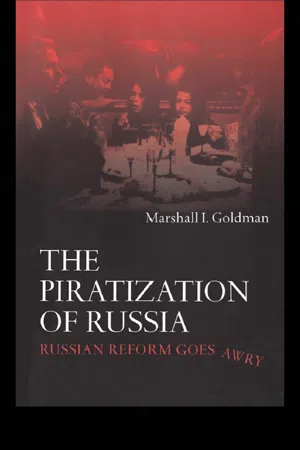
In 1991, a small group of Russians emerged from the collapse of the Soviet Union and enjoyed one of the greatest transfers of wealth ever seen, claiming ownership of some of the most valuable petroleum, natural gas and metal deposits in the world. By 1997, five of those individuals were on Forbes Magazine's list of the world's richest billionaires.
1
Russia’s financial buccaneers
The wild and woolly East
The battle for Sviazinvest would never pass as soap opera. Who would believe it? But the 1997 struggle for ownership and control of Russia’s largest and potentially most profitable telecommunication company among one-time allies highlights the perverted and seamy nature of Russia’s economic reform. The battle sparked not only a scurrilous, semi-violent struggle over ownership of valuable corporate assets, but also a battle for influence over Boris Yeltsin, then the president of Russia. J.R.Ewing in Dallas never reached so high in his battles. However, within a year, on August 17, 1998 when the Russian stock market crashed and their paper holdings fell to almost one-tenth of their original value, the winners also became losers.
The bitter combatants in the 1997 Sviazinvest fight had agreed just a year earlier to set aside their previous quarrels to stage-manage the June 1996 presidential election campaign. Together they worked to manipulate the Russia electorate into voting for Boris Yeltsin. This small but influential band of thirteen businessmen-or “oligarchs” as they came to be called-mobilized themselves into a Yeltsin for President campaign committee headed by Anatoly Chubais. Yeltsin had just fired Chubais from his post as First Deputy Prime Minister, but everyone agreed that he had been a very effective administrator who almost single-handedly pushed through the government’s privatization effort. Until Chubais and the businessmen took over, the opinion polls showed that Yeltsin’s opponent, Gennady Zyuganov, the head of the Communist Party, would be the most likely winner, a prospect the oligarchs feared would lead to a return to a Soviet-style economy. On a personal level that meant that such a born-again communist state might not only seize the hundreds of millions of dollars worth of property they had accumulated since 1991, but might imprison or execute them as well.
In gratitude for his come-from-behind victory, Yeltsin gladly acquiesced as seven of the participants, Peter Aven, Boris Berezovsky, Mikhail Fridman, Vladimir Gusinsky, Mikhail Khodorkovsky, Vladimir Potanin, and Alexander Smolensky, divided up some of the country’s most valuable raw materials, businesses, and media outlets. In addition, he also appointed two of them-Potanin and Berezovsky-to senior government posts; Potanin as First Deputy Prime Minister and Berezovsky as Deputy Secretary of Russia’s Security Council. Insensitive to the issue of “conflict of interest,” their government appointments enhanced their business dealings. Thus by late 1996, Berezovsky was able to boast that these seven influential bankers had gained control of 50 percent of the country’s assets.1 An exaggeration perhaps, but not too far from the truth.
They grabbed an even more important hold on the media. This “Big Seven,” or Semibankirshchina, as the Russians began to call them, came close to controlling 70 percent of the Moscow press and radio and 80 percent of the nation’s TV (The Semibankirshchina, a play on words, alludes to the seven Boyars (Semiboyarshchina) who acted as the government of Russia after Czar Vasily Shuisky was overthrown in 1610.)
That should have been enough power and influence, but as Grigory Yavlinsky, the leader of Yabloko, the main democratic party in the Russian Duma, said, “Russia’s financial oligarchy knows no limit to its greed. They will never be satisfied.”2 As the state continued to sell off its enterprises, these bankers established holding companies or, as they described them, financial-industrial groups (FIGS) with which to acquire more and more. There were minor squabbles and accusations that this or that auction of an oil company or an aluminum smelter was rigged, and even reports of a beating or assassination, particularly among the bankers and directors involved with the aluminum smelters. But generally these natural rivals agreed that by working together there would be enough for all. Equally significant, the close if not incestuous relationship between government leaders and corporate directors and bankers allowed for insider deals, golden parachutes, corporate jets, villas in Cyprus and Spain, and instant millionaire status for those who played along.
By contrast to this narrow elite, 80 to 90 percent of the rest of the population found themselves cast off, many in very dire straits. In 1999, for example, almost 38 percent of the population was declared to be below the poverty line.3
Even those who had earlier put aside savings ended up with almost nothing to show after the 26-fold inflation of 1992. This looting of the country-all in the name of privatization and a move to the market-was a form of piratization. Yet despite the open and blatant seizure of what had been public property and the accompanying deterioration in the status of the overwhelming percentage of the population, there was relatively little protest or reaction from the ever-patient, long-suffering Russian people.
Even those who had earlier put aside savings ended up with almost nothing to show after the 26-fold inflation of 1992. This looting of the country-all in the name of privatization and a move to the market-was a form of piratization. Yet despite the open and blatant seizure of what had been public property and the accompanying deterioration in the status of the overwhelming percentage of the population, there was relatively little protest or reaction from the ever-patient, long-suffering Russian people.
I
What brought the Sviazinvest matter to a head and resulted in the collapse of this harmonious looting of the country was Yeltsin’s decision to bring inan outside reformer, Boris Nemtsov, as one of the country’s two First Deputy Prime Ministers. Nemtsov previously had been the appointed and subsequently elected governor of Nizhny Novgorod. As governor, Nemtsov toiled and lobbied relentlessly to bring the market to his region in an open, relatively transparent way, an anomaly in Russia where so much was done covertly. His record was not perfect, and once he assumed power in Moscow, rumors and accusations abounded. Nevertheless, except for two or three governors in regions such as Samara or Velikii, Novgorod, few others had managed the economic reform process as effectively as Nemtsov did in Nizhny Novgorod.
Summoned to Moscow by Yeltsin in March 1997, Nemtsov moved immediately to institute the same level of integrity that he had sought in his province. As he put it, “I will promise three things: I will not steal. I will not take bribes. I will not tell lies.”4 Few believed him. As they saw it, there was no way to work and breathe the air of Moscow without becoming similarly infected by the all-pervasive greed and graft. As one of his critics told me, “You don’t go into a brothel unless you expect to sample the wares.”
As he himself anticipated, Nemtsov’s arrival in Moscow sparked a tidal wave of accusations and charges of past, hidden or imagined indiscretions, most of them false (the Russians call this kompromat).5 This was a throwback to the Soviet era when slander and half-truths were used to discredit rivals. Accusations of prostitutes and financial manipulators against Nemtsov (some broadcast on television) were largely initiated by those fearful that Nemtsov’s crusade might impinge on their own interests.
Nemtsov’s initial attempts at a cleanup sparked fierce resistance and as a consequence produced rather trivial results. His opponents realized that if Nemtsov succeeded in forcing all government officials to replace their foreign-made cars with those made in Russia and to declare their income and wealth, Nemtsov might yet cause real damage. Thus, in the very first auction of the government’s foreign cars very few were sold off, and while a large number of officials did file income and wealth declarations, most of these reports bore little relationship to actual income or wealth. Moreover the decree did not cover family members, many of whom became the beneficiaries of assets put in their names.
II
Nemtsov insists that he was serious. He was also determined to clean up what was called the “Loans for Shares” program. This involved the auction to private buyers of some of the country’s most valuable holdings of petroleum and other raw materials. Until his arrival in Moscow almost no auction under the Loans for Shares program had brought the governmentmore than a fraction of the real value of those properties. This was because in almost all cases the “high” bidder turned out to be affiliated with the auction organizer. For that matter, the idea for the Loans for Shares program came from Vladimir Potanin, the head of Oneximbank, who outlined it on March 30, 1995. Not surprisingly, by the time most of the auctions had been held, Oneximbank emerged as the biggest beneficiary of the program.
The pretext for the Loans for Shares scheme was that the bankers wanted to do something to help the government reduce its budget deficit.6 Because almost no one, including the banks, was paying much in the way of taxes, the government could not generate the revenues it needed to underwrite its expenditures. Therefore in a gesture that proved too good to be true, the Big Seven Semibankirshchina offered to lend money to the government to substitute at least temporarily for the uncollected taxes. All the bankers asked in exchange was that the government put up collateral for these loans in the form of shares of government-owned stock from some of the larger enterprises the state was planning to sell. Ostensibly that was no cause for alarm. After all, once the government found a way to collect those taxes, it could repay its loan. The banks would then return the government’s collateral. Of course if the loans were not repaid (and no one thought they would be) the banks would then be free to sell off the collateral so they could recoup their money. Moreover, these were shares of stock that the state in any case intended to sell.
The original plan specified that to generate as much revenue for the state as possible, the bank holding the collateral would conduct an auction on the state’s behalf for the purchase of that collateral. This was thought to be the best way to attract additional bidders. If done properly the resulting competition would yield funds sufficient to repay the banks and would go on to generate for the state a considerably larger amount than the initial loan. But by holding the auction in remote locations, closing the airport on the day of the auction, or specifying terms that only the auctioneer himself could meet, the auction rarely generated more than a few dollars above the original offering price. And in virtually every instance, the winner of the auction was an affiliate of the bank that held the auction.
Determined to break this pattern and end the collusion between what under different circumstances should have been fierce rivals, Nemtsov promised that he would see that Sviazinvest, which was the next state enterprise to be privatized, would be auctioned at full value. Not only would this be a means to restore confidence in government procedures, but also the government desperately needed the proceeds from this sale in order to pay the back wages of government employees, particularly the military. At one point the government was behind by as much as $4.4billion in overdue wages.7 It did not take a Machiavelli to realize that the timely payment of military wages was of particular urgency. In mid-1997, angered by a host of grievances, several former generals began to call openly for “action” by the military. Eliminating their salary backlog would dissipate some of that anger.
Set for July 25, 1997, there was considerable uncertainty as to just how much interest the Nemtsov-organized auction for Sviazinvest would attract. This was not the first time an effort had been made to privatize Sviazinvest. In late 1995, the government reached a tentative agreement with STET, the Italian telecommunication company, to pay $1.4 billion for 25 percent of the company’s shares.8 At the last minute, however, STET withdrew its offer, complaining that the Russian authorities had refused to allow it access to long-distance markets as well as important financial data.9 Subsequently the privatization authorities called in N.M.Rothchild and ING Barings, Western financial advisors, for guidance in finding additional foreign investors.10 However, some of the Big Seven banks, particularly MOST-Bank, began to complain that Sviazinvest was too important to Russia’s national security to allow it to be sold to foreign investors. Succumbing to pressure, the government then severed its work with N.M.Rothchild and ING, Barings and announced that only a company with Russian majority control could bid for Russia’s telecommunication network. Everyone understood that this meant MOST-Bank had an inside track.
As the time for the auction approached, it became clear that other bids would also be submitted, including one from Oneximbank. When the plans to auction off Sviazinvest were drawn up, the founder of Oneximbank, Vladimir Potanin, was serving as First Deputy Prime Minister. He had taken a leave of absence from his bank, and he had made it clear that as a member of the government it would be unwise for his bank to submit a bid.11 But when he was removed from office in March 1997, he quickly decided to enter a serious offer.
In an attempt to avoid a real competition that would be costly for the winner, the two lead bidders, Potanin of Oneximbank and Vladimir Gusinsky, the founder of MOST-Bank, sought a meeting in France with the vacationing Anatoly Chubais to see if they could work out a sweetheart deal in advance. After all, they had all worked together so well the previous year during the presidential election. And after Yeltsin’s victory, Chubais had been brought back into the government and was serving as First Deputy Prime Minister along with Nemtsov. Potanin, Gusinsky, and Chubais were joined on the French Riviera by Boris Berezovsky, the founder of Logovaz bank, also one of the Semibankirshchina. Potanin had been accumulating more and more state property and Gusinsky andBerezovsky were worried that, if left unchecked, Potanin and his bank would soon become so dominant as to threaten their own business empires. Therefore the two decided to unite despite the fact that only a few years ago they had been bitter enemies. Berezovsky was present not openly as a banker but ostensibly in his official capacity as Deputy Secretary of the Security Council; he justified his presence by explaining that he wanted to insure there would be no foreign or criminal control of Sviazinvest. That, he insisted, would threaten Russia’s national security.
As the original architect of the privatization drive, Chubais had subsequently developed close relations with all three-Gusinsky, Potanin, and Berezovsky-during Yeltsin’s successful 1996 presidential campaign. Having been one of the leaders of the reform movement in Leningrad, Chubais had been regarded as Mr. Clean when he arrived in Moscow in 1991 to organize the privatization effort But when he was fired by Yeltsin in late 1995 and no longer a government employee, Chubais felt free to work the private sector. He worked fast. Within four months he had accumulated a taxable income of at least $300,000. According to an article in Izvestiia, that was in part income earned from a $3 million interest-free loan provided by Alexander Smolensky’s Stolichnyi bank, one of the Big Seven.12 Chubais then used the loan to invest in high-yielding government securities.13 Later, Chubais would also acknowledge that $538,000 in laundered dollar bills found in a suitcase being carried out of Yeltsin’s election headquarters by two of Chubais’ assistants was also ill gotten and, until its discovery, was intended also to be disposed of illicitly.14 Had they not been confiscated, the funds would have been used secretly to attack Yeltsin’s opponents.
Given Chubais’ involvement with the Big Seven, it seemed to Gusinsky, Potanin, and Berezovsky that if anyone would be sympathetic to their concerns, it would be Chubais. For that reason they requested a meeting with the First Deputy Prime Minister, who appeared to be amenable to a “sensible” settlement, unlike his colleague, the uncompromising Nemtsov.
The meeting was arranged for two nights before the auction. But despite Gusinsky’s and Berezovsky’s best efforts, Chubais refused to intervene. Upon their return to Moscow several other last minute meetings were called to seek some compromise. None were successful, and the auction was held as planned.15 Nemtsov had provided fair warning. Gathering the bankers together at an April meeting several weeks before the auction, he announced that henceforth there would be uniform treatment for everyone in the way government tax money from the budget was allocated to the banks to hold temporarily until spent by the government. In other words, the banks could no longer count on their connections to divert the government’s money to their bank as if it were their own.16 Furthermore, he added,“Guys [rebiata], enough! That’s it. Let’s live honestly,” by which he meant that henceforth the state auctions for government businesses would be transparent and that the highest bidder, not the highest briber, would be the winner. As he subsequently put it, there would be no more rigged deals where, “based on personal connections,” state property would be sold off “for f...
Table of contents
- COVER PAGE
- TITLE PAGE
- COPYRIGHT PAGE
- ILLUSTRATIONS
- ACKNOWLEDGMENTS
- 1. RUSSIA’S FINANCIAL BUCCANEERS: THE WILD AND WOOLLY EAST
- 2. SETTING THE STAGE: THE RUSSIAN ECONOMY IN THE POST-COMMUNIST ERA
- 3. THE LEGACY OF THE CZARIST ERA: UNTENABLE AND UNSAVORY ROOTS
- 4. IT’S BROKE, SO FIX IT: THE STALINIST AND GORBACHEV LEGACIES
- 5. PRIVATIZATION: GOOD INTENTIONS, BUT THE WRONG ADVICE AT THE WRONG TIME
- 6. THE NOMENKLATURA OLIGARCHS
- 7. THE UPSTART OLIGARCHS
- 8. FIMACO, THE RUSSIAN CENTRAL BANK, AND MONEY LAUNDERING AT THE HIGHEST LEVEL
- 9. CORRUPTION, CRIME, AND THE RUSSIAN MAFIA
- 10. WHO SAYS THERE WAS NO BETTER WAY?
- 11. CONFIDENCE OR CON GAME: WHAT WILL IT TAKE?
- APPENDIX 11.1
- NOTES
- BIBLIOGRAPHY
Trusted by 375,005 students
Access to over 1.5 million titles for a fair monthly price.
Study more efficiently using our study tools.
Frequently asked questions
Yes, you can cancel anytime from the Subscription tab in your account settings on the Perlego website. Your subscription will stay active until the end of your current billing period. Learn how to cancel your subscription
No, books cannot be downloaded as external files, such as PDFs, for use outside of Perlego. However, you can download books within the Perlego app for offline reading on mobile or tablet. Learn how to download books offline
Perlego offers two plans: Essential and Complete
- Essential is ideal for learners and professionals who enjoy exploring a wide range of subjects. Access the Essential Library with 800,000+ trusted titles and best-sellers across business, personal growth, and the humanities. Includes unlimited reading time and Standard Read Aloud voice.
- Complete: Perfect for advanced learners and researchers needing full, unrestricted access. Unlock 1.5M+ books across hundreds of subjects, including academic and specialized titles. The Complete Plan also includes advanced features like Premium Read Aloud and Research Assistant.
We are an online textbook subscription service, where you can get access to an entire online library for less than the price of a single book per month. With over 1.5 million books across 990+ topics, we’ve got you covered! Learn about our mission
Look out for the read-aloud symbol on your next book to see if you can listen to it. The read-aloud tool reads text aloud for you, highlighting the text as it is being read. You can pause it, speed it up and slow it down. Learn more about Read Aloud
Yes! You can use the Perlego app on both iOS and Android devices to read anytime, anywhere — even offline. Perfect for commutes or when you’re on the go.
Please note we cannot support devices running on iOS 13 and Android 7 or earlier. Learn more about using the app
Please note we cannot support devices running on iOS 13 and Android 7 or earlier. Learn more about using the app
Yes, you can access The Piratization of Russia by Marshall I. Goldman in PDF and/or ePUB format, as well as other popular books in Economics & Business General. We have over 1.5 million books available in our catalogue for you to explore.