- 248 pages
- English
- ePUB (mobile friendly)
- Available on iOS & Android
eBook - ePub
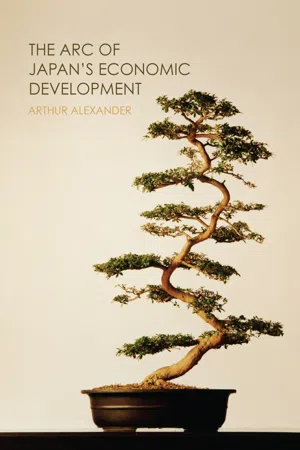
The Arc of Japan's Economic Development
About this book
This core textbook is the definitive overview of the Japanese economy. It charts its history from the period before the Meiji restoration and its astonishing growth throughout the twentieth century before conducting a thorough analysis of the contemporary scene and the implications of the ongoing financial crisis.Written by a leading authority in t
1
Japan’s place in the contemporary economic world
Prologue: the arc of the Japanese economy
For 150 years, the Japanese economy followed the arc traced by a ballistic trajectory: an economy blasted from the muzzle of a Meiji-era cannon, an arc characterized by increasing, and then falling, economic growth, development and government intervention in the economy
Japan’s approach to economic affairs was conditioned by the circumstances surrounding the origins of the modern Japanese state in the Meiji Restoration of the 1870s. A central objective was to develop industrial capabilities to supply a modern military force that would protect Japan from the European and American colonial powers. The centrality of defence led to the dominance of the military in government and the primacy of military objectives. A crucial institutional feature that influenced events was that the Imperial Army was accountable only to the emperor, bypassing the prime minister and cabinet as well as the Diet, often placing army behaviour beyond the reach of political control.
A combination of defence, political and economic motivations created a powerful logic for an expansionist imperialism. This logic was supported by mimicry of western imperialist practice, including the creation of colonies. The Japanese government promoted economic and military expansion in Taiwan and Korea. Japan’s military forces were in Manchuria from the early 1900s, at first to bar Russian expansion and then to develop Manchuria’s resources.
To promote industrialization, especially the underpinnings of military industry, the state encouraged the import and then the indigenous development of technology and industry in fields such as steel, machine tools and shipbuilding. Led by military planners in the 1930s, the resources of Manchuria and China were sought to guarantee the availability of industrial inputs and to secure markets for finished goods. This policy became especially prominent when the Great Depression in the early 1930s suppressed Japan’s trade with Europe and North America, which had the side-effect of diminishing the western powers’ ability to influence Japan’s external behaviour.
Drawing lessons from the large-scale fighting during the First World War, Japan’s military strategists saw the need for mobilization planning, led by the military itself and by like-minded government bureaucrats. Mobilization staff promoted the ideas of government authority over economic affairs. Manchurian industrial development in the 1930s, coordinated by these mobilization bureaucrats, trained a cadre of government officials to distrust Japan’s capitalists. Motivated by Marxist beliefs and the examples of state planning in the Soviet Union and Germany’s mobilization economy, the economic planners in Manchuria returned to Tokyo to organize the country for total war. Back home, they faced opposition to their policies and were unable to implement them as thoroughly as they desired, but they managed to alter the structure of the economy in important ways, especially in corporate finance and governance. Some scholars refer to these ideas, methods and institutions as the 1935–45 system, which continued to influence public policy and private economic activity for several more decades after the war.
Looking backward, there is ample evidence to identify a linear sequence from the Meiji Restoration to the Second World War: defeat, Occupation and Japan’s post-war economic policy. However, it would be wrong to assert that there was an inevitable linear progression. At every step along the way, other paths could have been taken, paths that were vigorously advocated by many politicians and government officials. Until the military takeover of the government in the mid-1930s, Diet members and the electorate sought to rein in the military’s adventures and stop its more dangerous policies. Finance ministers attempted to control the army through the budget. Right up to Japan’s attacks on the United States and British possesions in December 1941 (Australia, Hong Kong, Borneo, etc.), an active political opposition tried to thwart military ambitions. However, when opposition to expansion looked like it might be effective, assassinations and coups ended such endeavours.
Although Japan suffered a devastating defeat in 1945 and was ruled for seven years by an occupying army, the native bureaucrats’ methods of economic management that had prevailed for 10 wartime years did not disappear. The Americans chose to work through the existing organs of government. Through 1948 they reinforced Japanese bureaucrats’ inclinations to use the state to monitor the economy and intervene when it was deemed necessary or desirable. Industrial coordination was not a strange idea to American bureaucrats. In both the First World War and the Second World War, the US government created agencies to manage military production, allocate materials, and control prices and wages. The lessons learned from these experiences were that government had an obligation and ability to coordinate vast enterprises in times of crisis.
The weight of the evidence is that direct government involvement in the immediate post-war economy, even with the backing of the Americans, most likely did not achieve its main objectives, even in the high-priority production of coal. Nevertheless, the commonly told story is one of successful government intervention. The myth that wise bureaucrats managed the post-war coordination problem became embedded in the official government consciousness and in the mind of the public. This view bolstered officials’ inclinations to guide economic affairs to meet varied objectives, at times strategic, but at other times political or personal.
Though often confused, inappropriate and twisted by politicians and indus-try, an interventionist-minded government presided over the Japanese economic miracle. Battles for dominance within the government weakened any sense of coherent strategy, but bureaucrats’ distrust of markets plus belief in their own vision continued to influence written and unwritten regulation and guidance. Of course, Japan is not unique among developed countries for its faith in bureaucratic judgments and a disinclination to rely on markets to achieve social goals. France and Germany come to mind as other examples of these tendencies.
The 1935–45 system, which gradually lost force amidst the conditions of rapid post-war economic growth, eroded even faster in the 1970s and especially since the 1990s, when the economic environment and political institutions changed. In the economy, growth slowed, deregulation occurred in finance, transportation, retail and other areas, and foreign companies took a larger role in the domestic economy. Greater weight was given to shareholders as financial markets regained their importance in corporate funding. In politics, the shift in the 1990s to single-member parliamentary districts and the increasing centrality of the media in elections altered party power structures and nudged politicians’ incentives towards broader, national interests. By the twenty-first century, Japan’s economy had moved away from its nineteenth-century origins.
The scale of the Japanese economy
By any measure, Japan is in the top tier of economic powers. At the beginning of the twenty-first century, Japan’s economy was the third largest in the world, after the United States and China. Fifty years earlier, when Japan was rebuilding from the destruction of the Second World War, its gross domestic product (GDP) ranked number seven. High rates of economic growth following its wartime devastation propelled Japan into third position by 1966, behind the United States and the Soviet Union, where it remained until the dissolution of the USSR in 1990, when it moved up one position. However, China’s rapid growth displaced Japan in the mid-1990s, according to several different estimates. (Such international comparisons are made using purchasing power parities; see Box 1.1.)
Not only did Japan’s economy get big, its people also became wealthy—Japan was the first Asian nation to join the European and North American club of rich nations. As measured by GDP per person, it moved from 32nd position in 1950 into the top 10 between 1985 and 1990. Finer distinctions are harder to make because they depend on the other countries included in the comparison and the particulars of how purchasing power parities are constructed. Figure 1.1 shows Japan’s ranking in terms of GDP per capita according to the Penn World Table (PWT 6.1; see Heston et al. 2002).
Japan’s economic growth slowed in the 1990s and its relative position deteriorated: from number five in 1994, it slipped to 12th place by the end of the decade. Japan is not the only rich economy to slide down in the rankings. Switzerland, for example, which was in first place on the 1954 list, slipped to number seven by 2000. Japan and Switzerland have not become poorer, but other countries have grown faster and overtaken them; both are still among the world’s most affluent economies.
| Box 1.1 Purchasing power parity Comparing economic output across countries extends the concept of comparing the same country at different times. The national income framework—the system of national accounts—is the standardized statistical device for describing countries’ macroeconomic affairs. Gross domestic product is the most common measure of aggregate output in the national accounts. However, since prices are used to calculate the values of the millions of goods and services contributing to GDP, price changes from one period to another complicate assessments of changes in real output. Price indices such as the GDP deflator are used to deal with these problems; nominal GDP can be converted into ‘real’ values by dividing the nominal figures by the price index. Economists often make distinctions between nominal and real values. ‘Nominal’ refers to the actual, unadjusted, ‘named’ monetary amount; nominal values and prices are the everyday ones seen in shops, advertisements, annual company reports and interest rates. ‘Real’ values, as the term implies, try to get behind the price changes to measure values as if prices had not changed. To estimate real values, it is necessary to adjust the nominal values to account for price changes that may disguise changes in the output of stuff: of tangible goods and services. Real, price-adjusted values are proxies for the number of items produced or resources used in production; real interest rates, for example, subtract the rate of price inflation from the nominal interest rate to reveal the quantity of real expenditures that can be made at the end of a period with the nominal interest payments. The process of comparing different countries’ outputs begins by valuing each country’s output by its own set of prices, which presents each country’s GDP in its own currency. The next step converts one country’s output into the other country’s currency. The obvious method of conversion is to use the exchange rate, which defines the value of one currency in terms of another. The problem with using the market exchange rate is that it responds to forces that are unrelated to changes in domestic prices, such as international capital flows; therefore, the output of a country estimated with exchange rates would rise and fall with the currency markets, suggesting swings in a country’s output that are not, in fact, occurring. Economists have developed another method for converting one country’s output into the currency of another country by using so-called purchasing power parity (PPP). The ideal ... |
Table of contents
- Contents
- Figures
- Tables
- 1 Japan’s place in the contemporary economic world
- 2 The nineteenth-century transformation of the Japanese economy
- 3 From Meiji to the Second World War
- 4 Economic developments in the first half of the twentieth century
- 5 Planning supplies for war
- 6 The American Occupation and the post-war economy
- 7 Bank-centred finance and corporate governance
- 8 Capital investment and rates of return
- Corporate returns
- 9 Structural change in the Japanese economy
- 10 The privatization of Japan’s public corporations
- 11 Is Japan different?
- 12 Economic prospects for Japan
- Appendix
- Notes
- Bibliography
- Index
Trusted by 375,005 students
Access to over 1.5 million titles for a fair monthly price.
Study more efficiently using our study tools.
Frequently asked questions
Yes, you can cancel anytime from the Subscription tab in your account settings on the Perlego website. Your subscription will stay active until the end of your current billing period. Learn how to cancel your subscription
No, books cannot be downloaded as external files, such as PDFs, for use outside of Perlego. However, you can download books within the Perlego app for offline reading on mobile or tablet. Learn how to download books offline
Perlego offers two plans: Essential and Complete
- Essential is ideal for learners and professionals who enjoy exploring a wide range of subjects. Access the Essential Library with 800,000+ trusted titles and best-sellers across business, personal growth, and the humanities. Includes unlimited reading time and Standard Read Aloud voice.
- Complete: Perfect for advanced learners and researchers needing full, unrestricted access. Unlock 1.5M+ books across hundreds of subjects, including academic and specialized titles. The Complete Plan also includes advanced features like Premium Read Aloud and Research Assistant.
We are an online textbook subscription service, where you can get access to an entire online library for less than the price of a single book per month. With over 1.5 million books across 990+ topics, we’ve got you covered! Learn about our mission
Look out for the read-aloud symbol on your next book to see if you can listen to it. The read-aloud tool reads text aloud for you, highlighting the text as it is being read. You can pause it, speed it up and slow it down. Learn more about Read Aloud
Yes! You can use the Perlego app on both iOS and Android devices to read anytime, anywhere — even offline. Perfect for commutes or when you’re on the go.
Please note we cannot support devices running on iOS 13 and Android 7 or earlier. Learn more about using the app
Please note we cannot support devices running on iOS 13 and Android 7 or earlier. Learn more about using the app
Yes, you can access The Arc of Japan's Economic Development by Arthur Alexander in PDF and/or ePUB format, as well as other popular books in Economics & Business General. We have over 1.5 million books available in our catalogue for you to explore.