
eBook - ePub
Mechanical Tribology
Materials, Characterization, and Applications
- 508 pages
- English
- ePUB (mobile friendly)
- Available on iOS & Android
eBook - ePub
About this book
Studying the morphology, defects, and wear behavior of a variety of material surfaces, Mechanical Tribology examines popular and emerging surface characterization techniques for assessment of the physical, mechanical, and chemical properties of various modified surfaces, thin films, and coatings.
Its chapters explore a wide range of tribolo
Information
1
Surface Characterization of Materials
Paul J. Pigram and Narelle Brack
La Trobe University, Bundoora, Victoria, Australia
La Trobe University, Bundoora, Victoria, Australia
Peter D. Hodgson
Deakin University, Geelong, Victoria, Australia
Deakin University, Geelong, Victoria, Australia
I. INTRODUCTION
A. The Nature and Importance of Surfaces
The surface of a material is the interface between the bulk and the external phase in direct contact with the material. The external phase may be solid, liquid, or gas. The surface of a material may be defined in a number of ways, depending principally on the interaction being considered. In fundamental terms, the outermost layer of atoms of the material composes the surface. The physical and chemical behavior of these atoms, however, is strongly influenced by atomic layers in the vicinity, to a depth of the order of several nanometers into the bulk. In practical terms, surface modification and the application of thin films, for example, for lubrication, creates a functional surface region of the order of 100 nm thick [1].
Controlling and characterizing the behavior of surfaces is central to physical and chemical tribology. Friction and wear processes occur at surfaces and interfaces and are a manifestation of the physical and chemical characteristics of the materials in question. Surface modification is the means by which these processes are controlled or mitigated. For example, the inherent wear properties of a material depend on parameters such as hardness, structure at the surface, and chemical reactivity. Erosion may be influenced by preferential surface segregation of species and processes occurring at the surface such as oxidation and degradation. Wear behavior may be controlled by the application of hard surface films, as in plasma nitriding, and appropriate lubrication regimes.
Analytical tribology necessarily involves the determination of the chemical, electronic, and structural characteristics of the surface and wear debris. Modern surface analytical techniques provide a comprehensive understanding of tribological mechanisms via spectroscopy, imaging, and depth profiling.
B. Surface Properties and Processes Occurring at Surfaces
Surface phenomena, which determine surface properties and processes, occur on scales ranging from tenths to hundreds of nanometers. Figure 1 summarizes the characteristic length scales of tribological phenomena and associated materials properties.
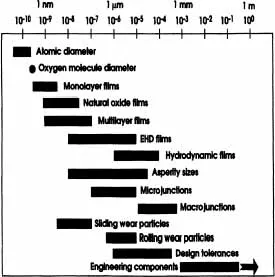
Figure 1 Surface-related phenomena in tribology and associated length scales. (From Ref. 2.)
The characterization of surface processes is also influenced by similar factors. Bonding between atoms and adhesion, for example, involve atomic and molecular interactions on a nanometer or subnanometer length scale. Similarly, the work function of a material and the nature of electrical contact between different materials are determined by the properties of a nanometer-scale interfacial or surface region. Wettability is a function of surface chemistry, cleanliness, and roughness. Surfactants radically alter wettability through the formation of molecular monolayers, bilayers, and aggregated structures at the surface [3]. In catalytic processes, interactions involve the adsorption of individual atoms or molecules at the surface, reaction of adsorbed species, and subsequent desorption of products. Optical absorption by materials is also a function of the characteristics of the surface region. It follows then that tribological phenomena, such as friction, wear, and lubrication, are strongly affected by processes occurring on the nanometer or subnanometer scale.
Length or depth scales of the order of 10 nm are characteristic of important surface chemical processes including preferential segregation of species, the formation of surface oxides, and corrosion. Surface passivation is implemented on a similar scale via surface chemical modification. Thin films applied to surfaces are often up to 100 nm in thickness. In the tribology context, these may include thin lubricating layers applied to the surface to reduce friction or modification of the surface region itself for the purpose of wear mitigation. Surface coatings, functional films, sensors, and optical structures have thicknesses on this scale. The distinction between a modified surface region and a discrete surface coating is arbitrary. However, layer structures with thicknesses exceeding 100 nm may have both surface and bulk properties in their own right, necessitating separate consideration from the underlying substrate material.
C. Methodologies for Characterization
1. Overview of Characterization Strategy
A comprehensive physical and chemical surface characterization of a material requires the selection of an appropriate set of analytical techniques and methodologies. Table 1 presents an overview of the principal areas to be considered. It is important to recognize that no one analytical technique will necessarily supply all the information required. The use of techniques in combination provides a workable solution for characterization.
A robust characterization strategy can be constructed using the following stages:
1. Clear identification and definition of the issue/problem to be investigated
2. Identification of one or more possible hypotheses to be tested
3. Clear definition of the questions to be answered by the characterization and the nature of the information to be obtained; for example, identification of an unknown material via chemical and molecular surface spectroscopy, or determination of a coating layer profile via elemental depth profiling
4. Assignment of one or more analytical techniques to each question to generate objective data by the most reliable and efficient route
5. Choice of experimental methodologies and acquisition of quality data, sufficient to address the analytical questions. Data processing, interpretation, and integration of results from different techniques
6. Evaluation of data and proposal of a solution or answer to the question and testing of the validity of the outcome. Confirmation of the reproducibility of the results and consistency of the findings from different techniques
7. Presentation of the outcome
This strategy has been adapted from a recently published, comprehensive work on surface and interface analysis edited by Riviere and Myhra [4]. The work contains an extended discussion of characterization strategy, properties of surface analytical techniques and case studies and is recommended for readers seeking further information.
Table 1 Physical and Chemical Characteristics of Materials and Analytical Methods
| Physical characteristics | Chemical characteristics |
| Structure Morphology, topography Mechanical properties Stress | Elemental composition • Spectroscopy • Imaging • Depth profiling Chemical composition • Spectroscopy • Imaging • Depth profiling Molecular composition • Spectroscopy • Imaging • Depth profiling |
Table 2 Techniques Frequently Deployed in Characterizing the Elemental Composition of Surfaces
| Technique | Properties |
| AES | Description: An electron beam technique with elemental information obtained by analysis of electron-induced Auger secondary electrons emitted from the sample surface. Can detect elements from lithium in the periodic table. Overlaying secondary electron micrographs and elemental images can be obtained, allowing compositional analysis of topographic features. AES is a key surface analytical technique for conducting and semiconducting samples. Spatial resolution: Of the order of 10 nm in a modern instrument with a field emission electron gun. Resolution is influenced by sample features, with rough and particulate samples returning lower-resolution images. Depth of analysis: Of the order of 5 nm, determined by inelastic scattering of emerging Auger electrons. Limitations: High surface sensitivity rules out the use of conducting overlayers on insulating samples to mitigate surface charging. Insulating samples cannot be analyzed. |
| XPS | Description: A photoelectron technique with elemental information obtained by analysis of x-ray excited photoelectrons emitted from the sample surface. Can detect elements from lithium in the periodic table. Charge neutralization allows high-resolution spectra to be obtained from insulators using a monochromatic x-ray source. XPS is a key surface analytical technique for all vacuum compatible sample types. Spatial resolution: Imaging instruments can achieve resolutions of the order of 1 urn. Resolution is influenced by sample features, with rough and particulate samples returning lower-resolution images. Depth of analysis: Of the order of 5 nm, determined by inelastic scattering of emerging photoelectrons. Limitations: Elemental detection sensitivity is limited to approximately 0.5 at.% |
| SIMS | Description: An ion beam technique with elemental information obtained y the massanalysis of secondary ions sputtered from the sample surface by a primary ion beam or pulse. Mass spectra are commonly generated using quadrupole, magnetic sector, and time-of-flight systems. Can detect all mass fragments; this capability is particularly useful for light elements such as hydrogen and for heavy clusters. Charge neutralization in modern instruments allows high-resolution spectra to be obtained from insulators. Spatial resolution: Imaging instruments can achieve resolutions better than 100 nm. Resolution is influenced by sample features, with rough and particulate samples returning lower-resolution images. Depth of analysis: Ranges from less than one monolayer in static SIMS analyses to 10 urn and greater in depth profiling tasks. Limitations: SIMS produces mass spectra, and the data obtained are often information-rich, requiring substantial analysis and interpretation. While high mass resolution techniques such as TOF-SIMS facilitate identification of elemental species, peak overlaps or interferences are a serious consideration in identifying unknown materials. |
2. Elemental Composition
Surface characterization of materials in any field starts with the elemental composition of the surface region. The selection of a technique or techniques depends critically on...
Table of contents
- Front Cover
- Half Title
- Title Page
- Copyright
- Preface
- Contents
- Contributors
- 1. Surface Characterization of Materials Paul J. Pigram, Narelle Brack, and Peter D. Hodgson
- 2.Surface Characterization Techniques: An Overview Kazuhisa Miyoshi
- 3. Mechanical Behavior of Plastics: Surface Properties and Tribology Nikolai K. Myshkin and Mark I. Petrokovets
- 4. Visualization and Characterization of Bulk and Surface Morphology by Microthermal Analysis and Atomic Force Microscopy Scott Edwards, Nguyen Due Tran, Maria Provatas, Namita Roy Choudhury, and Naba Dutta
- 5. Macromechanics and Micromechanics of Ceramics Besim Ben-Nissan, Giuseppe Pezzotti, and Wolfgang H. Miiller
- 6. Scuffing and Seizure: Characterization and Investigation Tadeusz Burakowski, Marian Szczerek, and Waldemar Tuszynski
- 7. Wear Mapping and Wear Characterization Methodology Christina Y. H. Lim and S. C. Lim
- 8. Measuring Technique and Characteristics of Thin Film Lubrication at Nanoscale Jianbin Luo and Shizhu Wen
- 9. Tribology of Metal Cutting Viktor P. Astakhov
- 10. Tribology in Metal Forming Emile van der Heide and Dirk Jan Schipper
- 11. Tribology in Textile Manufacturing and Use Stephen Michielsen
- 12. Biotribology Hong Liang and Bing Shi
- 13. Biocompatible Metals and Alloys: Properties and Degradation Phenomena in Biological Environments Alexia W. E. Hodgson, Sannakaisa Virtanen, and Heimo Wabusseg
- 14. Epilamization/Barrier Films Zygmunt Rymuza
- Index
Trusted by 375,005 students
Access to over 1.5 million titles for a fair monthly price.
Study more efficiently using our study tools.
Frequently asked questions
Yes, you can cancel anytime from the Subscription tab in your account settings on the Perlego website. Your subscription will stay active until the end of your current billing period. Learn how to cancel your subscription
No, books cannot be downloaded as external files, such as PDFs, for use outside of Perlego. However, you can download books within the Perlego app for offline reading on mobile or tablet. Learn how to download books offline
Perlego offers two plans: Essential and Complete
- Essential is ideal for learners and professionals who enjoy exploring a wide range of subjects. Access the Essential Library with 800,000+ trusted titles and best-sellers across business, personal growth, and the humanities. Includes unlimited reading time and Standard Read Aloud voice.
- Complete: Perfect for advanced learners and researchers needing full, unrestricted access. Unlock 1.5M+ books across hundreds of subjects, including academic and specialized titles. The Complete Plan also includes advanced features like Premium Read Aloud and Research Assistant.
We are an online textbook subscription service, where you can get access to an entire online library for less than the price of a single book per month. With over 1.5 million books across 990+ topics, we’ve got you covered! Learn about our mission
Look out for the read-aloud symbol on your next book to see if you can listen to it. The read-aloud tool reads text aloud for you, highlighting the text as it is being read. You can pause it, speed it up and slow it down. Learn more about Read Aloud
Yes! You can use the Perlego app on both iOS and Android devices to read anytime, anywhere — even offline. Perfect for commutes or when you’re on the go.
Please note we cannot support devices running on iOS 13 and Android 7 or earlier. Learn more about using the app
Please note we cannot support devices running on iOS 13 and Android 7 or earlier. Learn more about using the app
Yes, you can access Mechanical Tribology by George E. Totten,Hong Liang in PDF and/or ePUB format, as well as other popular books in Technology & Engineering & Materials Science. We have over 1.5 million books available in our catalogue for you to explore.