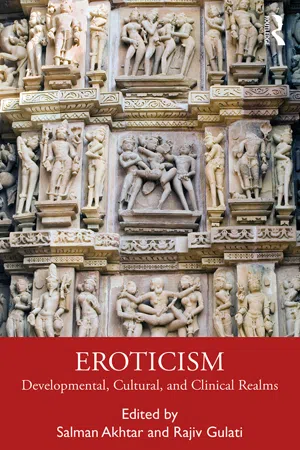
With contributions from distinguished scholars and clinicians who view human erotic desire from modern developmental, relational, societal, and cross-cultural perspectives, Eroticism: Developmental, Cultural, and Clinical Realms offers a multifaceted and up-to-date glimpse into what we find sexually attractive and why. While psychoanalysis has unshackled itself from the narrow confines of instinct theory to include ego psychology, object relations theory, self psychology, and the contemporary relational paradigm, such heuristic and clinical advance is sorely needed to further our grasp of human eroticism and love. Accommodation also needs to be made for the cultural changes that have occurred over the last five or six decades. These include the feminist corrective to the phallocentrism of 'classical' psychoanalysis, the new insights into human subjectivity and personality development provided by the gay and lesbian movement, the contemporary de-centering of the essentialist and binary gender formulations, and the post-colonial voices of the non-Western people. By providing theoretically anchored clinical guidelines, Eroticism provides not only an update on the early analytic understanding of human eroticism but advances clinical praxis as well.
eBook - ePub
Eroticism
Developmental, Cultural, and Clinical Realms
- 232 pages
- English
- ePUB (mobile friendly)
- Available on iOS & Android
eBook - ePub
Eroticism
Developmental, Cultural, and Clinical Realms
About this book
Information
Part I
Developmental realm
Chapter 1
Eroticism from an evolutionary perspective
Men and women are at war. It is a silent war, often fought over dinner dates and between bedroom sheets. It is a war that is written into the fabric of our beings, right down to our DNA. It is a war that sees its participants use subtle deceit, both of self and others. Without this war, humans would cease to exist. The war is one of reproduction and relationships, the balance of which ensures the short-term survival of one’s offspring and self, and the long-term survival of one’s genes. And, the players of this war often do not understand the ends to which they strive. Our aim is to enlighten. But to understand this war, and the often-hidden motives of each side, we must first explore evolutionary theory and what has sculpted the differences in what men and women found to be erotic for millions of years.
Evolutionary psychology
We begin our discussion of evolutionary theory by quoting something Freud (1914) said over one hundred years ago.
The individual does actually carry on a twofold existence: one to service his own purposes and the other as a link in a chain, which he serves against his will, or at least involuntarily. The individual himself regards sexuality as one of his own ends; whereas from another point of view he is an appendage to his germplasm, at whose disposal he puts his energies in return for a bonus of pleasure. He is the mortal vehicle of a (possibly) immortal substance ‒ like the inheritor of an entailed property, who is only the temporary holder of an estate which survives him.
(p. 78)
Evolutionary psychology is the natural progression from Darwin’s (1859) evolutionary theory, originally published in his seminal work, Origin of the Species. Though Darwin did not have the benefit of a full understanding of DNA and genetic material, the idea behind the theory has stood the test of time. It has ensnared many of the fields of scientific pursuit and caught the eye of the father of modern mental health himself, Sigmund Freud. In 1914, Freud came close to articulating what is now known as the ‘Modern Darwinian Synthesis’, reflected in the quote above.
A brief overview of evolutionary theory is necessary to lay out the arguments in our main text. It is thus: traits are passed on from generation to generation. If an individual with that trait is better able to survive an environment and to reproduce, he or she is more likely to have offspring who will possess the same characteristics that allowed that individual to survive and reproduce. On and on these traits will pass, with the possessing progeny propagating the traits further. The better these traits, the more offspring will be had, and the more these traits will spread through a given species or population. These traits will be ‘selected for’, as those lineages that possess the least beneficial traits will ultimately die off. After millions of copies, with subtle changes throughout a species’ history, these traits will be commonly found throughout that species.
Though we owe our modern evolutionary theory to Darwin, our current understanding of evolution did not occur until the genesis of the ‘Modern Darwinian Synthesis’ in the mid-twentieth century. By combining the basic principles of Origin of the Species with Mendel’s theory of genetics, scientists finally understood that while traits (or phenotypes) appeared to be passed down, these traits were ultimately passed at the level of the gene. Those with genes that produced the most attractive faces, the strongest bodies, and the most socially adept individuals, were more likely to be passed on. And these genes combined to form many traits and phenotypes that trended towards the most useful in a given environment.
As we move forward, it may be easiest to think of genes and the people who possess them as having a ‘goal’, and that goal is to have the most copies made of themselves. Though genes, traits, and the organisms that possess them have no conscious awareness of such goals, that genes (and their resulting traits) are the driving force behind reproductive success often makes it seem as though traits/genes/organisms are in competition with one another. And the prize in these endless cycles of competition is representation throughout a given species.
The modern human is a relative latecomer to a long list, twenty-six to be exact, of hominid species who split from our common ancestor, which we shared with bonobos and chimpanzees, 5 to 7 million years ago. Imagine a twenty-four-hour day in which each hour represents 100,000 years. At midnight, our genus, Homo, appears in Africa. At dawn, some leave Africa for the first time. Around lunch time, some have made it into what is modern-day Europe. At dinnertime, our common ancestor with Neanderthals, Homo heidelbergensis, emerges in Africa. Some of them leave Africa, and by 9 p.m. have evolved into Neanderthals and the Denisovans in Europe and the northern latitudes of Asia. By 9 p.m. in Africa, 300,000 years ago, modern Homo sapiens appears. It is not until about 11:20 p.m., 70,000 years ago, that we fully modern Homo sapiens show up, and some leave Africa. Evidence suggests that around the time that our ancestors separated from the last common ancestor, the rainforests that they had once called home began to disappear (Walter, 2013). As humans made their way to the plains of Africa, they formed small coalitions that afforded survival benefits.
Imagine the world of early humans as a lifelong camping trip, with limited resources and an unending concern for safety (Cosmides and Tooby, 1992). This is our environment of evolutionary adaptedness, or EEA (Bowlby, 1969). Bowlby states that, “the only relevant criterion by which to consider the natural adaptation of any particular part of present-day man’s behavioral equipment is the degree to which and the way in which it might contribute to population survival in man’s primeval environment” (p. 59). As Cosmides and Tooby (2013) point out, the behaviors, cognition, and emotions that made sense in our EEA often fail to fit well with our ever-changing modern environment.
For all that time, our ancestors lived in hunter-gatherer societies. These were societies that survived by hunting game and gathering edible plants. The basic characteristics of these societies were few. The primary institution was the family, which decided how food was shared, how children were socialized, and how members were protected. The groups were small, usually only fifty or fewer people. The typical hunter-gatherer society was nomadic. They moved to follow food supplies. There was high, necessary mutual interdependence. There was a division of labor. Men hunt. Women gather and provide primary childcare.
What is clear even in the eyes of modern biology is that men and women are fundamentally different, and these differences created a divergence in the traits that would be adaptive for each gender. As such, sexuality in men and women is best understood by examining the traits that would give the most reproductive benefit to each gender. The eminent anthropologist Symons (1979) says it best:
Men and women differ in their sexual natures because throughout the immensely long hunting and gathering phase of human evolutionary history the sexual desires and dispositions that were adaptive for either sex were for the other tickets to reproductive oblivion.
(p. 2)
Erotic relationships through the lens of evolution
A core concept required to understand the fundamental difference between men and women and male and female sexuality is parental investment. This concept was first described by Trivers in 1972. He defines parental investment as “any investment by the parent in an individual offspring that increases the offspring’s chance of surviving (and hence reproductive success) at the cost of the parent’s ability to invest in other offspring” (p. 55). This includes both the metabolic and physical cost of producing that offspring and rearing it, as well as the cost incurred by time, protection, and resources invested in that offspring. Thus, the parent with the greater parental investment is one that invests much in a single offspring. Trivers notes that, in any species, the sex with the greater parental investment will be the limiting resource of reproduction, as their investment is time and metabolically intensive.
This was a crucial insight of Trivers. Sexual behavior is determined by parental investment, not the sex of the individual. In those few species in which the male has the greater parental investment, the difference in behavior holds true. In those species, the male is smaller than the female and choosier about with whom he mates. In these species, the females are larger and compete fiercely with one another for access to the male, the sex with the greatest parental investment.
When considering the human reproductive cycle, it should be obvious that women offer more parental investment than men. The woman must produce a nutrient-rich egg, build an expensive placenta, gestate the fetus for nine months, endure the hazards of childbirth, and burn countless calories to produce milk and breastfeed a child after birth. Even though modern women may choose not to breastfeed, the basic minimal physiologic investment is massive. Men’s baseline physiologic contribution is sperm and about two and half minutes of sexual activity. This creates a massive mismatch in the number of offspring available to either a man or a woman.
Men are therefore capable of bringing more offspring into the world than women. Those women who carefully selected mates who possessed good genes and could provide valuable resources to her and her offspring would have had more children that made it to adulthood. The genes for careful selection, therefore, would have propagated. As we will see, this has led to an incredibly nuanced evaluation pattern in women, which allowed for complex levels of arousal.
Men who copulated with as many fertile women as they could find had more offspring. As we see with the male interest in pornography, the biological drive towards partner novelty and a quantitative approach is still present in the male brain. However, though this may be a strong biological drive for men, the modern family unit is reflective of other pressures in our evolutionary past, the root of which we find in our environment of evolutionary adaptedness.
Hominid communities were small, and parents and offspring often had contact with one another (Draper and Harpending, 1988). This environment was harsh and afforded little food other than mothers’ milk. Babies nursed until the fourth year of life. With children in constant contact, their cries were often heard and tended to by parents. Failure to do so would mean a parent had to give up their reproductive fitness, as surrogates were not readily available (Draper and Harpending, 1988). This explanation only goes so far as to explain a mother’s role in childrearing, as men are unable to produce milk to sustain an infant. So, what possible explanation can there be for a father’s role?
Gathering food was a primary means of food source for the clan, and women more so than men were the primary gatherers. While women were foraging, men spent a significant amount of time watching the children (Miller and Fishkin, 1997). With the dawn of bipedalism, humans were forced to carry infants in their arms, which prevented parents from having full use of their hands. The move to the open savannah afforded hominids less protection from predators than they had enjoyed while in the forests and trees. A more proactive role by the father for both aid to the mother and protection of both the mother and the couple’s offspring would have been beneficial to the father in maintaining both current and future reproductive fitness (Fisher, 1989). With women being a limiting factor in mating, longer pair bonds and male caregiving behavior were favored as fewer willing and available women meant fewer opportunities to reproduce. Fathers who invested in their offspring’s protection and care were more likely to see their offspring survive to adulthood in the harsh environment that shaped these adaptations (Miller and Fishkin, 1997).
The push towards monogamy can be seen in one survey of 853 societies. While 84 percent permitted polygyny, and 44 percent of those cultures viewed it as the preferred form of marriage, only 10 percent of the men in those societies practiced polygyny (Fisher, 1989). The results of that survey speak both to the evolutionary drive towards co-parenthood as well as the strength of the female reproductive strategy to find an optimal mate and stay with her.
The importance of reproductive optimization can be seen in trends in modern US divorce rates (Fisher, 1989). Eighty-two percent of women who get divorced are under the age of forty-five, within their reproductive years. Divorce occurs more often when there are no children, less so when there is one child, and infrequently when there are more than two children. Probably the most striking trend is that the duration of a marriage that ends in divorce has a mean of four years, which, as we noted previously, is around the average time that it took to wean a child in our EEA (Fisher, 1989). This data suggest that even though modern society has childcare available outside the immediate family circle, relatively more resources, and less overt predation, the mechanism by which we remain bonded with someone depends on whether we can have future offspring and whether there are current offspring to rear, the evolutionary mechanisms that became engrained in our DNA through our EEA.
As highlighted above, there are vast differences in the basic reproductive strategies that would benefit men and women the most. And, with the balancing act of these diverging reproductive strategies, coupled with our harsh EEA, we see a consistent drive across the globe to pair bond and have a family unit. However, underneath the familiar façade of the nuclear family remains the conflict of maximizing reproductive potential. Since the mating strategies that would have maximized reproductive success for men and women are so different, this will lead them to be preferentially attracted to different attributes of their partners, as these attributes would have provided the greatest reproductive benefit in our EEA. The directions of these preferences fit with what we know about the reproductive costs garnered by each sex.
In our modern world of technology, the differences between men and women regarding mate selection and romance may best be identified in their use of dating applications. In their study of the dating application Tindr, Tyson et al. (2016) found that men indiscriminately selected women regardless of their intention to message them should a match occur. Men received more matches if they included a short biography about themselves, presumably as this would provide women with more clues as to their quality as a partner, information not as easily garnered from a photograph. The differences extended in how they used these applications ‒ women preferred to seek out dates and relationships, men preferred one-night stands (Tyson et al., 2016).
As men require less investment in order to produce an offspring, it would stand to reason that their ideal partners would have the most to offer in terms of reproductive capacity. Women who are fertile and young would offer the most reproductive benefit as a potential mate.
Age is the strongest indicator of the reproductive potential offered by a woman. Across thirty-three countries, men were observed to prefer mates that were younger than themselves (Buss, 1989). Across cultures, men prefer neotenous features of big eyes and a relatively small nose, which are features indicative of youth and nulliparity (Cunningham, Druen, and Barbee, 1997). Women who had larger breasts and were slender with low waist-to-hip ratio were perceived as younger and more attractive, and more desirable for short- and long-term relationships; women who were heavier and had larger hips were considered less attractive and older (Singh and Young, 1995). Youthful and fertile partners, both in appearance and in age, are highly valued by men. This is reflected in literature assessing the habits of online dating: men tend to seek out women who are younger than themselves (Abramova et al., 2016).
However, there is a floor effect to this. In a study examining teenage male preferences for mate ages, teenage males were found to prefer females that were a few years older than they were. As men get older, their preference for younger women was found to increase (Buss, 2004). It turns out that it is not youthfulness itself that is attractive, but rather reproductive ability. Women, unlike men, cannot reproduce throughout most of their adult lives. Starting around age fifty, women will go through menopause, which renders them infertile and unable to bare any more children. To improve his reproductive success, a man should be inclined to mate with women who are within their optimal reproductive window. This implies not just younger than menopause, but older than menarche. This explains why teenage males prefer to date women who are slightly older, and therefore in their reproductive prime. As a man ages, and youth becomes more desirable, visual cues of youthful appearance are used to try to spot women who are still able to reproduce (Feingold, 1992).
As physical attractiveness is correlated with youth, it would stand to reason that men place a higher premium on physical attractiveness than do their female counterparts; this is borne out in the literature (...
Table of contents
- Cover
- Half Title
- Title
- Copyright
- Dedication
- Contents
- Acknowledgments
- About the editors and contributors
- Introduction
- Part I Developmental realm
- Part II Cultural realm
- Part III Clinical realm
- References
- Index
Trusted by 375,005 students
Access to over 1.5 million titles for a fair monthly price.
Study more efficiently using our study tools.
Frequently asked questions
Yes, you can cancel anytime from the Subscription tab in your account settings on the Perlego website. Your subscription will stay active until the end of your current billing period. Learn how to cancel your subscription
No, books cannot be downloaded as external files, such as PDFs, for use outside of Perlego. However, you can download books within the Perlego app for offline reading on mobile or tablet. Learn how to download books offline
Perlego offers two plans: Essential and Complete
- Essential is ideal for learners and professionals who enjoy exploring a wide range of subjects. Access the Essential Library with 800,000+ trusted titles and best-sellers across business, personal growth, and the humanities. Includes unlimited reading time and Standard Read Aloud voice.
- Complete: Perfect for advanced learners and researchers needing full, unrestricted access. Unlock 1.5M+ books across hundreds of subjects, including academic and specialized titles. The Complete Plan also includes advanced features like Premium Read Aloud and Research Assistant.
We are an online textbook subscription service, where you can get access to an entire online library for less than the price of a single book per month. With over 1.5 million books across 990+ topics, we’ve got you covered! Learn about our mission
Look out for the read-aloud symbol on your next book to see if you can listen to it. The read-aloud tool reads text aloud for you, highlighting the text as it is being read. You can pause it, speed it up and slow it down. Learn more about Read Aloud
Yes! You can use the Perlego app on both iOS and Android devices to read anytime, anywhere — even offline. Perfect for commutes or when you’re on the go.
Please note we cannot support devices running on iOS 13 and Android 7 or earlier. Learn more about using the app
Please note we cannot support devices running on iOS 13 and Android 7 or earlier. Learn more about using the app
Yes, you can access Eroticism by Salman Akhtar, Rajiv Gulati, Salman Akhtar,Rajiv Gulati in PDF and/or ePUB format, as well as other popular books in Psychology & Mental Health in Psychology. We have over 1.5 million books available in our catalogue for you to explore.