eBook - ePub
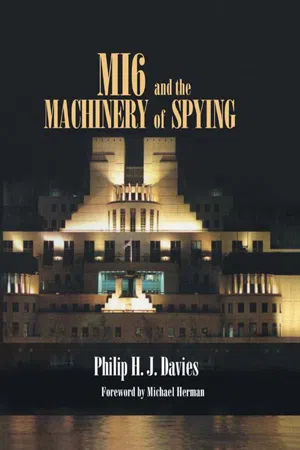
MI6 and the Machinery of Spying
Structure and Process in Britain's Secret Intelligence
- 408 pages
- English
- ePUB (mobile friendly)
- Available on iOS & Android
eBook - ePub
About this book
This book examines the structural development of the Secret Intelligence Service from its inception to the end of the Cold War.
Information
1
Introduction
Intelligence is organization.
Sherman Kent1
The British Secret Intelligence Service, known variously as SIS, MI6, the Firm, the Office, the Racket and the Friends, has served the UK government for more than 90 years. Created at the end of the first decade of the twentieth century, it has been a vital part of the UK's true first line of defence, the national intelligence machinery, throughout the twentieth century.2 It and its fellow intelligence and security agencies are almost certain to remain just as important, if not more so, in the next century as well.
The SIS is the oldest continuously operating organization of its type in the world, and as such it is perhaps one of the most instructive covert foreign intelligence organizations to study. Although it was preceded by its French equivalent in the Third Republic, and its founder turned very much to French advice when setting the agency up,3 it really had to be built up almost entirely from scratch. The invention, innovation and improvisation that this required was not merely a question of building up networks of agents or assets almost (but not entirely) from zero, but also of solving problems of organizing and managing secret intelligence work, and incorporating that work and its product into the day-to-day operation of the British state. In many respects, it was often the problems of organization and integration, that is, of institutionalization and institution-building, that proved to be among the most daunting for its early leadership. Without an effective institutional structure to coordinate the work undertaken, there would have been little prospect of success in either the long or short terms for the officers in the field in getting the job done, or for their colleagues at headquarters in seeing that the information obtained reached the consumers in government who are any intelligence service's ultimate raison d'être.4
It is impossible, therefore, to understand how an organization, intelligence or otherwise, works without understanding its formal structure.5 Organizational structure is the internal political lay of the land, a network of interdependencies and rivalries. It covers responsibilities taken, claimed or shirked and is, therefore, a central part of the practical, day-to-day rules of play for what one former SIS officer interviewed described – with an almost sociological turn of phrase – as ‘doing spying’.6 But even this sells the matter short, because this is only the internal function of organization in intelligence gathering. Formal, official organizational structure has an external function, which is to tie (or sometimes to fail to tie) the machinery of intelligence to the equally formal, and official machinery of central government. Those links can be many and varied, ranging from command and control of the agency through to communication links to convey the intelligence product to users on the overt side of government or issues and mechanisms of legislative and public accountability But, ultimately, how an activity is organized says a great deal about that activity, about how it is conceptualized and how it is undertaken by its participants. The organization of an intelligence service can, therefore, tell us a great deal about how that agency and its governmental and political masters go about ‘doing spying’.
Structure is also a potential liability as well as an asset. Management literature is replete with examples of ‘malorganization’, its causes, and its costs and consequences. Intelligence agencies are no different. The American Central Intelligence Agency (CIA) has often been criticized for excessive bureaucratization. Likewise, both the Security Service (or MI5) and the Government Communications Headquarters (GCHQ) have been criticized for excessive bureaucratization in difficulties and crises with which they have been publicly confronted.7 Variously weak and rigid structures, and over centralized and overly fragmented organizational structures have been identified as potential structural failings over the years.8 As such, they on numerous occasions have been blamed for failures to provide sufficient warning or to maintain effective security.
The SIS is no exception, and indeed its organizational structure has figured more than most in accounts of its failures and shortcomings. Hugh Trevor-Roper's judgement of SIS in the Second World War, and its legacy to the inter-war period, is that
It was not a rational extension of an efficient bureaucracy of information. Perhaps it never had been. When it was set up, before the First World War, it had not been intended as such. It had been a piece of machinery to passively receive, rather than actively to collect, such intelligence as the friends of Britain, in foreign countries, might wish to secretly impart…. As such, it no doubt performed its limited role well enough. But when it ventured outside those limits, it succumbed too easily to the inherent risks of all secret societies. It became divorced from the public bureaucracy; being recruited by patronage, it acquired some of the character of a coterie; and it preserved, as such coteries easily do, outmoded habits of thought.9
Numerous sources have also pointed to SIS's organizational weaknesses, inter- and intra-organizational turf wars being exacerbated by poor leadership and a divided wartime chain of command in the form of two feuding deputies to the then SIS Chief of Service Sir Stewart Graham Menzies.10
Perhaps most scathingly, Anthony Verrier has pointed the finger of blame at the SIS's failure to reform and reorganize effectively after the war as a fundamental reason that the Soviet penetration agent H.A.R. (‘Kim’) Philby could do as much damage as he did. The post-war reforms were nothing but trifling changes in which ‘the personnel pack was reshuffled in order to promote the ambitious (Philby above all) and remove critics. No root and branch reorganization was considered or attempted.’ As a result, the senior officers colloquially known as ‘robber barons’, that is, ‘directors under C whose responsibilities were territorial and not functional’ were unaffected. Therefore, ‘The robber barons, safeguarding their perquisites and responsible for all tasks within them, were certainly immune from introspection about organizations and methods.’11 The final blow was the failure to reform the then prevalent structure of counter-intelligence and counter-espionage under which, Verrier further argues, ‘Broadway's counter-intelligence sections were, in practice, subordinate to the regional directors, whose requirement to produce material dominated all other considerations. Penetration of an enemy – or any other foreign – intelligence organization was a secondary requirement, a factor which enabled Philby to be a traitor secure from detection for many years.’12 Verrier's judgements against the SIS, passed in 1983, have since been echoed throughout the last 20 years by other commentators, including journalists and amateur historians alike.13
Thus, SIS organization has consistently been portrayed as one of its underlying and most persistent shortcomings. However, few things in life are unalloyed good or evil, and if SIS developed in a particular direction, it is reasonable to ask what the thinking was behind a particular path of development, and given that thinking, were the failures unanticipated consequences of decisions which appeared otherwise reasonable, or were they by way of calculated risks which escaped their estimated boundaries of danger? If divided chains of command, amateurism, regional fiefdoms, turf wars and penetration were the costs of SIS organizational structure, what were the benefits? In the language of market economics, SIS organization has frequently been identified as a source of comparative disadvantage. But why did such a form of organization evolve and might that organizational structure have served as a comparative advantage in some ways which historians and critics have previously overlooked?
In his 1970 review of the British intelligence system, prepared against the background of a succession of scandals, revelations and allegations concerning the conduct of the American CIA, political scientist Harry Howe Ransom argues that ‘the Secret Service [SIS], unlike the CIA, has not become a foreign policy boomerang often returning to embarrass and injure the government … in contrast to the CIA, one rarely hears the suggestion that the Secret Service operates on the basis of its “own” foreign policy; one hears no debates as to whether the Secret Service ought to be disbanded; and there are few who would question whether the Secret Service is under responsible political control.’14 Ransom does admit that far stricter conditions of official secrecy in the UK have meant that there is far less information on which to formulate any judgements, and he further qualifies that matter by adding that British foreign policy goals are necessarily less ambitious than those of the United States as are those of its agencies. Nonetheless, Ransom's suggestion raises the fundamental question: if the SIS has avoided becoming either boomerang or rogue elephant, what institutional or structural aspects of the agency and its role and working arrangements in the machinery of British government have served to restrain or circumscribe its activities to keep it from running out of control?
Organization charts are, of course, a staple of intelligence literature. Perhaps such a fascination is inevitable in the study of the arcane, reminiscent of Kabbalistic demonology, in which knowing the names of the assorted nether beings gives the would-be sorcerer power over them. If nothing else, knowledge reduces the sense of powerlessness. Such charts may also appeal to the constitutionalist turn of mind, concerned as it is with rights and responsibilities, jurisdictions, powers, regulations and procedures. If so, it should be unsurprising that American intelligence literature is rich in wireframe plumbing charts, from the excruciatingly detailed studies of Jeffrey Richelson (occasionally in consort with Australia's Desmond Ball)15 to studies of the US intelligence community by former insiders16 and the US intelligence community's accounts of itself.17 However, as one reviewer of Richelson's and Ball's study of the UK–USA ‘special relationship’, Ties That Bind, has pointed out, mazes of wire-frame diagrams are of limited utility when divorced from their historical context.18
Popular historian Nigel West pointedly prefaces almost all of his intelligence books with a series of organization charts (including volumes on SIS), tracing the structural development of the subject of the agency in question over the interval covered by the book,19 while Christopher Andrew regularly pauses in his Secret Service to perform a sort of ‘the story so far’ stocktaking of SIS organization.20 Shortly before his death in 1994, Robert Cecil prepared an intricate, if somewhat entangled, organization chart of the SIS for the Oxford Companion to the Second World War.21 West's, Andrew's and Cecil's account...
Table of contents
- Cover
- Half Title
- Also in the Intelligence Series
- Full Title
- Copyright
- Contents
- Dedication
- List of Figures
- List of Photographs
- Foreword
- Preface
- Acknowledgements
- 1: Introduction
- 2: Origins and the First World War, 1903–18
- 3: The Inter-war Years, 1919–39
- 4: War Without and Within, 1939–45
- 5: A New Kind of War, 1946–56
- 6: To the End of the Cold War and After, 1956–95
- 7: Machineries of Government and Intelligence
- Glossary
- Bibliography
- Index
Trusted by 375,005 students
Access to over 1.5 million titles for a fair monthly price.
Study more efficiently using our study tools.
Frequently asked questions
Yes, you can cancel anytime from the Subscription tab in your account settings on the Perlego website. Your subscription will stay active until the end of your current billing period. Learn how to cancel your subscription
No, books cannot be downloaded as external files, such as PDFs, for use outside of Perlego. However, you can download books within the Perlego app for offline reading on mobile or tablet. Learn how to download books offline
Perlego offers two plans: Essential and Complete
- Essential is ideal for learners and professionals who enjoy exploring a wide range of subjects. Access the Essential Library with 800,000+ trusted titles and best-sellers across business, personal growth, and the humanities. Includes unlimited reading time and Standard Read Aloud voice.
- Complete: Perfect for advanced learners and researchers needing full, unrestricted access. Unlock 1.5M+ books across hundreds of subjects, including academic and specialized titles. The Complete Plan also includes advanced features like Premium Read Aloud and Research Assistant.
We are an online textbook subscription service, where you can get access to an entire online library for less than the price of a single book per month. With over 1.5 million books across 990+ topics, we’ve got you covered! Learn about our mission
Look out for the read-aloud symbol on your next book to see if you can listen to it. The read-aloud tool reads text aloud for you, highlighting the text as it is being read. You can pause it, speed it up and slow it down. Learn more about Read Aloud
Yes! You can use the Perlego app on both iOS and Android devices to read anytime, anywhere — even offline. Perfect for commutes or when you’re on the go.
Please note we cannot support devices running on iOS 13 and Android 7 or earlier. Learn more about using the app
Please note we cannot support devices running on iOS 13 and Android 7 or earlier. Learn more about using the app
Yes, you can access MI6 and the Machinery of Spying by Philip Davies in PDF and/or ePUB format, as well as other popular books in Politics & International Relations & Modern British History. We have over 1.5 million books available in our catalogue for you to explore.