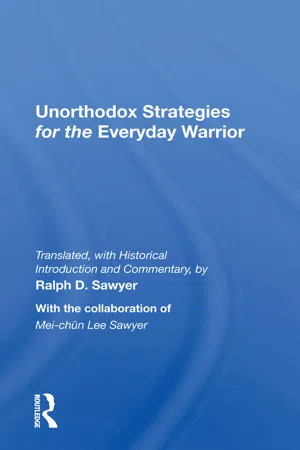
This is a handbook of tactics based on the ancient Chinese military classics. This unique work draws on over two thousand years of experience of warfare to present a distillation of a hundred key strategic principles applicable to modern life, including business and human relations.
eBook - ePub
Unorthodox Strategies For The Everyday Warrior
Ancient Wisdom For The Modern Competitor
- 316 pages
- English
- ePUB (mobile friendly)
- Available on iOS & Android
eBook - ePub
Unorthodox Strategies For The Everyday Warrior
Ancient Wisdom For The Modern Competitor
About this book
Introduction
The history of China, ever portrayed in terms of its glorious culture and storied continuity, differs remarkably from general perceptions and common knowledge, being instead an interminable struggle between the forces of light and dark, culture and brutality, the civil and the martial. For five millennia China has tortuously suffered constant warfare, upheaval, and disintegration, untold millions repeatedly perishing whenever central authority waned and barbaric forces sundered the realm. Powerful generals forged personal domains then exploited the loyalty of troops enamored by promises of great rewards to contend for ultimate power. Millenarian leaders manipulated spiritual beliefs and wreaked havoc in purported quests to realize utopian visions, frequently destroying everything before them, oblivious even to the humanitarian constraints of their own religious precepts. Nomadic peoples repeatedly mounted incursions from out of the steppes, pillaging and plundering the border regions except during brief respites consequent to their decimation by powerful dynastic Chinese armies. Various tribes successively dominated North China for many centuries after the Han, and a few peoples, such as the Mongols and Manchus, conquered all of it through massively destructive campaigns long thereafter. In short, virtually every year witnessed a major battle somewhere in China, significant conflicts erupted nearly every decade, and the nation was consumed by inescapable warfare at least once a century.
Within this context of interminable strife, warfare truly became—as Suntzu, the famous general and strategist, asserted—"the greatest affair of state, the basis of life or death, the Tao to survival or extinction." Accordingly, as battlefield technology improved and combat forces escalated from a few hundred nobles venturing forth in their chariots to hundreds of thousands of infantry troops massed for protracted campaigns, military science—encom-passing organization, tactics, command, and control—also developed and was studied by the professional military men who arose to cope with the growing complexity. Pondering their experiences, they formulated concepts and discerned principles to impose intellectual order upon the apparently chaotic nature of the battlefield. The resulting military manuals eventually furnished the officially sanctioned basis for systematically studying military doctrine, with seven such books, including Sun-tzu's famous Art of War, eventually being designated as canonical when compiled, edited, and published in the Sung dynasty as the Seven Military Classics.
Apart from the earliest periods of the Shang and Chou, and until the introduction of hot weapons and the impact of Western military practices, Chinese warfare showed remarkable tactical continuity. This continuity resulted from three factors: the slow evolution of the three component forces (chariots, cavalry, and infantry) with their relevant weapons groups; the systematic development of tactical doctrine that early assumed written form and was thereafter assiduously studied; and an innate reverence for tradition, for pondering the lessons and examples of the past. China's vaunted examination system, which really became effective in the T'ang, only to become stultifying from the Sung onward, reflected this penchant for revitalizing antiquity, for deliberately imitating the methods of the ancients in order to rectify contemporary shortcomings and deficiencies. This also proved true of the traditions embodied in the Seven Military Classics, although commanders could hardly ignore the ever-evolving nature of warfare and the pressing realities of the battlefield. They would also undoubtedly have been familiar with an incident in the Tso Chuan (reprised in Chapter 39 of the Unorthodox Strategies) where Duke Hsiang of Sung practiced the proper forms and thereby doomed his troops to defeat, and another later in the T'ang where an idealistic general slavishly emulated the ancient employment of battle chariots only to be destroyed by highly mobile cavalry and infantry.
Because imperial exams were also administered in technical subjects and the military arts, there was an added incentive to thoroughly study the orthodox military texts, particularly the Seven Military Classics, the designated basis for exam questions. The lessons derived from these writings not only provided a wide range of tactical knowledge but also furnished the concepts and vocabulary required for commanders to mutually communicate in their specialized area. Warfare thus became a Tao, a way of knowing or a science, encompassing battlefield analysis, enemy assessment, command and control, tactical decisionmaking, and numerous other important aspects of military activity. Analytic in nature, founded upon Sun-tzu's theoretical methods and parameters, Chinese military science was constantly augmented by the experience and ruminations of veteran generals and could be ignored by field commanders only at great peril.
The Unorthodox Strategies not only falls into this tradition but also constitutes a systematic summation of earlier military writings supplemented by historical illustrations that convert an otherwise conventional tactical manual into an astute casebook meriting close study. Composed perhaps at the very end of the Southern Sung dynasty or shortly thereafter, some decades subsequent to the publication of the Seven Military Classics, the unknown author availed himself of China's extensive dynastic histories to ferret out battles that would succinctly reveal the tactical principles in the context of concrete events. Many of these historical incidents preserve dialogues encompassing the commanders' own views, immediately revealing the vibrancy and continued relevance of the classical writings throughout Chinese history despite such important transitions as the shih from chariots to cavalry.
The author—sometimes claimed to be Liu Chi, also known as Liu Powen, of the early Ming dynasty—clearly ascribed to Sun-tzu's belief in the critical nature and importance of warfare. However, instead of initiating the book with this often-quoted thought, he commences with a chapter upon calculation and estimation, no doubt reflecting Sun-tzu's placement of "Initial Estimations" at the beginning of the Art of War to emphasize the analytic aspect of the Tao of warfare. Thereafter the Unorthodox Strategies proceeds with the consideration of some forty paired tactical concepts and a few individual principles, ending with two chapters on the essence of warfare whose concluding role equally stresses their importance. These last two chapters are premised upon a famous statement found in the Ssu-ma Fa— one perhaps still relevant in our troubled world—that states: "Even though a state may be vast, those who love warfare will inevitably perish. Even though calm may prevail under Heaven, those who forget warfare will certainly be endangered." No doubt the unknown author embraced the view that "when action should be taken one who hesitates and is quiet, without advancing, seriously injures all living beings. Weapons are inauspicious instruments, and the Tao of Heaven abhors them. However when their employment is unavoidable it accords with the Tao of Heaven."
Because the Unorthodox Strategies is founded upon Sun-tzu's concepts and adopts his tactics extensively, it almost merits being characterized as an explication of the Art of War. However, while the author obviously assimilated Sun-tzu's characterization of warfare as the Tao of tactics and command and quotes the Art of War in somewhat more than half his tactical discussions, he also fully takes cognizance of the dissimilar tactics and different concepts found in the other canonical military writings and even cites the Analects of Confucius and the earlier Book of Documents on a few occasions. The essential vision is one of maneuver warfare intended to exploit a full array of possibilities, including deception, speed, and even temporizing, to attain the strategic advantage that ultimately translates into overwhelming force suddenly vanquishing a startled enemy. It thus fundamentally differs from the Western penchant for direct, immediate confrontation, for butting strength against strength just as imagized by Greek phalanxes of old clashing on the semi-arid plains or arrays of thousands moronically marching toward each other at measured pace in the nineteenth century. In contrast, while ordinary campaign forces in China eventually numbered 200,000 and probably peaked at a million or more for major invasions, immediately engaging in battle was never the norm.
Although the individual lessons contained in the Unorthodox Strategies clearly discuss the tactical principles, the historical incidents generally illustrate them well, and both have been amplified with our commentary, a few of the book's assumptions and organizing principles might prove useful for orientation. Foremost, all military activities-whether single battles, entire campaigns, or full national mobilizations-require carefully calculating the chances for success. The enemy must be evaluated, and, in accord with methods apparently prevailing from Sun-tzu's era onward, the probability for success quantitatively determined. Naturally this procedure requires intelligence-gathering activities, including the employment of spies, and attempts to undermine the enemy's strengths. Furthermore, the results of this assessment cannot he considered final until contemplated and modified in the context of strategic options that might minimize or even negate enemy advantages in supplies or manpower, such as fatiguing them through forced marches or coercing them onto constricted terrain.
These situational analyses probably proceeded by evaluating the parameters first suggested in the Art of War, structuring the tactical options in terms of paired opposites. The lessons in the Unorthodox Strategies are similarly centered upon complimentary tactical principles, although considerably expanded in their formulation beyond Sun-tzu's original categories. Among the most important might be the natural advantages of Heaven and Earth; quantities of supplies as relatively plentiful or scarce; numbers of men, as few or many; the state of the troops, as well-trained or not, fatigu ed or rested, hungry or well nourished, confident or fearfu4 the commander as experienced or not, capable or ignorant, self-controlled or easily angered, arrogant or humble; and the morale of the contending sides, as fervent or terrified. However, one fundamental conclusion repeatedly emerges from these studies: no single principle can ever dominate nor be applicable in every situation. At times the army should avoid warfare, yet at other times it should forcefully engage in battle even though numerically outnumbered and, except for one or two factors, enmeshed in a situation identical to one previously requiring restraint.
Having determined a battle or campaign to be necessary, the commander must then ponder the possible routes to conquest and strive to realize victory with a minimum expenditure of energy, even without fighting if possible. Among the methods for nonviolent conquest, overawing the enemy with superior military and economic strength represents the ideal, but thwarting the enemy's plans the most realistic. Efforts to achieve the latter would include alliance building, subverting enemy coalitions, assuming preemptory positions, and even refusing battle, an idea less favored by Sun-tzu's original doctrines. Moreover, campaign forces, of whatever size, should strive to confuse the enemy, deceiving them as to intentions and capability, and then strike when and where unexpected. According to Sun-tzu, the formless represents the highest realization of deception. By not revealing any intentions or presenting a discernible form the enemy will be baffled and forced to prepare against all eventualities, even foregoing planned assaults because of their inability to detect weaknesses or "vacuities." Slightly less transcendent, but still effective, would be deliberately creating facades and deceptions, such as feinting east to strike in the west, thereby compelling the enemy to inappropriately commit their defenses or balk their plans. However, although the Unorthodox Strategies discusses several concrete deceptive practices, the concept receives far less emphasis than in such writings as the Art of War and the Six Secret Teachings.
For engaging the enemy in battle, the Unorthodox Strategies presents a wide range of tactical possibilities founded on the operant principle of flexible response, of varying tactics to suit circumstances and situations. Preliminary to the actual engagement would be efforts designed to reduce the enemy's warfare capabilities, to stress and debilitate their forces. These focus on manipulating them in various ways, such as tempting them with apparently easy gains in order to destabilize them, to provoke them into motion and then capitalize upon their disorder and fatigue. Heavily entrenched, overwhelmingly strong, or fervently animated forces should never be directly engaged. Conversely, even when enjoying a vast superiority in troop strength or component forces, the commander should still shape the battle to greatest advantage, weakening and dividing the enemy's units to ensure victory at the least cost. The circumstances should be molded so that the army's strategic power-raw power coupled with positional advantage, an essential concept in Sun-tzu's doctrine-may be explosively employed, just like "the sudden release of a pent-up torrent down a thousand-fathom gorge." When such disproportionate advantages are thus achieved, even mediocre generals in command of average troops cannot fail to achieve shattering victories.
The doctrine of the unorthodox and orthodox, first formulated by Suntzu, appears in the Unorthodox Strategies, but in a much de-emphasized role, perhaps because of the difficulty commanders experienced in implementing such complex tactics with the large armies of their times. In essence, unorthodox tactics are realized through the flexible, imaginative, unconventional employment of forces, while orthodox ones are simply normal, conventional, by-the-book methods. The unorthodox and orthodox are thus inherently interrelated, mutually defining, and highly context dependent. While a number of chapters in the Unorthodox Strategies elucidate tactics that might prove to be unorthodox, depending upon their contextual application, the historical illustration for "Wind in Warfare" furnishes a striking example of the unorthodox because Fu Yen-ch'ing, the commanding general, finding himself downwind of the enemy, nearly blinded by blowing sand, adopted the unexpected but ultimately successful measure of attacking, rather than observing the oft-repeated prohibition never to attack against the wind.
Commanding massive forces capable of complex maneuvers and fully exploiting the numerous deployments articulated by traditional Chinese military science required not only acumen and expertise but also resilience, determination, wisdom, courage, and inspiration. Any general beset by personal weakness or flaws, given to emotional reaction or debilitating traits such as arrogance and greed, would doom his men to death and defeat even before the armies had clashed. Accordingly, the military writings generally devote extensive passages to the character and requisite abilities of generals and officers at every level, while history is replete with examples of successfully manipulating character flaws and exploiting professional weaknesses, including several found as historical illustrations in the Unorthodox Strategies.
Effective commanders must also master the psychology of warfare and always be cognizant of the army's morale, as well as their physical condition and remaining capabilities. Many of the military writings extensively pondered the question of spirit or ch'i (the vital pneuma of life), gradually evolving a comprehensive approach to stimulating and maintaining the soldier's morale, arousing their fighting spirit just before battle, and ensuring their commitment to fight to the death once engaged. However, the early Tso Chuan already contained a passage showing how the soldiers...
Table of contents
- Cover
- Half Title
- Title
- Copyright
- Contents
- Preface
- A Note on Pronunciation
- Chronology of Approximate Dynastic Periods
- Introduction
- Appendix: Historical Characteristics of Chinese Warfare
- Index I: Strategic and Tactical Principles
- Index II: Names, Places, Books, and Special Terms
- Index III: Quotations from the Military Classics
Trusted by 375,005 students
Access to over 1.5 million titles for a fair monthly price.
Study more efficiently using our study tools.
Frequently asked questions
Yes, you can cancel anytime from the Subscription tab in your account settings on the Perlego website. Your subscription will stay active until the end of your current billing period. Learn how to cancel your subscription
No, books cannot be downloaded as external files, such as PDFs, for use outside of Perlego. However, you can download books within the Perlego app for offline reading on mobile or tablet. Learn how to download books offline
Perlego offers two plans: Essential and Complete
- Essential is ideal for learners and professionals who enjoy exploring a wide range of subjects. Access the Essential Library with 800,000+ trusted titles and best-sellers across business, personal growth, and the humanities. Includes unlimited reading time and Standard Read Aloud voice.
- Complete: Perfect for advanced learners and researchers needing full, unrestricted access. Unlock 1.5M+ books across hundreds of subjects, including academic and specialized titles. The Complete Plan also includes advanced features like Premium Read Aloud and Research Assistant.
We are an online textbook subscription service, where you can get access to an entire online library for less than the price of a single book per month. With over 1.5 million books across 990+ topics, we’ve got you covered! Learn about our mission
Look out for the read-aloud symbol on your next book to see if you can listen to it. The read-aloud tool reads text aloud for you, highlighting the text as it is being read. You can pause it, speed it up and slow it down. Learn more about Read Aloud
Yes! You can use the Perlego app on both iOS and Android devices to read anytime, anywhere — even offline. Perfect for commutes or when you’re on the go.
Please note we cannot support devices running on iOS 13 and Android 7 or earlier. Learn more about using the app
Please note we cannot support devices running on iOS 13 and Android 7 or earlier. Learn more about using the app
Yes, you can access Unorthodox Strategies For The Everyday Warrior by Ralph D. Sawyer in PDF and/or ePUB format, as well as other popular books in History & World History. We have over 1.5 million books available in our catalogue for you to explore.