- 279 pages
- English
- ePUB (mobile friendly)
- Available on iOS & Android
eBook - ePub
About this book
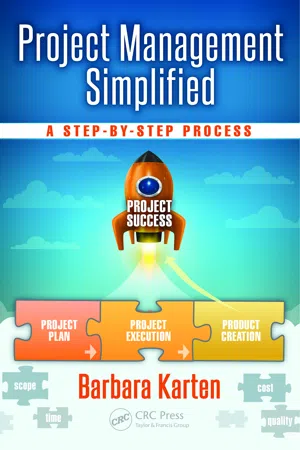
Are projects a problem for you? Do your projects cost too much, take too long, or are just not quite right? If so, Project Management Simplified: A Step-by-Step Process is the book for you. It applies well-defined processes for managing projects to managing change in our lives. It describes an approach modeled on a process used successfully in busi
Chapter 1
Projects
The Big Picture
Are projects a problem? Do your projects cost too much, take too long, or are just not quite right? If so, this book is for you; it is a no nonsense approach to projects—no jargon, just the facts.
Projects are all about change. They are temporary and have a defined beginning and end. They produce something unique; it may be a product, a service, or a result. Projects may be small or large, short term or long term, low risk or high risk. Planting a garden, planning a wedding, or changing jobs are all examples of projects.
Well-defined processes for managing projects have proven effective at delivering project success. This book applies these project processes to managing change in our lives. It views project management as a life skill.
Project management is for everyone; unlike other books about project management, this book focuses on the following:
- Everyday, low technology projects
- Simple, easy-to-use techniques for managing scope, schedule, budget, and quality
- Easily understood, jargon-free explanations of effective project management techniques
- Noncorporate projects
- Nonbusiness-focused project management
The book describes an approach modeled on a project process used successfully in businesses, not-for-profit organizations, schools, and other organizations. The skills and techniques are not unique to businesses and organizations; they are life skills available to everyone. This book presents a simplified version of the complete project management methodologies used in businesses. For simpler, less risky projects, the project and project team may not need all the components used in the business environment.
This is a journey, an adventure. Remember as children, we played a game called “Connect the Dots”? Once we connected all the dots, we had a picture of an animal, a basket, or a vehicle. As we progress through this book, we connect the dots necessary to complete our personal projects. This is our journey from the dreams you imagine to their realization.
The book includes a sample project in the text and a case study in the appendices that further illustrate the concepts explained in the text. This book also challenges the reader to select a project and, working along with the book, be the project manager and develop a project plan for this project. The project manager, working with the customers and funders of the project, defines the project and, based on this project definition, identifies how long it will take and how much it will cost. This begins the picture of connecting the dots.
The project manager writes this information down and builds on the initial information as he progresses through this journey. If he doesn’t write down the information as he creates and collects it, he will likely have conversations as follows:
- Do you remember what we agreed to?
- I don’t remember it that way. I think that we said… .
- We can’t take that long; we need to be finished by the end of the school year.
- I’m sure we agreed on gluten-free alternatives for our guests.
- We said we’d not spend more than $xxx.
To avoid this confusion, the project manager writes down the decisions and agreements as they happen. He documents the information in the project plan.
Once the project manager has a picture of the goal, he identifies processes, methods, tools, and templates that enable the project to reach the goal.
The project manager is really doing two separate things. He identifies the project goals and a plan to reach that goal. Maybe the goal is a thing (like a deck or pool for the yard) or a successful event (like a wedding, trip, or community event), or it might be simply a change (like moving from one place to another or changing jobs). The project is what the stakeholders do to cause the goal to happen. Broadly defined, a stakeholder is anyone positively or negatively affected by the project. We often call the goal “the product”—so we have a product of our project. Building a deck, having a successful event, or effectively changing the place of residence happens as a result of a process—and collectively these processes are our project.
Prior to project initiation, the person paying for the project (called the project sponsor) identifies the high level project and product details in the form of a project charter. This serves as a contract between the sponsor and the project manager; it is the basis for the details of the project.
This book includes information about the project core, project risks, a project toolkit, project context, and project execution.
1.1 The Project Core
Once the project manager has an agreement and sign off on high level project and product details in the project charter, he collects more information and elaborates on the initial project and product details. He talks to the project stakeholders and secures their perspective on the project and the product of the project. He needs to understand their requirements, the “features and functions” they expect, and any considerations with respect to schedule, budget, and quality. He writes down these details and secures ...
Table of contents
- Preface
- Author
- Chapter 1 - Projects: The Big Picture
- Chapter 2 - Project Charter
- Chapter 3 - Project Scope
- Chapter 4 - Project Schedule
- Chapter 5 - Project Budget
- Chapter 6 - Project Quality
- Chapter 7 - Project Risks
- Chapter 8 - Project Toolkit
- Chapter 9 - Project Context
- Chapter 10 - Project Stakeholders
- Chapter 11 - Project Communication
- Chapter 12 - Project Teaming
- Chapter 13 - Connect the Dots: Integrating the Project Components
- Chapter 14 - After the Plan, We Execute
- Chapter 15 - Steps to Execute Your Project
- Glossary
- Appendix A: Community Gardens Project
- Appendix B: Project Charter
- Appendix C: Project Scope Statement
- Appendix D: Work Breakdown Structure
- Appendix E: Work Breakdown Structure with Tasks
- Appendix F: Schedule Network Diagram
- Appendix G: Project Schedule
- Appendix H: Project Budget
- Appendix I: Project Quality Plan
- Appendix J: Risks and Risk Categories
- Appendix K: Risk Scores, Probability and Impact Scales
- Appendix L: Risk Response Plans
- Appendix M: Stakeholder Matrix
- Appendix N: Stakeholder Engagement Matrix
- Appendix O: Project Communication Plan
- Appendix P: Responsibility Assignment Matrices
- Appendix Q: Organization Chart
- Appendix R: Project Execution
Trusted by 375,005 students
Access to over 1.5 million titles for a fair monthly price.
Study more efficiently using our study tools.
Frequently asked questions
Yes, you can cancel anytime from the Subscription tab in your account settings on the Perlego website. Your subscription will stay active until the end of your current billing period. Learn how to cancel your subscription
No, books cannot be downloaded as external files, such as PDFs, for use outside of Perlego. However, you can download books within the Perlego app for offline reading on mobile or tablet. Learn how to download books offline
Perlego offers two plans: Essential and Complete
- Essential is ideal for learners and professionals who enjoy exploring a wide range of subjects. Access the Essential Library with 800,000+ trusted titles and best-sellers across business, personal growth, and the humanities. Includes unlimited reading time and Standard Read Aloud voice.
- Complete: Perfect for advanced learners and researchers needing full, unrestricted access. Unlock 1.5M+ books across hundreds of subjects, including academic and specialized titles. The Complete Plan also includes advanced features like Premium Read Aloud and Research Assistant.
We are an online textbook subscription service, where you can get access to an entire online library for less than the price of a single book per month. With over 1.5 million books across 990+ topics, we’ve got you covered! Learn about our mission
Look out for the read-aloud symbol on your next book to see if you can listen to it. The read-aloud tool reads text aloud for you, highlighting the text as it is being read. You can pause it, speed it up and slow it down. Learn more about Read Aloud
Yes! You can use the Perlego app on both iOS and Android devices to read anytime, anywhere — even offline. Perfect for commutes or when you’re on the go.
Please note we cannot support devices running on iOS 13 and Android 7 or earlier. Learn more about using the app
Please note we cannot support devices running on iOS 13 and Android 7 or earlier. Learn more about using the app
Yes, you can access Project Management Simplified by Barbara Karten in PDF and/or ePUB format, as well as other popular books in Business & Gestione. We have over 1.5 million books available in our catalogue for you to explore.