How cities are planned and designed has a major impact on individuals' mobility and safety. If individuals feel unsafe in public transportation or on the way to it, they may avoid certain routes or particular times of the day. This is problematic, since research has also found that, in some cities, especially those in the Global South, a large percentage of women are "transit captives". Namely, they have relatively less access to non-public forms of transportation and are, therefore, especially reliant on public transport. This issue is important not only because it affects people's safety but also because it influences the long-term sustainability of a city. In a sustainable city, safety guarantees the ability to move freely for everyone and provides a wider sense of place attachment.
Transit Crime and Sexual Violence in Cities examines the evidence of victimization in transit environments in countries around the world, exploring individuals' feelings of perceived safety or lack thereof and the necessary improvements that can make transit safer and, hence, cities more sustainable. The book's contributions are grounded in theories at the crossroads of several disciplines such as environmental criminology, architecture and design, urban planning, geography, psychology, gender and LGBTQI studies, transportation, and law enforcement. International case studies include Los Angeles, Vancouver, Stockholm, London, Paris, São Paulo, Mexico City, Bogotá, Tokyo, Guangzho, Melbourne, and Lagos, among others.
Mobility and safety are important attributes of sustainable cities. A safe and inclusive environment enabling all to participate in urban life without fear of violence and intimidation is essential for sustainability (UN-Habitat Safe Cities, 2018). Indeed, making cities and human settlements safe is one of the key aspirations reflected in Goal 11 of the United Nations’ 2030 Agenda for Sustainable Development (UN, 2019). A safe city is one that includes risk-free environments for all and which allows its residents to move around without fear of victimization. Such movement without fear should not only include transportation by private car, but since cities are looking to reduce single-car driving, also safe public transportation, cycling, and walking.
Yet sexual harassment and other forms of sexual violence in public spaces are everyday occurrences for women and girls around the world and a threat to the overall sustainability of the city. This lack of safety affects many women’s ability to participate with no worry in school, work, and public life. Although violence in the private domain is now widely recognized as a human rights violation, violence against women and girls in public places still remains a largely neglected issue (UN Women, 2017). Recent international research has found that young women in many cities feel unsafe when using public transport and more than half have to regularly modify their behavior and avoid going into public spaces to reduce their risk of harassment (Goulds et al., 2018).
Whether the risk of victimization is real or not, empirical studies have long shown that lack of perceived safety in public places is more prevalent among women than men (Smith and Cornish, 2006; Loukaitou-Sideris, 2012). Fear may affect the way some women engage in travel, leading them to take precautionary measures and strategies that, in turn, influence their travel patterns and constrain their mobility (Lynch and Atkins, 1988). These strategies range from the adoption of certain behavioral mechanisms when in public to choosing specific routes, travel modes, and transit environments over others, or to completely avoiding particular settings and activities (for example, walking, bicycling, or taking the bus) deemed as unsafe.
Feminist theories have problematized the triad of gender, mobility, and transport, emphasizing that they intersect and influence one another in deep and complex ways (Cresswell and Uteng, 2008). Feminist interest stems from the recognition that one’s ability to move in the city denotes freedom, while contrastingly, hindrance of movement and travel signifies exclusion (Hanson, 2010). On the one hand, mobility/immobility impacts the power relations and dynamics embedded in gender; on the other hand, gender affects mobility and transport, differentiating travel patterns and behavior (Hanson, 2010; Loukaitou-Sideris, 2016). Women’s mobility is often more affected than men’s because of fear, and this reflects and reinforces patterns of inequality between genders (Massey, 1994).
In the era of the #MeToo movement, researchers, journalists, and policymakers are finding that a particular hindrance on women’s mobility is their fear of sexual harassment while traveling, especially when using public transport. Such fear stems from a reality that seems quite universal, as incidents of sexual harassment are being reported on buses and trains in cities around the world, and “transit rapes” in New Delhi, Rio, Los Angeles, and Philadelphia have generated public outrage in the past (Best, 2013; Romero, 2013). As explained in a Washington Post article titled “Why the #MeToo movement is a public transportation issue,” many instances of sexual harassment for women commonly happen in public transportation settings. According to the article: “For many, it’s a depressing but foregone conclusion: If you’re a woman who rides public transportation, you’re almost guaranteed to experience the kinds of demeaning or threatening encounters that fit squarely within the bounds of the #MeToo conversation” (Powers, 2017).
If public transportation is not reliable or safe, women’s mobility is impaired (Ceccato, 2017a). Although women are most often the target of these types of behaviors, they are not the only victims. Studies have found evidence that gay men and transgender or non-gender conforming individuals are often victims of sexual harassment and violence in the São Paulo metro (Ceccato and Paz, 2017). This calls for a holistic approach to safety that encompasses an understanding of the intersectionality of victimization and fear, namely the idea that fear and victimization are not only influenced by gender but are rather a result of the intersection of an individual’s characteristics. For instance, being a disabled young student creates synergetic layers of disadvantage that affect how one experiences the world and expresses fear (Ceccato, 2017b). In this book, victimization and fear are examined through an intersectional lens, considering not only gender or age, but also sexual orientation, and for some cities race/ethnicity and age differences (see also Chapter 23).
How cities are planned and designed also has a major impact on an individual’s mobility and safety (Ceccato and Newton, 2015). If transportation environments such as train stations and bus stops are poorly designed and ill managed, they too can affect people’s willingness to use them. They can also attract a number of crimes, including sexual violence (Ceccato, 2014; Ceccato et al., 2018). This is problematic since research has also found that, in some cities, especially those in the Global South, a large percentage of women are “transit captives,” namely, they have relatively less access to non-public forms of transportation and are, therefore, overly reliant on public transport. For those with access to private cars, desolate bus stops or pedestrian paths in poorly designed environments may be just the last drop in their decisions to take a car to work instead. This issue is not only important because it affects people’s safety but also because it influences the long-term sustainability of a city.
Aims, Scope, and Context
This book examines the evidence of victimization in transit environments, feelings of perceived safety or lack thereof, and the necessary improvements that can make transit safer and, hence, cities more sustainable. More specifically, the aim of the book is to characterize the dynamics of transit crime, in particular sexual harassment and violence, from the perspective of those who are most targeted by these offenses, namely young people. Focus is given to the relationship between safety and the types of environments that individuals are exposed to when they travel by transit. The book focuses on women but also adopts a more holistic approach by considering the intersectionality of safety of young adults as transit passengers; it presents examples from a variety of cities worldwide, giving voices to young people from several countries in the Global North and the Global South.
Studies find that the majority of the victims of sexual harassment on transit are young people. For this reason, the book focuses on university students in 18 cities. Around the world, the vast majority of university students are between 18 and 29, an age group that is affected more than other age groups from sexual harassment and assault (Beller et al., 1980; Tripathi et al., 2017). Additionally, the age group between 18 and 29 is one of the most active segments of the population, having special daily and nocturnal routine activities. Typically, university students also have lower incomes and lower car ownership rates in many cities than the general public and may have to rely on transit more extensively than many other urban residents. At the same time, researchers can reach large numbers of university students more easily than other groups through their universities. Indeed, some of the authors in this book were able to partner with campus transportation service departments or other university authorities and survey transit pass holders, thus increasing the likely yield of survey respondents. Lastly, university students are more similar to each other in age than the general population, and this allows researchers to control for some factors in the analysis, and also have comparisons in the patterns of transit use and feelings of safety among students globally.
Studies show that the perception of personal security has a significant influence on travel patterns, and concern over lack of safety is an important reason why some individuals choose not to use transit (Hartgen et al., 1993; Loukaitou-Sideris, 1993; DfT, 2004). It is then possible that concerns about safety constrain the mobility of some student segments, possibly leading them to avoid public transit, or only using it during certain hours. This may create a “gender gap” in mobility and cause transportation inequity as women are typically found to be more reluctant to walk, bike, or use public transit out of safety concerns (Loukaitou-Sideris, 2016). In addition to this social justice concern, cities around the world often wish to encourage the use of transit over the private automobile to avoid traffic congestion and also reduce greenhouse gas emissions. Indeed, some universities and municipal governments commonly provide transit pass subsidies or offer reduced transit fares to students to encourage transit use among them. If fewer students feel comfortable using transit, more students are likely to drive to campus, thus contributing to traffic congestion and lower air quality.
Definitions and Terms
In this section, we define the most common terms used in this edited volume. This set of definitions and terms is expected to support the reading of the chapters that follow.
Victimization and safety perceptions. In this book we adopted the two UN-Habitat dimensions of safety and security: actual and perceived. Actual safety/security refers to the risk of becoming a crime victim, measured by a variety of metrics and crime statistics, while perceived safety/security refers to people’s safety perception through the lens of fear and anxiety. In many cases, urban dynamics and socio-spatial characteristics have an influence on whether a city has high levels of crime and violence. Spatial, social, and economic fragmentation and exclusion feed insecurity and vice versa (UN-Habitat Safe Cities, 2018).
Public transport or public transportation is the term used here to capture what North American readers often call “public transit,” “mass transit,” or “rapid transit” systems (Newton, 2014, 709). These systems, such as trains, buses, and trams compose forms of transport that are available to the public, charge set fares, and run on fixed routes. In this book, the type of transit systems may vary from city to city.
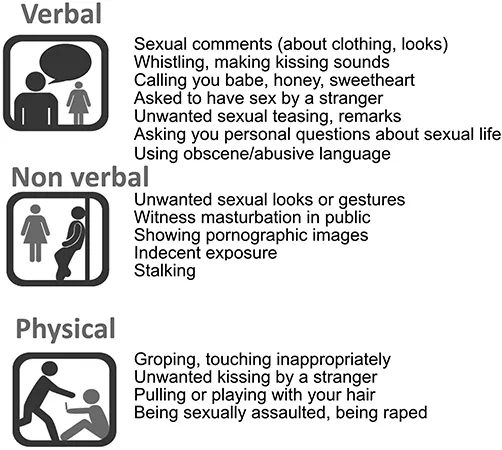
Sexual offenses and crimes can be a vast array of sexual behaviors that range from sexual harassment to sexual assault. The boundaries between these types of acts are blurred (Figure 1.1). As early as in the 1990s, Cohan and Shakeshaft (1995) distinguished between what they called “non-contact” and “contact” sexual violence. In the non-contact category, they included non-verbal sexual abuse and verbal sexual abuse, while in the contact category, they included sexual abuse such as touching, kissing, and rape.
Figure 1.1 Types of sexual violence in public places
Source: Adapted from RedDot Foundation SafeCity initiative by ...
Table of contents
Cover
Endorsements
Half Title
Title Page
Copyright Page
Dedication
Table of Contents
List of Figures
List of Tables
List of Contributors
Foreword
Acknowledgments
PART I: Transit Crime and Sexual Violence: An Introduction
PART II: Case Study Cities
PART III: Understanding Transit Crime and Sexual Violence: Crosscutting Themes
PART IV: Conclusions
Appendix – Survey: Women’s Transit Safety
Index
Trusted by 375,005 students
Access to over 1.5 million titles for a fair monthly price.
Study more efficiently using our study tools.
Frequently asked questions
Yes, you can cancel anytime from the Subscription tab in your account settings on the Perlego website. Your subscription will stay active until the end of your current billing period. Learn how to cancel your subscription
No, books cannot be downloaded as external files, such as PDFs, for use outside of Perlego. However, you can download books within the Perlego app for offline reading on mobile or tablet. Learn how to download books offline
Perlego offers two plans: Essential and Complete
Essential is ideal for learners and professionals who enjoy exploring a wide range of subjects. Access the Essential Library with 800,000+ trusted titles and best-sellers across business, personal growth, and the humanities. Includes unlimited reading time and Standard Read Aloud voice.
Complete: Perfect for advanced learners and researchers needing full, unrestricted access. Unlock 1.5M+ books across hundreds of subjects, including academic and specialized titles. The Complete Plan also includes advanced features like Premium Read Aloud and Research Assistant.
Both plans are available with monthly, semester, or annual billing cycles.
We are an online textbook subscription service, where you can get access to an entire online library for less than the price of a single book per month. With over 1.5 million books across 990+ topics, we’ve got you covered! Learn about our mission
Look out for the read-aloud symbol on your next book to see if you can listen to it. The read-aloud tool reads text aloud for you, highlighting the text as it is being read. You can pause it, speed it up and slow it down. Learn more about Read Aloud
Yes! You can use the Perlego app on both iOS and Android devices to read anytime, anywhere — even offline. Perfect for commutes or when you’re on the go. Please note we cannot support devices running on iOS 13 and Android 7 or earlier. Learn more about using the app
Yes, you can access Transit Crime and Sexual Violence in Cities by Vania Ceccato,Anastasia Loukaitou-Sideris in PDF and/or ePUB format, as well as other popular books in Ciencias sociales & Planificación urbana y paisajismo. We have over 1.5 million books available in our catalogue for you to explore.