eBook - ePub
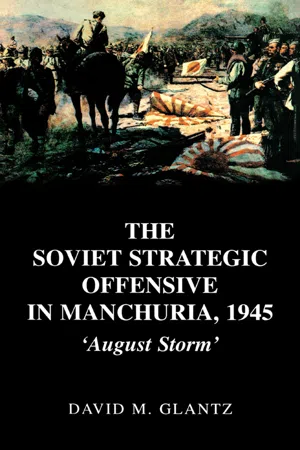
The Soviet Strategic Offensive in Manchuria, 1945
'August Storm'
- 288 pages
- English
- ePUB (mobile friendly)
- Available on iOS & Android
eBook - ePub
About this book
This critical examination of the final Soviet strategic offensive operation during World War II seeks to chip away at two generally inaccurate pictures many Westerners have of the war. Specifically, Westerners seem to think that only geography, climate, and sheer numbers negated German military skill and competency on the eastern front, a view that
Information
Part I:
Before the Offensive
1
Preparations for the Manchurian Strategic Offensive
BACKGROUND
Despite negotiating a non-aggression pact with Nazi Germany in August 1939, during the perilous days after the beginning of the Second World War in September, Stalin and the Red Army General Staff realized that Germany still posed a considerable military threat to the Soviet Union. Therefore, from September 1939 to the outbreak of the Soviet-German War in June 1941, the Soviet political leadership and General Staff formulated a military policy and strategy that sought to defend the Soviet Union against the frightening prospect of a war on two fronts. This defensive strategy accorded priority, first and foremost to the west, and secondarily to the east. In the west, the Soviets exploited their agreement with Germany for a partition of eastern Europe by subsequently occupying and annexing the Baltic States and Belorussia. The policy also promoted Stalin to wage war against Finland after Soviet threats had failed to intimidate that small nation.
Soviet defensive concerns assumed even greater urgency after the spring of 1940 when German forces seized Denmark, Norway, the Low Countries, and France, and drove British forces from the continent. Subsequent Soviet war planning reflected this urgency. In July 1940 the General Staff prepared a new strategic plan, drafted by Major General A.M.Vasilevsky, Deputy Chief of the General Staff’s Operations Division and approved by B.M. Shaposhnikov, the Chief of the Red Army General Staff.1 Like previous plans, this plan postulated an attack by Germany supported by Italy, Finland, Rumania, and possibly Hungary against the western Soviet Union and by Japan in the Soviet Far East. The General Staff assessed a total threat of 270 infantry division, 11,750 tanks, 22,000 guns, and 16,400 aircraft, the bulk of which would be directed against the most critical western theater. Soviet strategic deployment in accordance with this plan required the formation of three wartime fronts in the western theater: the northwestern and western protecting the main strategic axis and the southwestern protecting the region south of the Pripiat Marshes.
The General Staff planned to employ the Far Eastern Front and Trans-Baikal Military District, whose forces manned the boundaries of Japanese-occupied Manchuria, to deal with the Japanese threat to the Far East. The Far Eastern Front, whose original name was the Red Banner Far Eastern Front, had been organized in late June 1938 from the Special Red Banner Far Eastern Army. Initially, the front consisted of the 1st and 2d Red Banner Armies and the Khabarovsk Group of Forces. After the battle with the Japanese at Lake Khasan in late summer 1938, the General Staff disestablished the front, only to form it again in July 1940 on the base of the Chita Front Group of Forces with its subordinate 1st and 2d Separate Red Banner and 15th Armies and Northern Army Group. The Stavka added the 25th and 35th Armies to the front in July 1941.2
The Trans-Baikal Military District had been formed in May 1935 on the base of the Special Red Banner Far Eastern Army’s Trans-Baikal Group of Forces. When war began in 1941, it included the territory of Irkutsk and Chita oblasts [regions] and Buriat-Mongolian and lakutsk ASSRs, and its headquarters was at Chita. From June 1941 the military district consisted of the 16th and 17th Armies, and after July 1941, the 36th Army. Soon after the outbreak of war, the Stavka transferred the 16th Army to its reserve and then westward to the Smolensk region to reinforce the Western Front. The Trans-Baikal Military District then mobilized fresh forces to defend its borders with Manchuria. In September 1941 the Stavka reorganized the military district into the Trans-Baikal Front consisting of the 17th and 36th Armies, and after August 1942, the 12th Air Army.3
Diplomatic measures supplemented the Soviet’s new military strategy. As an adjunct to war planning, the Soviet government sought to defuse the threat in the east by signing a non-aggression pact with Japan, which would in turn allow the Soviet State to pay principal attention to its western borders and the German threat. Since it was angry over the German—Soviet non-aggression pact of 1939, which it viewed as a violation of its Anti-Comintern Pact with Germany, in April 1941 the Japanese signed a pact of neutrality with the Soviet Union.4
Reassured by its non-aggression pact with Japan but distressed over Germany’s evident mobilization, the Soviet Union began a strategic regrouping of forces from the Far East in the spring of 1941. In the second half of April, the People’s Commissariat of Defense [Narodnyi komissariat oborony—NKO] decided to reinforce its forces in the West at the expense of forces stationed in the Far East and Trans-Baikal regions. By 22 June 1941, it had dispatched the field headquarters of the 16th Army, two rifle and one mechanized corps, and two airborne brigades westward. This force, which included two rifle and two tank divisions, one motorized division and two separate regiments with a total strength of more than 57,000 men, 670 guns and mortars, and 1,070 light tanks, later participated in the Western and Southwestern Fronts’ defensive operations during the tragic initial months of war.5
SOVIET WARTIME STRATEGY VIS–Á–VIS JAPAN
The Soviet-Japanese neutrality pact benefited the Soviet Union immensely after June 1941 by partially mitigating against the adverse effects of the German Operation Barbarossa and permitting the Soviet Union to devote its energies to meeting and defeating the German threat. Despite the pact’s existence, however, the fragility of the earlier German—Soviet nonaggression pact and its violation by Germany prompted Stalin to suspect that the same fate might befall his pact with Japan. Consequently, while the Soviet Union shifted its strategic attention westward, nagging concerns over Japanese actions forced the Stavka (Headquarters of the Supreme High Command), which directed the Soviet war effort after late June 1941, to maintain strong defenses in the Far East. After December 1941, however, Japanese involvement in a Pacific war with the United States largely negated Soviet concerns over its eastern flank.
From 22 June 1941 through mid-1944, Stalin and his Stavka applied to the conduct of the war strategic concepts that had been fundamental tenets of Soviet military strategy during the 1920s and 1930s. In particular, the Soviet Union accorded the highest priority to, first, the conduct of strategic defense in the west to halt the German invasion and, second, the conduct of strategic offensive operations to defeat Nazi Germany. Whether or not Japan entered the war, the Soviet Union’s survival depended on successful defense and, ultimately, counteroffensive action in the west. All Soviet strategic measures served that essential end. Virtually from the first day of the war, Stalin and his military advisers shifted vital military resources westward from the Far East. All subsequent Soviet strategists agree that ‘The forces of the Far Eastern Military District made a worthy contribution to the overall matter of victory in the great Patriotic War.’6
In June 1941 Stalin ordered the Far Eastern Front and Trans-Baikal Military District to erect firm defenses along the Manchurian and Korean border and on 29 June begin transferring westward the bulk of their well-trained and battle-tested divisions.
To defend their territories once their best forces had departed, commanders in the East relied heavily on 14 fortified regions (12 in the Far Eastern Front and two in the Trans-Baikal Military District), some of which had been created as early as 1932, but the bulk of which were formed between 1938 and August 1941. Fortified regions [ukreplennyi raion—UR] consisted of from eight to 12 machine gun-artillery and antitank battalions positioned in increasingly well-fortified defensive positions. Although they were dispersed along the entire Soviet-Manchurian border, most of these fortified regions were concentrated in eastern Manchuria, ‘since it was in this area that the Soviets expected the main body of the Japanese Army to attack’ should hostilities break out.7 Japanese sources recognized their defensive nature, noting, ‘There is no room to doubt the initially defensive nature of the URs.’8
Behind this fortified defensive shield, the Soviets maintained a skeletal force structure in the Far East made up of rifle divisions, cavalry divisions, and a minimal number of mixed formations. After 22 June 1941, the vast majority of other forces moved westward to play a vital role in the war in the west, even though the Stavka still had reason to be concerned about its eastern flank.9 The force the Stavka allocated for wartime defense in the Far East was based on the assumption that it was possible to conduct a two-front war successfully if sufficient forces could be mustered to defend the Far East. The Stavka assumed ‘that Japan could allocate up to 50 divisions, 1,200 tanks, and 3,000 aircraft against the Soviet Union’. Therefore, ‘it was necessary to have 33–34 divisions and a specific quantity of forces and ships in the Pacific Fleet to guarantee fully a stable situation and for defense of the Far Eastern borders’.10
The wartime deployment of Red Army forces from the Far East to the west began in early July 1941 and accelerated thereafter. From July through November, the Stavka recalled 13 rifle, tank, and motorized divisions from the Far East, divisions that subsequently played a significant role in halting German forces on the approaches to Moscow and in launching the Red Army’s ensuing Moscow counteroffensive.11 A second wave of Far Eastern divisions, sent westward in 1942, contributed to Red Army success at Stalingrad in November 1942. This included two rifle divisions between 5 December 1941 and 30 April 1942 and ten rifle divisions and four rifle brigades with a total of 150,000 men and more than 1,600 guns and mortars between 1 May and 19 November 1942.12
Later still, in the winter of 1942–43, the NKO transferred one rifle division, three cavalry divisions, six howitzer artillery brigades, and three mortar regiments totaling 35,000 men, 557 guns and mortars, and 32 light tanks westward to reinforce the post-Stalingrad offensive.13 The transfers decreased sharply as Red Army combat fortunes soared in the summer of 1943. From March to May 1943, the NKO shipped eight newly formed howitzer artillery brigades with 9,000 men and 230 guns back to the west, and in 1944 an airborne brigade and four howitzer artillery regiments.14
In total, from 1941 to 1945, the Stavka redeployed 39 divisions, 21 brigades, and ten regiments totaling 402,000 men, 5,000 guns and mortars, and more than 3,300 tanks from the Far East to the western theater. In addition, it also sent as many as 150,000 personnel replacements.15 Deprived of these forces, by December 1941 Red Army strength in the Far East had dwindled to 32 divisions or divisional equivalents, barely enough to defend in accordance with the General Staff’s calculations.
Throughout the period from June 1941 through January 1944, Red Army forces in the Far East remained on the strategic defense, although the army’s strength in the region slowly crept up from 32 to 48 divisional equivalents.16 By mid–1944, when it became apparent that victory in the west was only a matter of time, Soviet strategic planners began entertaining thoughts of an offensive in the Far East and adjusted their Far Eastern strategic posture accordingly.
TRANSITION FROM DEFENSE TO OFFENSE, 1941–44
The Stavka began strengthening its strategic posture in the Far East in earnest during the summer of 1943 in the expectation that offensive operations would be required in the future. In August it formed the Coastal Group of Forces (the 1st and 25th Armies and the 9th Air Army) from the existing Far Eastern Front. This group, initially under 25th Army control, took over the ‘deployment of forces and responsibility for the separate coastal strategic axis protecting the approaches from the Far East into eastern Manchuria.’17 Ultimately, it provided the basis for the formation of the 1st Far Eastern Front in 1945.
Throughout the summer of 1943, the General Staff transferred personnel between theaters to improve its expertise on Far Eastern matters. The General Staff brought Major General N.A.Lomov from his previous position as Deputy Chief of Staff of the Far Eastern Front to the Operational Directorate of the General Staff, where he began serving as deputy to Lieutenant General S.M.Shtemenko, the directorate’s chi...
Table of contents
- Cover Page
- Title Page
- Copyright Page
- Illustrations
- Maps
- Figures, Tables and Charts
- Preface
- Abbreviations
- Symbols
- Introduction
- Part I: Before the Offensive
- Part II: The Conduct of the Offensive
- Part III: Analysis and Conclusions
- Appendix 1: Kwantung Army’s Order of Battle, 30 July 1945
- Appendix 2: Actual Strength of Kwantung Army Components at Outbreak of Hostilities (August 1945) and Killed-in-Action Estimates
- Appendix 3: The Operational Strength of Kwantung Army Forces, 9 August 1945
- Appendix 4: The Soviet Far East Command’s Order of Battle, 9 August 1945
- Appendix 5: Operational Indices of the Manchurian Offensive
- Appendix 6: Soviet Documents on Operations in Manchuria
- Appendix 7: Soviet Documents on Operations on Southern Sakhalin, the Kuril Islands, and Hokkaido
- Appendix 8: Japanese Maps Showing the Daily Development of Operations in Manchuria
- Bibliography
Trusted by 375,005 students
Access to over 1.5 million titles for a fair monthly price.
Study more efficiently using our study tools.
Frequently asked questions
Yes, you can cancel anytime from the Subscription tab in your account settings on the Perlego website. Your subscription will stay active until the end of your current billing period. Learn how to cancel your subscription
No, books cannot be downloaded as external files, such as PDFs, for use outside of Perlego. However, you can download books within the Perlego app for offline reading on mobile or tablet. Learn how to download books offline
Perlego offers two plans: Essential and Complete
- Essential is ideal for learners and professionals who enjoy exploring a wide range of subjects. Access the Essential Library with 800,000+ trusted titles and best-sellers across business, personal growth, and the humanities. Includes unlimited reading time and Standard Read Aloud voice.
- Complete: Perfect for advanced learners and researchers needing full, unrestricted access. Unlock 1.5M+ books across hundreds of subjects, including academic and specialized titles. The Complete Plan also includes advanced features like Premium Read Aloud and Research Assistant.
We are an online textbook subscription service, where you can get access to an entire online library for less than the price of a single book per month. With over 1.5 million books across 990+ topics, we’ve got you covered! Learn about our mission
Look out for the read-aloud symbol on your next book to see if you can listen to it. The read-aloud tool reads text aloud for you, highlighting the text as it is being read. You can pause it, speed it up and slow it down. Learn more about Read Aloud
Yes! You can use the Perlego app on both iOS and Android devices to read anytime, anywhere — even offline. Perfect for commutes or when you’re on the go.
Please note we cannot support devices running on iOS 13 and Android 7 or earlier. Learn more about using the app
Please note we cannot support devices running on iOS 13 and Android 7 or earlier. Learn more about using the app
Yes, you can access The Soviet Strategic Offensive in Manchuria, 1945 by David Glantz,David M. Glantz in PDF and/or ePUB format, as well as other popular books in Politics & International Relations & Military & Maritime History. We have over 1.5 million books available in our catalogue for you to explore.