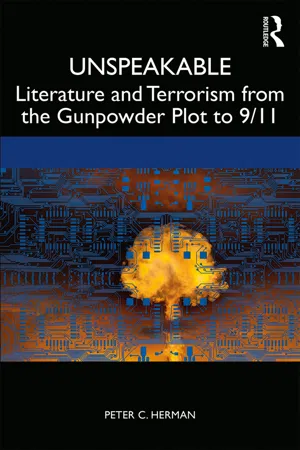
Unspeakable: Literature and Terrorism from the Gunpowder Plot to 9/11 explores the representation of terrorism in plays, novels, and films across the centuries. Time and time again, writers and filmmakers including William Shakespeare, Joseph Conrad, Henry James, Gillo Pontecorvo, Don DeLillo, John Updike, and Steven Spielberg refer to terrorist acts as beyond comprehension, "a deed without a name," but they do not stop there. Instead of creating works that respond to terrorism by providing comforting narratives reassuring audiences and readers of their moral superiority and the perfidy of the terrorists, these writers and filmmakers confront the unspeakable by attempting to see the world from the terrorist's perspective and by examining the roots of terrorist violence.
- 212 pages
- English
- ePUB (mobile friendly)
- Available on iOS & Android
eBook - ePub
About this book
Information
1
“A Deed Without a Name”
Macbeth, the Gunpowder Plot, and Terrorism
The Gunpowder Plot
In 1605, a group of disaffected Catholics, horribly disappointed by King James’s rejection of his earlier promises of religious toleration (James never admitted that he gave them any such hopes), decided that they had no choice but to strike a blow against the source of their oppression, and so they plotted to blow up the English parliament on its opening day, thus destroying, as the Venetian ambassador, Nicolo Molin, puts it in his diplomatic report to his superior, “the King, Queen, Princes Clergy, Nobility and Judges … , and thus to purge the kingdom of perfidious heresies.” 1 The plotters also intended to kidnap the King’s surviving children, and put on the throne someone who would return England to Catholicism.
That is not how things worked out. The plot was discovered in time, some participants were killed trying to evade capture, others were apprehended, tried, and quickly executed. Even so, the plot’s discovery and the possibility that nearly the entire ruling class would be killed in one terrible conflagration (in a remarkable parallel to the panic following 9/11) thoroughly traumatized the king and London generally. 2 If the object of terror is to terrorize, then Molin’s dispatch shows that the plot succeeded admirably even though the barrels never exploded: 3
The King had let it be known that he wished to have the Scots about his person, as he has not much confidence in the English, who know this and are greatly annoyed. The King is in terror; he does not appear nor does he take his meals in public as usual. He lives in the innermost rooms, with only Scotchmen about him. The Lords of the Council also are alarmed and confused by the plot itself and the King’s suspicions; the city is in great uncertainty; Catholics fear heretics, and vice-versa; both are armed; foreigners live in terror of their houses being sacked by the mob that is convinced that some, if not all, foreign Princes are at the bottom of the plot. The King and Council have very prudently thought it advisable to quiet the popular feeling by issuing a proclamation, in which they declare that no foreign Sovereign had any part of the conspiracy. God grant this be sufficient, but as it is everyone has his own share of alarm.
The plotters unfortunate enough to be caught did not hide their motivations or what they intended to happen. The terrorists, in other words, spoke to their captors, and they spoke very clearly. In his written confession (after, it must be remembered, extensive torture to wring out of him the names of his fellow conspirators), Guy Fawkes told his interrogators that he and four others, “for reliefee of the Catholique cause” in England, decided to set “a Myne under the upper House of Parliament: which place wee made choice of the rather, because Religion having been universally suppressed there, it was fittest the Justice and punishment should be executed there.” 4 Sir Edward Digby, declared at his trial that he joined this plot for: 5
the cause of Religion, which alone, seeing (as hee sayd) it lay at the stake, hee entred into resolution to neglect in that behalfe, his estate, his life, his name, his memorie, his posterities, and all worldly and earthly felicitie whatsoever, though he did utterly extirpate, and extinguish all other hopes, for the restoring of the Catholike Religion in England. His third Motive was, that promises were broken with the Catholikes. And lastly, That they generally feared harder Lawes from this Parliament against Recusants, as that Recusants wives, and women should bee liable to the mulct as well as their husbands, and men. And further, that it was supposed, that it should be made a Praemunire [meaning, one is loyal to someone other than the English monarch, a capital crime in early modern England], onely to be a Catholike.
A contemporary manuscript explaining and partly justifying the events by the Jesuit, Oswald Tesimond, probably intended for circulation among the English community in Rome, also provides a clear explanation for the reasons behind the plot: 6
[Robert Catesby] decided after much reflection to gather together all the enemies of the catholic religion in England and get rid of them in one single blow. Liberty and religion would then be restored to catholics with no resistance. To carry out this resolve, the best way seemed to him to await the reassembly of parliament, when the three estates of the realm would all be together with the king, councillors, puritans and bishops. These were all of them determined that in that time and place they would give the final death blow to the catholic cause, as we have said. In that same moment of time, the plotters hoped to bring upon their heads the evil they had designed for others.
In addition, Tesimond’s manuscript demonstrates the plotters’ concern for what we would call today “spin.” The plotters were keenly aware that they, not their oppressors, needed to shape the interpretation of the event, and so they procured
a ship which was to serve for no other purpose than to cross over to Flanders at the very moment of the explosion. This was to give news of the deed to the rulers of Christendom, to forestall adverse reports put out by enemies and to present the facts in the best light possible. 7
When their deed “spoke,” as it were, they wanted to ensure that it reflected their perspective, not their enemy’s.
But King James and the other intended victims of the plot would not or could not comprehend what they were hearing. To them, the plot was literally unspeakable, unthinkable, and indescribable. On November 9, 1605, four scant days after the plot was uncovered, James gave a speech before Parliament declaring that he had not the words to describe what the plotters intended. James had endured attempted assassination before, and he understood it. The Gunpowder Plot, however, was something else entirely: 8
But in this, which did so lately fall out, and which was a destruction prepared not for me alone, but for you all that are here present, and wherein no ranke, age, nor sexe should have bene spared; This was not a crying sinne of blood, as the former [plot to assassinate James], but it may well be called a roaring, nay a thundring sinne of fire and brimstone, from the which GOD hath so miraculously delivered us all. What can I speak of it? And therefore I must for horror say with the Poet, Vox faucibus haeret [My voice sticks in my throat] … the like was never either heard or read.
James was not alone in invoking the rhetoric of absolute originality leading to the failure of speech and language. The next day, November 10, the Bishop of Rochester, William Barlow, at the government’s behest, delivered a sermon at Paul’s Cross in which he also grasped for words beyond his reach. Barlow described the Plot as “a production without a match, … a Treason without Parallel; a slaughter beyonde comparison.” 9 Robert Cecil, the Earl of Salisbury, uses nearly the same phrase in a letter dated November 14, 1605 to Sir Thomas Edmondes: “By my last letters you have received the particulars of that horrible attempt which hath no example in no ages.” 10
Doubtless, James, Barlow, and Salisbury are right when they claim that the Gunpowder Plot represented a new form of political violence. Political assassinations were hardly unknown at the time. Both Elizabeth and James endured several attempts on their lives; Henry III and Henry IV of France were assassinated; and the religious wars in France demonstrated for all to see how doctrinal fanaticism could lead to mass murder, the St. Bartholomew Day Massacre in 1572 being only the best known of many such events. Yet there was truly something new in the attempt to “decapitate” England, and consequently, the “unspeakability” of the plot became its defining rhetorical trope.
In his indictment of the plotters, Sir Edward Phillips, “his Majesties Sergeant at Law,” begins his brief by admitting that the matter may be: 11
Treason; but of such horror, and monstrous nature, that before now,
The Tongue of man never delivered.
The Ear of man never heard.
The Heart of man never conceited.
Nor the malice of hellish or earthly devil ever practiced.
Attorney-General Coke began his prosecution by stressing how this treason is so novel and so terrible, that, to use Kristiaan Versluys’s phrase, the Plot constitutes “a limit event that shatters the symbolic resources of the culture”: 12
Now touching the offences themselves, they are so exorbitant and transcendent, and aggregated of so many bloody and fearefull crimes, as they cannot be aggravated by any inference, argument or circumstance whatsoever, and that in three respects: First, because this offense is Prima impressionis, and therefore sine Nomine, without any name which might bee adaquatum sufficient to expresse it, given by any Legist, that ever made or writ of any Lawes. For the highest Treason that all they could imagine, they called it only Crimen lasae Majestatis, the violating of the Majesty of the Prince. But this Treason doth want an apt name.
A year later, two neo-Latin epics would also describe the plot as something “unheard of” (“inaudito”), a deed so nefarious that not even the most creatively evil nations the world has known could conceive of it:
of which neither the Carthaginians infamous in the name of perfidy nor the cruel Scyth...
Table of contents
- Cover
- Half-Title
- Title
- Copyright
- Dedication
- CONTENTS
- List of Figures
- Acknowledgments
- Introduction: Speakable/Unspeakable: The Rhetoric of Terrorism
- 1 “A Deed Without a Name”: Macbeth, the Gunpowder Plot, and Terrorism
- 2 Terrorism in the Nineteenth Century: From the French Revolution to the Stevensons, Greer, James, Conrad, and the Rossetti Sisters
- 3 When Terrorism becomes Speakable: Pontecorvo’s The Battle of Algiers and the Literature of the Troubles
- 4 Israel/Palestine: Unspeakability in John le Carré’s The Little Drummer Girl, Steven Spielberg’s Munich, and Mohammed Moulessehoul [Yasmina Khadra]’s The Attack
- 5 “Why Do They Hate Us?”: Updike, Hamid, DeLillo
- Epilogue: Where Do We Go from Here? Nadeem Aslam, Amy Waldman, and Jodi Picoult
- Index
Trusted by 375,005 students
Access to over 1.5 million titles for a fair monthly price.
Study more efficiently using our study tools.
Frequently asked questions
Yes, you can cancel anytime from the Subscription tab in your account settings on the Perlego website. Your subscription will stay active until the end of your current billing period. Learn how to cancel your subscription
No, books cannot be downloaded as external files, such as PDFs, for use outside of Perlego. However, you can download books within the Perlego app for offline reading on mobile or tablet. Learn how to download books offline
Perlego offers two plans: Essential and Complete
- Essential is ideal for learners and professionals who enjoy exploring a wide range of subjects. Access the Essential Library with 800,000+ trusted titles and best-sellers across business, personal growth, and the humanities. Includes unlimited reading time and Standard Read Aloud voice.
- Complete: Perfect for advanced learners and researchers needing full, unrestricted access. Unlock 1.5M+ books across hundreds of subjects, including academic and specialized titles. The Complete Plan also includes advanced features like Premium Read Aloud and Research Assistant.
We are an online textbook subscription service, where you can get access to an entire online library for less than the price of a single book per month. With over 1.5 million books across 990+ topics, we’ve got you covered! Learn about our mission
Look out for the read-aloud symbol on your next book to see if you can listen to it. The read-aloud tool reads text aloud for you, highlighting the text as it is being read. You can pause it, speed it up and slow it down. Learn more about Read Aloud
Yes! You can use the Perlego app on both iOS and Android devices to read anytime, anywhere — even offline. Perfect for commutes or when you’re on the go.
Please note we cannot support devices running on iOS 13 and Android 7 or earlier. Learn more about using the app
Please note we cannot support devices running on iOS 13 and Android 7 or earlier. Learn more about using the app
Yes, you can access Unspeakable by Peter C. Herman in PDF and/or ePUB format, as well as other popular books in Letteratura & Critica letteraria storica. We have over 1.5 million books available in our catalogue for you to explore.