eBook - ePub
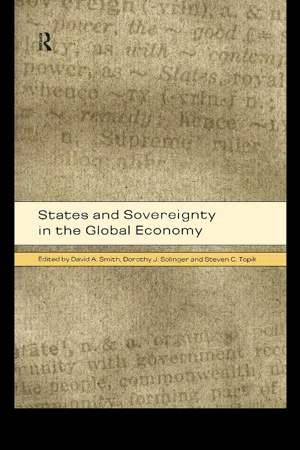
States and Sovereignty in the Global Economy
- 304 pages
- English
- ePUB (mobile friendly)
- Available on iOS & Android
eBook - ePub
States and Sovereignty in the Global Economy
About this book
Globalization and the role of the state are issues at the forefront of contemporary debates. With editors and contributors of outstanding academic repututation this exciting new book presents an unconventional and radical perspective. Revealing that states do still matter despite the vigour of international capital flows and the omnipresence of the
1 States? Sovereignty?
The dilemmas of capitalists in an age of transition
Immanuel Wallerstein
There have long been debates, as we all know, about the relationship of the individual states to the capitalists. Views range from those who emphasize the degree to which states are manipulated by capitalists to serve their individual and collective interests to those who emphasize the degree to which states are autonomous actors who deal with capitalists as one interest group among several or many. There has also been debate about the degree to which capitalists could escape control by the state machineries, and there are many who are arguing that their ability to do this has increased considerably in recent decades, with the onset of the transnational corporation and so-called globalization.
In addition, there have long been debates about the relationship of so-called sovereign states to each other. Views range from those who emphasize the effective sovereignty of the various states to those who are cynical about the ability of socalled weak states to resist the pressures (and blandishments) of so-called strong states. This debate is often kept separate from the debate about the relationship of individual states to capitalists, as though we were dealing with two different questions. It seems to me difficult, however, to discuss these issues intelligently without looking at them in tandem, because of the peculiar structure of the modern world-system.
The modern world-system, in existence in at least part of the globe since the sixteenth century, is a capitalist world-economy. This means several things. A system is capitalist if the primary dynamic of social activity is the endless accumulation of capital. This is sometimes called the law of value. Not everyone, of course, is necessarily motivated to engage in such endless accumulation, and indeed only a few are able to do so successfully. But a system is capitalist if those who do engage in such activity tend to prevail in the middle run over those who follow other dynamics. The endless accumulation of capital requires in turn the ever-increasing commodification of everything, and a capitalist world-economy should show a continuous trend in this direction, which the modern world-system surely does.
This, then, leads to the second requirement, that the commodities be linked in so-called commodity chains, not only because such chains are “efficient” (meaning that they constitute a method that minimizes costs in terms of output), but also that they are opaque (to use Braudel’s term). The opacity of the distribution of the surplus-value in a long commodity chain is the most effective way to minimize political opposition, because it obscures the reality and the causes of the acute polarization of distribution that is the consequence of the endless accumulation of capital, a polarization that is more acute than in any previous historical system.
The length of the commodity chains determines the boundaries of the division of labor of the world-economy. How long they are is a function of several factors: the kinds of raw materials that need to be included in the chain, the state of the technology of transport and communications, and perhaps most important the degree to which the dominant forces in the capitalist world-economy have the political strength to incorporate additional areas into their network. I have argued that the historical geography of our present structure can be seen to have three principal moments. The first was the period of original creation between 1450 and 1650, during which time the modern world-system came to include primarily most of Europe (but neither the Russian Empire nor the Ottoman Empire) plus certain parts of the Americas. The second moment was the great expansion from 1750 to 1850, when primarily the Russian Empire, the Ottoman Empire, southern and parts of Southeast Asia, large parts of West Africa, and the rest of the Americas were incorporated. The third and last expansion occurred in the period between 1850 and 1900, when primarily East Asia, but also various other zones in Africa, the rest of Southeast Asia, and Oceania were brought inside the division of labor. At that point, the capitalist world-economy had become truly global for the first time. It became the first historical system to include the entire globe within its geography.
Though it is fashionable to speak of globalization today as a phenomenon that began at the earliest in the 1970s, in fact transnational commodity chains were extensive from the very beginning of the system, and global since the second half of the nineteenth century. To be sure, the improvement in technology has made it possible to transport more and different kinds of items across great distances, but I contend that there has not been any fundamental change in the structuring and operations of these commodity chains in the twentieth century, and that none is likely to occur because of the so-called information revolution.
Still, the dynamic growth of the capitalist world-economy over 500 years has been extraordinary and very impressive, and of course we are dazzled by the ever more remarkable machines and other forms of applied scientific knowledge that have come into existence. The basic claim of neoclassical economics is that this economic growth and these technological accomplishments are the result of capitalist entrepreneurial activity, and that, now that the last remaining barriers to the endless accumulation of capital are being eliminated, the world shall go from glory to glory, wealth to wealth, and therefore satisfaction to satisfaction. Neoclassical economists, and their associates in other disciplines, paint a very rosy picture of the future, provided their formulae are accepted, and a quite dismal one if these formulae are rejected or even hampered.
But even neoclassical economists will admit that the last 500 years have not been in reality ones of unlimited “free flow of the factors of production.” Indeed, that is what the talk about “globalization” tells us. Seemingly, it is only today, and not even yet, that we are seeing this truly free flow. If so, one has to wonder how the capitalist entrepreneurs have been able to do so well prior to the last few decades, since persons of virtually every intellectual and political persuasion seem to agree that capitalist entrepreneurs have indeed, as a group, done quite well over the past few centuries in terms of their ability to accumulate capital. To explain this seeming anomaly, we have to turn to that part of the story that the neoclassical economists since Alfred Marshall have been strenuously excluding from consideration, the political and social story. And here is where the states come in.
The modern state is a peculiar creature, since these states are so-called sovereign states within an interstate system. I contend that the political structures that existed in non-capitalist systems did not operate in the same way, and that they constituted qualitatively a different kind of institution. What, then, are the peculiarities of the modern state? First and foremost, that it claims sovereignty. “Sovereignty,” as it has been defined since the sixteenth century, is a claim not about the state but about the interstate system. It is a double claim, looking both inward and outward. Sovereignty of the state, inward-looking, is the assertion that, within its boundaries (which therefore must necessarily be clearly defined and legitimated within the interstate system) the state may pursue whatever policies it deems wise, decree whatever laws it deems necessary, and that it may do this without any individual, group, or substate structure inside the state having the right to refuse to obey the laws. Sovereignty of the state, outward-looking, is the argument that no other state in the system has the right to exercise any authority, directly or indirectly, within the boundaries of the given state, since such an attempt would constitute a breach of the given state’s sovereignty. No doubt, earlier state forms also claimed authority within their realms, but “sovereignty” involves in addition the mutual recognition of these claims of the states within an interstate system. That is, sovereignty in the modern world is a reciprocal concept.
However, as soon as we put these claims on paper, we see immediately how far they are from a description of how the modern world really works. No modern state has ever been truly inwardly sovereign de facto, since there has always been internal resistance to its authority. Indeed, in most states this resistance has led to institutionalizing legal limitations on internal sovereignty in the form, among others, of constitutional law. Nor has any state even been truly outwardly sovereign, since interference by one state in the affairs of another is common currency, and since the entire corpus of international law (admittedly a weak reed) represents a series of limitations on outward sovereignty. In any case, strong states notoriously do not reciprocate fully recognition of the sovereignty of weak states. So why is such an absurd idea put forth? And why do I say that this claim to sovereignty within an interstate system is the peculiar political characteristic of the modern world-system, in comparison to other kinds of world-system?
The concept of sovereignty was in fact formulated in western Europe at a time when state structures were, in reality, very weak. States had small and ineffective bureaucracies, armed forces they did not control very well, and all sorts of strong local authorities and overlapping jurisdictions with which to deal. It is only with the so-called new monarchies of the late fifteenth century that the balance begins— just begins—to be redressed. The doctrine of the absolute right of monarchs was a theoretical claim of weak rulers for a far-off utopia they hoped to establish. Their arbitrariness was the mirror of their relative impotence. Modern diplomacy, with its recognition of extra-territoriality and the safe passage of diplomats, was an invention of Renaissance Italy and spread Europe-wide only in the sixteenth century. The establishment of a minimally institutionalized interstate system took over a century to realize, with the Peace of Westphalia in 1648.
The story of the past 500 years has been the slow but steady linear increase, within the framework of the capitalist world-economy, of the internal power of the states and of the authority of the institutions of the interstate system. Still, we should not exaggerate. These structures went from a very low point on the scale to somewhere further up the scale, but at no point have they approached anything that might be called absolute power. Furthermore, at all points in time, some states (those we call strong) had greater internal and greater external power than most other states. We should of course be clear what we mean by power here. Power is not bombast and it is not a theoretically (that is, legally) unlimited authority. Power is measured by results; power is about getting one’s way. The truly powerful can be (and usually are) soft-spoken, respectful, and quietly manipulative; the truly powerful succeed. The powerful are those who are heeded, even when their legitimacy is only partially accorded. Their threat of force most often obviates the need to use it. The truly powerful are Machiavellian. They know that their ability to use force in the future usually is diminished by the very process of actually using it in the present, and they are therefore quite sparing and prudent in such use.
This political system of sovereign states within an interstate system, of states and an interstate system both having an intermediate degree of power, suited perfectly the needs of capitalist entrepreneurs. For what do persons whose goal is the endless accumulation of capital need in order to realize their objectives? Or, another way of asking this is, why isn’t the free market sufficient for their purposes? Could they really do better in a world in which no political authority existed at all? To ask the question is to see that no capitalist or capitalist apologist, not even Milton Friedman, not even Ayn Rand, has ever quite asked for this. They have insisted at the very least on having the so-called night-watchman state.
Now what does a night watchman do? He sits in relative darkness, twiddling his thumbs in boredom, occasionally twirling his baton or revolver when not asleep, and waiting. His function is to ward off intruders who intend to pilfer property. He does this primarily just by being there. So here we are at basics, the universally noted demand for securing property rights. There’s no point in accumulating capital if you can’t hold on to it.
There are three major ways in which entrepreneurs can lose accumulated capital outside market operations. Capital can be stolen; it can be confiscated; it can be taxed. Theft in one form or another is a persistent problem. Outside the modern world-system, the basic defense against serious theft had always been to invest in private security systems. This was even true of the capitalist world-economy in its early days. There exists however an alternative, which is to transfer the role of providing anti-theft security to the states; generically this is called the police function. The economic advantages of shifting the security role from private to public hands is admirably laid out in Frederic Lane’s Profits from Power (1979),1 in which he invents the term “protection rent” to describe the increased profits that result from this historic shift, a benefit from which some entrepreneurs (those in strong states) drew far greater advantage than others.
For the truly rich, however, theft has probably been a smaller problem, historically, than confiscation. Confiscation always was a major political and economic weapon in the hands of rulers, especially of powerful rulers in non-capitalist systems. Confiscation has undoubtedly been one of the major mechanisms whereby capitalists were prevented from making the priority of the endless accumulation of capital prevail. This is why institutionalizing the illegitimacy of confiscation via the establishment not only of property rights but of the “rule of law” has been a necessary condition of constructing a capitalist historical system. Confiscation remained widespread in the early days of the modern world-system, if not directly then indirectly via state bankruptcies (see the four successive ones of the Spanish Hapsburgs), and confiscation via socialization has been a phenomenon of the twentieth century. None the less, the remarkable thing is not how much but how little confiscation there has been. There has been no comparable level of security for capitalists in any other world-system, and this security against confiscation has actually grown with time. Even the socialization processes have been frequently effectuated “with compensation” and furthermore, as we know, they have often been reversed and therefore, from a systemic point of view, have been only temporary. In any case, the pervasiveness of the rule of law has tended to make future levels of income more predictable, which allows capitalists to make more rational investments and therefore ultimately more profit.
As for taxation, no one wants to be taxed of course, but capitalists as a class have never been opposed to what they think of as reasonable taxation. From their point of view, reasonable taxation is the purchase of services from the state. As with all other purchases, capitalists prefer to pay the lowest rates available, but they do not expect to get these services gratis. In addition, as we know, taxes on paper are not the same as taxes really paid. Still, it is fair to say that the rate of real taxation has grown over the centuries of the capitalist world-economy but this is because the services have grown. It is not at all sure that it would be less costly for capitalists to assume the costs of these necessary services directly. Indeed, I would argue that relatively high rates of taxation are a plus for large capitalists, since much, even most, of the money is recycled to them in one way or another, which means that state taxation tends to be a way of shifting surplus-value from small enterprises and the working classes to the large capitalists.
What are the services that capitalists need of the state? The first and greatest service they require is protection against the free market. The free market is the mortal enemy of capital accumulation. The hypothetical free market, so dear to the elucubrations of economists, one with multiple buyers and sellers, all of whom share perfect information, would of course be a capitalist disaster. Who could make any money in it? The capitalist would be reduced to the income of the hypothetical proletarian of the nineteenth century, living off what might be called “the iron law of profits in a free market,” just enough barely to survive. We know that this is not how it works, but that is because the real existing market is by no means free.
Obviously, any given producer will be able to increase his returns to the extent that he monopolizes the market. But the free market does tend to undermine monopolies, which is of course what the spokespersons of capitalists have always said. If an operation is profitable, and monopolized operations are by definition so, then other entrepreneurs will enter the market if they can, thereby reducing the price at which a given item is sold on the market. “If they can”! The market itself puts only very limited constraints on entry. These constraints are called efficiency. If an entrant can match the efficiency of existing producers, the market says welcome. The really significant constraints on entry are the doing of the state, or rather of the states.
The states have three major mechanisms that transform the economic transactions on the market. The most obvious one is legal constraint. The states can decree or forbid monopolies, or create quotas. The most utilized methods are import/export prohibitions and, even more important, patents. By re-labeling such monopolies “intellectual property,” the hope is that no one will notice how incompatible this notion is with the concept of a free market, or perhaps it lets us see how incompatible the concept of property is with that of a free market. After all, the classic mugger’s opening gambit, “your money or your life,” offers a free market alternative. So does the classic terrorist menace, “do x or else.”
Prohibitions are important for entrepreneurs but they do seem to violate grossly much of the rhetoric. So there exists a certain amount of political hesitation to use them too frequently. The state has other tools in the creation of monopolies that are somewhat less visible and hence probably more important. The state can distort the market very easily. Since the market presumably favors the most efficient, and efficiency is a question of reducing cost for comparable output, the state can quite simply assume part of the cost of the entrepreneur. They assume part of the costs whenever the state in any way subsidizes the entrepreneur. The state can do this directly for a given product. But more importantly, the state can do this on behalf of multiple entrepreneurs simultaneously in two ways. It can build so-called infrastructure, which of course means that given entrepreneurs do not have to assume those costs. This is usually justified on the grounds that the costs are too high for any single entrepreneur and that such state expenditure represents a collective sharing of the cost that...
Table of contents
- Cover Page
- Title Page
- Copyright Page
- Notes On Contributors
- Preface
- Introduction
- 1. States? Sovereignty?: The Dilemmas of Capitalists In an Age of Transition
- 2. Globalization and Sovereignty
- 3. Globalization, State Sovereignty, and the “Endless” Accumulation of Capital
- 4. Two Worlds of Trade, Two Worlds of Empire: European State-Making and Industrialization In a Chinese Mirror
- 5. The Economics of the Latin American State: Ideology, Policy and Performance C. 1820–1945
- 6. The Modern Colonial State and Global Economic Integration, 1815–1945
- 7. Sovereignty, Territoriality and the Globalization of Finance
- 8. Embedding the Global In the National: Implications for the Role of the State
- 9. Convergent Pressures, Divergent Responses: France, Great Britain, and Germany Between Globalization and Europeanization
- 10. From Comprador State to Auctioneer State: Property Change, Realignment, and Peripheralization In Post-State-Socialist Central and Eastern Europe
- 11. Globalization, Sovereignty, and Policy Choice: Lessons from the Mexican Peso Crisis
- 12. States, Sovereignty and the Response of Southeast Asia’s “Miracle” Economies to Globalization
- 13. Reinterpreting the Asianization of the World and the Role of the State In the Rise of China
- 14. Hemmed In?: The State In Africa and Global Liberalization
Trusted by 375,005 students
Access to over 1.5 million titles for a fair monthly price.
Study more efficiently using our study tools.
Frequently asked questions
Yes, you can cancel anytime from the Subscription tab in your account settings on the Perlego website. Your subscription will stay active until the end of your current billing period. Learn how to cancel your subscription
No, books cannot be downloaded as external files, such as PDFs, for use outside of Perlego. However, you can download books within the Perlego app for offline reading on mobile or tablet. Learn how to download books offline
Perlego offers two plans: Essential and Complete
- Essential is ideal for learners and professionals who enjoy exploring a wide range of subjects. Access the Essential Library with 800,000+ trusted titles and best-sellers across business, personal growth, and the humanities. Includes unlimited reading time and Standard Read Aloud voice.
- Complete: Perfect for advanced learners and researchers needing full, unrestricted access. Unlock 1.5M+ books across hundreds of subjects, including academic and specialized titles. The Complete Plan also includes advanced features like Premium Read Aloud and Research Assistant.
We are an online textbook subscription service, where you can get access to an entire online library for less than the price of a single book per month. With over 1.5 million books across 990+ topics, we’ve got you covered! Learn about our mission
Look out for the read-aloud symbol on your next book to see if you can listen to it. The read-aloud tool reads text aloud for you, highlighting the text as it is being read. You can pause it, speed it up and slow it down. Learn more about Read Aloud
Yes! You can use the Perlego app on both iOS and Android devices to read anytime, anywhere — even offline. Perfect for commutes or when you’re on the go.
Please note we cannot support devices running on iOS 13 and Android 7 or earlier. Learn more about using the app
Please note we cannot support devices running on iOS 13 and Android 7 or earlier. Learn more about using the app
Yes, you can access States and Sovereignty in the Global Economy by David A. Smith,Dorothy J. Solinger,Steven C. Topik in PDF and/or ePUB format, as well as other popular books in Economics & Political Economy. We have over 1.5 million books available in our catalogue for you to explore.