- 224 pages
- English
- ePUB (mobile friendly)
- Available on iOS & Android
eBook - ePub
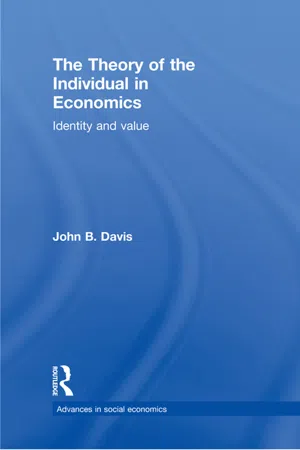
About this book
The concept of the individual and his/her motivations is a bedrock of philosophy. All strands of thought at heart come down to a particular theory of the individual. Economics, though, is guilty of taking this hugely important concept without questioning how we theorise it. This superb book remedies this oversight.The new approach put forward by Da
1 Framing the issues
[T]he real self is “extensionless”; it is nowhere but in this power to fix things as objects.
(Taylor 1989: 172)
No entity without identity.
(Quine 1969: 23)
This is a book about our understanding of the individual in economics. The concept of the individual is one of the most fundamental in contemporary society. It may even be the most fundamental of all our concepts. We cannot understand the historical evolution of political systems in terms of democracy, freedom, and human rights, the development of knowledge and science, and the quality and meaning of life without recognizing the centrality of the individual to our thinking. Human society could conceivably have developed differently in this regard. However, one thing we can know with certainty at this point in history is that individuality is a fundamental preoccupation of contemporary human society.
Yet in economics, with its tremendous influence on society, very little attention is given to the theory of the individual. The theory of the individual concerns our most basic assumptions regarding what explains individuality. Economics, in fact, takes the individual as given, and operates on the implicit assumption that one particular conception of the individual, indeed one of well-established lineage—the subjectivist view—successfully explains individuality. In this respect it is remarkably alone since, almost everywhere else in science, the humanities, the arts, and law, most believe this conception of the individual in economics to be naive. At the same time, it is difficult for those outside economics to say how individuals should be approached in economics, since the theory of individual choice—in which the understanding of the individual within economics is elaborated, and which economists generally regard as the centerpiece of scientific achievement in the field—places a forbidding array of technical issues in the way of any inquiry into the nature of individuals in economic life. Indeed, the theory of choice blocks economists’ own investigation of the nature of individuality in economics as well, and most economists accordingly take the view of the individual in economics as a given.
This book, then, attempts to expand the space in which individuals can be discussed in economics. It does so by examining the requirements for a theory of the individual in economics, and by investigating the two main conceptions of the individual in economics—the familiar orthodox conception associated with neoclassical and mainstream economics and a less sharply articulated conception associated with dissident traditions in heterodox economics. Though this is an investigation carried out within the philosophy and history of economics, it should be seen as having considerable practical significance. Thinking about the individual in economics is not just important for the future development of that field. How economics understands individuals has extremely important social consequences. In particular, if the way most economists understand the individual actually contributes to a decline and weakening of contemporary society’s commitment to the integrity of the individual, then a closer look at conceptions of the individual in economics is surely in order.
In this chapter, I seek to frame the issues this book investigates. I begin in Section 1.1 with a review of the seventeenth century philosophical origins of the modernist conception of the individual that ultimately came to underlie neoclassical economics at the end of the nineteenth century. Section 1.2 outlines the main contemporary critiques of this conception in order to explain what is problematic about this understanding of the individual. Here, I distinguish between the social science critique and the postmodernist critique. Section 1.3 introduces the systematic framework which I use in the book to examine the theory of the individual in economics, namely, an individual identity analysis that has parallels to personal identity analysis in philosophy. In Section 1.4, I briefly differentiate the two main conceptions of the individual in economics, that associated with orthodox economics and that associated with heterodox economics. Finally, Section 1.5 closes with a summary of the plan and organization of the book.
1.1 Modernism as dualism: origins of the modernist concept of the individual
The modern concept of the individual has its origins in the Cartesian–ewtonian dualism of human subjectivity and objective nature associated with Enlightenment conceptions of science and society.1 Contemporary history of science emphasizes the Newtonian vision and the nature side of this dualism, but the inseparable accompaniment of this vision was Descartes’ view of the individual as a disengaged, subjective inwardness. In my view, like most dualisms, this Cartesian–Nwtonian one was fundamentally problematic and therefore ultimately unsustainable in each of its two aspects. Just as we cannot understand nature purely as a mechanism, so neither can we understand the human individual purely as a disengaged subjectivity. Thus, looking ahead, that neoclassicism took up this particular concept of the individual planted the seeds of its ultimate dissolution as a theory of the individual in economics.
In his Sources of the Self: The Making of the Modern Identity, Taylor traces the development of the modernist concept of the individual from Descartes to Locke. Descartes’ image of the self as a disengaged subject identifies the self with the power of reason by virtue of the self not being “in” the material world. Locke carries this image further in ascribing a power to the self to objectify the world. As not being in space— as an extensionless point—the “punctual” self, as Taylor puts it, has the power to set aside the influences that opinion, custom, and desire can have upon us, so as continually to remake itself in a manner that magnifies its own happiness. For Locke:
To take this stance is to identify oneself with the power to objectify and remake, and by this act to distance oneself from all the particular features which are object of potential change. What we are essentially is none of the latter, but what finds itself capable of fixing them and working on them. This is what the image of the point is meant to convey, drawing on the geometrical term: the real self is “extensionless”; it is nowhere but in this power to fix things as objects.
(Taylor 1989: 171–2)
What is it that makes this particular image of the individual a characteristically modern one? The answer lies in the unique response it permits to the rise of mechanical science in the seventeenth century. For Descartes, seeing the individual as disengaged from the world provided both an independent basis for scientific reason and also a means of reconciling science and theology.
In the prescientific medieval world, before nature came to be understood as a mechanism, all was thought to be governed by eternal Ideas imperfectly embodied in the physical world. Plato originally developed this conception, but his basic understanding was later systematically integrated into Christian theology, with the eternal Ideas reinterpreted as the Thoughts of God. According to this view, the things of earthly life are imperfect exemplifications of a cosmic order organized as a constellation of Ideas, and human understanding, embodied in the fallen human form, could never be more than a striving to imperfectly grasp these Ideas through their manifestation in the phenomena of the world. In contrast, then, to the later, modernist conception of the human mind as a “mirror of nature” (Rorty, 1979), before the Enlightenment “nature was the image of mind,” that is, the mind of God.2 Moreover, in contrast to our later understanding of the world as ruled by cause and effect, in both Plato’s philosophy and Christian theology the world was organized teleologically, exhibiting a Reason and Goodness for Plato and then the Wisdom of God in Christian theology. Human understanding and behavior had their own particular role in all this. As Taylor puts it, “As humans we are to conform to our Idea, and this in turn must play its part in the whole, which among other things involves our being ‘rational’, i.e., capable of seeing the self-manifesting order” (Taylor 1989: 161).
Adopting a view of the world as mechanism dethroned this medieval picture of the world. Descartes still preserved a place for God outside nature by supposing the world operated according to the axioms of mathematics and analytic geometry, themselves determined by divine fiat. More importantly, he supposed that our capacity to understand the world as mechanism depended upon our being able to form clear and distinct ideas which only God could guarantee. The connection to the new concept of the individual was direct and immediate. Individual existence, rationality, and God were all tied together by Descartes in his famous cogito ergo sum argument, in which he withdraws into himself in doubting his ordinary beliefs, finds certainty in his clear and distinct ideas made possible only by God’s goodness, and simultaneously proves his own existence as consciousness, that is, as pure subjective inwardness. From this interior vantage point, Descartes the scientist might proceed to explain Newton’s world through exercise of a reason that was certain and powerful by virtue of its joint authorization by God and removal from the earthly world.
However, God only guaranteed us a capacity for clear and distinct ideas, and it was still possible that we might have obscure and indistinct ones. How, then, were scientists to proceed in producing scientific truths about the world? Descartes’ solution was an extension of his basic solution in that it involved distinguishing between the primary and secondary qualities of things. The sources of our obscure and indistinct ideas, he reasoned, are the distortions of sensation and perception, which concern secondary qualities such as color, taste, smell, sound, and temperature, as compared with primary qualities such as figure, number, position, and size which are amenable to mathematical analysis. Descartes’ view was that only primary properties are “in” nature, and that secondary qualities are “in” our senses. Attaining scientific truth thus requires that we “disengage” ourselves from our senses and rely upon our Godgiven ability to form clear and distinct ideas of the way the world is in itself, or in terms of its primary qualities. Reason, reposited in the subjectively inward individual, possesses the capacity to see the inner nature of the world. Descartes’ famous cogito argument consequently gave the Enlightenment an epistemology for science, a new ontology of nature without God’s participation, and a new view of the individual—one that withdrew from the world to understand and control the world’s mechanical laws.
This fundamental division of the world into an inner subjective domain and an outer objective domain was Descartes’ great contribution to modern thinking, and it remains the foundation for contemporary thinking about the individual as a disengaged subjectivity and the modern view of nature as a “spiritless” domain. However, Descartes’ commitment to the idea of disengagement and recourse to an inner reason contained tremendous ambiguities. In a seventeenth century England that combined the Puritan regicide, hatred of Catholicism, and the science of Newton and Boyle, Locke sought to resolve Descartes’ ambiguities by rejecting Descartes’ doctrine of innate ideas. The clear and distinct ideas that Descartes thought our inner reason made possible were innate ideas, because God had created our capacity to grasp them. In the climate of his time, however, Locke feared that what might be represented as ideas God guaranteed us might just be the opinions of men. He consequently proposed a thorough clearing away of “the rubbish that lies in the way to knowledge” (Locke 1975 [1694]: Epistle, 14), and called for a rebuilding of knowledge out of the simple ideas that came to us through sense experience—ideas he regarded as inalterable atoms of understanding. This rebuilding itself took the form of an assembly and reassembly of simple ideas in ways that would create complex ideas, so that a quasi-mechanical, associational organization of the mind would parallel the mechanical organization of nature.
Of course, Locke’s view of knowledge as being built up through association of simple ideas hardly amounts to an apparatus likely to support the new ambitions of science in the seventeenth and eighteenth centuries. However, Locke was less interested in science than in the relationship between the individual and the state, and thus it seems that the important thing about his view of our assembly and reassembly of simple ideas was that it presupposed an empowered disengagement from the world, a “double movement of suspension and examination [in which] we wrest the control of our thinking and outlook away from passion or custom or authority and assume responsibility for it ourselves” (Taylor 1989: 167). This ability of individuals to make their mental activities their own, free of the influence, even the despotism, of others, was what seems to have motivated Locke most strongly. Indeed, he characterized this capacity to suspend judgment and dispassionately examine the credentials of our ideas as a question of freedom versus slavery. This in turn tied in with his theory of legitimate government that presupposed a prior state of nature in which all persons had incontrovertible title to their own persons and labor. For Locke, that is, a capacity for subjective disengagement and title to oneself were part and parcel of a single political theory of the individual. Thus, whereas Descartes laid individualist foundations for science and knowledge, Locke extended these foundations to the subject of individuals and their relation to society.
Arguably, a consequence of this extension was that Locke was more radical than Descartes in the degree to which he understood subjectivity as constituting individuals as independent, autonomous beings. Since Descartes relied on God to guarantee clear and distinct ideas, the existence of individuals in effect depended on God. However, in abandoning innate ideas and reason, and in supposing that individuals had a natural ability to recognize the simple and inalterable ideas of sense experience, Locke effectively made individuals responsible for their own existence. Thus, he advanced what is generally regarded as the first philosophical theory of personal identity—a theory that for him involved defining the self reflexively and self-identically: “For it is by the consciousness it has of its present thoughts and actions, that it is a self to itself now, and so will be the same self, as far as the same consciousness can extend to actions past and to come” (Locke 1975 [1694]: 2.27.10). The self reflexively constitutes itself, because as nothing but consciousness it must always be a “self to itself” at any point in time. The self is also the same through time, or self-identical, because it can never be anything but consciousness through all “actions past and to come.” I return to this conception of personal identity in Chapter 3.
For now, let us simply note another important feature of Locke’s view: the individual understood as consciousness is not only an autonomous being but also an inescapably private being. A being understood simply as consciousness must be a private being, both because the self as pure consciousness can only be conceived in first-person terms, and because consciousness, by virtue of its intentional character, must always be separate from that which consciousness is of. For Locke, individuals are confined within a first-person world, with the world of real things only available to them as intentional objects. That is, his conception of the individual is solipsistic and idealist.
Locke thus gave the strongest possible interpretation to the Cartesian–ewtonian dualism of subject and object worlds. However, there exists a long history of critique of Locke’s conception of the individual, the outline of which can briefly be introduced here. Basically, the idea of subjectivity understood as a complete disengagement from the world borders on being incoherent or even self-contradictory. Wittgenstein (1958 [1953]) made essentially this critique in his arguments against the possibility of there being a private language. The Lockean individual presumably employs a private language generated from names privately given to sense experience events. But how would such an individual know that a name given to one experience applies also to a like experience? Something like this would be required if the assembly and reassembly of simple ideas depended upon relations of similarity and likeness. Wittgenstein’s view was that, unless we want to assume some innate faculty for detecting similarity and likeness (which Locke of course ruled out), we must depend on how we learn to use names from others in a shared, public language. Language for Wittgenstein is social. This, however, is incompatible with Locke’s view of the individual as a subjectively disengaged being. But if the individual cannot realistically disengage, then the self is either undefined or defined through identification with others (termed “social identification” in contemporary social psychology). This Scylla and Charybdis was inherited in the neoclassical appropriation of Locke’s view and goes a considerable distance towards h...
Table of contents
- Cover
- Title
- Copyright
- Contents
- Preface and acknowledgments
- 1 Framing the issues
- PART I Orthodox economics
- PART II Heterodox economics
- Notes
- References
- Index
Trusted by 375,005 students
Access to over 1.5 million titles for a fair monthly price.
Study more efficiently using our study tools.
Frequently asked questions
Yes, you can cancel anytime from the Subscription tab in your account settings on the Perlego website. Your subscription will stay active until the end of your current billing period. Learn how to cancel your subscription
No, books cannot be downloaded as external files, such as PDFs, for use outside of Perlego. However, you can download books within the Perlego app for offline reading on mobile or tablet. Learn how to download books offline
Perlego offers two plans: Essential and Complete
- Essential is ideal for learners and professionals who enjoy exploring a wide range of subjects. Access the Essential Library with 800,000+ trusted titles and best-sellers across business, personal growth, and the humanities. Includes unlimited reading time and Standard Read Aloud voice.
- Complete: Perfect for advanced learners and researchers needing full, unrestricted access. Unlock 1.5M+ books across hundreds of subjects, including academic and specialized titles. The Complete Plan also includes advanced features like Premium Read Aloud and Research Assistant.
We are an online textbook subscription service, where you can get access to an entire online library for less than the price of a single book per month. With over 1.5 million books across 990+ topics, we’ve got you covered! Learn about our mission
Look out for the read-aloud symbol on your next book to see if you can listen to it. The read-aloud tool reads text aloud for you, highlighting the text as it is being read. You can pause it, speed it up and slow it down. Learn more about Read Aloud
Yes! You can use the Perlego app on both iOS and Android devices to read anytime, anywhere — even offline. Perfect for commutes or when you’re on the go.
Please note we cannot support devices running on iOS 13 and Android 7 or earlier. Learn more about using the app
Please note we cannot support devices running on iOS 13 and Android 7 or earlier. Learn more about using the app
Yes, you can access The Theory of the Individual in Economics by John B Davis in PDF and/or ePUB format, as well as other popular books in Economics & Business General. We have over 1.5 million books available in our catalogue for you to explore.