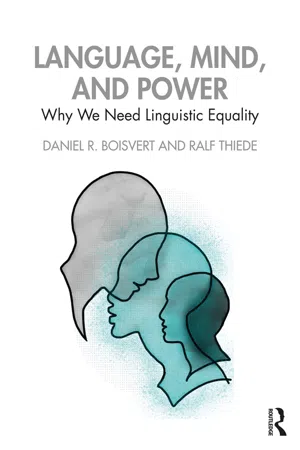
Language is a natural resource: Power and vulnerability are associated with access to language, just as to food and water. In this new book, a linguist and philosopher elucidate why language is so powerful, illuminate its very real social and political implications, and make the case for linguistic equality—equality among languages and equality in access to/knowledge of language and its use—as a human right and tool to prevent violence and oppression. Students and instructors will find this accessible, interdisciplinary text invaluable for courses that explore how language reflects power structures in linguistics, philosophy/ethics, and cognitive science/psychology.
- 190 pages
- English
- ePUB (mobile friendly)
- Available on iOS & Android
eBook - ePub
About this book
Information
Part ILanguage and Mind
Why is language so powerful? Answering this question is the primary job, but not the sole job, of the first three chapters. The central theme is that language is powerful because of its triadic relationship with brains and minds.
Chapter 1, ‘Profile of an Alpha(bet) Predator,’ introduces the notion of informational entropy. Human language has moved further and further away from signals that carry dense information. Many animals are still relying on single calls having single meanings (such as ‘eagle!,’ ‘snake!,’ ‘food!’), which of course invites other animals to mimic those calls for deception (e.g. pretending that there is an ‘eagle!’ so the animal runs away from its ‘food!’). To protect themselves from such deceitful mimicry, some animals have taken to using calls that are by themselves not very informative but create specific meaning through their combination. Outsiders have a harder time fooling them now. Humans have ramped up the encryption by several levels, by combining combinations: vowels and consonants > morphemes > words > phrases > clauses > sentences > narratives, each level with its own set of combinatorial rules, and all levels interacting simultaneously. The complex cortical connectivity needed for such massively parallel, hierarchical processing seems to set human brains fundamentally apart.
The cognitive requirements for the competence to put such a multi-layered system to use are extraordinary. Since the informational content of the individual signals is so much lower than in other naturally occurring communication systems, humans compensate by inferring what they think the speaker means to say, using context, past history, knowledge of the speaker’s preferences, etc. Other animals have a Theory of Mind, too (predicting what other individuals can and should know and what they will do—see Chapter 2). Humans, however, must use Theory of Mind to understand each other’s words, and they must continually negotiate each other’s assumptions. This kind of mental cooperation works very well. Humans are hyper-social and can cooperate to the point of sacrificing their own needs for the sake of others. Humans are also top predators; in fact, human evolution is characterized by humans eliminating other top predators—including each other. Our linguistic cooperation cuts both ways: altruistically subordinating our own interests to others’, or forming alliances to destroy a third party.
Chapter 2, ‘Thinking Animals,’ explains the most important ways that language use exercises and, thereby, enhances—individually and evolutionarily—the very capacities that make language possible. Language use indeed requires a suite of mental capacities. For example, we couldn’t use ‘The cat is sleeping on the mat’ to describe a particular cat as sleeping on a particular mat if we didn’t have the mental capacity to form concepts of objects and events. But when we use language, we exercise and thereby exponentially enhance—individually and as a species—those very mental capacities.
concept The idea of what something is. Perceiving that something is, in the moment, without labeling and classifying it is a meditation exercise—difficult, but strangely peaceful.
Like some other animals, we have the mental capacities to form basic concepts of objects, events, and relations; to perform basic thinking tasks, such as remembering, analyzing, comparing, synthesizing, and imagining; to perform more complex thinking tasks, such as doubting, wondering, and planning; to perform basic social thinking tasks, such as paying attention to what others are paying attention to; and to perform more complex social thinking tasks, such as attributing mental states to others. But by using language, human beings have exercised these capacities and taken them to places that no other species—and no individuals among those species—can come close to taking them. Human beings can now conceive ‘objects’ and ‘events’ as complex and abstract as universe, existence, and Big Bang and can collectively intend to send a person to Mars within 25 years.
Chapter 3, ‘The Narrating Brain,’ explores what our brains and minds do to compensate for the fact that we do not have ‘total recall’: We create stories. Language, involving most of the brain to begin with, has become its information management system. We forget the majority of what we experience in a given day (some say 90 percent or more), and if we really need to reproduce a particular piece of information after all, then we create a likely story to produce that information. It may even be right.
Just as likely, however, our memory will differ from what ‘really’ happened. First of all, our very perceptions are already conceptual in the sense already explained, that we typically see or hear something as something. Second, we recall to accommodate a purpose, and that purpose can guide the story we create to produce that memory. Third, someone may have asked us for past information and framed that question in a way that biases us because we want to cooperate. How fast would you say was the defendant’s car going when it {tapped / slammed into} the plaintiff’s car? Frames provide a selective focus on a narrative, and that focus is its own message; we pick up on that message subliminally. In fact, given the degree to which we read and affect one another’s minds, it is actually possible to plant a false memory in someone else. There are trained professionals who know how to create false certainties by using frames and by triggering plausible predictions. However, those dangers cannot take away from the rewards of linking our brains in stories: reading to a child, devouring a book by a favorite author, or listening to a storyteller as part of an audience.
memory implantation The creation of a false memory. One setup involves showing someone a (Photoshopped) picture from a fictitious childhood event. If the depicted event is not too implausible, the subject will sometimes ‘remember’ it and volunteer details. Skillful orators and advertisers have comparable techniques for creating false certainties that amount to memory implants.
1Profile of an Alpha(bet) Predator
POINT BY POINT
•Using single calls to warn each other, animals can react instantly, but they can also be co-opted by imitators.
•Languages instead spread information over combinations of combinations of signals (=high entropy).
•High entropy invites variation and change and allows creativity.
•Variation acts as encryption, offering obscurity to outsiders and presuming trust and cooperation from insiders.
•As a hyper-social species, humans can cooperate altruistically, but they can also cooperate to deprive and destroy.
•A cognitive arms race has made humans capable of learning multiple languages, hence capable of making alliances with outsiders (e.g. to raid a third party). Language is a power tool.
•Language is processed through intricate pathways connecting brain areas that did not evolve for it.
Entropy and Cooperation
Cooperation augments the information contained in speech / writing.
To understand the nature of human language, we must be willing to embrace paradoxes. One of the great paradoxes underlying this book is this: Human language gets more information across by detaching meaning from individual speech signals. From the wealth of intended information active in the speaker’s mind and creatively reconstrued in the listener’s, words convey only a fraction. The speech sounds themselves (consonants like /t/ and vowels like /æ/) and letters (<t>, <a>) are downright meaningless. A complex system is required to create the sparse information in speech: Consonants and vowels combine and recombine in a hierarchy of levels (morphemes, words, clauses, sentences, discourse), each prone to variation and change. Visual communication—intonation, gestures, movements, facial expressions—and speech mutually enhance each other for added bandwidth (which is why we feel more connected talking face to face rather than over the phone). But why did our species put so much stock in speech, an informationally unpredictable and relatively inefficient encoding system?
Languages are high in informational entropy (entropy increases as information gets spread out over many signals). Informational entropy is low in a word like huh?, but high if we spread out the equivalent information over the sequence Could you say that again, please? Nonetheless, we don’t rely on utterances like oh? and ugh! much and prefer more ‘polite’ expressions like Is that so? and Bless your heart! Monosyllabic bluntness is not safe. Indeed, raising signal entropy and, thereby, lowering informational predictability started as a survival strategy in nature—on two fronts. First, unless the animal already is a top predator and has little to fear from being imitated (like a chimpanzee), the creation of an encrypted communication system increases protection from being duped by tricksters and predators. Second, going beyond a system that relates signal and meaning in unambiguous one-to-one mappings affords improvisational room for creative flexibility.
entropy In thermodynamics, the degree of randomness or disorder within a system. In information theory, a measure of the unpredictability of information content (Shannon 1948). Low entropy means high predictability; high entropy means low predictability.
Flexibility allows change. In human languages (but also among birds, whales, and prairie dogs), flexibility quickly results in the formation of dialects. New varieties of communication separate groups within the species that might be competing for the same resources. The rate of change can be fast enough to create regional distinctions within a generation, but not so fast as to preclude alliances between local groups in contact with each other (e.g. for raiding resources from a third party or, in the case of humans, for warfare or for building megastructures or coordinating controlled burns). As one would expect, a complex, flexible, high-entropy communication system requires cognitive resources: creativity, a theory of mind (being able to anticipate what others might not know and what they would or should understand), and a sufficient understanding of events to communicate about them instructively. The interaction between language and cognitive faculties shall be explored in Chapter 2.
Theory of Mind The ability of an individual to anticipate and track what other individuals believe, feel, or can be aware of.
Human languages have achieved a delicate and remarkable balance: High entropy provides much creative flexibility, drifting linguistic change, and secure enough encryption to exclude ‘others’; and mental resources compensate for that lossiness. To communicate a complex three-dimensional mental model of associations that is ‘in her head,’ a speaker must compress it into a linear sequence of words that can only reflect the original complexity as abstract, arbitrary tokens; that is to say, a multidimensional, hierarchical neural representation has to interface with a flat serial string (such as underline). From that string, the listener/reader again constructs a complex mental model. How closely the mental model co-created by the recipient resembles the sender’s is a matter of cooperation and of matching associations (‘neural mirroring’ between brains). Human communication thus relies in good measure on mind reading, on empathy, and on adducing information pragmatically (Wilson and Sperber 2004). Human communication works on t...
Table of contents
- Cover
- Half Title
- Title Page
- Copyright Page
- Contents
- List of Figures
- List of Tables
- Permission
- Acknowledgments
- Introduction
- Part I Language and Mind
- Part II Language and Power
- Conclusion
- Index
Trusted by 375,005 students
Access to over 1.5 million titles for a fair monthly price.
Study more efficiently using our study tools.
Frequently asked questions
Yes, you can cancel anytime from the Subscription tab in your account settings on the Perlego website. Your subscription will stay active until the end of your current billing period. Learn how to cancel your subscription
No, books cannot be downloaded as external files, such as PDFs, for use outside of Perlego. However, you can download books within the Perlego app for offline reading on mobile or tablet. Learn how to download books offline
Perlego offers two plans: Essential and Complete
- Essential is ideal for learners and professionals who enjoy exploring a wide range of subjects. Access the Essential Library with 800,000+ trusted titles and best-sellers across business, personal growth, and the humanities. Includes unlimited reading time and Standard Read Aloud voice.
- Complete: Perfect for advanced learners and researchers needing full, unrestricted access. Unlock 1.5M+ books across hundreds of subjects, including academic and specialized titles. The Complete Plan also includes advanced features like Premium Read Aloud and Research Assistant.
We are an online textbook subscription service, where you can get access to an entire online library for less than the price of a single book per month. With over 1.5 million books across 990+ topics, we’ve got you covered! Learn about our mission
Look out for the read-aloud symbol on your next book to see if you can listen to it. The read-aloud tool reads text aloud for you, highlighting the text as it is being read. You can pause it, speed it up and slow it down. Learn more about Read Aloud
Yes! You can use the Perlego app on both iOS and Android devices to read anytime, anywhere — even offline. Perfect for commutes or when you’re on the go.
Please note we cannot support devices running on iOS 13 and Android 7 or earlier. Learn more about using the app
Please note we cannot support devices running on iOS 13 and Android 7 or earlier. Learn more about using the app
Yes, you can access Language, Mind, and Power by Daniel R. Boisvert,Ralf Thiede in PDF and/or ePUB format, as well as other popular books in Languages & Linguistics & Linguistics. We have over 1.5 million books available in our catalogue for you to explore.