This book examines a relatively unexplored area of leadership research – personal aspects of leadership – by considering the impact of leaders navigating their own personal crises on their relationships with teams, peers, and supervisors. Through original research as well as an integrative review of the literature, Hickman and Knouse focus on the "leader-as-person in crisis," including the real-life personal crises and experiences of leaders. This important volume offers a detailed and thoughtful description of intersecting factors that contribute to the ways in which leaders experience and cope with personal crises to spur additional research attention to this neglected area. This book also offers current and prospective leaders advice and direction on effectively navigating personal crises.
Two years ago, my wife was diagnosed with breast cancer. This was extremely traumatic for the both of us. It really affected me and her as well.
Of course, we managed the crisis by going to her doctor’s visits to have the cancer treated. It was a life event that neither of us could have foreseen; so, there is no one to blame and no reason to feel ashamed or embarrassed about it.
I tried my best not to let the crisis affect my work. I tried not to take out any anger on my employees or get too sad to lead. I decided to tell most of my staff about the crisis just to let them know what was going on. I also shared it with a few of my colleagues and supervisors. I was very open to talking about the crisis with basically anyone. I am satisfied with my decisions about who to talk to at work concerning my personal crisis. I don’t regret anything. For people I didn’t tell about the crisis, I don’t know if they could tell something was wrong.
It felt very safe in my company to share information about the crisis. My organization is a very supportive place for employees to share a personal crisis and handle the impact of it. I am satisfied with the way I handled the crisis in my leadership role and I am happy to say there was no impact on my relationships with my staff and coworkers or supervisors.
On a personal basis, I naturally discussed the crisis with my family members. I just tried my very best to think positively. I also prayed a lot. I found prayer was an effective way for me to cope with the crisis but trying to think positively was less effective.
This crisis really made me think about how precious life is. I was able to remain hopeful during the crisis. I just prayed a lot and stayed as positive as I can. But, I do not consider this personal crisis a turning point event. It was big, but not turning-point big.
My advice to others who face a personal crisis while in a leadership role is to share it with your coworkers. It helps workers to understand you more as a person. I would also advise them to talk it out with whoever they feel comfortable with at work or at home so that they can cope with it. Talking always helps.
I have never really received any training on what I should do during a personal crisis. I just did what I thought was right. I think that there should be classes to help people like me.
EMILY’S STORY
I experienced a very messy divorce from the father of my first child. The first few months were difficult while I tried to handle the crisis, manage 60 employees, and raise my son. I do not blame myself for the crisis though I am a little embarrassed about the situation.
I tried to do everything alone. I didn’t take care of myself. I was really hurt and lost self-confidence. I decided to go to therapy for professional help and turned to my mom for personal support.
I didn’t tell my staff or supervisor and didn’t talk to anyone about my personal life. I tried to leave my personal problems at home and just soldier through at work taking one day at a time. If I needed a minute to cry, I would go in my office and cry. One day, however, a colleague saw me crying. I needed someone to talk to so I told the colleague about my crisis.
I was satisfied with my decision not to share my crisis with most people at work. I don’t like airing my dirty laundry. I was concerned that people would look at me differently after I told them what happened. I don’t know whether my staff and supervisors could tell something was wrong since I didn’t really talk about it. My work environment is not really psychologically unsafe but it is slightly unsupportive. Business comes first. Though, I must say that the few colleagues I told were supportive.
I was able to remain hopeful during the crisis. I just thought about my son and his future. I wanted the best for him. The crisis was a turning point event for me. I regained my self-confidence and my life improved a great deal after everything was over.
I would advise other leaders not to share their personal crisis at work. I think it changes the work dynamic and people lose a little respect for you. If it is affecting your work, talk to your supervisor. Otherwise keep it to yourself. Talk to a therapist instead of sharing the crisis at work. You need it even if you don’t think you do. Talk to friends and family. They can be a good support system.
My training on handling personal crisis came from my employees. I learned how to treat them when they experienced adversity in their personal lives. Based on these experiences, I think organizations should have counseling services available to support employees even if it is just over the phone.
How to use this chapter: We hope that readers will use this chapter in a manner that is most relevant for them. Leaders who recently or previously experienced a specific personal crisis may prefer to read about their specific crisis type, while academic readers may want to explore all crisis types and examine the cited research studies in more depth.
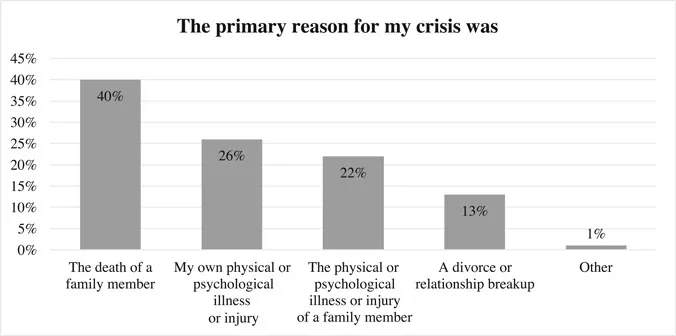
In our first survey study, we found that the majority of leaders experienced a personal crisis at some point during their tenure in leadership roles. Steven and Emily’s stories are examples of the range of crises – a spouse’s illness and a divorce – that leaders in our studies experienced; and they exemplify two different approaches to disclosure of the crisis at work which we examine in Chapters 3 and 5. Participants consistently identified four types of crises – death of a family member, the leader’s own physical or psychological illness or injury, physical or psychological illness or injury of a family member, and divorce or a relationship breakup. We recognize that there are other types of crises that affect leaders; however, in this text we focus only on the crises that the leaders in our survey identified most frequently.
In Study 2, the most frequent personal crisis was the death of a family member followed by the leader’s own illness or injury, physical or psychological illness or injury of a family member, and a divorce or relationship breakup, as illustrated in Figure 1.1.
FIGURE 1.1 Reason for Personal Crisis
Note: Totals may not equal 100% due to rounding.
The leader as person-in-crisis
Leaders are quite used to handling organizational crises. There are workshops, courses, articles, and books dedicated to equipping them to respond to crises in the work-place. A crisis that affects leaders personally is a different matter. Leaders may not be accustomed to handling their own vulnerability, and they may not be prepared for the duration of a personal crisis. As one popular journal contributor commented:
Entrepreneurs [and other executive leaders] aren’t used to asking for help. Many are accustomed to being the hero, solving everyone else’s problem and excellent in responding to an outside crisis. Yet some business leaders are not so great at caring for themselves and attending to their own needs.
(Huhman, 2014)
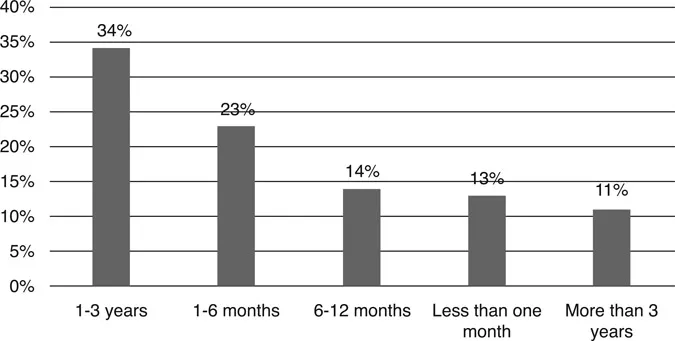
Participants in Study 2 reported that their crisis lasted an average of 23 months, with 34% reporting that the duration of their crisis was one to three years (see Figure 1.2). The longer the crisis lasted the less effective leaders felt they were in handling the crisis in their leadership role. However, the duration of the crisis was not related to overall satisfaction in handling the crisis.1
1 Correlation (Pearson’s r) between duration and perceived effectiveness was −.14 (p = .04). Correlation with satisfaction was .04 (p = .31).
FIGURE 1.2 Personal Crisis Duration
Note: Five percent did not answer.
Leaders experience fully human responses to a personal crisis. At their core, personal crisis events threaten the things that people hold most dear – their health, family, relationships, social standing, sense of self, and sense of meaning. Responses to crises, whether they are actions or emotions, can be understood as responses to the threat, harm, or loss caused or represented by the crisis event. Many of these responses are involuntary or “hard wired” components of humans’ evolved responses to threat or loss events (Lazarus, 2006). For example, a current or imminent threat to one’s well-being triggers fear and anxiety, irrevocable losses generate sadness, and harm to those we love and what we value and provokes frustration and anger (Lazarus, 2006). Importantly, these emotional responses have behavioral or action components that, in our evolutionary past, served to increase the likelihood of successfully managing these threats. Fear and anxiety are accompanied by escape, avoidance, or shoring up resources for the future. Sadness motivates pulling back during a time of vulnerability and signals to others the need for care and resources. Anger and frustration activate efforts to push through barriers or neutralize a source of harm. In sum, although crisis situations themselves may fall outside of a person’s typical life circumstances, emotional and behavioral responses to a crisis are often not unexpected, given our evolutionary history and the degree of threat, harm, or loss that such crises represent. They affect a person’s sense of well-being and stability.
Leaders in our study experienced a wide range of physical, emotional, and psychological responses across all four crises types. The majority experienced feeling depressed (71%), sadness (65%), loss of sleep (62%), and stress/worry (50%) (see Figure 1.3). Executive leaders and middle managers differ slightly on their experiences of depression and sadness. More middle managers (78%) reported feeling depressed during a personal crisis than executive leaders (62%); similarly, more managers (74%) than leaders (54%) reported feeling sad. We are uncertain whether these differences are due to more experience with personal crises among executive leaders than middle managers or other reasons. More research is needed on personal crises among leaders and middle managers to explain these differences where they exist.
FIGURE 1.3 Crisis Types Crisis on Leaders – Across All Effect of Personal
Several leaders in our survey reported positive effects during the crisis, such as, I remained positive/positive thinking (37%), realized my strength (37%), developed a philosophical perspective (31%), took better care of myself (23%), and took control (17%).
In the remaining sections, we look at how the four crises types identified by participants in our survey affect the “leader-as-person” in crisis. We provide our participants’ responses in Figure 1.3 along with research studies on how a person in crisis experiences these various situations.
Effects of different crisis types
The leader as bereaved person – death of a family member
My dad passed away from ALS. He was my hero. It was hard to explain to coworkers how sad it made me.
Survey participant
My husband was diagnosed with cancer in October [date deleted]. Despite surgery, radiation and chemo therapy, he died in April [date deleted]. I took him to every doctor’s appointment and treatment and stayed with him in the hospital after two surgeries. I was absent from work for blocks of time.
Survey participant
I had a personal crisis which was the passing of my mother from pancreatic cancer, 2 years ago. She was diagnosed and passed away 4 months later. She was in an incredible amount of pain, and I was torn with having to be at work and be by her side. I felt distracted a lot at work and often became agitated at employees. There were times I was unable to handle my emotions even though I was as neutral on my job as I could be.
Survey participant
My sibling passe...
Table of contents
Cover
Half Title
Series Page
Title Page
Copyright Page
Dedication Page
BRIEF CONTENTS
CONTENTS
Series foreword
Preface
Acknowledgements
Introduction
1 Personal crisis as a stressful life event
2 Coping with crisis
3 Deciding to disclose, asking for help
4 The organization’s interpersonal environment
5 Responsibility for leadership: adaptive approaches
6 Toward a culture of reciprocal care: advice and recommendations
7 Leaders in personal crisis: proposals for practice and research
Appendix A: preliminary study
Appendix B: Study 1 method and participant description
Appendix C: Study 2 method, participant description, and supplementary tables
Index
Trusted by 375,005 students
Access to over 1.5 million titles for a fair monthly price.
Study more efficiently using our study tools.
Frequently asked questions
Yes, you can cancel anytime from the Subscription tab in your account settings on the Perlego website. Your subscription will stay active until the end of your current billing period. Learn how to cancel your subscription
No, books cannot be downloaded as external files, such as PDFs, for use outside of Perlego. However, you can download books within the Perlego app for offline reading on mobile or tablet. Learn how to download books offline
Perlego offers two plans: Essential and Complete
Essential is ideal for learners and professionals who enjoy exploring a wide range of subjects. Access the Essential Library with 800,000+ trusted titles and best-sellers across business, personal growth, and the humanities. Includes unlimited reading time and Standard Read Aloud voice.
Complete: Perfect for advanced learners and researchers needing full, unrestricted access. Unlock 1.5M+ books across hundreds of subjects, including academic and specialized titles. The Complete Plan also includes advanced features like Premium Read Aloud and Research Assistant.
Both plans are available with monthly, semester, or annual billing cycles.
We are an online textbook subscription service, where you can get access to an entire online library for less than the price of a single book per month. With over 1.5 million books across 990+ topics, we’ve got you covered! Learn about our mission
Look out for the read-aloud symbol on your next book to see if you can listen to it. The read-aloud tool reads text aloud for you, highlighting the text as it is being read. You can pause it, speed it up and slow it down. Learn more about Read Aloud
Yes! You can use the Perlego app on both iOS and Android devices to read anytime, anywhere — even offline. Perfect for commutes or when you’re on the go. Please note we cannot support devices running on iOS 13 and Android 7 or earlier. Learn more about using the app
Yes, you can access When Leaders Face Personal Crisis by Gill Robinson Hickman,Laura E. Knouse in PDF and/or ePUB format, as well as other popular books in Business & Leadership. We have over 1.5 million books available in our catalogue for you to explore.