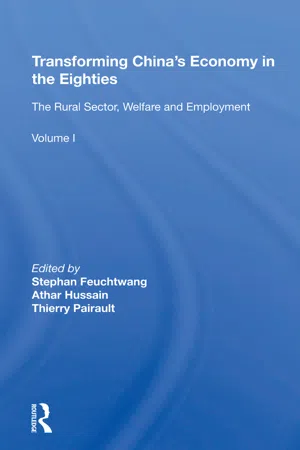
This is the first of two volumes on the transformation of China since 1978. The second volume concentrates on the government administration of the reforms which have brought changes in economic organization; it deals with the urban economy. The focus of this volume is on changes in the rural economy, provision for basic needs such as nutrition and
eBook - ePub
Transforming China's Economy In The Eighties
Vol. 1: The Rural Sector, Welfare And Employment
- 272 pages
- English
- ePUB (mobile friendly)
- Available on iOS & Android
eBook - ePub
Transforming China's Economy In The Eighties
Vol. 1: The Rural Sector, Welfare And Employment
About this book
1 NEP and Beyond: The Transition to ‘Modernization’ in China (1978-85)
Yves Chevrier
NEP minus non-NEP = modernization?
Since Deng Xiaoping snatched the Chinese leadership from Hua Guofeng in December 1978, China's economic reforms have gone hand in hand with demaoization. And they have gone much further under this banner than Khrushchev's reforms ever did under that of destalinization. That is to say that Deng's political and ideological return to orthodoxy, as it existed in China during the 1940s and 1950s, has been coupled with structural changes unparalleled in the Soviet Union or, for that matter, in China before 1978.
To be sure, none of the elements of this breakthrough in the previous Soviet-style or Chinese practice of economic reform is unprecedented, Deng's 'readjustment' (tiaozheng) and 'reform of the economic structure' (jingji tizhi gaige) has unfolded along three main axes: 1) rural reforms; 2) Western trade, financial and technology transfers; and 3) industrial and urban reforms. China, the Soviet Union, Yugoslavia, the Soviet East European satellites, Cuba and Vietnam, have all explored these paths (Hussain, 1983 and Knight, 1983). But whereas they shuffled along and stopped short of any coherent achievement, Deng's policies - for all their shortcomings, compromises and counter effects, have created a set whose scope, depth and range of implementation is unmatched, except perhaps in tiny Hungary or breakaway Yugoslavia. And what is more, these reforms have not stopped at systemic changes. Ten years after Mao 'went to see Marx' (as he was fond of saying), they have begun to change the face of Old China.
This change is perhaps deeper than the transformations brought about by Maoism during the first thirty years of the People's Republic. Maoist policies, and the backlash that followed them, de facto froze and preserved old structures and old ways, especially but not exclusively in the countryside. Mao was certainly as adamant as Stalin in his determination to destroy them, in order to make way for the New Man and Woman. But the edge of Maoism was blunted, if only because more than four Chinese out of five were kept out of the cities and the modern sector of the economy. The sweeping impact of Stalinism in the Soviet Union had much to do with the addition of a stark modernization drive to the generalization of a totalitarian rule. This generalization was 'the one leg' on which Maoism walked in the countryside and it was hamstrung by economic constraints, peasant inertia and cadre adhesion to local communal interests. In the cities and within the intellectual and bureaucratic elite, the patriarchal structure of authority (to quote only one example) betrayed the lingering shadow of the past. China's societal sluggishness was one factor (among many) of the 'cultural' leap in the Cultural Revolution: the shadow was to be erased in spite of inappropriate social and economic trends.
The ancient social structures and the tradition-oriented mix of old and Maoist ways, are now exposed to the disruptive influence of the reborn market economy, as well as city and Western-oriented models. To be sure, the relaxation of controls started by giving them a new chance. Old China is coming back to the fore - but perhaps only to die for good. In Skinner's words (1985): 'It is almost as if China's pragmatic leaders were letting commercial capitalism run its course in the countryside, bringing the economy very quickly to where it would have been had the Maoist experiments not intervened.' In many ways, Deng's policies - not just his economic reforms - have bridged the gap. China's society and development were blocked by Mao's failed attempt at socialist construction and uninterrupted revolution. Modernization, on the other hand, builds on historical continuities.
This process of historical rebirth and transition between old and new is a politically significant process, whereby society is coming back to life. Chinese society is still far from being fully-fledged and integrated, with independent economic elites. But it is no longer part of the power structure, or crushed by it. Whatever their economic significance, Deng's economic reforms, bolstered here by the post-Mao return to the rule of law, as well as other non-economic reforms, did alter the balance of the regime. Since the mid-1950s, Chinese society was not so much beheaded - deprived of its natural economic elites (by the land reform and collectivization drive) - as kept lifeless because it was deprived of economic blood at the infra-capitalist layers of the socio-economic pyramid (in Braudel's architectural view of the economic and social order). Although the imposition of a Stalinist-type ideological and organizational monism was marred at rural grassroots levels by lack of support for a complete modernization drive, Maoism did achieve party domination of the whole and, most particularly, of the urban nexus, through economic as well as political means.1
Deng Xiaoping has now taken the risk of discarding this weapon, because it has proved unable to achieve the other goal of communism: that of economic growth and country-strengthening which goes beyond mere party-building and political control. He needs to treat society as it is as a partner where Stalin and Mao viewed it as a dangerous challenger and saw social transformation as the prime lever of economic progress (with differing points and degrees of emphasis).
Using capitalist means, however, does not necessarily mean discarding socialist ends. There exists a median term, whereby the latter can be obtained through a careful sifting of the former: an up-to-date version of the Tongzhi self-strengtheners' strategy, whose motto was Zhongxue wei ti, Xixue wei yong (take Chinese ways as the basis and Western learning as means), often rendered, in Deng's China, as gongchan zhuyi wei ti, zichan zhuyi wei yong (communism as basis, capitalism as means).
It is possible to read in two ways the resulting post-Mao pattern of historical mending and non-political pluralism aimed at maximizing state initiative for economic development. In a non-communist regime, it would be a clear-cut modernization programme. Within the communist world, it can be viewed as another New Economic Policy (NEP), on the lines of the Soviet experiment of the 1920s and the Chinese version of that experiment in the early 1950s (called the New Democracy).
There is one essential difference, however. The NEP was a political strategy meant to bolster the grip of the party in the wake of the civil war, when the Soviet leadership realized that their dictatorship was suspended in a social and political void (Lewin, 1968). And it was overridden by non-NEP (under Stalin) for the task of modernization, in a climate of pristine ideological faith and virgin enthusiasm for system-building. Hence the efficiency of the Stalinist mix (command structure + modernization) in establishing an absolute and unchallenged rule. The fact that this mix was constructed in one country added the unifying power of nation-building to the building of the system: the latter became identified with the former. The victory over Germany and the building of Soviet military power and empire legitimized the whole process in spite of growing frustrations with the economic result of Stalin's construction.
Deng's NEP, on the other hand, is conceived as the very instrument of modernization, not of system-building through modernization: the system, after all, has already been built, in spite of the many structural weaknesses in the Chinese building process. Post-Mao China, therefore, is not in the same situation as the Soviet Union at the end of Lenin's life. Neither is it, however, in the position of the USSR at the end of Stalin's rule: the very reason why Deng's reforms could not be restricted to a banal and superficial imitation of post-Stalin reforms.
As with the Soviet NEP, the goal of the reforms has been primarily political. They have aimed at strengthening the party (and the system) in the wake of Mao's cataclysmic end. In this sense, the Cultural Revolution and post-Cultural Revolution succession struggles played the part of war communism and the civil war (rather than that of their model: Stalin's Great Terror). In addition, whereas Leninism and Stalinism ended in victory, Maoism backfired in failure. The intra-party criticism that spread in 1978 and after stemmed from a tremendous sense of loss, which reached much wider and deeper than the frustrations voiced against Stalin's or the system's economic shortcomings after 1956, in the 1960s or after Brezhnev and Chernenko's demise. These Chinese frustrations can be summed up in this way: not only is China not a rich and strong country because the socialist growth of the industrial economy has failed to modernize the whole, but the system has been built at the expense of modernization (Chevrier, 1983).2
It would be inaccurate, however, to think that Chinese clocks were set back to pre-Stalin time, giving only a short life expectancy to the new direction that has developed since 1978. Although the theoretical fig-leaf of the 'Four Modernizations' drive, in Deng's version, is definitely NEPian ('temporarily making use of, and adapting, capitalist ways and means to Chinese socialist needs'); although the political, social, economic and even ideological framework of the 1980s often recalls the ill-fated New Democracy model, strategic clocks and historical time seem to have changed. The readily avowed necessity of readjusting and reforming the economic system, as well as repositioning the whole power structure (in relation to society), does not simply translate short-term political and economic difficulties (which are also admitted). It betrays an underlying but unavowed weakness, which is more than ideological wear: the very impossibility of a second Stalinian spurt which, according to party logic - but not to the Chinese historical experience would be the best cure for these difficulties. The creation of a new legitimacy for the regime in China is a process similar to the one which started after the Great Terror and during the anti-German war in the Soviet Union. But since it rests on a negative, not triumphant, experience, the Chinese process entails a fair degree of 'illegitimate' (but de facto legitimized) means: a bitter cup which the Soviet leadership, so far, has succeeded in keeping at a safe distance.
It should not come as a surprise, then, if the other path followed by Deng's new economic policy recalls the strategy with which Bukharin opposed Stalin after 1927: to continue NEP after NEP instead of resorting to a non-NEP.3 Bukharin's model for economic regulation and social pluralism within an overall strategy of balanced development and gradual change (as against the imposition of a voluntarist and destructive command structure) rested on key assumptions, which are clearly echoed in the post-Mao Chinese economic policies and economic policy debates. Of paramount importance were the answers to the crucial questions raised by the difficulties (the so-called 'crisis') of the NEP. How to plan? How much planning? How to finance accumulation? What part should social differentiation and dynamics play? And, above all, what to do with the peasantry (Nove, 1969)? Other similarities can be found on the tactical level (as we shall see below), namely in the leading part played by the rural sector in the reformist drive, as well as in the use of Lenin's and Bukharin's commanding heights principle which gives some leeway to the private play and intercourse of economy and society (provided the party retains control of the strategic points which control the whole).
The gradual and pluralistic perspective of Bukharinism was nothing other, after all, than a communist translation of non-communist modernization strategies (such as Bismarck's in Prussia, or the anti-Bakufu forces in Meiji Japan), where state power also led and controlled the overall process of change in spite of, and above, the liberated interplay of economic, social and societal forces (non-centralized or micro-political and domestic institutions).4
Bukharin's scheme, however, rested on two interrelated ideological assumptions which raised many questions in the real world of reforms and politics. First was a peasant grassroots capitalism compatible with socialist structures. A head-on contradiction could be avoided, Bukharin believed, since the countryside was not central to the overall political balance of the regime (commanding heights, in other words, were mostly urban strongholds), and as long as the peasant economy provided food and funds for the cities whose growth, in the long run, would solve the problem by drawing to them a large fraction of the peasant population and modernizing those who remained in the villages. Would this very process, however, not reinforce conflicts and contradictions in urban society where they could not be by-passed so easily? What if modernization did not generate more proletarians, as Engels and Kautsky had said, but more urban and rural petty bourgeois - a Bernsteinian 'middle class'? A moot point, Bukharin believed, since the admittedly questionable hegemony of the proletariat in the socio-economic process of growth would be supported by party organization, socialist state-building and an uninterrupted (albeit 'civilized') political and ideological struggle aimed at conquering non-proletarian classes. Because of the profound complementarity between his modernistic outlook and his ideological faith, Bukharin believed that party retrenchment would not disturb the teleology of revolution. The proletariat and the party could play the part of the capitalist bourgeoisie and the central modern state, ensuring their domination over a pluralist, dynamic and altogether compliant polity: a truly socialist (that is, at once proletarian and modern) civil society.
The post-Mao, post-Hua Guofeng Chinese leadership may not share this ideal vision in steering the country away from Mao's rash short cuts and unbalanced emphasis on cultural factors. They believe more strongly in the unabashed dynamics of capitalism, Western capital and technology imports, as well as relying on patriotism and some basic tenets of Confucianism to mobilize the Chinese people around the goals of modernization and alleviate the 'atomizing' effects of recent transformations in family structures and social behaviour. Authoritarian modernization strategies are more readily referred to (in Japan, Hong Kong, Taiwan and the experiments of the Tongzhi era) than Bukharinism. Emphasis is laid on state-building rather than party-building. However, Bukharinism and, for that matter, socialism, are not forgotten. The modernization scheme has to work within the framework of party hegemony. We can safely assume, therefore, that for all practical purposes - and for legitimation purposes as well - Deng Xiaoping's NEP has already gone beyond NEP, not into non-NEP, but into modernization. And the crucial issues of the relationship between the power of the party, state integration and professionalization, as well as those of elite formation and circulation, are far from being solved.
My goal in the following sections is to show that systemic constraints were not such that the modernization process could not have included some more drastic changes than the minor, post-1978, political shake-ups, with some room given to management professionalization and autonomized socio-economic processes. These constraints remain, however, and could halt the whole process or, at the very least, bring about counter effects damaging to both the integrity of the socialist system and the processes of modernization. The last section will look in this light at the difficulties and prospects of the 'New Course'.
Reforms within the System: a Tentative Ecology
Following the 'revolution-restoration' of 1868, the transition from traditional order to modernization in Japan entailed drastic political and organizational changes. Not so with Deng's own revolution-restoration of 1978 which, as we have said, restored communist orthodoxy everywhere except in economic matters (and related organizational areas). In this light, the Chinese experience conforms to the common post-Stalin reformist experience, which appears to have depended on two main factors: a succession at the top providing a (usually narrow and short-lived) political opportunity, in which some factions and established groups find it useful to shake bureaucratic inertia; the resulting reforms grow and survive within the dynamics of the system, which should not be viewed as a frozen monolith. Indeed, far from opposing reforms to system, or society to system, we should look for an historical and systemic continuum in which reforms help build a low-grade organizational and social pluralism. The reforms occupy, legitimize and tend to enlarge a systemic 'ecological niche', which goes a long way towards explaining their initial successes and later fading; the niche is neither large nor capable of much expansion. In sum, reforms and system add up not to a zero sum but to a limited dialectic.
The Chinese record of the past eight years would seem to confirm this analysis. The Chinese breakthrough, however, raises two related questions. The conventional one is: how did the post-Mao reforms grow beyond the 'normal' stage without overthrowing the system (or without being overthrown by the system)? A more difficult issue is to know why the system + reforms dialectics achieved a higher measure of success in China.
A general overview shows that the Chinese reforms and their socio-economic consequences grew by fitting in with the environment, thanks to the concurring acceptance by the system (established power netwo...
Table of contents
- Cover
- Half Title
- Title
- Copyright
- Contents
- List of Contributors
- List of Abbreviations
- Map
- Preface
- 1. NEP and Beyond: The Transition to 'Modernization' in China (1978-85)
- 2. The People's Livelihood and the Incidence of Poverty
- 3. The New Peasant Economy in China
- 4. China's Food Take-Off?
- 5. The Implications of Contract Agriculture for the Employment and Status of Chinese Peasant Women
- 6. Implementation and Resistance: The Single-Child Family Policy
- 7. China's New Inheritance Law: Some Preliminary Observations
- 8. Urban Employment in Post-Maoist China
- 9. Urban Housing Policy after Mao
- Bibliography
- Index
Trusted by 375,005 students
Access to over 1.5 million titles for a fair monthly price.
Study more efficiently using our study tools.
Frequently asked questions
Yes, you can cancel anytime from the Subscription tab in your account settings on the Perlego website. Your subscription will stay active until the end of your current billing period. Learn how to cancel your subscription
No, books cannot be downloaded as external files, such as PDFs, for use outside of Perlego. However, you can download books within the Perlego app for offline reading on mobile or tablet. Learn how to download books offline
Perlego offers two plans: Essential and Complete
- Essential is ideal for learners and professionals who enjoy exploring a wide range of subjects. Access the Essential Library with 800,000+ trusted titles and best-sellers across business, personal growth, and the humanities. Includes unlimited reading time and Standard Read Aloud voice.
- Complete: Perfect for advanced learners and researchers needing full, unrestricted access. Unlock 1.5M+ books across hundreds of subjects, including academic and specialized titles. The Complete Plan also includes advanced features like Premium Read Aloud and Research Assistant.
We are an online textbook subscription service, where you can get access to an entire online library for less than the price of a single book per month. With over 1.5 million books across 990+ topics, we’ve got you covered! Learn about our mission
Look out for the read-aloud symbol on your next book to see if you can listen to it. The read-aloud tool reads text aloud for you, highlighting the text as it is being read. You can pause it, speed it up and slow it down. Learn more about Read Aloud
Yes! You can use the Perlego app on both iOS and Android devices to read anytime, anywhere — even offline. Perfect for commutes or when you’re on the go.
Please note we cannot support devices running on iOS 13 and Android 7 or earlier. Learn more about using the app
Please note we cannot support devices running on iOS 13 and Android 7 or earlier. Learn more about using the app
Yes, you can access Transforming China's Economy In The Eighties by Stephen Feuchtwang in PDF and/or ePUB format, as well as other popular books in Economics & Economic Theory. We have over 1.5 million books available in our catalogue for you to explore.