eBook - ePub
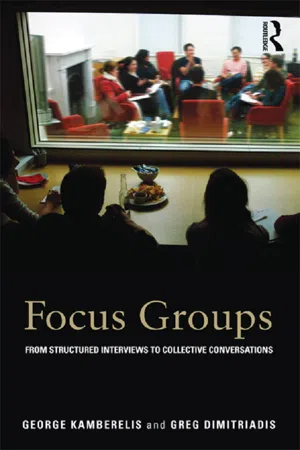
Focus Groups
From structured interviews to collective conversations
- 128 pages
- English
- ePUB (mobile friendly)
- Available on iOS & Android
eBook - ePub
Focus Groups
From structured interviews to collective conversations
About this book
Focus Groups: From Structured Interviews to Collective Conversations is a conceptual and practical introduction to focus group. As the title indicates, focus groups traditionally encompass a wide range of discursive practices. These span from formal structured interviews with particular people assembled around clearly delimited topics to less forma
Information
Chapter 1
Focus groups
A brief and incomplete history
Focus groups have become a part of the collective consciousness of the qualitative research community and of the public imagination. Recall here the extensive use of focus groups on virtually all the major US networks following the US presidential and vice-presidential debates of 2008. Although these were sometimes called “polls,” or “town hall meetings,” they all exhibited the forms and functions of large-scale focus groups as most people understand them. The first debate in Columbus, Ohio, was particularly instructive. The CNN press release noted:
Special correspondent Soledad O’Brian will moderate a focus group in Columbus, Ohio. The group will be comprised of a selection of voters from the hotly contested state. During the debate, the participants will operate electronic dial testers that will allow television viewers to see the group’s reaction in real time.
(CNN, 2008)
This group was made up of voters who had not yet decided about their vote. Their individual reactions, as noted, were measured in “real time” by way of a special meter that registered positive, negative, or indifferent responses. Afterwards, they were gathered together and queried about their responses.
SOLEDAD O’BRIAN: Barbara, you are 71 years old. Hold the mike up pretty close so we can get to hear you pretty well. I was watching you watch the debate. It was so interesting because you had a rapt attention and you were working your little dial like crazy, what resonated with you?
BARBARA HOOPER: Well it was what didn’t, if I could speak about that.
O’BRIAN: OK.
HOOPER: I mean, we have so many things going on in our country today, everyone has named so many of those tonight. But I would like for them to have been more specific about the war and a plan on when to bring our troops home. That concerned me a great deal.
(CNN Transcripts, 2008)
Individual group members spoke about their reactions to these debates first and foremost—as Hooper did here. There was very little dialogue between participants and moderator or between and among participants. Moderators like O’Brian tended to be quite directive in their questioning. The goal of the whole enterprise was to elicit a quick snapshot of how messages were taken up (or not) by people across the political spectrum. The end goal was clear—determining whether the debates swayed these undecided voters. Much like the earliest focus group work on propaganda messages in the 1940s, quantitative data (i.e. meters that register a continuum of responses) were privileged but complemented by delimited qualitative data (i.e. participants’ interview responses). This pattern is exemplary of the dominant approach to focus group work—an approach that treats focus groups as extensions of one-on-one interviews and subordinates them to what many researchers deem to be “hard” data.
This example highlights the appeal focus groups have had over time, as well as their place in the popular imagination. Both privately and publicly, focus groups are now routinely used to gauge popular attitudes and dispositions. They are used by politicians to test their platforms or to gauge popular sentiment around key issues. They are used by executives in the entertainment industry to test their latest creations—films, television shows, CDs. They are used by marketing analysts in industry to test their latest consumer goods. Indeed, in the media we often see focus groups on spectacular display, taking them out of clandestine offices and putting them in front of a global audience. Looking across these displays, it is remarkable to see how little has changed in use and function of focus groups during the past 70 or more years.
In many respects, CNN’s version of focus groups—a part of what the network called the most technologically advanced coverage of any election to date—was old-fashioned. More specifically, the double elision alluded to above has continued to mark much of the work on focus groups to date, particularly in more applied fields. First, focus groups are often not framed as distinct from one-on-one interviews. Instead, they are conceptualized as large interviews. In this regard, we will note much slippage between individual and group data gathering strategies throughout this book. Researchers are still puzzling through the similarities and differences between and among such strategies. Second, data from focus groups are often seen to serve a secondary function in research—to complement quantifiable data gathered using surveys or other instruments. Importantly, both of these elisions can be traced to the earliest use of focus groups in research. And both are still prevalent in contemporary research across a wide range of fields today. Indeed, both were prominent in CNN’s coverage of the 2008 elections.
The applied nature of much focus group work helps account for the persistence of this double elision. That is, focus groups have been used to solve a wide array of “real world” or practical problems. Because of their prevalence as practical tools in applied domains, focus groups have been under-theorized. And because they do not rest on a firm conceptual foundation, they are typically reinvented (almost from “scratch”) by each new generation of researchers or in relation to new empirical problems.
The origins of focus group research
The use of focus group research extends back to early propaganda or media effects studies at the Bureau of Applied Social Research at Columbia University in the 1940s. Originally founded to study the (then) new media of radio, research was soon undertaken on a wide range of media and their effects. Of particular interest in the post-World War II era was the study of mass-mediated “propaganda.” Several new methods emerged from the Bureau including the focus group or “focussed interview.” Merton and Kendall (1946) were rather inconsistent in their spelling of focused/focussed. We have chosen to use the more common spelling— focused—throughout. The so-called “focused interview” had the virtue of expediency. It was a way to get relevant, specific information from relatively large numbers of subjects quickly. This approach to focus groups was rooted in positivist or post-positivist epistemologies, which assume that the Truth is “out there” to be efficiently excavated, reported, and used. In many respects, the empirical material that emerged from these early focus groups could be analyzed with the same tools used to analyze one-on-one interviews. Here, focus groups were simply extensions of interviews meant to elicit individual opinions. While taking place in a group, the “unit of analysis” was still the individual.
This look at the beginnings of focus group research highlights the role and importance of “epistemology” in research methodology. As we have argued elsewhere, epistemologies are basic ways of seeing and understanding the world. For example, constructivists understand the world as constituted through human interactions. And thus see “fact” and “value” as interrelated. Positivists and post-positivists understand the world as independent from human interactions and thus see “fact” as completely separate from “value.” Epistemologies are different from “theories” which tend to be coherent but also contingent and emergent architectures of ideas. For example, Marxists see oppressive class relations as constitutive of much of how social relations between and among people have been organized throughout human history. Feminists see gender as central. Both epistemologies and theories are distinct from approaches to research and data collection strategies—the frameworks and tools used to gather, interpret, and disseminate empirical findings. See Kamberelis and Dimitriadis (2005) for a fuller explanation of the relations between and among epistemologies, theories approaches, and strategies.
These levels of analyses often get confused and muddled. In particular, researchers and others have tended to conflate positivist epistemologies with quantitative research approaches and strategies, and constructivist epistemologies with qualitative ones. Yet the “paradigm wars” of the 1980s and 1990s, played out in the journal Educational Researcher and elsewhere, demonstrated in no uncertain terms that these distinctions do not hold. Much early focus group research was grounded in positivist epistemologies. The Truth was assumed to be out there to be collected through rigorous and highly “focused” interviews— where situations or problems were defined, hypotheses formulated, interview protocol generated, and individuals questioned. Moreover, because the individual was the basic unit of analysis, in this research, the Truth was thought to be located in individual minds. This is not at all surprising given that western science is both a product of the Enlightenment and is still heavily imbued with Enlightenment principles such as Descartes’ separation of mind and body and privileging of mind and Leibniz’s monadology, where all individuals are unique substances that harbor their unique truths within themselves.
This focus on the individual had disciplinary implications as well. Specifically, by locating the Truth in the individual, focus group research tended to favor psychological approaches and explanations over sociological ones. Indeed, psychological approaches and explanations are dominant within many fields to this day (e.g. education, nursing, and marketing). In contrast (and despite the fact that most major advances in intellectual history during the past few decades have come from social and sociological theory), sociological approaches and explanations have remained marginal in these and other fields. Problems and explanations, here, tend not to be viewed in terms of social forces and structures such as class structure or gender inequalities or race and racism but in the motivations, attitudes, and beliefs of individuals. By thinking of focus groups as extensions of one-on-one interviews key directions for theory and research have been systematically underutilized.
With an eye toward broadening our understanding of the nature and functions of focus groups in research, knowledge generation, and application, Focus Groups: From Structured Interviews to Collective Conversations is both a conceptual and a practical introduction to focus group research. As the title indicates, focus groups can and have encompassed a wide range of discursive practices—from formal structured interviews with particular people assembled around clearly delimited topics to less formal, more open-ended conversations with large and small groups that can unfold in myriad and unpredictable ways. In addition, focus groups can serve (and have served) many overlapping purposes—from the pedagogical, to the political, to the traditionally empirical. In this volume, we look to explore focus groups systematically, not as an extension or elaboration of interview work alone, but as its own specific research strategy with its own particular affordances.
This is a practical distinction. The techniques and tools one uses to collect one on-one interview data cannot easily be imported into focus group settings. Or rather, if they are imported into these settings, they do not usually mine the unique and rich potentials for knowledge generation, pedagogy, and political work that focus groups can afford. But the differences between individual interviews and focus group conversations extend beyond technique alone. There are important theoretical or conceptual distinctions between the two. One-on-one interviews are often undergirded by an Enlightenment notion of the “self.” Recall that the Enlightenment was the source of positivist and post-positivist epistemologies. From this perspective, the self is a transcendent consciousness that functions unencumbered by social and material conditions, and that is the source of all knowledge and the agent of all action. Such a self is unified, coherent, autonomous, and non-contradictory. Moreover, the self is radically separate from the external world (the subject-object dichotomy of western thought) and thus able to know this world “objectively” through the rational and/or technical-instrumental separation of subject and object. This separation is achieved in one of two ways. For rationalists or pure theorists, it is achieved through the systematic application of reason to achieve unmediated access to formal principles or the formal logic that makes possible the observables of the world. For empiricists, it is achieved through controlled observation and experimentation with the goal of “finding” interpretation-free brute facts.
In contrast, from a more sociological or social constructionist perspective, the self is seen as produced in and through historical, social, and material practices. Recent post-structuralist accounts of the self are instructive here, especially accounts generated from within critical social theory and cultural studies (e.g. Bourdieu, 1990; deCerteau, 1984; Smith, 1988). In these accounts, the dualism that has thwarted advancement in conceiving the self in relation to social, cultural, and ideological discourses and practices has been rejected and alternatives have been proposed. Selves are seen as simultaneously continuous and contradictory, constituting and constitutive, produced and resistant, and they are animated by two basic and co-implicated processes: the interpellation of individuals into materially, socially, and ideologically formed subject positions, and the negativity or contradiction of being multiply positioned, which spawns resistance to such positioning. This pragmatic yet paradoxical articulation of subjectivity as a process that is both singular and multiple and that is able therefore both to resist discursive and material oppression and to take responsibility for its history is something that most systematic accounts of the self (e.g. Cartesian, utopian Marxist, deconstructionist) have failed to produce. And central to all aspects of this double articulation of subjectivity is the idea that both the interpellation of individuals into multiple subject positions and the negativity inherent in this process that engenders resistance are grounded in the same complex discursive processes. The self, therefore, does not get reduced to an a priori mind, a social formation, or a sign. No particular self can ever be known or guaranteed in advance. Rather, the self is a particular configuration of discursive and material practices that is constantly working on itself—constructing, deconstructing, and reconstructing itself in and by multiple discourses and social practices, their effects, and the ways they intersect, transverse, and challenge one another. Finally, conceived in this way, the “self” is always already the social.
Madriz’s (1997) study of women’s fear of crime (discussed in more detail in Chapter 2) is an excellent example of how this way of thinking about the relations between the self and the social can play out in focus group work. Through focus group conversations, Madriz realized that fear is, by and large, a collective phenomenon. Although she did not use the same language we are using here to talk about the individual, the collective, and the relations between them, she clearly treated the “group” as the unit of analysis and saw the self and the social as constituting each other. This allowed her to understand fear as a collective phenomenon—not as an atomistic affective entity residing in the minds and bodies of individuals. The implications of her insights in this regard are profound. Fear is to be understood and addressed as a social issue and not a psychological one. To put it perhaps too reductively, a “sociology of fear” supplants the all-too-often evoked “psychology of fear.” The “reality” of fear is thus challenged as a normative concept. Once challenged, fear can be imagined, lived, and responded to differently, and we would argue, more productively. The reason for this is that research and its application can now be directed toward the conditions of possibility of women’s fears about crime such as institutional sexism.
Focus groups are perfect sites for empirical investigations of these new theoretical formulations of self. In particular, they give us opportunities to see whether and how “self,” “other,” and “context” seem to be co-emergent phenomena, getting us to the very heart of the social processes social theorists argue constitute reality or the world we live in. In other words, exploring the relations among “self,” “other,” and “context” can help us answer Foucault’s most fundamental question: why is reality organized as it is and not some other way? Again, focus groups are especially fertile sites for such forms of inquiry. But only if we treat focus groups as their own unique method—not as a simple extension of traditional one-on-one interviews, and not as a mere “add on” to quantitative studies. Our approach to focus groups does have this emergent and ecumenical character. As such, it has particular consequences for how we think through the kinds of data we gather in focus group research and what we do with these data.
In this book, we try to develop a workable set of theoretical and practical distinctions that mark focus group work as quasi-unique in the world of method. Although the term “focus group,” coined in the middle of the twentieth century by Robert Merton and colleagues in their work on propaganda effects, had very specific meaning as we noted above, we are using the term to cover a much broader range of facilitated social activity. As we have noted, focus groups can be group interviews or collective conversations. Most fall somewhere along the continuum between them. Key here is the degree to which groups are “managed” by the researcher or allowed to develop in more free-flowing and self-organizing ways. When they are allowed to be more free flowing, focus groups can mitigate or inhibit the authority of the researcher, allowing participants to “take over” or “own” the interview space. This allows researchers to explore group dynamics, the lifeblood of social activity, as well as to explore the constitutive power of discourse in people’s lives. While not a “natural” occurrence, focus groups allow researchers to create very good approximations to natural interactions than do individual interviews and sometime even observations where the presence of the researcher makes people cautious. Finally, focus groups can allow for what we call “memory synergy” and “political synergy” among participants. These (and other) knowledge generating affordances are in many ways unique to focus group work; they are extraordinarily important for gaining access to and for saturating one’s under-standing of certain kinds of social phenomena; and we will discuss them in considerable detail in Chapter 3.
We turn now to the earliest work on focus groups, teasing out some key continuities and discontinuities that still pepper the landscape of qualitative inquiry today.
The focus
The researcher puts the “focus” in “focus groups.” That is, the researcher typically positions the topic under question a priori. Of course, this can imply a range of directed and less directed approaches. Thus, focus groups can share much with traditional one-on-one interviews. In their most controlled form, individual interviews often imply a dyadic and even clinical relationship between interviewer and interviewee. In this form, the interviewer holds most of the power and authority, extracting information from the interviewee. The control is in the hands of the researcher, who sets the parameters, defines the interview protocol, and channels the flow of discussion. In their less controlled form, the interviewer negotiates an emergent relationship with the interviewee. Control is negotiated, interview protocols are more open-ended, the interviewee is encouraged to introduce topics and manage the “floor,” and the conversation is allowed to move in various, even unpredictable, directions.
So it is with focus groups, where the researcher has latitude about the degree of “focus” he or she brings to the group. In their earliest form, this focus was very tight. Robert Merton and his colleagues at Columbia University used focus groups to measure lim...
Table of contents
- Front Cover
- Focus Groups
- Title Page
- Copyright
- Contents
- Acknowledgments
- 1. Focus groups: A brief and incomplete history
- 2 Multiple, interrelated functions of focus group work
- 3 Key affordances of focus group research
- 4 Fundamental elements of effective focus group research practice
- 5 Contemporary dilemmas and horizons of focus group research
- Epilogue
- References
- Index
Trusted by 375,005 students
Access to over 1.5 million titles for a fair monthly price.
Study more efficiently using our study tools.
Frequently asked questions
Yes, you can cancel anytime from the Subscription tab in your account settings on the Perlego website. Your subscription will stay active until the end of your current billing period. Learn how to cancel your subscription
No, books cannot be downloaded as external files, such as PDFs, for use outside of Perlego. However, you can download books within the Perlego app for offline reading on mobile or tablet. Learn how to download books offline
Perlego offers two plans: Essential and Complete
- Essential is ideal for learners and professionals who enjoy exploring a wide range of subjects. Access the Essential Library with 800,000+ trusted titles and best-sellers across business, personal growth, and the humanities. Includes unlimited reading time and Standard Read Aloud voice.
- Complete: Perfect for advanced learners and researchers needing full, unrestricted access. Unlock 1.5M+ books across hundreds of subjects, including academic and specialized titles. The Complete Plan also includes advanced features like Premium Read Aloud and Research Assistant.
We are an online textbook subscription service, where you can get access to an entire online library for less than the price of a single book per month. With over 1.5 million books across 990+ topics, we’ve got you covered! Learn about our mission
Look out for the read-aloud symbol on your next book to see if you can listen to it. The read-aloud tool reads text aloud for you, highlighting the text as it is being read. You can pause it, speed it up and slow it down. Learn more about Read Aloud
Yes! You can use the Perlego app on both iOS and Android devices to read anytime, anywhere — even offline. Perfect for commutes or when you’re on the go.
Please note we cannot support devices running on iOS 13 and Android 7 or earlier. Learn more about using the app
Please note we cannot support devices running on iOS 13 and Android 7 or earlier. Learn more about using the app
Yes, you can access Focus Groups by George Kamberelis,Greg Dimitriadis in PDF and/or ePUB format, as well as other popular books in Social Sciences & Education General. We have over 1.5 million books available in our catalogue for you to explore.