eBook - ePub
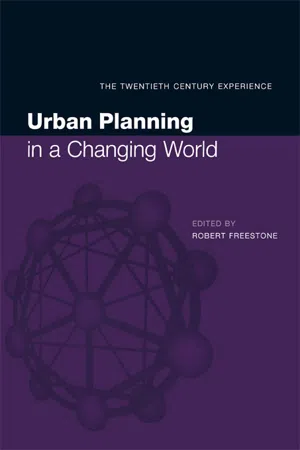
Urban Planning in a Changing World
The Twentieth Century Experience
- 304 pages
- English
- ePUB (mobile friendly)
- Available on iOS & Android
eBook - ePub
About this book
Urban planning in today's world is inextricably linked to the processes of mass urbanization and modernization which have transformed our lives over the last hundred years. Written by leading experts and commentators from around the world, this collection of original essays will form an unprecedented critical survey of the state of urban planning a
Information
CHAPTER 1
Learning from Planning’s Histories
If the twentieth century is remembered as the city century, it will also prove memorable as the century of urban planning. According to the late Gordon Cherry, in its ‘long-standing sense of common concern for environment and the setting it provides for individual life chances and community satisfactions’, planning ranks as ‘one of the significant movements’ of the past one hundred years (Cherry, 1980, p. 20). The history of cities, urban development and urbanization has attracted a prodigious, multi-faceted literature dealing with everything from the morphology of town layouts to the experience of urbanism. A self-conscious history of modern planning, alive to linkages between and within the social sciences, humanities and design arts, is a more recent phenomenon of the last quarter century, although it could be said that the history of planning has always been part of planning.
PLANNING AND HISTORY
An immanent historicity characterized all the seminal early texts, particularly those in the English language. The first issues of the Town Planning Review – started in 1910 by the pioneering Department of Civic Design at the University of Liverpool – contained many articles dealing with an historical appreciation of old towns (Cherry, 1991). The core of Professor Stanley Adshead’s opening article to the first issue was an ‘historical retrospect’ (Adshead, 1910). Raymond Unwin’s classic Town Planning in Practice (1909) treats history as mostly contributing to the ‘individuality of towns’. It introduces the neo-medievalism expounded by Viennese architect Camillo Sitte in Der Städtebau nach seinen künstlerischen Grundsätzen (1889) to help codify artistic, intimate techniques for the modern ‘art of designing cities and suburbs’. (And there is a direct link to the present-day neo-traditionalism of Andreas Duany (1994) who welcomes the reprinting of Unwin’s work nearly nine decades after its first appearance ‘not as a memorial to its historical significance, but as a modern manual on technique’.) Almost invariably, the first texts on town planning contained an obligatory historical preamble and this practice was carried into actual planning documents. Daniel Burnham and Edward Bennett’s landmark Plan of Chicago (1909) included a preliminary review of ‘city planning in ancient and modern times’ as one of the inspirational underpinnings of a strategy for remaking Chicago as a global city renowned for its exemplification of modern planning goals: convenience, healthfulness, beauty and order.
History, as it was written in this manner, quickly became entrapped in a narrow ideological formula: the past was appropriated to legitimate the roots and emergent professionalization of what was a very new and practical discipline. The treatment was at best myopically focused, at worst idiosyncratic, and generally always historicist. The revisionist high points of the past – be they Pericles’ Athens or Louis XIV’s Paris – were selectively excavated to define a chronology of world’s best practice. The mythology of the past was linked to the idealism of the present, with great male visionaries of the early twentieth century responsible for updating and carrying the glorious story forward into the modern era. Inevitably, it was not long before the hero-planner volumes appeared: Charles Moore (1921) on Daniel Burnham, Dugald MacFadyen (1933) on Ebenezer Howard, and landscape architect and civic artist Thomas Mawson (1927) on himself.
This was the model institutionalized by planning education, as the widespread bureaucratization of state intervention into urban development processes after World War Two demanded larger numbers of trained professionals. Most standard texts of the 1940s and 1950s stick, at most, to the inherited historiography. The first rite of passage for learning to plan anew was thus to see how it had been done before, although the contemporary relevance of the layout of fourth century Alexandria or thirteenth century Montpazier was not always apparent. The treatment of history became increasingly derivative and dull – ‘dumbed down’ to a tedious chronology of events and images estranged from any kind of political, social, or economic context. A couple of generations of planning students, at the least, had to endure this desultory historical prolegomenon before they broke through to the interesting, practical stuff. It was an exclusive, empirical archaeology divorced from practice. At the same time, any chance of an enlightened historical consciousness was undermined during the very period when planners were beginning to make decisive impacts on modern urban landscapes in tandem with architects, developers and government.
With planning machines comfortably bedded down in the postwar welfare state, the early signs appear of a social science flavoured approach to planning history. William Ashworth’s (1954) account of the origins of British planning is a breakthrough contribution: conservative, atheoretical, and seeking historical continuities, but significantly embedded in social and economic context. Generally, however, urban planning remained a scholarly backwater, of little real interest to other academic disciplines. The dominant discourse was of planning as an unambiguously beneficent statist activity: comprehensive, technocratic, scientific, and still somehow magically reformist. More was better. Regardless of platitudes about community participation, this was strictly a professional activity for trained experts. The planning history of the day largely legitimated this conventional wisdom.
The literature of planning thus entered the 1960s in an innocent, dreamlike state, its antediluvian history increasingly remote from social reality, professional practice, and the new urban politics. This comfort zone was soon under siege. The postwar political consensus about the scope and direction of state intervention in the broad ‘public interest’ had been good to planning. The heady days immediately after World War Two saw planning elevated to one of the central planks of social reconstruction. Even when that could not be sustained, it quietly prospered from bi-partisan tolerance. But now a new world order was coming into play: the notion of the centralized, benevolent state was crumbling; economic policy was forced to look beyond the industrial Fordism which had been the touchstone of social progress in the first half of the twentieth century; there was dissent on the streets about unpopular wars and civil rights; and the environmental movement was awakening. The old verities, as has been said, were being blown away.
Foundational elements of modernist planning like new towns, comprehensive redevelopment, low density suburbs, mono-functional land use zoning, high rise public housing towers, and freeways came under greater scrutiny. All had had their downsides, a track record of economic disbenefits and socially redistributive outcomes belying the inclusive, visionary rhetoric at their birth. Urban communities did not seem to be inheriting the planning wisdom of the ages. All-knowing, all-seeing comprehensive master plans – along with allied scientistic methodologies (Taylor, 1998) – came under particular assault. Planning began to fragment into epithetical ventures around specialist concerns: transportation, the social environment, ecological issues. The fragmentation and uncertainty reflected planning’s internalization of wider social tensions and crises (Harvey, 1978).
It was possible, in the face of this, to reaffirm the old values: the quest for urban salvation through all-encompassing city and metropolitan blueprints. Informed by interviews with some of the central participants in planning in the early twentieth century, Mel Scott’s American City Planning since 1890 (1969) did precisely this. It is an important account which unapologetically treats planning as a fundamental force in national history and breaks free of the tired, decontextualized descriptions which had dominated planning history. But encased in a narrow professionalism, and being sponsored by the American Institute of Planners, it not only failed to ‘penetrate the rhetoric of reform that planners drew upon to legitimize their actions’ but also denied the ‘differential impacts’ of planning on diverse communities (Sies and Silver, 1996, p. 8). While it pulls much together to remain an obligatory reference work to today, it leaves so much out by failing to situate the theory and practice of planning more critically within their fullest societal milieus.
The self-confidence of Scott’s book contrasts achingly with other interpretations emerging from the 1960s. The contributions by Paul Davidoff (1965) and Robert Goodman (1972) are devastating professional auto-critiques with a radically different spin on top-down technocratic planning. As planning got political, it attracted wider interest. The really influential texts telling new, or reinterpreting old, history were being written by commentators outside the planning profession. The classic text is Jane Jacobs’ dyspeptic view of mainstream planning ideology viewed from Greenwich Village, The Death and Life of Great American Cities (1962). At the other end of the political spectrum, more supportive of established structures and re-establishing the case for enlightened, neo-Fabian public policy, was the suburb-friendly argument of political scientist Hugh Stretton (1970). The main point here was that planning history was now beginning to attract wider interest and a re-invigoration from multidisciplinary contributions.
In the wake of this maelstrom, a new planning history emerges in the 1970s. Its appearance seems partly explained by a collective urge to make sense of a cathartic period from which planning emerged somewhat bruised and battered, its fortunes declining, and no longer riding the wave of the welfare state. This was also a time of generational change, with the baton of leadership in the profession passing from the die-hard physicalists of the early postwar period to progressive, social science types. Planning history provided a scholarly focus for academic planners, and was well placed to benefit from the rising interest in urban studies, urban history, local history, and heritage studies. The new planning history crystallized in an inter-disciplinary zone welcoming of practitioners, philosophers and teachers from all fields – ‘a definitive specialism in its own right, notwithstanding its indeterminate boundaries’ (Cherry, 1991, p. 40). An event which captures this moment is the formation in 1974 of what has become the International Planning History Society. National societies would follow in North America, Europe and South Africa.
Since the mid-1970s, a significant literature has been amassed. Its early growth is captured by Sutcliffe’s (1981) herculean bibliography. Amid entries recording dogged institutional narratives, myth-building, and asocietal assemblages of facts and figures, are glimpses of a new critical literature. The better guides now are bibliographic essays reviewing national literature at the intersection of planning and history (for example, Burgess, 1996; Cherry, 1991; Freestone and Hutchings, 1993; Miller, 1998; Monclús, 1992). The nature of this literature is not easily typecast. The four main strands identified by Cherry (1981) are still evident: ‘professional involvements’ (the history of what planners have done); ‘techniques and performance’ (the history of town building and physical plans); ‘social and institutional settings’ (the history of planning events in their social context); and the biographical (post-hagiographic examination of broader themes through individual lives). Specific interests can be related to these broader approaches – institutions, legislation, methodologies, design, theory, post-colonial and cultural studies perspectives. The historiography of planning is now delivered through diverse modes, albeit with traditional narratives and case studies – indeed a propensity for virtual microscopic histology – predominating.
It would be erroneous to telescope all this into a homogeneous output varying only by subject matter and length. The tension identified in the early 1980s between the art historian and social historian (Birch, 1981) has largely dissolved with the reassertion of space in social theory and the erosion of physical fetishism in built environment studies. But different spins on common subject matter are evident depending on whether it is a historian, geographer, architect, political scientist or planner telling the story. The influences of Marx (Benevolo, 1967; Foglesong, 1986; Scott, 1980), Foucault (Boyer, 1983), and other postmodern theorists (Sandercock, 1998b) are now evident, usually making their initial mark on foreign-language literature before diffusing into anglophone discourse. Atheoreticism still abounds, but at least in a post-idealist vein quite distinct from earlier studies which saw planning disconnected from any political context (Hague, 1984).
This is not to cast the past quarter century as a golden era of reflexivity. Too many historical studies cast planning as an unproblematic endeavour, emphasize success over failure, and stress the ‘supply side’ (the neatness of theories and design intentions) rather than ‘demand side’ (the messiness of actual outcomes and lived experiences) of planning activity. Partly in response to these lacunae, a self styled, ‘noir’ history has lately been constructed. Yiftachel (1998) surveys the realities of planning as a tool of social control and oppression. This is darker, more sinister territory – planning’s ‘advancement’, or at least technical facilitation, of regressive social goals involving exclusion, segregation, marginalization, and injustice. Also in extraordinary short supply, given planning’s throughgoing practical and vocational aspirations, are detailed historically-informed and politically-contextualized policy evaluations. This genre is relatively weakly developed. The deterrents lie in the analytical complexities of such projects, the formidable methodological challenges of disentangling planning from other influences, and the necessary descent to the often untrendy realm of the local where planning and development control arguably have their greatest impacts on the urban landscape (cf. Hall et al., 1973; McLoughlin, 1992).
Krueckeberg (1997) distills planning history’s sins of omission and commission into three categories: exclusion (stories and values left out); unexamined contradictions (between theory and practice, philosophy and practice, social justice and narrow professionalism); and experimentalism (the trivialization of planning disaster). There is good and bad historical writing, and the flaws can be magnified if connections are made with current planning practice and urban policy (Abbott and Adler, 1989; Hutchings, 1998; Shaw and Robinson, 1998). While much of the literature on planning retains an unreconstructed present-mindedness, the contribution of an historical awareness will count for little if rooted in misunderstandings, misinterpretations and misreadings of the past. To avoid becoming ‘the planners of history’s mistakes’, Krueckeberg counsels us to ‘to look back more often’ (p. 269).
Various texts have done that through the twentieth century. Even when forward-looking, they speak most directly to their own times. Five archetypal Anglo-American texts of different eras are those of Triggs (1909), Abercrombie (1933), Keeble (1952), Hall (1996), and Sandercock (1998a). The first of these, H. Inigo Triggs’ Town Planning: Past, Present and Possible, is representative of the part-polemical, part-substantive treatises in the early decades of the emergence of modern town planning theory. Now an historical document in its own right, it was published in the extraordinary year 1909: the year in which, among other things, the British Parliament passed that nation’s first Town Planning Act, Unwin’s Town Planning in Practice appeared, the Plan of Chicago was completed, and the First American Conference on City Planning ‘and the Problems of Congestion’ was held in Washington DC. With the Haussmannization of Paris in living memory and Welwyn Garden City not even a glint in Howard’s eye, it is ingrained with historicism and historic examples. Yet formal ‘history’ is confined to what becomes the obligatory early chapter on ‘Types of Ancient and Modern Towns’ dealing with town formation, siting, and layout.
Patrick Abercrombie’s Town and Country Planning was first published in 1933, and reprinted and revised several times into the late 1950s. Abercrombie, the founding editor of Town Planning Review, was the great British patrician land use planning expert, and his book was probably the most widely-read imperial text of its day. It was exp...
Table of contents
- Front Cover
- Half Title
- STUDIES IN HISTORY, PLANNING AND THE ENVIRONMENT
- Title Page
- Copyright
- Contents
- Contributors
- 1. LEARNING FROM PLANNING’S HISTORIES
- 2. THE CENTENARY OF MODERN PLANNING
- 3. RE-EXAMINING THE INTERNATIONAL DIFFUSION OF PLANNING
- 4. QUASI UTOPIAS: PERFECT CITIES IN AN IMPERFECT WORLD
- 5. LEARNING FROM TWENTIETH CENTURY URBAN DESIGN PARADIGMS: LESSONS FOR THE EARLY TWENTY-FIRST CENTURY
- 6. RETHINKING THE SIGNIFICANCE OF THE CITY BEAUTIFUL IDEA
- 7. THE NEIGHBOURHOOD PARADIGM: FROM GARDEN CITIES TO GATED COMMUNITIES
- 8. PLANNING FOR SOCIAL BETTERMENT: FROM STANDARD OF LIVING TO QUALITY OF LIFE
- 9. THE PARADOXES OF ANTI-SPRAWL REFORM
- 10. MOTOR VEHICLES AND THE INNER CITY
- 11. PLANNING AND HERITAGE: TOWARDS INTEGRATION
- 13. DIVERSITY, DIFFERENCE AND THE MULTI-LAYERED CITY
- 14. GLOBAL CITY REGIONS: PLANNING AND POLICY DILEMMAS IN A NEO-LIBERAL WORLD
- 15. IS PLANNING HISTORY?
- Index
Trusted by 375,005 students
Access to over 1.5 million titles for a fair monthly price.
Study more efficiently using our study tools.
Frequently asked questions
Yes, you can cancel anytime from the Subscription tab in your account settings on the Perlego website. Your subscription will stay active until the end of your current billing period. Learn how to cancel your subscription
No, books cannot be downloaded as external files, such as PDFs, for use outside of Perlego. However, you can download books within the Perlego app for offline reading on mobile or tablet. Learn how to download books offline
We are an online textbook subscription service, where you can get access to an entire online library for less than the price of a single book per month. With over 1.5 million books across 990+ topics, we’ve got you covered! Learn about our mission
Look out for the read-aloud symbol on your next book to see if you can listen to it. The read-aloud tool reads text aloud for you, highlighting the text as it is being read. You can pause it, speed it up and slow it down. Learn more about Read Aloud
Yes! You can use the Perlego app on both iOS and Android devices to read anytime, anywhere — even offline. Perfect for commutes or when you’re on the go.
Please note we cannot support devices running on iOS 13 and Android 7 or earlier. Learn more about using the app
Please note we cannot support devices running on iOS 13 and Android 7 or earlier. Learn more about using the app
Yes, you can access Urban Planning in a Changing World by Freestone, Robert Freestone in PDF and/or ePUB format, as well as other popular books in Architecture & Urban Planning & Landscaping. We have over 1.5 million books available in our catalogue for you to explore.