- 288 pages
- English
- ePUB (mobile friendly)
- Available on iOS & Android
eBook - ePub
About this book
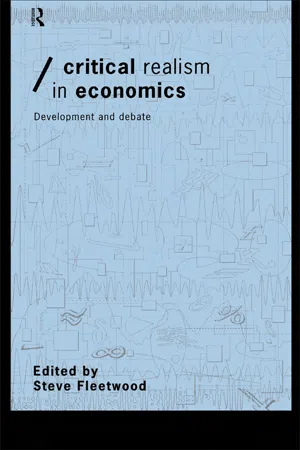
Drawing on the fields of economic methodology and economic theory, this title opens up new forms of investigation in economics and transforms the nature of economic reasoning. The work combines contributions from authors critical of this approach with those who are concerned to clarify its full implications for contemporary economics. This is a vol
Part I: DEVELOPMENT
1 DEVELOPMENTS IN ECONOMICS AS REALIST SOCIAL THEORY
Tony Lawson
Social theory explicitly committed to elaborating the nature of social being and/or how we access social reality is experiencing something of a revival in economics.1 The five chapters which follow can all be counted as contributing to this trend. In fact they all in some way connect with a specific social theory project of the sort in question, one that has been systematised within economics as critical realism.2 Under this head, numerous results, arguments, conjectures and critiques have been produced in recent years,3 and the chapters included here aim to take some of these specific developments further.4 My own object in this introductory chapter is merely to facilitate the contributions which follow: to outline something of their context and to sketch certain basic ideas and results that are treated in the following chapters as ‘given’, that are taken as sufficiently well grounded (if of course always corrigible) premises.
Underlabouring
Within economics critical realism has very much played the role of underlabourer for a more fruitful approach to scientific explanation (Lawson, C., Peacock and Pratten 1996). In this it has been both critically explanatory (of the existing situation in economics) and in varying degrees developmentally constructive (in elaborating an alternative perspective). In the following paragraphs, as in the ordering of the chapters included here, the move is from the (more) critical to the (more) constructive moment.
One primary object of critical realism in economics has been to identify the basic nature or character of mainstream economics. Most critics of the mainstream project have, in attempting to characterise it, isolated particular substantive claims, such as theories of rationality, or of equilibrium. It has been the contention of critical realism, in contrast, that it is at the level of method that its essence lies. In fact the insight that it is not substantive theory that defines the project is clear enough once we recognise that, despite the mainstream project being widely regarded as persisting, specific substantive theories come and go, often with some rapidity. Even the cherished conceptions of rationality and of equilibrium have been dispensed with in recent contributions regarded as central to the mainstream (see Lawson 1997, Chapter 8). Yet through all its transformations and apparent metamorphoses the essential method of mainstream economics has been found to remain reasonably constant. It is this, then, that must be taken as the most central and defining feature of the mainstream project.5
Deductivism
The method of the mainstream project which, according to critical realist analysis, is its characteristic feature is, briefly put, closed system modelling. This is also its essential error. A reliance upon closed systems modelling is an error in that the social world appears to be quintessentially open and hardly susceptible to scientifically interesting local closures. By a closed system here I simply mean situations in which regularities of the form ‘whenever event (or state of affairs) x then event (or state of affairs) y’ occur. Methods of analysis, including modes of explanation, which are formulated on the presupposition that elaborating regularities of this form or structure are at least necessary in science6 can be labelled deductivist. It is deductivism so interpreted that, it has been shown elsewhere (Lawson 1997), characterises mainstream economics and which, in an open social system, is the essential error of modern economics.
Now it does not follow that because deductivism is a mistake, science and explanation are thereby impossible. Rather, the latter need to be more adequately conceptualised. An important observation here is that event regularities of the sort presupposed in deductivism actually occur only under rather specific conditions. In fact, outside astronomy, event regularities of interest in science usually occur only in conditions of experimental control. Once this is recognised, it is easily seen that any conception which ties science to activities involving the elaboration of event regularities serves systematically to fence off science from most of the goings on in the world. Moreover, any such conception is inevitably unable to make sense of the further observation that science is after all successfully applied even in situations where event regularities are not in evidence.
These two observations—that event regularities are restricted to rather specific situations and that science is successful even where event regularities are not in evidence—clearly warrant explanation. We can make sense of them. But in order to do so we need first of all to augment the ontology of events and experiences that is so basic to mainstream economics, to include underlying structures of things, their powers, mechanisms and tendencies that, if triggered, act even if their effects are not directly manifest. Certain things, by virtue of their intrinsic structures, have various powers (including liabilities): bicycles to facilitate rides, aspirins to relieve head-aches, language systems to facilitate speech-acts, shops to facilitate trade, or autumn leaves to fall to the ground under the influence of gravitational attraction. And it is clear enough that such powers may exist without being triggered (e.g. the aspirin may remain in the bottle; the shop closed on Sundays), or if triggered, may set forth mechanisms and tendencies that are not directly manifest or actualised because of countervailing factors. The fall of an autumn leaf, for example, does not conform to an empirical regularity, precisely because it is governed in complex ways by the actions of different juxtaposed and counteracting mechanisms. Not only is the path of the leaf governed by gravitational pull, but also by aerodynamic, thermal, inertial and other mechanisms. Similarly, the headache sufferer may take the aspirin in an environment which is, say, sufficiently noisy that the pain experienced actually worsens despite the aspirin’s pain-reducing effect.
According to this conception, experimental activity can now be understood as an attempt to intervene in order to insulate a particular mechanism of interest by holding off all other potentially counteracting influences. The aim is to engineer a system in which the actions of any mechanism being investigated are more readily identifiable. Thus, experimental activity is rendered intelligible not as the production of a rare situation in which an empirical law is put into effect, but as an intervention designed to bring about those special circumstances under which a non-empirical mechanism can be insulated and its tendencies empirically identified. This explains the restriction of so many event regularities to situations of experimental control: where triggering conditions and effects of mechanisms are found to be correlated. But a mechanism itself, if triggered, can be operative whatever else is going on. This is what is expressed by the notion of transfactuality in critical realism. A transfactual statement is not a counter-factual, i.e. it does not express what would happen if conditions were different. Rather it refers to something that is going on, that is having an effect, even if the actual (possibly observable) outcome is jointly co-determined by (possibly numerous) other influences. On this understanding, for example, a leaf is subject to the gravitational tendency even as I hold it in the palm of my hand or as it ‘flies’ over roof tops and chimneys. Through this sort of reasoning we can render intelligible the application of scientific knowledge outside experimental situations. If triggered, a mechanism may have its effects irrespective of the context in which it is operative.
It follows that science and explanation are not so much concerned to elaborate patterns at the level of actual events as to identify and understand the causal mechanisms responsible for them. This is as feasible in the social realm as in the natural domain (Lawson 1997). Only under special conditions does this activity involve the generation of strict event regularities, and in the social realm, where the opportunities for meaningful experimental control are limited, such conditions may not materialise at all. The basic error of deductivism, then, is to generalise what must now be recognised as a special case—where a single set of mechanisms is insulated and thereby empirically identified. The error of deductivism in its guise of mainstream economics is to abduct this special case to a context where it may have almost no scientific bearing at all.
Of the chapters included here, it is Stephen Pratten’s contribution that builds most directly on this characterisation of mainstream economics as deductivist. Pratten, though, is wanting to move beyond the characterising of mainstream economics. Indeed, his general concern is with the degree to which coherence can be found in the non-mainstream economic traditions. His particular concern is whether the set of contributions systematised as neo-Ricardianism can comfortably fit under the umbrella of a coherent Post-Keynesianism. There is no doubt that the reputed relation of neo-Ricardianism to Post-Keynesianism (or description of the former as Post-Keynesian) involves many tensions and has often been questioned previously. Usually the question of whether the two projects are the same or at least complementary has been taken to turn on substantive issues of some sort. From the perspective elaborated in critical realism, however, this strategy can now be questioned. Specifically, if the essence of the mainstream project is its deductivist methodology, then any truly alternative approach will be non-deductivist in nature and presumably not wholly distinct from the project and perspective elaborated as, or within, critical realism. Elsewhere, indeed, I have suggested that coherence in such traditions as Austrianism and Institutionalism as well as Post-Keynesianism, should also be sought on this basis (Lawson 1994). Pratten’s question then can be framed as follows: if mainstream economics is deductivist and the essence of a coherent Post-Keynesianism is akin to critical realism, does neo-Ricardianism have affinities (mainly) with the latter or the former? His answer is formulated as follows:
neo-Ricardian economics, to the extent that it takes closure for granted as a natural and useful starting point for analysis, retains an underlying commitment to deductivism and so is difficult to reconcile with Post-Keynesianism. In other words, if Post-Keynesianism is to be a consistent project, its link with neo-Ricardianism appears untenable. Alternatively, if, perhaps for institutional reasons, it is felt that in outlining the nominal characteristics of Post-Keynesianism some reference has to be made to neo-Ricardianism, then the project of seeking coherence may have to be abandoned.
The chapter by Clive Lawson has parallels with Pratten’s. Lawson’s concern is with the ‘new institutionalist’ economics, or, more directly, with certain methodological results that certain strands of that school attribute to Menger. If deductivism is the structure of mainstream reasoning it encourages a material form of social atomism. That is, to guarantee results of the ‘whenever this then that’ form the entities of analysis are required to be crypto atomistic (basically preprogrammed). In economics this has inevitably meant that explanations are couched in terms of human (typically ‘optimising’) individuals. Of course, once the manner in which deductivism drives the project is recognised, it is easy enough to see that notions like economic rationality, at least as formulated in mainstream economics, are little more than a gloss on the proceedings. But the mainstream project needs to present things differently. Specifically, the insistence upon explaining things in terms of individual (typically rational) decisions or some other attribute, i.e. the doctrine of methodological individualism, is recognised as something that warrants an independent justification. One apparent attraction of Menger’s work to the mainstream project, then, one explicitly referred to by its ‘new institutionalist’ strand or offspring, is precisely that it is perceived to have provided an argument to justify the individualist approach.
In fact, the question of whether Menger has actually been successful in this is of particular interest here because Menger also adopts an Aristotelian orientation which, in some significant aspects at least, is not dissimilar to the perspective developed in critical realism. Is, then, methodological individualism, and perhaps by implication the deductivist structure on which it rests, justified after all? Lawson’s findings are as follows:
Menger’s particular essentialist-realist position, once transposed to the social realm, becomes the position now familiar as methodological individualism. But it is most noticeable that the method which is so transposed is hardly justified. That theory must start with the simplest elements is simply asserted by Menger. However, this assertion is of crucial importance as it appears to be the only link provided by Menger between the notion of theory, which he spends so much time defending against the Historical School, and the individualism for which he is so well known. Moreover,… criticisms made of Menger’s work, which are understood to be criticisms of his Aristotelianism, in fact hinge on just this assertion that exact types are the simplest elements in everything real.
If the usual material form of deductivism (i.e. methodological individualism) is (erroneously) assumed by some economists to be justified in Menger’s contributions, others suppose that a generalised reliance upon deductivist modes of reasoning is directly grounded in the writings of Popper. Indeed, it is not uncommon to find econometrics textbooks and articles averting to ‘Popperian falsificationism’ as authoritative support for deductivist methods thereafter elaborated. Jochen Runde’s chapter provides a challenge to the claim that Popper provides deductivism with such a general grounding. Critical realism, it has been noted, argues that it is only in relatively special conditions (outside astronomy mostly in well-controlled experimental situations) that event regularities can be rationally anticipated, so that it is only in such conditions that predictive accuracy, the central falsificationist concern, can be accepted as a relevant criterion of theory assessment. Runde’s chapter suggests not only that Popper does not justify deductivism as a general approach, but also that, in his writings on propensities, something like its limitations as emphasised in critical realism are recognised by Popper all along. It is true that in his contributions on falsificationism Popper’s emphasis has served to encourage a widespread acceptance of the deductivist approach. Nevertheless, it can be argued that, in his discussions on propensities especially, Popper always situated the relevance of this method. However that may be, recent developments in Popper’s thinking are such that, with the publication of his final book A World of Propensities (Popper 1990), a conception sharing many similarities with central features of critical realism is, according to Runde, quite evident. Thus Runde makes the following observations:
Whereas in his earlier writings he [Popper] had focused almost exclusively on propensities identified in experimental situations, the shift reported in his 1990 book is his fully taking on board that non-experimental situations have propensities too, that, as he puts it, we live in a world of propensities.
Two important consequences follow directly from this shift, both of them emphasised in CR [critical realism]. First Popper now acknowledges explicitly that only a small proportion of the now expanded ontology of propensities will be amenable to statistical measurement…
The second key consequence is that Popper now feels bound to emphasise that, with the exception of the ‘unique natural laboratory experiment’ of the planetary system, regular associations of events or states of affairs—what he calls ‘natural laws of a deterministic character’ and ‘natural laws of a probabilistic character’—are rarely found to occur outside of situations of experimental control. The reason is simply that in non-laboratory situations there will typically be ‘disturbing propensities’, the exclusion of which is the very purpose of laboratory experiments.
Given the usual interpretation of Popperianism in economics (as elsewhere) as (naive) falsificationism it is tempting to conclude (although I must emphasise that Runde does not put things in quite this way) that Popper is perhaps more critical realist than Popperian.
Retroduction
I move now to consider the context of contributions more directly concerned with the developmental...
Table of contents
- COVER PAGE
- ECONOMICS AS SOCIAL THEORY
- TITLE PAGE
- COPYRIGHT PAGE
- CONTRIBUTORS
- PREFACE
- PART I: DEVELOPMENT
- PART II: DEBATE
Trusted by 375,005 students
Access to over 1.5 million titles for a fair monthly price.
Study more efficiently using our study tools.
Frequently asked questions
Yes, you can cancel anytime from the Subscription tab in your account settings on the Perlego website. Your subscription will stay active until the end of your current billing period. Learn how to cancel your subscription
No, books cannot be downloaded as external files, such as PDFs, for use outside of Perlego. However, you can download books within the Perlego app for offline reading on mobile or tablet. Learn how to download books offline
Perlego offers two plans: Essential and Complete
- Essential is ideal for learners and professionals who enjoy exploring a wide range of subjects. Access the Essential Library with 800,000+ trusted titles and best-sellers across business, personal growth, and the humanities. Includes unlimited reading time and Standard Read Aloud voice.
- Complete: Perfect for advanced learners and researchers needing full, unrestricted access. Unlock 1.5M+ books across hundreds of subjects, including academic and specialized titles. The Complete Plan also includes advanced features like Premium Read Aloud and Research Assistant.
We are an online textbook subscription service, where you can get access to an entire online library for less than the price of a single book per month. With over 1.5 million books across 990+ topics, we’ve got you covered! Learn about our mission
Look out for the read-aloud symbol on your next book to see if you can listen to it. The read-aloud tool reads text aloud for you, highlighting the text as it is being read. You can pause it, speed it up and slow it down. Learn more about Read Aloud
Yes! You can use the Perlego app on both iOS and Android devices to read anytime, anywhere — even offline. Perfect for commutes or when you’re on the go.
Please note we cannot support devices running on iOS 13 and Android 7 or earlier. Learn more about using the app
Please note we cannot support devices running on iOS 13 and Android 7 or earlier. Learn more about using the app
Yes, you can access Critical Realism in Economics by Steve Fleetwood in PDF and/or ePUB format, as well as other popular books in Economics & Business General. We have over 1.5 million books available in our catalogue for you to explore.