eBook - ePub
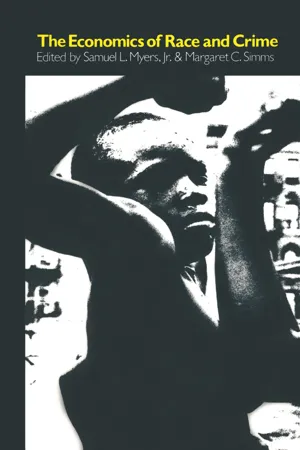
The Economics of Race and Crime
- 232 pages
- English
- ePUB (mobile friendly)
- Available on iOS & Android
eBook - ePub
The Economics of Race and Crime
About this book
The relationship between crime and the economy has received too little attention from researchers. This volume remedies that deficit, resurrecting several classic writings on this elusive topic by and about blacks, and presenting new contributions by researchers at the frontier of work on the subject. Among the landmark articles included are W.E.B. Dubois' famous examination of crime in Philadelphia, an analysis of black criminal behavior by Walter Willcox, who was chief statistician of the Census Bureau at the time he wrote this essay, and excerpts from the ninth Atlanta Conference on Negro Crime. The frontier articles use quality microdata to understand particular aspects of criminal justice processes. They address the relationship between employment and criminal behavior, trade-offs among education, employment, and crime, and the link between overall economic conditions and rates of incarceration. Among the authors represented in the landmark research articles are Harold Votey and Llad Phillips, Richard Freeman, David Good and Maureen Pirog-Good, Dario Melossi, and Samuel Meyers and William Sabol. Richard MaGahey concludes the volume with comments on the current status of research in the field. This volume captures the emerging tension within scholarship on race and crime, and provides both a reflective vision of work in this area as well as state-of-the-art research by leading scholars.
Information
THE RELATION OF CRIMINAL ACTIVITY TO BLACK YOUTH EMPLOYMENT
This article reports on a study which attempts to estimate the extent to which current and previous criminal activity reduces the employment of inner city black male youths from high poverty neighborhoods. The study finds a significant trade-off between employment and crime, with crime associated with a 10 to 12 percent reduction in employment of these youths. The policy implication is that increased criminal deterrence, as well as other programs, has a role to play in efforts to resolve the employment crisis for disadvantaged youths.
To what extent is youth crime associated with joblessness? If youth crime were reduced as a result of, say, a successful deterrence program, what is the likely consequence for the employment of persons in a high-unemployment high-crime population?
Economic studies of crime and the labor market, which focus on the impact of unemployment and other measures of market opportunities on criminal behavior, do not readily provide answers to these questions. By making crime the dependent variable they neglect potentially important causal links from crime to employment, such as the effect of past criminal behavior on future employment prospects. Moreover, because crime and employment are far from dichotomous alternatives (some employed persons commit crimes; most unemployed persons do not commit crimes), it is necessary to study separately the crime-to-employment link to evaluate what a change in criminal behavior would do to employment.
In this article I provide such an analysis. I reverse the direction of standard labor market-crime analyses by studying the impact of crime on employment, focusing on out-of-school black males aged 16–24 from the 1979-80 National Bureau of Economic Research (NBER) Survey of Inner City Youths in the worst poverty tracts in Chicago, Boston, and Philadelphia. The principal conclusion reached is that for these youths crime is associated with substantially less employment, implying that criminal deterrence programs can play a role, along with other programs, in increasing their employment.
HOW CRIME AFFECTS EMPLOYMENT
There are six distinct ways in which criminal activity and the incentive to commit crime can reduce employment in legitimate activities.
First, in the framework of standard labor supply models, when crime is more rewarding than legitimate work, it may substitute for employment. While crime often requires little time and may complement rather than substitute for employment (white collar crimes, in particular, take place at the work place), the direction and magnitude of this effect is uncertain, dependent on the technology of crime and work.
Second, there is likely to be an income effect from successful crime, with persons who earn a lot choosing leisure over work: Make a fortune robbing Fort Knox and you are less likely to show up for work tomorrow.
Third, there is an “incapacitative effect” because unsuccessful crime that lands someone in jail removes him from the labor force. While for most demographic groups reductions in employment due to jail time is small, for black youths the effect is far from negligible. Criminal justice figures suggest that approximately 187,500 black men aged 18–29 were in prison in the early 1980s—roughly 5% of the population in that age bracket.1 Census of Population data tell a similar story, showing 5% of young black men “institutionalized” in 1980.2
Fourth, upon release from jail, an ex-offender is likely to have trouble getting a job. Employers generally shun persons with criminal records. Moreover, persons are more likely to learn criminal than legitimate work skills in jail.
Fifth, criminal activity that injures the criminal or victims may also reduce employment possibilities. In its most extreme form, criminal activity kills people, and homicide rates are extraordinarily high for black youths: in 1979, there were 126.9 deaths by homicide per hundred thousand black males 25-29 compared to 14.8 deaths by homicide per hundred thousand white males 25-29.3 These figures and those for adjacent age groupings imply that nearly 1% of black youths die of homicide in their twenties, and thus are removed from the potential work force. By age 40 the percentage roughly doubles.4
Finally, to the extent that crime is concentrated in an area, the costs of doing business or working there will be high, reducing business activity, demand for labor, and employment. The fact that inner city poverty areas tend to be high-crime areas thus lowers employment prospects.
In sum, the concentration of the crime literature on the effect of unemployment (and deterrence) on crime notwithstanding,5 there is an important feedback from crime to employment that deserves study.
THE TRADE-OFF IN THE INNER-CITY MINORITY YOUTH SURVEY
In 1979–80 as part of its project on minority youth employment the NBER commissioned Mathematica Policy Research to survey some 2400 inner city youths from the worst poverty tracts in Boston, Chicago, and Philadelphia—a set of youths with lower employment and school-going than found among black youths in general or among white youths.6 Because of concern with the relation between crime and employment, one module of the survey dealt with self-reported criminal behavior and the youths’ perceptions of opportunities for crime. In an important set of papers Viscusi has analyzed the determinants of criminal behavior in these data, finding a significant role for economic factors,7 which suggests that the module can be fruitfully used to evaluate the crime-employment trade-off.
Does the survey show a substantial inverse relation between criminal activity and employment? The cross-tabulations of the number of out-of-school youths who reported working the survey week with various measures of criminal activity and perceptions of criminal opportunity shown in table 1 indicates that it does. Relatively fewer youths who admitted committing crimes were working than other youths: the rate of employment was 30% for those who committed crimes the previous month (33% for those committing crimes the previous year) compared to 46% for those who did not commit a crime. Moreover, youths who had relatively high crime earnings had exceptionally low proportions employed, as did those who spent time in jail or who were on probation. Finally, the data on perceptions of crime show lower employment among youths who see the environment as offering a significant “chance to make money illegally” and among youths who view their neighborhoods as particularly dangerous.
Because criminal behavior in the NBER Survey is self-reported, it is subject to reporting bias. Comparisons of self-reported crime with independent police records show, in fact, that underreporting is substantial among black youths,8 with crime understated by 2 to 4 fold.9 Assuming, as seems reasonable, that the youths who committed but failed to report crimes have lower employment rates than youths who did not commit crimes, the underreporting will significantly bias downwards the measured tradeoff between crime and employment. Assume, conservatively, an underreporting factor of 2, and assume further that youths who commit but do not report crimes had the same employment probability as youths who admitted committing crime. Then the true rate of employment for youths who did not commit crimes in table 1 would be 51% rather than 46%, increasing the tradeoff by five percentage points. If the underreporting rate were as large as 4 the gap would be understated by 10 points.10 As the employment of youths who committed but did not report crimes may lie somewhere between that of youths who did not commit crimes and that of youths who reported crimes, these calculations probably overstate the impact of the self-reporting bias. Howeve...
Table of contents
- Cover
- Title Page
- Copyright Page
- Table of Contents
- About the Authors
- Preface
- Introduction
- Landmark Articles
- Frontier Articles
Trusted by 375,005 students
Access to over 1.5 million titles for a fair monthly price.
Study more efficiently using our study tools.
Frequently asked questions
Yes, you can cancel anytime from the Subscription tab in your account settings on the Perlego website. Your subscription will stay active until the end of your current billing period. Learn how to cancel your subscription
No, books cannot be downloaded as external files, such as PDFs, for use outside of Perlego. However, you can download books within the Perlego app for offline reading on mobile or tablet. Learn how to download books offline
Perlego offers two plans: Essential and Complete
- Essential is ideal for learners and professionals who enjoy exploring a wide range of subjects. Access the Essential Library with 800,000+ trusted titles and best-sellers across business, personal growth, and the humanities. Includes unlimited reading time and Standard Read Aloud voice.
- Complete: Perfect for advanced learners and researchers needing full, unrestricted access. Unlock 1.5M+ books across hundreds of subjects, including academic and specialized titles. The Complete Plan also includes advanced features like Premium Read Aloud and Research Assistant.
We are an online textbook subscription service, where you can get access to an entire online library for less than the price of a single book per month. With over 1.5 million books across 990+ topics, we’ve got you covered! Learn about our mission
Look out for the read-aloud symbol on your next book to see if you can listen to it. The read-aloud tool reads text aloud for you, highlighting the text as it is being read. You can pause it, speed it up and slow it down. Learn more about Read Aloud
Yes! You can use the Perlego app on both iOS and Android devices to read anytime, anywhere — even offline. Perfect for commutes or when you’re on the go.
Please note we cannot support devices running on iOS 13 and Android 7 or earlier. Learn more about using the app
Please note we cannot support devices running on iOS 13 and Android 7 or earlier. Learn more about using the app
Yes, you can access The Economics of Race and Crime by Samuel L. Myers Jr,Margaret C. Simms,Samuel L. Myers Jr. in PDF and/or ePUB format, as well as other popular books in Social Sciences & Economic Conditions. We have over 1.5 million books available in our catalogue for you to explore.