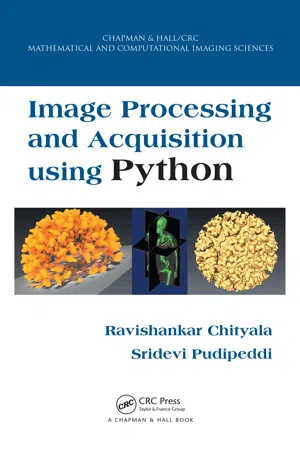
Image Processing and Acquisition using Python provides readers with a sound foundation in both image acquisition and image processing-one of the first books to integrate these topics together. By improving readers' knowledge of image acquisition techniques and corresponding image processing, the book will help them perform experiments more effectiv
- 390 pages
- English
- ePUB (mobile friendly)
- Available on iOS & Android
eBook - ePub
Image Processing and Acquisition using Python
About this book
Information
Publisher
Chapman and Hall/CRCYear
2014Print ISBN
9781466583757
9781466583757
Edition
1eBook ISBN
9781498760577
Part I
Introduction to Images and Computing using Python
Chapter 1
Introduction to Python
1.1 Introduction
Before we begin discussion on image acquisition and processing using Python, we will provide an overview of the various aspects of Python. This chapter focuses on some of the basic materials covered by many other books [2], [36], [54], [103]. If you are already familiar with Python and are currently using it then you can skip this chapter.
We begin with an introduction to Python. We discuss the installation of Python with all the modules. The details of the installation process are available in Appendix A. To simplify the installation, we will discuss the Python distributions Enthought Python Distribution (EPD) and PythonXY. If you are an advanced programmer, you can install the various modules like scipy, numpy, Python imaging library etc. in the basic Python distribution. Once the installation has been completed, we can begin exploring the various features of Python. We will quickly review the various data structures such as list, dictionary, and tuples and statements such as for-loop, if-else, iterators and list comprehension.
1.2 What is Python?
Python is a popular high-level programming language. It can handle various programming tasks such as numerical computation, web development, database programming, network programming, parallel processing, etc. Python is popular for various reasons including:
- It is free.
- It is available on all the popular operating systems such as Windows, Mac or Linux.
- It is an interpreted language. Hence, programmers can test portions of code on the command line before incorporating it into their program. There is no need for compiling or linking.
- It gives the ability to program faster.
- It is syntactically simpler than C/C++/Fortran. Hence it is highly readable and easier to debug.
- It comes with various modules that are standard or can be installed to an existing Python installation. These modules can perform various tasks like reading and writing various files, scientific computation, visualization of data etc.
- Programs written i...
Table of contents
- Preliminaries
- Series
- Dedication
- Foreword
- Preface
- Introduction
- About the Authors
- List of Symbols and Abbreviations
- Part I: Introduction to Images and Computing using Python
- Part II: Image Processing using Python
- Part III: Image Acquisition
- Appendix A: Installing Python Distributions
- Appendix B: Parallel Programming Using MPI4Py
- Appendix C: Introduction to ImageJ
- Appendix D: MATLAB® and Numpy Functions
- Bibliography
Trusted by 375,005 students
Access to over 1.5 million titles for a fair monthly price.
Study more efficiently using our study tools.
Frequently asked questions
Yes, you can cancel anytime from the Subscription tab in your account settings on the Perlego website. Your subscription will stay active until the end of your current billing period. Learn how to cancel your subscription
No, books cannot be downloaded as external files, such as PDFs, for use outside of Perlego. However, you can download books within the Perlego app for offline reading on mobile or tablet. Learn how to download books offline
Perlego offers two plans: Essential and Complete
- Essential is ideal for learners and professionals who enjoy exploring a wide range of subjects. Access the Essential Library with 800,000+ trusted titles and best-sellers across business, personal growth, and the humanities. Includes unlimited reading time and Standard Read Aloud voice.
- Complete: Perfect for advanced learners and researchers needing full, unrestricted access. Unlock 1.5M+ books across hundreds of subjects, including academic and specialized titles. The Complete Plan also includes advanced features like Premium Read Aloud and Research Assistant.
We are an online textbook subscription service, where you can get access to an entire online library for less than the price of a single book per month. With over 1.5 million books across 990+ topics, we’ve got you covered! Learn about our mission
Look out for the read-aloud symbol on your next book to see if you can listen to it. The read-aloud tool reads text aloud for you, highlighting the text as it is being read. You can pause it, speed it up and slow it down. Learn more about Read Aloud
Yes! You can use the Perlego app on both iOS and Android devices to read anytime, anywhere — even offline. Perfect for commutes or when you’re on the go.
Please note we cannot support devices running on iOS 13 and Android 7 or earlier. Learn more about using the app
Please note we cannot support devices running on iOS 13 and Android 7 or earlier. Learn more about using the app
Yes, you can access Image Processing and Acquisition using Python by Ravishankar Chityala,Sridevi Pudipeddi in PDF and/or ePUB format, as well as other popular books in Mathematics & Mathematics General. We have over 1.5 million books available in our catalogue for you to explore.