eBook - ePub
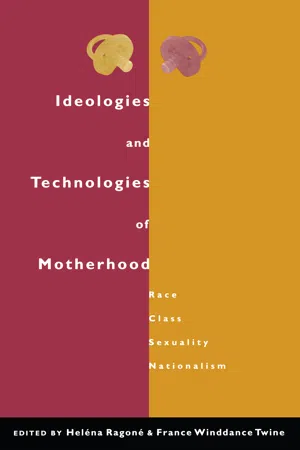
Ideologies and Technologies of Motherhood
Race, Class, Sexuality, Nationalism
- 352 pages
- English
- ePUB (mobile friendly)
- Available on iOS & Android
eBook - ePub
Ideologies and Technologies of Motherhood
Race, Class, Sexuality, Nationalism
About this book
Ideologies and Technologies of Motherhood charts new territory by exploring the notion of motherhood for women of differing classes, races, religions and nations in the light of various strategies and new technologies used to attain motherhood.
Information
III
Blurred Boundries
Legal, Political, and Economic Parameters of Motherhood
7 | |
Nonbiological Mothers and the Legal Boundaries of Motherhood | |
An Analysis of California Law | |
In 1997, two mothers, each of whom entered a co-parenting relationship with her female partner by assisting her in achieving pregnancy and then, with the partner’s encouragement, forming a mothering relationship with the resulting children, were denied the legal right to contact their children following the breakdown of the adult relationships. As in previous lesbian co-mother cases, the judges in these cases declared the nonbiological mothers legally unrecognizable as mothers per se.1 What is interesting about these cases is that in each the trial court judge attempted to maneuver around the legal, biologically based definition of a mother for the purpose of preserving the relationships between the nonbiological mothers and their children.
The difficulty California judges have in recognizing social mothering performed by women who are neither birth parents nor genetic parents is neither new nor limited to lesbian co-parent cases. Indeed, the tendency of judges not to recognize social mothering that is performed by nonbiological mothers is tied to the historical development of American law, which has traditionally enabled judges to consider both social and biological reproduction in determinations of father status but only biological reproduction in determinations of mother status. In this analysis I examine four lesbian co-mother custody cases and three surrogacy cases involving heterosexuals to explore how recent changes in the two-parent family, brought about by changes in both the organizational structure of lesbian and gay communities and reproductive technology, have “alter[ed] the means and meaning of human reproduction [as well as] the meaning and scope of family” (Dolgin 1997: 1–2). By focusing on the court’s understanding and use of sex, gender, and sexuality in legal cases involving both lesbian and heterosexual nonbiological mothers, this analysis demonstrates how the treatment of these variables as interchangeable within institutions such as the law works to naturalize institutional heterosexuality to the apparent detriment of all social mothers.
What Is Motherhood?
Feminists often ask what makes a person a mother on a purely social level—that is, what the relationship is between the day-to-day physical and emotional care individuals perform with regard to children and the status the U.S. courts assign them. Should men, for instance, who do primary child care labor on a daily basis be assigned the status of mother? Or should the practices of “othermothering,” common in African-American communities,2 or ohana, common in native Hawaiian cultures,3 lead to the legal recognition of social mothers as legitimate mothers?
More recently the question of what makes a person a legitimate mother has emerged within the legal arena as well.4 Recent advances in medically based infertility treatments have worked to “defamiliarize what was once understood to be the ‘natural’ basis of human procreation and relatedness” (Ragoné 1998: 118). Medical procedures such as in vitro fertilization (IVF) have created situations in which the very act of physically reproducing a child, traditionally considered the incontestable determinant of mother status, may now be divided between two women simultaneously, one who contributes the genetic material (the egg) and another “who gestates the embryos but who bears no genetic relationship to the child” (Ragoné 1998: 119). Procedures such as these act to seriously complicate even the most traditional constructions of the category “mother.”
Likewise, changes in lesbian and gay communities over the past thirty years, coupled with the use of usually low-tech intervention strategies such as alternative insemination, have led to the emergence of yet another family formation, families consisting of lesbian or gay couples who choose to bear and raise children within their intimate relationships (McCandish 1987; Patterson 1992, 1994, 1995; Kurdek 1993).5 Like families created through most surrogacy arrangements, lesbian two-parent families contain at least one parent who physically and emotionally nurtures children with whom she shares no genetic or biological link.
One way nonbiological parents, both heterosexual and homosexual, have for creating a legally recognizable relationship between themselves and the children they parent is through adoption. For married heterosexual couples who become parents through surrogacy arrangements, two types of adoption are available. The first, the stepparent adoption, would be indicated anytime one member of the marital couple is biologically related to the child while the other is not. This is often the case in traditional surrogacy arrangements, where the husband’s sperm is used to impregnate the surrogate. In these cases, the nonbiological parent, usually the wife, is considered a stepparent because she is married to the child’s biological and custodial father. The independent adoption is available to couples when neither is biologically related to children they help produce through a surrogacy arrangement. In instances where a heterosexual couple acquires a donation of both sperm and egg and then pays to have that genetic material implanted into a surrogate for gestation, neither is biologically related to the resulting child, and thus both must adopt the child to acquire legal parental status.
For lesbian couples who become parents by using donated sperm to impregnate one member of the couple, the only type of adoption available is the limited consent adoption, a modified version of the independent adoption that legally resembles the stepparent adoption.6 The major drawbacks of the limited consent adoption include its unavailability in many parts of the country (including numerous counties in California), its prohibitive cost, and the unfamiliarity of many lesbian and gay parents as well as family law practitioners with the procedure.7
For whatever reason, many adults who become parents either through surrogacy arrangements or private co-parenting agreements fail to legally establish themselves as legitimate parents via a formal adoption procedure. In the seven cases discussed in this essay, the courts were asked to make parenting determinations when the agreements between adults, designed to make clear their intended parenting arrangements, broke down. In some cases the parenting agreements began to fail before the children were even born, while in others the agreements did not begin to unravel until years after the parent-child relationships had been firmly established. In each of these cases, the courts attempt to answer the question: What makes a person a mother under California law? What this analysis makes apparent is that legal determinations of parental status are heavily influenced by gendered notions of biological reproduction, sexuality, and parenthood, leaving men differently situated than women, and married couples differently situated than legally single lesbian couples in the eyes of the courts.8
This analysis builds on Rubin’s observation that while feminist theorists understand sex and gender to be different systems, related yet distinct, most “fail to separate gender and sexuality analytically,” leading them to understand “the oppression of lesbians in terms of the oppression of woman” (1989: 308). Feminist scholars theorizing the effects of gender on social and legal constructions of the family have, for example, either lumped lesbians and heterosexual women together or disregarded lesbianism completely, leading them to ignore the interaction between sex, gender, and sexual orientation (see Brown 1981; Hartmann 1981; Rhode 1989; Weitzman 1985; Smart and Sevenhuijsen 1989; Smart 1991). While some authors do differentiate between heterosexual and lesbian mothers to specify that lesbians are often denied custody of children because of their sexual orientation (see Chesler 1991), they still fail to fully conceptualize sex, gender, and sexual orientation as distinct analytical categories. At the same time, gay and lesbian legal scholars, theorizing the effects of homosexuality on child custody decisions, have traditionally lumped lesbians and gay men together, forgoing a more nuanced analysis into the ways sex, gender, and sexual orientation, both separately and in combination, affect child custody decisions (see Susoeff 1985; Richards 1979, 1993; Sherrill 1993; Wilson and Shannon 1979; Arriola 1992; Byrne 1993; Stivison 1982; Robson 1992; Rivera 1982; Rubenstein 1993).
As Ingraham argues, a failure to fully develop sex, gender, and sexual orientation as independent variables leads to the construction of a theoretical framework that “closes off any critical analysis of heterosexuality as an organizing institution” (1996: 169). By defining gender simply as “the cultural side of the sex-gender binary,” feminists continually naturalize a male-female binary that relies upon unquestioned assumptions of heterosexuality (Ingraham 1996: 186). A critical analysis of sexuality, according to Namaste (1996: 204), must “examine the rhetorical, institutional, and discursive mechanisms needed to ensure that heterosexuality maintains its taken-for-granted status.”
In this essay I analyze seven custody cases from the 1990s to explore how legal conceptualizations of reproduction, sex, gender, and sexual orientation affect legal determinations of both mother and father status. I focus on the legal construction of motherhood to explore how judicial conceptualizations of biological reproduction, sex, and gender affect social mothers’ ability to be recognized as mothers in a court of law. Here I determine that the courts, through the development of legal fictions concerning reproduction, untie parenthood from biological reproduction, first for married men and later for a few married women. Because the use of these legal fictions relies on the blurring of the boundaries between marital status and reproductive status, however, individuals who do not fit within the organizational logic of the fictive reproductive scenario remain excluded. Finally, because the legal fiction requires that judges at least imagine the nonreproductive parent as the child’s biological parent, and because men and women play significantly different roles in the reproductive scenario—men produce sperm, while women gestate and give birth—women have a much more difficult time than men convincing judges to imagine them as having fulfilled their gender-appropriate role in the reproductive scenario and thus granting them legitimate parental status. Following a brief review of California’s presumed father statute, which is used to explain that development of the legal fiction, the analysis shifts first to the four lesbian co-mother cases, followed by the three surrogacy cases.
The Legal Development of the Presumed Father
In an insightful 1965 anthropological study of California’s family law, Herma Hill Kay argues that if we examine the law as it pertains to the legitimation of children, we can observe an “evolving … legal concept of the family” (1965: 57). This evolution of the legal conceptualization of the family is founded on a broadening of the legal definition of fatherhood that occurs in two primary ways. First, the California legislature adopted Civil Code 230, which encouraged judges to consider men’s social fathering when making fatherhood determinations. This act encouraged judges to emphasize the social aspects of parenting for men but not women. Second, California legislators, through the adoption of the presumed father statute, developed a legal fiction that was grounded in the reproductive scenario and used to blur the boundaries between biological and social reproduction for a particular set of married men.
An examination of English laws throughout the seventeenth and eighteenth centuries—from which California family law was adopted—shows that children’s legitimacy status was originally inseparable from the marriage of their biological parents (Kay 1965). In 1872 California legislators, wishing to soften the effects of illegitimacy on children, broke with English law and established the legal means by which biological fathers who were not married to their children’s biological mothers could legitimate their children retroactively (Kay 1965). This retroactive legitimation, called” conduct legitimation,” was achieved when
the father of an illegitimate child, by publicly acknowledging it as his own, receiving it as such, with the consent of his wife, if he is married, into his family, and otherwise treating it as if it were a legitimate child, thereby adopts it as such; and such a child is thereupon deemed for all purposes legitimate from the time of its birth. (Kay 1965:61)9
In addition to Civil Code 230, which allowed courts to declare unmarried men fathers, California adapted from English law a presumed father statute. This statute, Civil Code 193, established that whenever a child is “conceived during a time when the mother [is] living in the same house with her husband … and the husband is not impotent, … the child is conclusively presumed to be legitimate” (Kay 1965: 61).10 This statute, while purportedly based on an inference about biological fact, actually “grows out of a normative aspiration” that quickly becomes “a prescriptive command about marriage and family” (Shultz 1990: 317). The important issue, Shultz argues, becomes “not who is, but who should be having sex with the mother: her husband” (emphasis in original).
The enactment of Civil Codes 230 and 193 was undoubtedly driven, at least in part, by the economic empowerment of men but not women that occurred during the eighteenth and nineteenth centuries. As Aries (1970), Brown (1981), Hartmann (1981), Basch (1992), Rhode (1989), and Chused (1992) all argue, women living in early American society experienced both legal and economic subordination that largely prevented them from accessing or acquiring wealth independent of their relationships with men. This legislation, which encouraged judges to consider men’s biological and social connections to children separately, allowed judges considerable maneuverability in granting father status to men willing to economically care for children.
Today, the presumed father statute is subsumed under the Uniform Parentage Act, first enacted in 1973. Once married, adults in California fall under the jurisdiction of this act, which, among other things, facilitates the creation of legal relationships between married adults and children either born or adopted into their families. Under the Uniform Parentage Act, for example, children born to a married woman are legally presumed to be the children of her husband even in cases where the husband is not the biological father (Bancroft and Whitney 1996).11 According to the Uniform Parentage Act:
A man is presumed to be the father of a child if … (a) [h]e and the child’s natural mother are or have been married to each other and the child is born during the marriage, or within 300 days after the marriage is terminated; (b) [b]efore the child’s birth, he and the child’s natural mother have attempted to marry each other by a marriage solemnized in apparent compliance with law; (c) [a]fter the child’s birth, he and the child’s natural mother have married, or attempted to marry, each other by a marriage solemnized in apparent compliance with law … and either of the following are true: (1) [w]ith his consent, he is named as the child’s father on the child’...
Table of contents
- Cover
- Title
- Copyright
- Contents
- Dedication
- About the Contributors
- Foreword by Rayna Rapp
- Acknowledgments
- Introduction: Motherhood on the Fault Lines
- I Racial Ideologies and Racial Realities
- II Narratives of Personhood
- III Blurred Boundaries: Legal, Political, and Economic Parameters of Motherhood
- Afterword by Kristin Luker
- Bibliography
- Index
Trusted by 375,005 students
Access to over 1.5 million titles for a fair monthly price.
Study more efficiently using our study tools.
Frequently asked questions
Yes, you can cancel anytime from the Subscription tab in your account settings on the Perlego website. Your subscription will stay active until the end of your current billing period. Learn how to cancel your subscription
No, books cannot be downloaded as external files, such as PDFs, for use outside of Perlego. However, you can download books within the Perlego app for offline reading on mobile or tablet. Learn how to download books offline
Perlego offers two plans: Essential and Complete
- Essential is ideal for learners and professionals who enjoy exploring a wide range of subjects. Access the Essential Library with 800,000+ trusted titles and best-sellers across business, personal growth, and the humanities. Includes unlimited reading time and Standard Read Aloud voice.
- Complete: Perfect for advanced learners and researchers needing full, unrestricted access. Unlock 1.5M+ books across hundreds of subjects, including academic and specialized titles. The Complete Plan also includes advanced features like Premium Read Aloud and Research Assistant.
We are an online textbook subscription service, where you can get access to an entire online library for less than the price of a single book per month. With over 1.5 million books across 990+ topics, we’ve got you covered! Learn about our mission
Look out for the read-aloud symbol on your next book to see if you can listen to it. The read-aloud tool reads text aloud for you, highlighting the text as it is being read. You can pause it, speed it up and slow it down. Learn more about Read Aloud
Yes! You can use the Perlego app on both iOS and Android devices to read anytime, anywhere — even offline. Perfect for commutes or when you’re on the go.
Please note we cannot support devices running on iOS 13 and Android 7 or earlier. Learn more about using the app
Please note we cannot support devices running on iOS 13 and Android 7 or earlier. Learn more about using the app
Yes, you can access Ideologies and Technologies of Motherhood by Helena Ragone,France Winddance Twine in PDF and/or ePUB format, as well as other popular books in Social Sciences & Anthropology. We have over 1.5 million books available in our catalogue for you to explore.