This book provides a comprehensive overview of the concept of "Total Exposure Health" and presents details on subject areas which make up the framework. It provides in-depth coverage of the science and technology supporting exposure and risk assessment. This includes advances in toxicology and the "-omics" as well as new techniques for exposure assessment. The book concludes with a discussion on bioethics implications, including ethical considerations related to genetic testing.
Discusses advances in exposure monitoring
Presents a systems biology approach to human exposures
Examines how overall well-being translates to worker productivity
Considers the link between work-related risk factors and health conditions
Covers the study of genomics in precision medicine and exposure science
Explores bioethics in genomic studies
Aimed at the exposure professionals (industrial hygienists, toxicologists, public health, environmental engineers), geneticists, molecular biologists, engineers and managers in the health and safety industry as well as professionals in the public administration field.
Chapter 16 of this book is freely available as a downloadable Open Access PDF at http://www.taylorfrancis.com under a Creative Commons Attribution-Non Commercial-No Derivatives (CC-BY-NC-ND) 4.0 license.
6 Personalizing Environmental Health for the Military—Striving for Precision
Christopher E. Bradburne
Johns Hopkins University
Contents
6.1 The Need for Precision in Military Environmental Health
6.2 From Past to Present: The Changing Landscape of Precision Medicine
6.2.1 Technology and Medicine
6.2.2 Genetics versus Genomics
6.2.3 Genomics and the Overpromise of GWAS
6.2.4 Sequencing and ‘Omics’ Technology Advancements
6.2.5 The ‘Great GWAS Do-over’?
6.2.6 Incorporating the Changing Landscape of Genomics into the Clinic over Time
6.3 Precision beyond Genomics: Environment, Exposures, and Social Background
6.3.1 Getting More Personal: The Microbiome as an Interface
6.3.2 Models of Risk and Exposure
6.3.3 Likelihood Ratio (LR)
6.3.4 Social Determinants of Health (SDOH)
6.4 Precision Medicine and Environmental Health for the Military
6.4.1 The Million Veterans Program
6.4.2 Ethical, Legal, and Social Issues (ELSI)
6.5 Outlook
References
6.1 The Need for Precision in Military Environmental Health
Military service members see a broad range of operating environments, with a range of known and unknown chemical and immunological challenges during deployments. High-profile chronic health conditions have been associated with toxic agents, such as Agent Orange in Vietnam, but there are also those with no clear cause, such as Gulf War Syndrome. These cases did more than just cause health issues—they also resulted in enormous costs, lost time and productivity, and the degradation of trust in the military to protect its own. Better understanding of causes and effects could have provided better options for preventive medicine, personal protection, and other means of risk mitigation. Likewise, better understanding of individual susceptibilities, proximity and duration of exposures, and extenuating factors could have provided additional avenues to protect those most vulnerable.
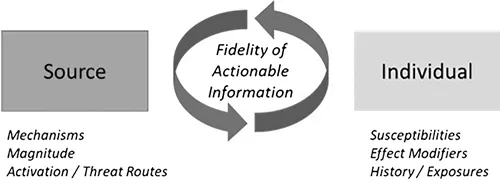
Current advances in both environmental health and precision medicine offer some intriguing possibilities. A goal of the environmental/occupational health field is to identify health risks and minimize their impact on workers. Goals include identifying, characterizing, and mitigating threats; implementing preventive and protective strategies, detection with health surveillance and diagnostic tools; and providing treatment where needed. Scientific approaches have historically focused on reducing threats to single chemical causes, using established epidemiological tools population statistics to predict individual risks. While useful for sources and exposures of high or sustained effect, these approaches can collapse for exposures with more moderate effect and/or multifactorial causes and when trying to estimate individual risks and susceptibilities. It is difficult to overstate the need for better individual tracking and susceptibility characterization to environmental threats; generally, the more that is known about the source and the individual, the better (Figure 6.1). Knowledge of ‘personalized’ susceptibility and individual exposures can illuminate health threats that might otherwise be invisible in population health data. Such information can identify toxicological sources and health effect modifiers and provide more precise actionable information for decision makers, health care providers, and researchers.
FIGURE 6.1 ‘Knowledge is power’: The more known about a hazard source, the individual, and their overall interaction, the better decisions can be made by individuals, decision makers, and stakeholders.
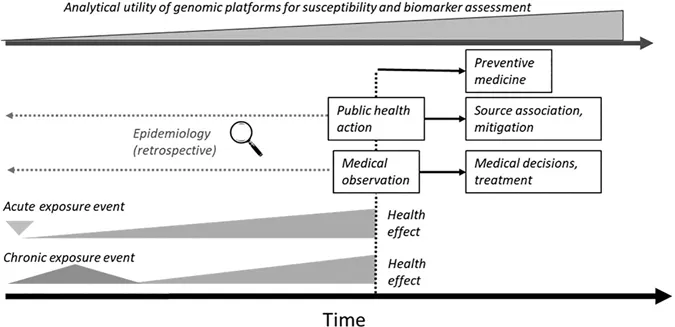
Most strategies for connecting active health effects with sources are retrospective. For example, for an acute exposure that results in a health effect, an epidemiological investigation may involve ‘tracing back in time’ an individual’s geo-temporal activities to co-localize them with a source. Similar actions may be taken for chronic exposures, but it may be years before associations and other affected individuals are identified, if ever. Characterizing the threat from toxicological sources would benefit from better tools which allow precise measurements of components, geographic outlay, functionalization, and persistence. For the individual, better understanding of genetic susceptibility, individual risk factors, geographic proximity, and duration of exposure would also be useful. Many studies have been done to associate toxicological health effects in populations and associate them with genetic markers. However, the analytic utility (i.e., the ability of the technology to detect true genomic markers) can shift over time as the technologies shift in their ability measure sources of genetic variation (Figure 6.2).
FIGURE 6.2 Temporal nature of tools and actions for precision (genomic) environmental health. Actionable information for precision environmental health is developed using retrospective investigation techniques and a constantly changing genomic toolset. For population studies, GWAS done with earlier genomic technologies may miss variants that are predictive of susceptibility to an exposure event. For individual exposures, genomic tools used for detection of exposure-linked adducts or biomarkers may be inadequate.
One particular challenge is dealing with the constant change in technology and interpretation of impacts for precision medicine. The genomics and other ‘omics’ technologies present an array of new tools and techniques to characterize individual susceptibility and a range of biomarkers (Bradburne & Lewis 2018). However, interpretation can change over time as tools improve, meaning that an understanding of ‘where we have been’ is just as important as ‘where we are going’. This chapter will attempt to shed light on the history and trajectory of precision (genomic) medicine tools for determining genetic susceptibility to environmental toxicants and review a framework for how comprehensive risk outlooks can be developed which combine genomic and environmental diagnostic approaches.
6.2 From Past to Present: The Changing Landscape of Precision Medicine
6.2.1 Technology and Medicine
Technology is constantly changing over time, which can create both excitement and frustration in a technology-dependent field, such as medicine. An example is the genomic tool evolution over the past few decades that has created the field of ‘precision medicine’.
Precision medicine is defined by the American College of Medical Genetics (ACMG) board of directors (Adler & Stead 2015) as ‘… an approach to disease treatment and prevention that seeks to maximize effectiveness by taking into account individual variability in genes, environment, and lifestyle’. It has at its core the sub-field of genomic medicine.
Genomic Medicine is defined by the Clinical Pharmacogenetics Implementation Consortium (CPIC) (National Academies of Sciences 2014) as ‘… the use of genomic information and technologies to determine disease risk and predisposition, diagnosis and prognosis, and the selection and prioritization of therapeutic options’.
Neither term would have been coined without the emergence of genomic typing and sequencing tools. But as these tools have emerged and improved, how have they changed medicine, and how can we tell where we are at any given time in the medical landscape? Does a genomic test from 2010 provide the same efficacy as a genomic test from 2020?
6.2.2 Genetics versus Genomics
Historically, the field of genetics is very different than the newer field of genomics. Genetics started >150 years ago with Gregor Mendel, who described patterns of inheritance that followed simple mathematic rules. These ‘Mendelian traits’ are described as phenotypes that can be localized to individual genetic loci. However, the majority of common traits in higher organisms and humans are complex (e.g., tied to more than one locus) and do not follow Mendelian patterns of inheritance. For example, most chronic diseases come about through some level of inherited genetics and environmental exposures. Therefore, the field of genetics has evolved to rely on heavy mathematical inference, with little understanding of individual molecular mechanisms. The heyday of quantitative genetics was in the 1900s–1930s, when statisticians such as Ronald Fisher described quantitative descriptions of inheritance that are still used to this day in agriculture and animal breeding, such as linear mixed models, the infinitesimal model, and others (Bradburne & Lewis 2017).
In the 1990s, the new field of genomics offered to change that paradigm. Genomics emerged with the advent of the human genome project, which in 2001 generated a draft sequence of one person (Bradburne et al. 2015) and later went on to characterize population genetic variation between tens of global human ethnic populations. The mapping of the human genome and the contrasting of individual differences offered to provide the ‘roadmap’ to understanding molecular mechanisms, by tying individual genomic...
Table of contents
Cover
Half Title
Title Page
Copyright Page
Dedication
Table of Contents
Foreword
Preface
Acknowledgments
Editors
Contributors
Section I Overview and Fundamentals
Section II Advances in Toxicology and the -Omics
Section III Bioethics
Index
Trusted by 375,005 students
Access to over 1.5 million titles for a fair monthly price.
Study more efficiently using our study tools.
Frequently asked questions
Yes, you can cancel anytime from the Subscription tab in your account settings on the Perlego website. Your subscription will stay active until the end of your current billing period. Learn how to cancel your subscription
No, books cannot be downloaded as external files, such as PDFs, for use outside of Perlego. However, you can download books within the Perlego app for offline reading on mobile or tablet. Learn how to download books offline
Perlego offers two plans: Essential and Complete
Essential is ideal for learners and professionals who enjoy exploring a wide range of subjects. Access the Essential Library with 800,000+ trusted titles and best-sellers across business, personal growth, and the humanities. Includes unlimited reading time and Standard Read Aloud voice.
Complete: Perfect for advanced learners and researchers needing full, unrestricted access. Unlock 1.5M+ books across hundreds of subjects, including academic and specialized titles. The Complete Plan also includes advanced features like Premium Read Aloud and Research Assistant.
Both plans are available with monthly, semester, or annual billing cycles.
We are an online textbook subscription service, where you can get access to an entire online library for less than the price of a single book per month. With over 1.5 million books across 990+ topics, we’ve got you covered! Learn about our mission
Look out for the read-aloud symbol on your next book to see if you can listen to it. The read-aloud tool reads text aloud for you, highlighting the text as it is being read. You can pause it, speed it up and slow it down. Learn more about Read Aloud
Yes! You can use the Perlego app on both iOS and Android devices to read anytime, anywhere — even offline. Perfect for commutes or when you’re on the go. Please note we cannot support devices running on iOS 13 and Android 7 or earlier. Learn more about using the app
Yes, you can access Total Exposure Health by Kirk A. Phillips, Dirk P. Yamamoto, LeeAnn Racz, Kirk A. Phillips,Dirk P. Yamamoto,LeeAnn Racz in PDF and/or ePUB format, as well as other popular books in Technology & Engineering & Public Health, Administration & Care. We have over 1.5 million books available in our catalogue for you to explore.