Capetian France 987–1328 is an authoritative overview of the country's development across four centuries, with a focus on changes to the political, religious, social and cultural climate during this period.
When Hugh Capet took the throne of France in 987, his powers were weak and insignificant, but from an inauspicious beginning he founded a dynasty that was to last over 300 years and that came to dominate western Europe. This carefully updated third edition draws extensively on new scholarship that has emerged since the previous edition. It contains images, maps, family trees and a discussion of key sources, allowing the reader to develop a strong contextual knowledge as well as a greater connection with the material world of the period.
Maintaining a balance between a compelling narrative and an in-depth examination of central themes of the age, Capetian France987–1328 provides a comprehensive account of this significant era within France's history and is essential reading for all students of medieval France and Europe.
FRENCH SOCIETY IN THE TENTH AND ELEVENTH CENTURIES
Introduction
The origins of West Francia
From the later Middle Ages onwards the idea that France had ‘natural limits’ was widely held. The identification of the French kingdom with Roman Gaul, with its boundaries formed by the Alps, the Rhine and the Pyrenees, was used to justify the aggressive expansionist policies of French rulers. Yet this view had almost no foundations. The kingdom of France, far from developing as a natural political and geographical unit, evolved gradually during the earlier Middle Ages from the decaying Roman empire and the Frankish kingdoms which arose in its place and reached their apogee in the Carolingian empire.
The lands which were to make up France showed a great diversity in their languages, peoples and cultures, a series of contrasts that have continued to influence French history, and which are further emphasised by its great geographical diversity. The northern and central regions of France are in a temperate zone, while the south enjoys a Mediterranean climate, and there are further variations of climate and vegetation connected with the existence of the great central mountainous region, the Massif Central, the Alps and the Pyrenees. The valleys of the great rivers, the Loire, the Seine and the Rhône, are fertile and provide channels of communication. They were settled early, but the settlements were separated by great tracts of forest, marsh and heath.
Before the Romans came these lands were inhabited by the Gauls, living in settlements organised into tribal groups; these the Romans described as pagi, and their larger groupings as civitates. Mediterranean Gaul had a well-developed city life and was a prosperous region, and it was conquered by the Romans as early as 121 bc. As the province of Narbonnnaise Gaul, or simply The Province (hence Provence), it became an important part of the Roman empire. Expansion into northern Gaul came rather later; Caesar conquered it in 58–51 bc and it was divided into the three provinces of Belgic Gaul, Celtic or Lyonnaise Gaul and Aquitaine. The three Gauls could be administered as one, a unity unprecedented in pre-Roman times and the foundation of the sentiment of the ‘Gallic motherland’.
Existing pagi and civitates were often taken over by the Romans as the basis of their local government system, and Gallic and then Roman cities remained as regional centres and capitals into the Middle Ages and beyond. One important reason for this continuity of settlement was the adoption of these cities as centres of bishoprics by the Christian church, and although some were lost and others gained in succeeding centuries, the ecclesiastical provinces which eventually emerged by the tenth century and that lasted virtually unchanged until the French Revolution bore a broad correspondence with the divisions of Gaul into civitates, and with the Roman administrative organisation.
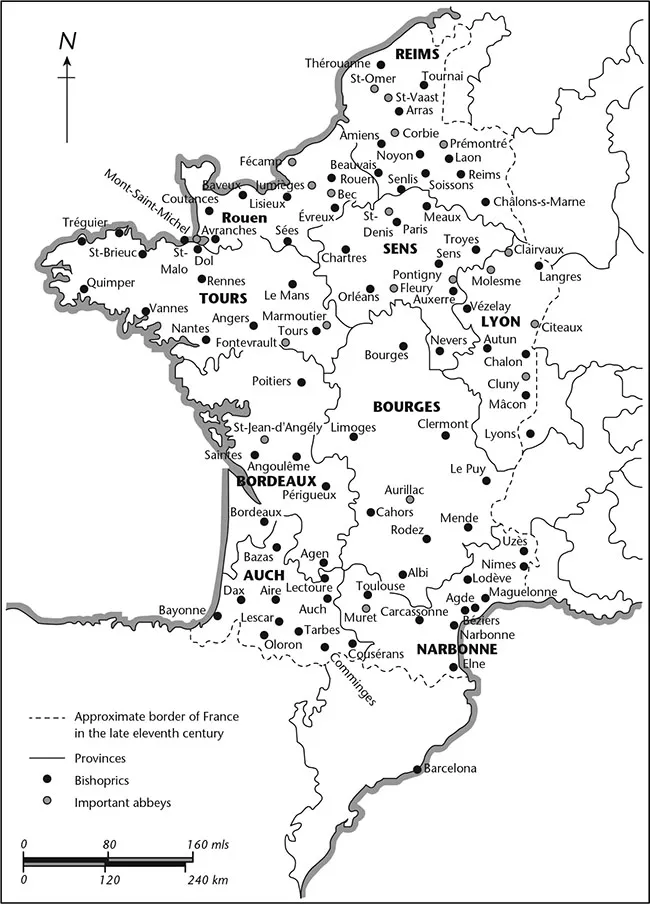
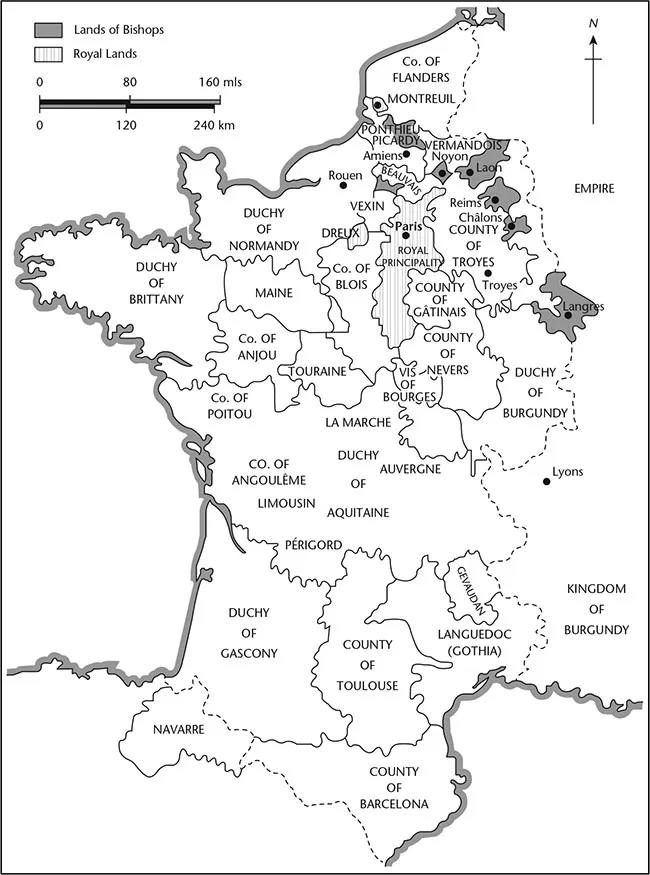
Gallic and Roman settlements had been denser in the south, and thus more archiepiscopal and episcopal sees were established there. The more isolated seats of bishops in the north often shrank greatly in size and were heavily fortified; some became the centres of important lordships. The ecclesiastical geography of France remained to some extent at variance with its political geography, and tensions sometimes arose as a result (e.g., compare Maps 1.1 and 1.4).
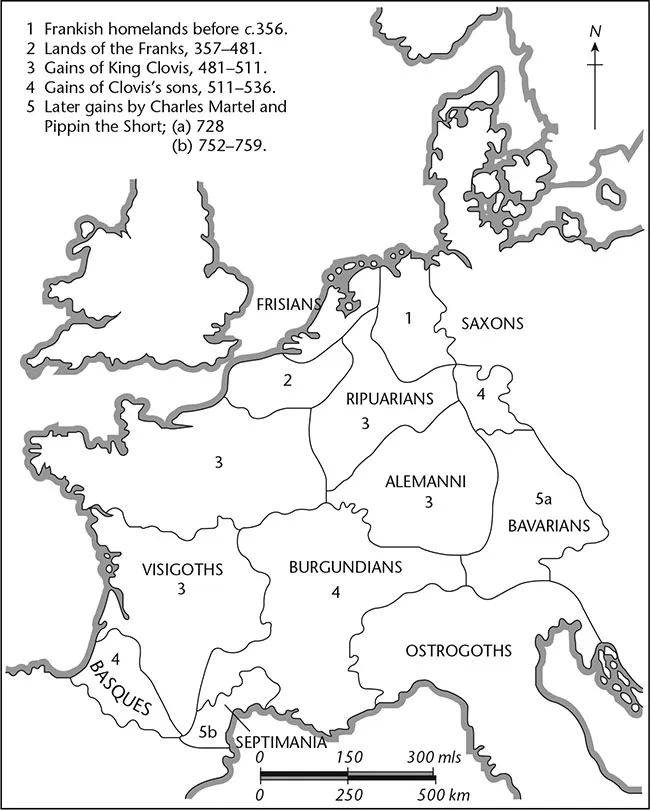
As the Roman empire collapsed in the west, a number of groups moved into Gaul and superimposed their own languages and cultures upon the existing inhabitants in varying degrees. Celtic-speaking Bretons moved into Brittany from western Britain; the Burgundians settled in south-eastern Gaul, the Visigoths in its south-west, although leaving room for Basque expansion in this region as well. Most striking of all was the expansion of the Franks, a militarised group of Germanic-speaking people who, after crossing the Rhine in the third century, first settled in the Low Countries and then, under King Clovis and his sons, overran the whole of Gaul. One of the Frankish kingdoms, known as west Francia, would become the kingdom of France, ‘a direct legacy of what had once been Gaul’.1
The geographical extent of this kingdom was not, however, defined or limited either by the frontiers of Roman Gaul or by any ‘natural frontiers’, such as the Pyrenees or the Rhône. Regions were considered to be subject to the west Frankish kings that no longer form part of France, notably Catalonia. The kingdom of west Francia was simply the territory in which its king’s authority was acknowledged, which fluctuated according to personal factors such as the wealth and familial alliances of individual kings.
MAP 1.1 Ecclesiastical provinces in medieval France
In most of west Francia the common language was a Romance tongue based on low Latin, which was to develop into the French language. There were regional differences in this tongue, of which the most striking was the divide between the language of the south, the Langue d’oc, which was quite close to Catalan and was later known as Provençal, and the language of the north, the Langue d’oil, which had a stronger Celtic and German influence on it and which developed into modern French. The distinguishing ‘oc’ and ‘oil’ were the words used for ‘yes’ in the two parts of France, and the names Languedoil and Languedoc were later used for the northern and southern lands.
In addition, there were other considerable differences between north and south which emerged clearly as west Francia fragmented into a series of regional principalities in the tenth and eleventh centuries. The southern lands used Roman law, which was written down; the northern lands followed customs which developed gradually and were not codified until the thirteenth century. Aristocratic society in the north had a considerable ‘feudal’ element in it; vassalage was almost unknown in the south (pp. 16–21).
MAP 1.2 The Frankish expansion, 356–795
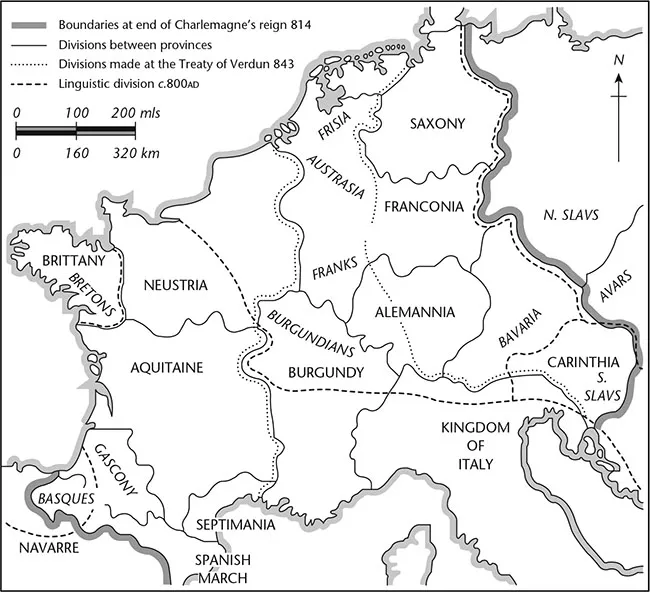
MAP 1.3 The Carolingian Empire
There were other contrasts too, more local, some stemming from the different peoples found within the west Frankish kingdom, such as the Basques, the Bretons and later the Normans. But the common language of the church, and hence of administration, remained Latin, and it was a vitally important medium of contact in the political life of western Europe as the Carolingian Empire came apart.
What did the name Francia mean in the tenth and eleventh centuries? It still retained a wide general use; both Byzantine and western writers at the time of the crusades described the western forces as Franks. But from the tenth century, the rulers of the east Frankish kingdom increasingly abandoned both the royal title rex Francorum – king of the Franks – and the name Francia to the western kingdom.
Yet in this ‘French’ context, as the area where the king could assert his authority shrank, the name Francia was additionally used to describe one of the three divisions of the kingdom (Francia, Aquitania, Burgundia). The Robertians, forerunners of the Capetians, were duces Francorum, dukes of the Franks, and their ‘duchy’ covered in theory most of northern France. Then as royal power contracted further, leaving the early Capetians only a small bloc of lands round Paris and Orléans (Map 1.4), the term Francia was used for this region. In the eleventh century the name could thus mean one of several things, which reflects the political decentralisation of the west Frankish – or French – kingdom in this period.
MAP 1.4 France in the mid-eleventh century
The French economy and society
A stagnant economy?
For many years the ninth and tenth centuries were considered an era of stagnation in the economy of northern and western Europe. The ideas of Henri Pirenne were very influential in shaping this view.2 Writing before the Second World War, he suggested that the Germanic invasions of the fifth century, which brought to an end the Imperial Roman government in the west and established the Merovingian kingdoms, still allowed the existing patterns of trade, centring on Constantinople, and economic life to continue. It was the rise of Islam in the seventh century which caused the true break with antiquity; the empire of Charlemagne, blocked off from the Byzantine world, was focussed northwards.
The economy of the Carolingian empire Pirenne considered to have been weak, static, agricultural and localised, despite Charlemagne’s attempts to revive it; symbolic of this was the disappearance of gold coinage in the eighth century, not to reappear until the thirteenth. Further disruption was caused by the Vikings and other invaders in the eighth and ninth centuries, and signs of economic recovery, particularly an expansion in towns and commerce, were not to appear until the eleventh.
Ever since the ‘Pirenne thesis’ was put forward, historians have debated it, and it has subsequently been considerably revised. The sources for this period, both written and archaeological, are now read as indicating that the seventh century perhaps did mark a break with ancient patterns of trade and exchange, but that a slow expansion was already at work from as early as the eighth century.3
In the ninth century there are faint but definite signs of this economic expansion, of improving agricultural yields and of gradual growth in the population. Markets were selling both local produce and goods from further afield such as salt, slaves and luxuries – silk, spices and ivory – and urban life was beginning to revive. All this was, however, on a small scale, for the late Carolingian economy was undeniably agrarian-based.4 And apart from rare gold coins with a ceremonial function, such as those struck for Louis the Pious, Carolingian coinage, which was fixed and controlled by the emperor up to the late ninth century, was not gold, but entirely silver.5
The effects on this slowly expanding economy of the new wave of invasions which gathered strength in the ninth century have also provoked considerable debate. These incursions came from several directions – the Vikings from the north, the Muslims from the south, and the Hungarians from the east. The Saracen pirates set up a base at Fraxinetum (La Garde-Freinet) in Provence, controlling the Alpine passes, terrorising the coast and causing considerable disruption in the area, both to life and trade. The Hungarian horsemen swept in from Pannonia, raiding frequently in northern Italy and Germany, and at times in France as well; in 937, for example, they reached Orléans. Their looting and pillaging produced major problems in lands east of France, and some localised hardship in France itself.
Far more significant for France, however, were the activities of the Vikings (Image 1.1 and 1.2). Our sources for their expeditions in the ninth century, as seen from the Frankish side, tend to present a picture of unmitigated gloom. In his celebrated mid-ninth-century account of the wanderings of the monks of Noirmoutier who fled from their island on the west coast of France eventually to settle at Saint-Philibert at Tournus, the monk Ermentarius writes:
The number of ships grows larger and larger, the great host of Northmen continually increases; on every hand the Christians are the victims of massacres, looting, incendiarism, clear proof of which will remain as long as the world itself endures; they capture every city they pass through, and none can withstand them; they take the cities of Bordeaux, Périgueux, Limoges, Angoulême and Toulouse. Angers and Tours, as well as Orléans, are wiped out; the ashes of many a saint are carried away.6
To monastic chroniclers such as Ermentarius, the hordes of savage heathen raiders seemed to be a manifestation of the wrath of God. Accounts such as theirs, coloured by the outlook of the cloister, should not, however, be discounted as merely hysterical imaginings. In France as in England, the raids, with their plundering and burning, clearly caused much hardship, damage and misery on a local level for the monasteries, castles and towns attacked, although the Noirmoutier monks probably travelled further than most.
The long-term impact of the raids is harder to assess, for the destruction they wreaked clearly varied from region to region. The ...
Table of contents
Cover Page
Half Title
Title Page
Copyright Page
Table of Contents
List of Figures
List of Maps
List of Images
List of Sources
Preface
Acknowledgements
1 French Society in the Tenth and Eleventh Centuries
2 Politics and Society: A Regional View
3 The Early Capetians, 987–1108
4 The Revival of Royal Power, 1108–1226
5 Louis IX: The Consolidation of Royal Power, 1226–70
6 The Last Capetians, 1270–1328: The Apogee of Royal Power
7 Epilogue
Select Bibliography
Index
Trusted by 375,005 students
Access to over 1.5 million titles for a fair monthly price.
Study more efficiently using our study tools.
Frequently asked questions
Yes, you can cancel anytime from the Subscription tab in your account settings on the Perlego website. Your subscription will stay active until the end of your current billing period. Learn how to cancel your subscription
No, books cannot be downloaded as external files, such as PDFs, for use outside of Perlego. However, you can download books within the Perlego app for offline reading on mobile or tablet. Learn how to download books offline
Perlego offers two plans: Essential and Complete
Essential is ideal for learners and professionals who enjoy exploring a wide range of subjects. Access the Essential Library with 800,000+ trusted titles and best-sellers across business, personal growth, and the humanities. Includes unlimited reading time and Standard Read Aloud voice.
Complete: Perfect for advanced learners and researchers needing full, unrestricted access. Unlock 1.5M+ books across hundreds of subjects, including academic and specialized titles. The Complete Plan also includes advanced features like Premium Read Aloud and Research Assistant.
Both plans are available with monthly, semester, or annual billing cycles.
We are an online textbook subscription service, where you can get access to an entire online library for less than the price of a single book per month. With over 1.5 million books across 990+ topics, we’ve got you covered! Learn about our mission
Look out for the read-aloud symbol on your next book to see if you can listen to it. The read-aloud tool reads text aloud for you, highlighting the text as it is being read. You can pause it, speed it up and slow it down. Learn more about Read Aloud
Yes! You can use the Perlego app on both iOS and Android devices to read anytime, anywhere — even offline. Perfect for commutes or when you’re on the go. Please note we cannot support devices running on iOS 13 and Android 7 or earlier. Learn more about using the app
Yes, you can access Capetian France 987–1328 by Elizabeth M Hallam,Charles West,Elizabeth M. Hallam in PDF and/or ePUB format, as well as other popular books in History & European Medieval History. We have over 1.5 million books available in our catalogue for you to explore.