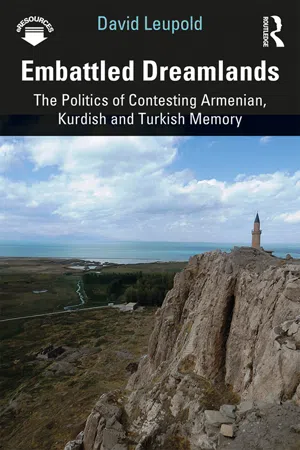
Embattled Dreamlands
eBook - ePub

Embattled Dreamlands

The Politics of Contesting Armenian, Kurdish and Turkish Memory

  1. 248 pages
  2. English
  3. ePUB (mobile friendly)
  4. Available on iOS & Android
eBook - ePub

Embattled Dreamlands

The Politics of Contesting Armenian, Kurdish and Turkish Memory

About this book

Winner of the 2021 annual book award of the Central Eurasian Studies Society (CESS).

"David Leupold's exceptional book explores the complex and contested Turkish, Kurdish, and Armenian visions of homeland in the greater Van region of contemporary Turkey. Through a layered analysis of collective violence, constructed national histories, and imagined homelands, Embattled Dreamlands demonstrates how violence and population displacement in the early 1900s produced homeland imaginaries and mutually exclusive interpretations of the past. Based on five years of ethnographic and historical research, Leupold's rich tapestry of Ottoman and Soviet history, imagined geographies, and national narratives makes unique theoretical contributions to studies of collective memory and provides an insightful and impartial assessment of sectarian and national identities. The book invites us to evaluate critically and carefully our past and its impact on our contemporary imagined worlds."

Embattled Dreamlands explores the complex relationship between competing national myths, imagined boundaries and local memories in the threefold-contested geography referred to as Eastern Turkey, Western Armenia or Northern Kurdistan.

Spatially rooted in the shatter zone of the post-Ottoman and post-Soviet space, it sheds light on the multi-layered memory landscape of the Lake Van region in Southeastern Turkey, where collective violence stretches back from the Armenian Genocide to the Kurdish conflict of today. Based on his fieldwork in Turkey and Armenia, the author examines how states work to construct and monopolize collective memory by narrating, silencing, mapping and performing the past, and how these narratives might help to contribute and resolve present-day conflicts.

By looking at how national discourses are constructed and asking hard questions about why nations are imagined as exclusive and hostile to others, Embattled Dreamlands provides a unique insight into the development of national identity which will provide a great resource to students and researchers in sociology and history alike.

Frequently asked questions

Yes, you can cancel anytime from the Subscription tab in your account settings on the Perlego website. Your subscription will stay active until the end of your current billing period. Learn how to cancel your subscription.
No, books cannot be downloaded as external files, such as PDFs, for use outside of Perlego. However, you can download books within the Perlego app for offline reading on mobile or tablet. Learn more here.
Perlego offers two plans: Essential and Complete
  • Essential is ideal for learners and professionals who enjoy exploring a wide range of subjects. Access the Essential Library with 800,000+ trusted titles and best-sellers across business, personal growth, and the humanities. Includes unlimited reading time and Standard Read Aloud voice.
  • Complete: Perfect for advanced learners and researchers needing full, unrestricted access. Unlock 1.4M+ books across hundreds of subjects, including academic and specialized titles. The Complete Plan also includes advanced features like Premium Read Aloud and Research Assistant.
Both plans are available with monthly, semester, or annual billing cycles.
We are an online textbook subscription service, where you can get access to an entire online library for less than the price of a single book per month. With over 1 million books across 1000+ topics, we’ve got you covered! Learn more here.
Look out for the read-aloud symbol on your next book to see if you can listen to it. The read-aloud tool reads text aloud for you, highlighting the text as it is being read. You can pause it, speed it up and slow it down. Learn more here.
Yes! You can use the Perlego app on both iOS or Android devices to read anytime, anywhere — even offline. Perfect for commutes or when you’re on the go.
Please note we cannot support devices running on iOS 13 and Android 7 or earlier. Learn more about using the app.
Yes, you can access Embattled Dreamlands by David Leupold in PDF and/or ePUB format, as well as other popular books in Social Sciences & Emigration & Immigration. We have over one million books available in our catalogue for you to explore.

1 Saving the Empire, Killing Its Subjects

Circassian and Armenian Tales

“Every dream and every great initiative is paranoia, doctor.” – “Great initiatives rarely succeed…”: the fragment is taken from the fictitious dialogue between a Yugoslavian morphine-addict disguised as a doctor and a Russian colonel suffering from paranoid schizophrenia in Hristo Boytchev’s award-winning play The Colonel Bird (2007).1 Set in The Forty Holy Martyrs, a fictitious psychiatric clinic somewhere in the Balkan Mountains left to its fate during the Bosnian War (1992–1995), Boytchev tells the story of its mentally ill patients who, upon dressing in military uniforms regain the belief in their sanity, declare “a separate European territory here in the Balkans” and form under the leadership of a schizophrenic Russian colonel a small combat unit to join forces with NATO.2 As the plot evolves it powerfully reveals the arcane link between paranoid fears and self-aggrandizing dreams that informs the rationality not only of the madman. A century ago, it was the multi-ethnic empires of the east – Tsarist Russian, Habsburg Austrian and Ottoman Empire – that while dreaming the elevated dream of reforming themselves into modern and self-sovereign “Europe-style” nation-states were equally haunted by a fatal paranoia: the paranoia of treason and internal enemies.
In an attempt to recapitulate the history of present-day Eastern Turkey and its adjacent regions (Caucasus, the Balkans and the Black Sea Region) reckless territorial policies, collective violence and mass deportations emerge as the three main aspects that dominated, haunted and annihilated the lives of millions. Religious and/or linguistic affiliations should form the main criteria according to which people were categorized into trustworthy and untrustworthy groups, with the latter being subjected to reckless policies of deportation and massacre. With present-day Eastern Turkey and the Caucasus region at the intersection point where the influential spheres of three empires collide – Ottoman, Persian and Tsarist Russian – populations are rationalized as either “assets” or “obstacles” to large-scale military campaigns. With the advance of ideologies which promote national liberation, the previously military considerations give way to an unprecedented form of demographic engineering that now utilizes populations en masse as pawns in a cold-blooded game of chess. While previously framed within notions of “imperial conquest” and “divine providence”, territorial aspirations are now cloaked in the language of “right to the homeland” and “national defense”.
In the following sections, these considerations shall form the lens through which I will envisage the Armenian Genocide as the nadir in a continuity of dreadful events propelled by misguided mass-mobilization, reckless state calculations and an environment of constant anxiety. As a matter of fact, today there is a widely shared consensus in international academia that from 1915 onwards “deportations and massacres had occurred; that they had been ordered, organized, and carried out by the Young Turks and their agents; and that the target of these brutal policies had been defined ethnoreligious groups”.3 After long considerations and thorough research in both archive sources and secondary literature I have reached the conclusion that the word “genocide” is indeed the most adequate term available to us to describe these violent events. Or as the New York University professor Paul Boghossian pointed out in a rhetorical question to those colleagues reluctant to employ this notion: “you accept that all this happened, and you still do not want to call it genocide, then you give us the word”.4 Yet beyond the narrow framework of an “ethno-national tragedy”, 1915 also tells us a wider story of fratricide and of destructive learning processes in which the victims of yesterday emerge on the stage of history as the perpetrators of tomorrow and vice versa. It is the history of collective violence that expands from the Caucasian mountains to the Balkans and the plains of the Armenian highland. It is clear that the subsequent discussion can only provide a broad overview of the region’s history of collective violence and mass expulsion in the late 19th and early 20th centuries. Accordingly, later acts of collective violence and mass expulsion, such as the World War II deportations of Meskhetian Turks and Crimean Tatars under Stalinist rule or the mutual expulsions of Armenians and Azerbaijanis during the Nagorny-Karabakh war (1988–1994), exceed the scope of my research as cases that deserve treatment in a separate framework tailored to their contextual particularities. The same is true for the case of Georgian IDPs in the aftermath of warfare in Abkhazia (1992–1993) and South Ossetia (2008). Although not at the center of my attention, displacement policies against (largely rural) Kurdish populations during the period of the Kurdish-Turkish conflict (1993–1999) are briefly discussed at the end of this chapter to provide the reader with a contextual framework for understanding the Kurdish notion of a “continuing genocide”.
Thus I will focus on two historical events: the killing and mass expulsion of Muslim populations from Circassia (1864–1867) following the defeat of the Tsarist army in the Caucasus campaign and the genocide against Armenians (1915–1918) in the Ottoman Empire during World War I. Two reasons prompted me to discuss these cases in more detail: contextual similarities and substantial evidence for a causal relationship between the cases. In both cases ethnic markers of differentiation disqualify certain populations of war-ridden regions as “trustworthy”. In both cases, a consensus is reached that (purportedly) these untrustworthy populations have to be removed to restore order. Finally, in both cases, deportation policies form the smokescreen for state-backed armed forces to commit acts of collective violence ranging – from case to case – from arbitrary expropriations to genocidal massacre. Besides these contextual similarities, there is strong evidence for a causal relationship between both cases on the level of agency and structure. On the level of agency, I will show with the case of Circassian refugees in the CUP (and later, Armenian Genocide survivors in the ARF) how the victims of yesterday can return to the stage of history as the perpetrators of today. On the structural level, I will show that while 1915 did “successfully” end the previous conflict between Ottoman central state authority and Armenian insurgents, at the same time it laid the foundations for an ongoing conflict between Turkish central state authority and Kurdish insurgents.

“Treacherous Muslims”: The Fate of “Tsarist Circassians” (1864–1867)

Situated in the periphery of both the Tsarist Russian and Ottoman empires, the northwestern region of the Caucasus, at that time known by its exonym Circassia, was home to a variety of diverse populations, tribally organized and predominantly speakers of Northwest Caucasian languages (Adgyghe, Abaze and extinct Ubykh) commonly referred to by the umbrella term “Circassians”. In mid-19th century, at the height of the Russian “conquest of the Caucasus”, Circassia would become the historical stage to witness expropriation, massacre and deportation within the framework of a new form of state-sanctioned collective violence aimed at an irrevocable “reconfiguration” of the demographic landscape:
Wiping away the last vestiges of Ottoman influence there required not only Russian strategic acumen and military firepower, but also twin policies of what one would today call genocide and state terrorism – the systematic burning of villages, wholesale killing of native peoples, and forced deportation.5
While it proves difficult to determine an exact date of the so called “conquest of the Caucasus”,6 Tsarist Russia’s push into the Caucasus started as early as 1777, when forts were erected along a geographical stripe ranging from Mozdok (today’s Republic of North Ossetia–Alania) to Azov (today’s Rostov Oblast) to prepare military expansion to the Kuban river. In the ensuing 101 years the Northern Caucasus witnessed a series of battles and wars that in their aftermath would irrevocably alter the demographic landscape of the region at the expense of the region’s Muslim populations. Russia’s push into the Caucasus occurs in an environment in which religion is used instrumentally as the benchmark to measure loyalty. As King observes, “Russia assumed the mantle of protector of Eastern Christians – which had been one of the key catalysts of the Crimean War – while the Ottomans often attempted to utilize Islam as a link to Caucasus Muslims in Circassia and Dagestan”.7 Consequently, when the last forces of local resistance surrendered to the Tsarist army at Qbaada canyon (renamed Krasnaya Polyana) on May 21, 1864, Tsarist Russia followed the very rationale Tsar Nikolai II had formulated in a letter to his field marshal Ivan Paskevich 35 years before: “the ultimate suppression of the mountain people or the destruction of the rebellious [istrebleniye nepokornykh]”.8 The Russian officer Ivan Drozdov would remember the events that ensued later in his war diary on The Last Struggle with the Highlanders in the Western Caucasus (1977) when he reports of roads covered with “scattered corpses of children, women, old people, tattered, half-eaten by dogs” while the surviving populations were driven out into the port of Sochi where Ottoman vessels – tellingly called “floating graveyards” by contemporary observers – waited for them.9 From there they embarked on an uncertain fate. Drozdov recounts with horror how
the Turkish skippers, out of greed, piled Circassians like shipload … and, like ballast, they threw overboard the useless [lishnikh], at the slightest sign of illness. The waves spilled the corpses of these unfortunates onto the shores of Anatolia. Hardly half of those who went to Turkey arrived to the place.10
In this sense, 1864 marks not only the military victory of imperial power over local resistance but more importantly the starting point for a radical intervention and reconfiguration of the region’s demographic landscape: “[t]he Kuban region was not only conquered, but also cleared” (ne tolko zavoyevana, no i ochishchena),11 Drozdov would recount later, and remarks that “[f]rom the former, rather large population, there remained [only] a handful of people who were settled along the Kuban [river]”.12 In place of the Muslim highlanders, Christian populations deemed as “loyal” were resettled to the region emptied of its former “suspicious” populations.13 Most importantly “Armenians, and other groups considered loyal to the empress” were utilized as the spearhead of Russian expansion, which according to King was “cloaked in the civilizing missio...

Table of contents

  1. Cover
  2. Endorsements
  3. Half Title
  4. Title Page
  5. Copyright Page
  6. Dedication
  7. Table of Contents
  8. Acknowledgments
  9. Foreword
  10. Introduction: Fatal Ties: Armenians, Kurds and Turks
  11. 1. Saving the Empire, Killing Its Subjects: Circassian and Armenian Tales
  12. 2. Eternal Histories, Elusive Homelands: Eastern Turkey. Western Armenia. Northern Kurdistan
  13. 3. Mirrored Narratives: Remembering as the Nation
  14. 4. Mnemonic Frontiers, Alien Homelands: The Greater Van Region, the Residing and the Expelled
  15. 5. Entwined Narratives: Remembering Beyond the Nation
  16. 6. Conclusion: Old Nightmares, New Awakenings
  17. Index