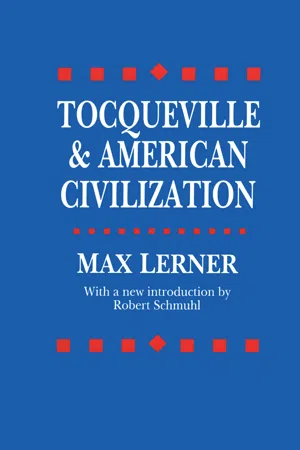
Not long after Max Lerner completed his comprehensive and influential study, America as a Civilization. he began work on a sustained analysis and assessment of Alexis de Tocqueville's Democracy in America. The result, Tocqueville and American Civilization. ls a primer of Tocqueville's central concepts, as well as a detailed discussion of their meaning in the twentieth century. Originally published 1n 1966, Lerner's study ls a sweeping introduction to both Tocqueville's life and thought. Lerner devotes most of his attention to an exposition of the text. A meditative reading of Tocqueville's landmark work, its strengths and weaknesses. He ls especially adept at explaining Tocqueville's treatment of what he refers to as "master ideas." They include "the idea of democracy," "the idea of revolution." "the idea of a social style and character," and "the idea of history and God and man interacting with each other within the 'fatal circle' of necessity and freedom." Another important issue Lerner discusses ls the fragility of freedom, a concern he shared with Tocqueville. The new introduction by Robert Schmuhl traces the influence of Tocqueville on Lerner, showing how Democracy in America became an abiding point of reference in Lerner's thinking about the United States and the world at large. It was Tocqueville who drew Lerner's attention to the fusion of custom, law, and innovation that has become the hallmark of the American character. As a result, Tocqueville and American Civilization continues to be important for social and political theorists, historians, and scholars of American studies.
- 126 pages
- English
- ePUB (mobile friendly)
- Available on iOS & Android
eBook - ePub
Tocqueville and American Civilization
About this book
Information
1
SOME PARADOXES
Alexis de Tocqueville saw America a good while before its meridian: in Emerson’s scarring phrase he saw it at “the cockcrowing and the morning star.” He described it, in his Democracy in America, with a reflective passion whose obsessiveness had less to do with the state of America itself than with his inner drive to discover the solution of the problems posed by the Western democratic revolutions, and the relevance of that solution to the problems of France. His luck—and ours—was that when he made his voyage to Jacksonian America in 1831 he came to the right place, at the right time, with the right questions, and the right preparation to see the bearing of the American experience on them. The result was not only the greatest book ever written on America, but probably the greatest on any national polity and culture.
One thinks of Polybius and Machiavelli on the Roman Republic, of Gibbon on Imperial Rome, Burckhardt on the Greeks, Emerson on the British, Michelet on the French, of Bryce, Parrington, and Beard on America—but all of them are either too narrow or fragmented in analysis or too discursive as history. Tocqueville alone knew how to portray America as a case study in the nature of the democratic revolution in Europe as well as America, and democracy as a case study in the nature of political man and his institutions. What his mind was able to seize, his will and skill carved into the hard rock of his material. The profile has held, surviving the storms and bufferings of history, its meaning cutting across the varied languages into which it has been translated and the national experience through which it has been filtered. One may venture that today its influence is greater than ever, its relevance to the needs of the day deeper.
It is one of the paradoxes of intellectual history that a gentle, reflective man, who loved his secluded library and was sensitive to noises from the outside world, should have busied himself all his life with the theme of revolution; that a social and intellectual aristocrat should have become one of the early prophets, if something less than a champion, of the modern mass democracy; that a young man who spent less than ten months in the United States should have produced so fundamental a study of American civilization. Yet these paradoxes apply to Tocqueville and point to the stature of Democracy in America. It has gaps, wrong guesses, moralizing, and blind spots, and is often rhetorical. But it is also shrewd in observation, piercing in insight, sensitive about the dilemmas of modern political man, profound in following out the bearing of the facts it cites, all but clairvoyant about the later growth of the institutions whose earlier lineaments it draws.1
1 Throughout this essay I am heavily indebted to my friend J. P. Mayer, whom I joined as co-editor of Tocqueville’s Democracy in America (Harper & Row, 1966; Anchor, 1968). Everyone who works on Tocqueville starts from his pioneer book, Alexis de Tocqueville. A Biographical Study m Political Science (1939; Harper Torchbook, 1960) and from his monumental definitive edition of Tocqueville’s writings (Gallimard, 1950- ), of which 12 volumes have already appeared in French and perhaps another twelve are to come. He has been a generous but also exacting critic of my ideas on Tocqueville for fifteen years; I have found his scholarship scrupulous and his over-all view of Tocqueville admirably balanced. Without burdening him with the faults of this essay, I am grateful for the discussions of it we have had at every phase.
2
THE MAKING OF A SOCIAL THINKER
In the history of ideas, as in literature, creativeness is likely to come at the convergence of psychological need with experience. It took a young man who was at once a European intellectual and a fiercely sensitive contemporary, open to the currents of his time, to see what the America of Andrew Jackson’s day was like. The young Tocqueville had an intense need to clarify his own thinking and shape his intellectual and political direction. America in turn needed someone to interpret its current problems and its historic role and destiny, to itself as well as to the world outside. When he came to America in 1831, Tocqueville was ready for the America he encountered.
He came of the Norman aristocracy, with his family roots deep in the countryside of the departement of Manche, only a few miles from the English Channel. His birth in Paris, on July 29, 1805, came at the height of Napoleon’s world adventures and his power. While he was later (in the second volume of his study on the French Revolution) to square his intellectual accounts with the dictator in an unsparing way, the grandeur of Napoleon’s scope and daring in the political realm must have left with the young men who grew up in his shadow a heightened sense of what the human mind could accomplish.
The boy grew up in a setting encased in the conservatism of status, religion, and a deep commitment to the royalist tradition. His family was strongly royalist: his mother was the granddaughter of the man who defended Louis XVI before the Revolutionary Tribunal, his grandfather and one of his aunts were guillotined, and his parents were barely saved from the scaffold. His early childhood was spent in a chateau at Vemeuil, near Paris, amidst family memories of a vanished regime. When Napoleon fell and the Bourbon dynasty returned, the elder Tocqueville became a prefect, and showed himself a thoughtful and competent administrator, moving from one prefectural post to another. Brought increasingly into his father’s confidence (there is a portrait of the father, as prefect, dictating a report to his son), he developed a lively sense of hard fact and of difficult judgments. He was later, in the Ancien Regime, to write scornfully of the French revolutionary philosophies who undercut the foundations of a society, without any experience of the concrete facts of social or political life. He attended the lycée at Metz, and found some books that shook his religious faith—a not uncommon experience at the time, but for him a matter of enduring anxiety. His reading was spotty rather than comprehensive, and while he did well in composition and rhetoric, carrying off several prizes, he was only a tolerably good student in other subjects and a failure at the classics. Thus his was not at all the kind of mind that performs well at every task in youth, but the more searching mind that picks its tasks, poses new questions for the experience it meets, and turns its experience into meaningful use.
His great leap forward came when, the family having moved to Versailles, he started the study of law at eighteen, became juge auditeur (magistrate) at Versailles at twenty-one, and had to face a society and world whose foundations were being shaken. He felt somewhat ill at ease in the law at the start and regarded it as narrowing. Yet he accustomed himself to the search for the relation between the concrete fact and the frame of the universe. He was lucky in having as a fellow magistrate and close friend a remarkable young man called Gustave de Beaumont. Together they attended Guizot’s lectures and plunged into the political and intellectual currents of their time.
As the son of an important man Tocqueville was at ease with the men who shaped the legislative acts and parliamentary maneuvers of his day. His friends too were the sons of the commanding elite of his day. He had the means for travel. A trip to Italy and Sicily with his brother, when he was twenty and had finished his law studies, resulted in a journal containing some striking insights into the relations between land tenure and political institutions. An early letter of his, recently discovered, on the history of England, shows shrewd perception in an area that today we call political sociology. He learned relatively early to regard legal custom, statute, and code as keys for unlocking the inner meaning of social structure and national character. On this score the influence of Montesquieu and his L’Esprit des Lois on his thinking must be considered a capital one.
A sharp conflict between his private loyalties and his public duty came in the “July Days” of 1830, with the overthrow of the Bourbon dynasty of Charles X, and the accession of Louis Philippe as a bourgeois monarch brought to power by a group of the haute bourgeoisie. Tocqueville had foreseen the 1830 revolution as part of the continuing European revolution, begun in 1789. Yet he did not like the novi homines who came in with Louis Philippe—their vendible values, their desire for middle-class comforts, their terrifying mediocrity of mind and spirit. He was asked (as a magistrate) to take an oath to the new regime. To the bitter resentment of many of his friends who (like his family) clung to the Bourbon cause and must have seen him as a traitor to his class, he spoke the necessary three words. It took some moral courage. “I am at war with myself,” he wrote in a letter to Mary Mottley, his wife-to-be. “How simple the path would have been if duty had accorded with all the susceptibilities of honor.” Tocqueville had a very small opinion of Louis Philippe, a judgment which he was to repeat twenty years later in his Souvenirs. But what was decisive for him was his feeling that the new regime could bring order and might be the last chance to establish a constitutional regime in France. The combination of ambivalence, inner torment, moral sensitiveness, and detached final judgment which this episode displays was one that was to remain with Tocqueville for the rest of his life.
He was restless, a child of the malaise of the era between the fall of one Napoleon and the rise of another. It was this restlessness rather than (as has sometimes been suggested) a wish to avoid further political headaches by being out of the country in the troublesome months ahead, which made him think of an American trip. Accepting the French Revolution and its consequences, he and his friend Beaumont were excited about the continuing European Revolution: we must recall that the years 1830–1831 were years of democratic revolution not only in France but in Poland, Belgium, Ireland, Italy. They both wanted to think through their basic orientation to this revolution and come to terms with it in one way or another. In addition, Tocqueville already felt the need for a “new science of politics,” as he was to put it later in Democracy. Being fact-minded young men, rather than closet philosophers, they wanted to study the new social and political forces of their day in the setting of a particular nation, not their own, so that they could approach the subject with some detachment. America gave them the chance, and they set to work planning for the journey.
In August, 1830, one of Tocqueville’s letters boldly announced the plan: “I have long had the greatest desire to visit North America: I shall go see there what a great republic is like; my only fear is lest, during that time, they establish one in France.” Later letters suggest that he was also concerned about a career beyond his magistrate’s post, which was not going well because of the regime’s suspicions about his views. He wanted a political career and thought that if he became a specialist on America it would make him stand out from the other young men of his generation. “On returning to France,” he wrote, speaking of his own return, “… if the moment is favorable, some sort of publication may let the public know of your existence and fix on you the attention of the parties.”
This modest dream of glory, this tremulous hope of heaven, is in dramatic contrast with the fame which was to overwhelm him only five years later. There was one subterfuge which the two friends executed. Wanting official blessing for their trip from the regime, and knowing that a broad study of American democracy might be suspect, they proposed a study—harmless enough to be accepted—of the American penal system and its prison-reform measures, with a view to their application to France. They got no subsidy, but they did get government sponsorship for a project at once timely and useful. Prison reform was in the air: the new French regime was anxious to discover a base of American experience on which to build a program of its own, and the two bright young men were clearly fitted for their task and could do no harm with it.
By early February, 1831, the two young men had their leave and their appointment as government commissioners. Their boat was ready to sail from Le Havre at the end of March. They hurried their preparations. They got letters from French and American diplomats, from Beaumont’s cousin Lafayette, from Tocqueville’s relative, Chateaubriand, who had been among the American Indians and written an idealized novel about them, from other French counts and barons and dukes: their passport to the new democratic world was to be a strangely aristocratic one, but the patina of aristocracy was to serve them very well indeed in America. They studied English and put together a little packet of books for the boat, including an English book on the American prisons, an American history, and a volume by the French economist, J. B. Say. Tocqueville bought an array of boots and linens, a greatcoat, several hats (including a silk one), and a leather trunk. Each of them brought a gun, and Beaumont also took his sketch-books and flute. It was a strangely sophisticated outfitting for a voyage to the rough American cities and wilderness. Pioneers, O pioneers.
They carried also a cargo of ideas. It had been only seven years since Tocqueville began his law studies, but his mind had come of age in that time. The remarkable letters and notebooks he wrote in America show amply that he was no longer a fledgling intellectual when he took the boat at Le Havre. Saint-Beuve’s famous quip about the young Tocqueville, that “he began to think before having learned anything,” has a light sting of truth in it. There is little question that he had a whole trunkful of ideas stored away in his mind, the result of his reading of the political classics, his work as a magistrate, his observation of men and nations. He knew France and had studied Europe and its history. Like any thinker approaching any culture to study it, Tocqueville had a collection of basic concepts—call them preconceptions, as Harold Laski did in his last essay on Tocqueville—which are at once a thinker’s tools and his jailers. But, as much as anyone, Tocqueville made an effort to use his concepts as hypotheses to be tested, and not as rigid molds into which to fit the raw material he found. He did not wholly succeed, but who does? As for his youthfulness, we are less surprised to find it in the artist, the poet, the mathematician, than in the social thinker. We must remember that Tocqueville’s world was still a compassable one, that he had not had to go through the protracted ordeal of a graduate school, that he had not been overburdened with what other men had thought, but had used his own mind and imagination. This imaginative creativeness was the most valuable baggage he took with him to America, when the boat—after running aground in the harbor—finally sailed after midnight, April 2, 1831.
Reading their letters from shipboard, one catches the infection of their excitement. They were heading for a new world, about which there had been many descriptive accounts in French literature but no real social and philosophical analysis. It was a world which might have lessons for the agonized society of France and Europe, if only one could read them correctly. Several weeks out, Tocqueville, on a stormy dark night, climbed out on the bowsprit of the boat and stood there with the spray flying in his face, thinking doubtless not only of the vast land that awaited him beyond the darkness but of the difference it would make in his life. “We are meditating great projects,” Beaumont wrote his father. “Would it not be a fine book which would give an exact conception of the American people, would paint its character in broad strokes, would analyze its social conditions …?”
After a crossing of five and a half weeks the Havre reached Newport, and the following day the two friends reembarked on “a tremendous steamship,” the President. On May 11, 1831, they reached New York, docking at Cortlandt Street, and were surprised to find the next day that the news of their arrival was in the enterprising New York papers.
3
THE MAKING OF A BOOK
What was it like, the America of Jackson’s day and Clay’s and Van Buren’s, of Emerson and Channing, of John Quincy Adams and Webster and Nicholas Biddle, of Justice Story and Chancellor Kent, of Josiah Quincy and Francis Lieber and the Livingstons, of James Fenimore Cooper and Mathew Carey and George Bancroft, of the wharves and the colleges, the cities and farms and wilderness? If we try to assess the justice of Tocqueville’s description of this America against the historical sources, we meet the difficulty (as Marvin Meyers has pointed out) that Tocqueville is today one of the most important of those sources and that our knowledge of this America—in the sense of a grand overview—is in part derived from him.
He came at a good time for a social observer. The Jacksonian era was one of the watersheds of American history, when the driblets of small changes are gathered into a strong current of great change which conditions what is to come for some time. If America is, like every powerful society, primarily a system of social energies, then this period saw a great forward movement in American history because it saw one of its greatest bursts of social energy. There was a rapid development of a transportation system, of roads and steamships and canals, with the first railroads soon to be built. T...
Table of contents
- Cover
- Half Title
- Title Page
- Copyright Page
- Dedication Page
- CONTENTS
- Introduction to the Transaction Edition
- 1. Some Paradoxes
- 2. The Making of a Social Thinker
- 3. The Making of a Book
- 4. Master Ideas, Structure, Style
- 5. The Polity: Power, Law, and the Elite
- 6. Freedom in a Mass Society
- 7. Culture, Personality, and the Good Life
- 8. Last Years: Politics, History, and Belief
- Notes on Further Reading
- Index
Trusted by 375,005 students
Access to over 1.5 million titles for a fair monthly price.
Study more efficiently using our study tools.
Frequently asked questions
Yes, you can cancel anytime from the Subscription tab in your account settings on the Perlego website. Your subscription will stay active until the end of your current billing period. Learn how to cancel your subscription
No, books cannot be downloaded as external files, such as PDFs, for use outside of Perlego. However, you can download books within the Perlego app for offline reading on mobile or tablet. Learn how to download books offline
Perlego offers two plans: Essential and Complete
- Essential is ideal for learners and professionals who enjoy exploring a wide range of subjects. Access the Essential Library with 800,000+ trusted titles and best-sellers across business, personal growth, and the humanities. Includes unlimited reading time and Standard Read Aloud voice.
- Complete: Perfect for advanced learners and researchers needing full, unrestricted access. Unlock 1.5M+ books across hundreds of subjects, including academic and specialized titles. The Complete Plan also includes advanced features like Premium Read Aloud and Research Assistant.
We are an online textbook subscription service, where you can get access to an entire online library for less than the price of a single book per month. With over 1.5 million books across 990+ topics, we’ve got you covered! Learn about our mission
Look out for the read-aloud symbol on your next book to see if you can listen to it. The read-aloud tool reads text aloud for you, highlighting the text as it is being read. You can pause it, speed it up and slow it down. Learn more about Read Aloud
Yes! You can use the Perlego app on both iOS and Android devices to read anytime, anywhere — even offline. Perfect for commutes or when you’re on the go.
Please note we cannot support devices running on iOS 13 and Android 7 or earlier. Learn more about using the app
Please note we cannot support devices running on iOS 13 and Android 7 or earlier. Learn more about using the app
Yes, you can access Tocqueville and American Civilization by Samuel E. Wallace in PDF and/or ePUB format, as well as other popular books in Politics & International Relations & North American History. We have over 1.5 million books available in our catalogue for you to explore.