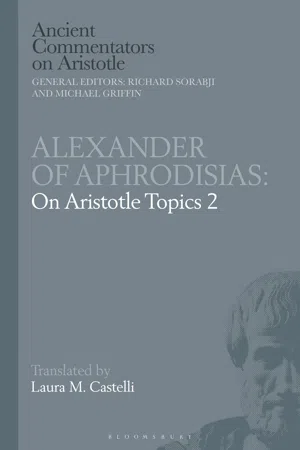
Aristotle's Topics is a handbook for dialectic, which can be understood as a philosophical debate between a questioner and a respondent. In book 2, Aristotle mainly develops strategies for making deductions about 'accidents', which are properties that might or might not belong to a subject (for instance, Socrates has five fingers, but might have had six), and about properties that simply belong to a subject without further specification.
In the present commentary, here translated into English for the first time, Alexander develops a careful study of Aristotle's text. He preserves objections and replies from other philosophers whose work is now lost, such as the Stoics. He also offers an invaluable picture of the tradition of Aristotelian logic down to his time, including innovative attempts to unify Aristotle's guidance for dialectic with his general theory of deductive argument (the syllogism), found in the Analytics.
The work will be of interest not only for its perspective on ancient logic, rhetoric, and debate, but also for its continuing influence on argument in the Middle Ages and later.
- 216 pages
- English
- ePUB (mobile friendly)
- Available on iOS & Android
eBook - ePub
Alexander of Aphrodisias: On Aristotle Topics 2
About this book
Information
Alexander of Aphrodisias
On Aristotle Topics 2
Translation
Alexander of Aphrodisias’s commentary on the second book of Aristotle’s topical investigation
125,3In the first book of the Topics1 he talked about the things it was necessary to discuss before the presentation2 of the topoi,3 and these were: [Top. 1.1] what is the objective of this investigation, what is a deduction, what are its differences, in what respect the dialectical one differs from the other [kinds of] deductions, and what a reputable opinion is; he also preliminarily set down to what extent one can expect precision in these discussions. And he said [Top. 1.2] for how many things and for what things this investigation is useful. Furthermore [Top. 1.3], he made clear what accomplishment in this [investigation] amounts to.4 And, after10 these things, having said in what things this [investigation]’s being resides [Top. 1.4], namely in problems and premises and the tools through which it is possible to have a great supply of such deductions, he first discussed premises and problems in general.5 And he showed that these are one thing in substrate, just as conclusion and assumption are (for all these things, i.e. problem, premise, assumption and conclusion, are propositions with respect to their genus, and their difference is based on their mode of expression and on the sort of relation they bear to some things).6 In what follows, he said how many the kinds of problems and premises are, and having shown that they are four and what they are, he said [Top. 1.5–6] what each of them is. He talked about the things that are pertinent to and belong together with each of them, which are ordered together20 with them based on similarity, but he also showed through induction and through deduction [Top. 1.8] the reason why the kinds [of problems and premises] are in this number. After these things, he [Top. 1.7] made a division of [the ways in which] the same [is said], since there are some problems from the same, too, that are ordered together with those concerning definition.7 After this,126,1 he defined [Top. 1.10–11] the dialectical premise and the dialectical problem and showed how they differ from each other; and he talked about the thesis,8 since the thesis, too, is a certain problem, but he also discussed [Top. 1.12] induction and showed what it is, and said that induction, too, like deduction, is a part of dialectical arguments.9 After these things, he said [Top. 1.13–18] what the tools are, and how many, through which one can have a great supply of dialectical arguments; and, having gone through each of them separately, he also showed what utility derives to dialectic from each of them.
Having discussed these things in the first book of the Topics as necessary to10 know in order to use the topoi that are to be presented, in the second book he begins the presentation of the topoi that are useful for each problem.
A topos is a principle and a starting point for an attack (they call ‘attack’ the dialectical deduction). For this reason, Theophrastus also defines the topos, as we have already said in the first book,10 in this way: a topos is a certain principle or an element, from which we take the principles about each subject; it is determined in its outline, but is indeterminate with respect to the particulars. For example, a topos is ‘if the contrary belongs to the contrary, then also the contrary belongs to the contrary’.11 For this statement, i.e. this proposition12 is determined with respect to the universal (it makes clear that it is in general about contraries), but it is not further determined in it whether it is about these or these particular 20contraries.
However, starting from this, it is possible to lead an attack about any contraries: for if the enquiry is about the good, whether it benefits, we will take, starting from the given topos, a premise appropriate13 to the given problem, e.g. ‘if the bad harms, the good benefits’. Both its being and its credibility will come to this premise from the given topos. If the object of the enquiry is whether the colour white dilates sight, we will again take a premise that is pertinent and appropriate to this problem from the given topos, i.e. ‘if the colour black contracts sight, then the colour white dilates sight’. But, if one enquires about pleasure whether it is30 good, from the given topos the premise will be taken that says ‘if pain is bad, pleasure is good’. For all these and similar things are potentially and indeterminately14 contained in the given topos.
Again, a topos of one about two is: ‘If the thing that seems to belong to127,1 something to a higher degree does not belong to it, the [same] thing that seems to belong to [something else] to a lesser degree will not belong to the that either’.15 For this statement, too, is determined with respect to the universal (it makes clear that it is about what belongs to a higher and to a lesser degree, just as the [statement] before it made it clear that it was about the contraries); however, it is indeterminate with respect to the particulars. For it is not made clear in it what the thing is in which the higher degree occurs: one can take the higher and lesser degree in colour or in taste as well as in goodness. By starting from the aforementioned topos it is possible to have a great supply of pertinent16 premises for each of the problems admitting of the use of the more and the less. For if one happens to be enquiring into whether richness is good or not, if one wants to10 show that it is not good, starting from the aforementioned topos he will take a premise appropriate to the given problem, through which he will deduce that richness is not good. For if health, which is good to a higher degree than richness, is not good, then richness will not be good either. Once this premise is taken, if a further premise were taken in addition, saying that health is not good (because, say, for some people it leads to something bad, and nothing good becomes a cause of what is bad), then it would be shown, based on the given topos, that richness is not good.
He begins with the presentation of the topoi relating to problems from the accident, both because this is more common and has priority in this sense (for the [property of] belonging [to their subjects] belongs to all [kinds of predicates]),17 and because in this way the presentation of the topoi becomes20 ordered and articulated.18 For the accident is – as he said in the previous book – that ‘which is neither a genus nor a definition nor a proprium, and still belongs to the thing’.19 However, the [property of] belonging follows upon the other [kinds of predicates] too: for nothing can be a genus or a definition or a proprium of something without belonging to it. For this reason, if the belonging – through which the accident is defined – is removed, then also each of the others is removed; on the other hand, it is not the case that, if one of the others is removed, then also the accident is removed at the same time. So the accident is, in this sense, prior in nature to the other [kinds of predicates].20 Furthermore, [he begins with the accident] because starting from the accident, the presentation of the topoi will become ordered and articulated, assuming that some [topoi] relate30 to the accident, some to the genus, some to the proprium and some to the definition. For, since the definition must not only signify the essence – rather, firstly, it has to belong to the thing whose definition it is; and then it has to be predicated in its what-it-is; but it also has to be predicated instead21 of it – if he had started the presentation of the topoi from the definition, it would have been128,1 necessary to mention, as concerning the definition, the topoi which are constructive and destructive of what belongs to the thing (which are pertinent to the accident), and those showing that [the predicate] is predicated in the what-it-is (which, in their turn, are pertinent to the problems concerning the genus), as well as those capable of showing that [the predicate] is predicated instead [of the subject] (which are pertinent to the problems from the proprium). In this way, he would have considered also the topoi that are pertinent to other problems as concerning the definition. But then, talking about them and mentioning them, he would have still said that some of them are from the genus and some from some other [kind of predicate], as if the same topoi were pertinent to several [kinds of problems]. Now, instead, starting from the accident, which is the most10 common and the simplest, he presents the topoi about belonging or not belonging as specific to the accident. Next, when he mentions the topoi relating to the genus, he presents as specific to the genus those that go beyond the [mere] belonging and reach out22 to the genus; and as pertinent to the proprium those that go beyond the genus and reach out to the proprium; and as relating to definitions those that go beyond the latter and reach out to the definition.
For these reasons, then, he starts from the topoi relating to the accident. But first he provides a certain division of problems which can be made with reference to the other [kinds of problems], too, but is particularly relevant to the problems from the accident. And the division is that some of the problems are universal20 and some are particular. For in the other kinds of problems, even if one took some particular as true per se, that has something universal in it nonetheless. For it is clear that the one who says: ‘the animal is the genus of some ensouled thing’ speaks in particular, but the [expression] ‘some this and this’ does not indicate an individual, but a universal. In the case of accidents, though, also the particular understood as individual can be taken as true per se. For in problems from the other kinds [of predicates] it is possible to take all the problems as <in truth> universal:23 for neither a genus nor a definition nor a proprium belongs to some individual without belonging to some other of the same species;24 rather, it either belongs to all or to none. Only the accident can belong to some particular thing, understood as an individual, and not to some other – e.g. the white or the musical, as well as any other of its accidents, [can belong in this30 way] to the human being: for some particular human being is musical, whereas some is not.
He will set the order of the presentation of the topoi through this division. For, having provided the aforementioned division, he will first show that one does not have to look for some specific topoi in order to demolish or establish all129,1 particular problems: for the topoi establishing the universals at the same time establish the particulars falling under them, too, so that these would be enough for both. Similarly, universally destructive topoi at the same time also remove the particulars together [with the corresponding universals]. Furthermore, the one who shows that ‘what is universally constructive or destructive is common’,25 will take that one has to start from the presentation of the topoi that show [something] univers...
Table of contents
- Cover
- Half-Title Page
- Series
- Title Page
- Contents
- Conventions
- Abbreviations
- Introduction: Alexander, Aristotle’s Topics and Peripatetic Logic
- List of Departures from Wallies’ Text
- Translation
- Notes
- Bibliography
- English–Greek Glossary
- Greek–English Index
- Index of Passages
- Subject Index
- Copyright
Trusted by 375,005 students
Access to over 1.5 million titles for a fair monthly price.
Study more efficiently using our study tools.
Frequently asked questions
Yes, you can cancel anytime from the Subscription tab in your account settings on the Perlego website. Your subscription will stay active until the end of your current billing period. Learn how to cancel your subscription
No, books cannot be downloaded as external files, such as PDFs, for use outside of Perlego. However, you can download books within the Perlego app for offline reading on mobile or tablet. Learn how to download books offline
Perlego offers two plans: Essential and Complete
- Essential is ideal for learners and professionals who enjoy exploring a wide range of subjects. Access the Essential Library with 800,000+ trusted titles and best-sellers across business, personal growth, and the humanities. Includes unlimited reading time and Standard Read Aloud voice.
- Complete: Perfect for advanced learners and researchers needing full, unrestricted access. Unlock 1.5M+ books across hundreds of subjects, including academic and specialized titles. The Complete Plan also includes advanced features like Premium Read Aloud and Research Assistant.
We are an online textbook subscription service, where you can get access to an entire online library for less than the price of a single book per month. With over 1.5 million books across 990+ topics, we’ve got you covered! Learn about our mission
Look out for the read-aloud symbol on your next book to see if you can listen to it. The read-aloud tool reads text aloud for you, highlighting the text as it is being read. You can pause it, speed it up and slow it down. Learn more about Read Aloud
Yes! You can use the Perlego app on both iOS and Android devices to read anytime, anywhere — even offline. Perfect for commutes or when you’re on the go.
Please note we cannot support devices running on iOS 13 and Android 7 or earlier. Learn more about using the app
Please note we cannot support devices running on iOS 13 and Android 7 or earlier. Learn more about using the app
Yes, you can access Alexander of Aphrodisias: On Aristotle Topics 2 by Laura M. Castelli in PDF and/or ePUB format, as well as other popular books in Philosophy & Ancient & Classical Philosophy. We have over 1.5 million books available in our catalogue for you to explore.