Isaac Blois argues that Paul's focus in Philippians on the mutual boasting shared between himself and his converts draws on the mutual boasting shared between Israel and her covenant God, as apparent in both Deuteronomy and Isaiah. Using the appearance of this central theme in the pivotal passages of Phil 1:25-26 and 2:14-16 as his focus, Blois stresses the integral relation between mutual boasting and the role that it plays in Paul's exhortations to the Philippian believers, exploring its backdrop in both the biblical tradition and the cultures surrounding them.
Blois demonstrates how the mutual boasting that Paul shares with his beloved community is culturally appropriate; the sharing of honor among friends and family was common in antiquity, as seen through the epistolary writing of prominent Roman authors such as Cicero, Seneca, and Fronto. In light of the Scriptural and cultural basis for this motif of shared boasting, Blois argues that the apostle is able to deploy the motif in order to motivate an appropriate response from his audience in the letter. Focusing on the prominence of mutual honor and its use for motivation in Philippians 1 and 2, Blois offers a fresh perspective on the exhortative function of the eschatological boasting that is to exist between Paul and his congregation on the day of Christ.
eBook - ePub
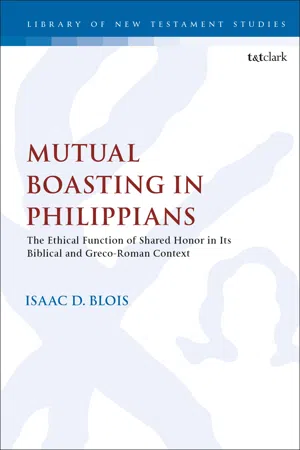
Mutual Boasting in Philippians
The Ethical Function of Shared Honor in its Biblical and Greco-Roman Context
- 240 pages
- English
- ePUB (mobile friendly)
- Available on iOS & Android
eBook - ePub
Mutual Boasting in Philippians
The Ethical Function of Shared Honor in its Biblical and Greco-Roman Context
About this book
Information
1
Introduction
This study focuses on the theme of mutual honor in Paul’s letter to the Philippians. That is, it is about the honor shared between two or more individuals in relationship with one another, in this case between Paul, the Philippian Christ-believing community, and the God whom they worshipped. Insofar as we are dealing with the concept of honor, we have our feet firmly grounded in the Roman world of Paul and his addressees in Philippi. Paul’s identity as an “apocalyptically minded pastor,”1 however, brings him to reorient the common Greco-Roman notion of honor toward the future eschatological hope of glory on the day of Christ.2 Thus, as James Harrison adduces, “The intersection of honorific perspectives from the eastern Mediterranean basin with the praise traditions of Second Temple Judaism allowed Paul to bring the culmination of glory in Christ into a rich cross-cultural dialogue in his letters.”3
In some ways, however, the present study’s use of Jewish Scripture, in combination with Roman and Hellenistic concepts, to interpret the theme of mutual boasting in Philippians is an attempt to swim against the tide of recent research on the letter. A glance at recent monographs on Philippians demonstrates an almost exclusive focus on the Roman background for interpreting the epistle, highlighting the stark Romanitas of Paul’s audience in the letter.4 In contrast, this study attempts to understand Paul’s language of honor in the letter from the combined perspective of the Jewish theology that shaped Paul’s message and the Roman milieu in which that message is conveyed. Therefore, the structure of the present work reflects the three interrelated contexts in which the theme of mutual honor is developed in Philippians: its Scriptural context (Part 1), its Greco-Roman cultural context (Part 2), and its literary context (Part 3).
Argument and Arrangement of the Study
This study argues that the basis for Paul’s mutual boasting with the Philippians rests in the Scriptures, and that, since this mutuality is culturally intelligible, Paul can use it to persuade the Philippians to heed his exhortation to maintain unity and perseverance. Specifically, the study analyzes Paul’s use of the motif of mutual boasting (καύχημα) in two passages in Philippians (1:25–26 and 2:14–16), the second of which is steeped in Scriptural language. When viewed together against this Scriptural backdrop, these two appearances of καύχημα demonstrate the eschatological and ecclesial significance of the close mutuality between the apostle and his Philippian converts, with regard to their shared boasting in one another and in God, which Paul then capitalizes on culturally to motivate behavioral change in the community.
The study will thus begin by presenting a history of research on the three areas most pertinent to the investigation of mutual honor in Philippians: (1) boasting in Paul, (2) the presence of Scripture in Philippians, and (3) the Greco-Roman context for understanding the relationship of κοινωνία between Paul and the Philippians. Then, Part 1 of the study will engage the theological context of the theme of mutual honor, presenting close readings of two Scriptural texts, Deuteronomy and Isaiah, to which Paul overtly refers in his exhortation to the Philippians. Both Scriptural sources receive their own chapters, each of which begins with an analysis of the passage to which Paul directs his readers (Deut 32:5 and Isa 49:4), and then draws on resonances within their wider contexts of relevance for Paul’s argument. The first chapter in this section, Chapter 2, argues that, within the closing chapters of Deuteronomy, Deut 26:19 LXX provides Paul with the key language of καύχημα in the context of a mutuality of honor between YHWH and his covenant people. Chapter 3 then argues that the latter portion of Isaiah affords Paul the mediatorial role of the Servant as the means for facilitating the mutual honor between God and his people envisioned in Deuteronomy (see Isa 42:7; 49:5–6), honor in which the Servant himself participates through the divine reward he earns from his ministry.
Part 2 of the study investigates the cultural context of the theme of mutual honor within the Roman and Hellenistic milieu, focusing especially on the use of this motif as a rhetorical strategy in friendship and family letters. The first chapter in this section, Chapter 4, discusses the way in which honor was shared in the Greco-Roman world among friends and family. Chapter 5 then shows how prominent letter writers, Cicero, Seneca, and Fronto,5 employed this theme of mutual honor to persuade their correspondents paraenetically.
Finally, Part 3 brings these two strands of Jewish and Greco-Roman presentations of mutual honor to bear on the interpretation of Paul’s letter to his Philippian converts, investigating the literary context in which this theme appears in the letter. The first chapter in this section, Chapter 6, offers a close reading of Phil 1:25–26, where Paul establishes his faithfulness in relationship with the Philippians, showing that his decision to remain alive for their sake will therefore garner a boast for their benefit. Chapter 7 then treats Paul’s related admonition in Phil 2:14–16 regarding the Philippians’ faithfulness, demonstrating how the Scriptural traditions of mutual honor elaborated in Deuteronomy and Isaiah describe the boasting that will accrue for Paul himself through the Philippians’ honorable behavior. Finally, Chapter 8 shows how Paul utilizes the role of mutual honor within the Greco-Roman culture6 to motivate the Philippians to maintain their side of the relationship, thereby preserving unity in order to bring about honor for their “brother,” Paul. Whereas the Scriptures provide the content and significance of their mutual honor, the Philippians’ own cultural context provides its rhetorical force and function.
Status Quaestionis
Previous scholars have called attention to the notion of “reciprocal boasting” shared between Paul (Phil 2:16) and the Philippians (1:26) in the letter.7 For instance, Fee notes how the opening section of the letter dealing with Paul’s situation (1:12–26) culminates in boasting for the Philippians, whereas the later paraenetic section dealing with the Philippians’ situation (1:27–2:18) culminates in boasting for Paul, thereby displaying “reciprocal ‘boasting.’”8 Similarly, Fowl highlights the sharing between apostle and converts that emerges from their reciprocal boasting.9 This demonstrable agreement about the presence of reciprocal or mutual boasting in Philippians, however, lacks scholarship addressing both (1) the source of this idea of mutual boasting for Paul in the letter and (2) the way in which mutual boasting is deployed rhetorically by the apostle in accord with cultural norms. It is the purpose of the present study to fill this lacuna of scholarship by identifying the Scriptural source of the theme of mutual honor in Philippians, and by demonstrating the cultural context in which mutual honor could garner rhetorical power for exhortation. In the end, I will argue that attention to these twin aspects of the theological source and the cultural context for the theme of mutual honor renders a more complete account of how Paul deploys mutual honor in Philippians to motivate his audience to maintain obedience in the face of persecution.
Definition for Mutual Honor
Since the notion of mutual honor is core to the argument of the present study, we first provide a definition for mutuality. The psychologist Judith Jordan offers the following description of how mutuality occurs within relationships:
In a mutual exchange one is both affecting the other and being affected by the other; one extends oneself out to the other and is also receptive to the impact of the other. There is … a constantly changing pattern of responding to and affecting the other’s state. There is both receptivity and active initiative towar...
Table of contents
- Cover
- Series Page
- Title Page
- Contents
- Acknowledgments
- Abbreviations
- 1 Introduction
- Part 1 Mutual Glory in the Jewish Scriptures
- Part 2 Mutual Honor in Roman Antiquity
- Part 3 Mutual Honor in Philippians
- Bibliography
- Author Index
- Ancient Sources Index
- Scripture Index
- Subject Index
- Copyright Page
Trusted by 375,005 students
Access to over 1.5 million titles for a fair monthly price.
Study more efficiently using our study tools.
Frequently asked questions
Yes, you can cancel anytime from the Subscription tab in your account settings on the Perlego website. Your subscription will stay active until the end of your current billing period. Learn how to cancel your subscription
No, books cannot be downloaded as external files, such as PDFs, for use outside of Perlego. However, you can download books within the Perlego app for offline reading on mobile or tablet. Learn how to download books offline
Perlego offers two plans: Essential and Complete
- Essential is ideal for learners and professionals who enjoy exploring a wide range of subjects. Access the Essential Library with 800,000+ trusted titles and best-sellers across business, personal growth, and the humanities. Includes unlimited reading time and Standard Read Aloud voice.
- Complete: Perfect for advanced learners and researchers needing full, unrestricted access. Unlock 1.5M+ books across hundreds of subjects, including academic and specialized titles. The Complete Plan also includes advanced features like Premium Read Aloud and Research Assistant.
We are an online textbook subscription service, where you can get access to an entire online library for less than the price of a single book per month. With over 1.5 million books across 990+ topics, we’ve got you covered! Learn about our mission
Look out for the read-aloud symbol on your next book to see if you can listen to it. The read-aloud tool reads text aloud for you, highlighting the text as it is being read. You can pause it, speed it up and slow it down. Learn more about Read Aloud
Yes! You can use the Perlego app on both iOS and Android devices to read anytime, anywhere — even offline. Perfect for commutes or when you’re on the go.
Please note we cannot support devices running on iOS 13 and Android 7 or earlier. Learn more about using the app
Please note we cannot support devices running on iOS 13 and Android 7 or earlier. Learn more about using the app
Yes, you can access Mutual Boasting in Philippians by Isaac D. Blois in PDF and/or ePUB format, as well as other popular books in Theology & Religion & Biblical Studies. We have over 1.5 million books available in our catalogue for you to explore.