Encountering theology for the first time is exciting, but it can also be daunting. Some struggle to connect with doctrinal discussion they perceive to be abstract or abstruse. Others may find the scope of theology, and the connections between different theological issues, dizzying. In order to address these difficulties and keep the initial excitement alive, A New Introduction to Theology offers a range of accessible, practical, experiential and interactive encounters with the major elements of academic Christian theology.
The guiding motif of this book is the claim that theology is full-bodied thought. The phrase 'full-bodied' shows both the richness of the experience of theology and its nature as a thoroughly embodied encounter with ways of knowing God and God's ways with the world. This motif allows the authors to bring together topics ranging from theology through the arts, sexuality and the body and the nature of the church's everyday life, to mystical theology, spirituality, political action and ecology. Working imaginatively with the five senses and the notions of loving and resting, each chapter provides a range of activities, guided discussions and reflections on key theological texts, authors and issues. This is a unique introduction to the key innovative and interdisciplinary elements from contemporary theology, ideal for individual reflection, classroom work, or flexible and distributed learning.
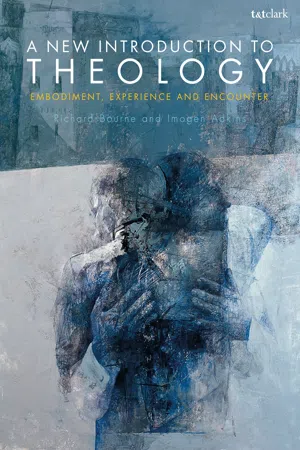
eBook - ePub
A New Introduction to Theology
Embodiment, Experience and Encounter
- 208 pages
- English
- ePUB (mobile friendly)
- Available on iOS & Android
eBook - ePub
About this book
Information
1
Seeing: Reading and being read by the Bible
Seeing is believing
It all begins with sight. ‘God said, “Let there be light”; and there was light’ (Gen. 1:3). The same is true in our daily experience. Every morning our days begin, after some semi-conscious fumblings with an insistent alarm clock, when we open our eyes. From that moment our eyes provide our minds with a constant array of stimuli – many mundane, some delightful, some upsetting. Perhaps more than any other time in history, in twenty-first century Western societies images play before our eyes in such giddy saturation that we may sometimes lack the capacity to truly focus. We live in what the French philosopher Guy Debord famously named ‘the society of spectacle’ (Debord, 1994). Perhaps no wonder then that to find sabbatical rest from this incessant parade, to truly focus, many close their eyes in prayer or meditation. In seeing the light and in the enveloping darkness, vision defines our experience of God, the world and ourselves.
Sight is perhaps the defining sense of the modern world. For many of us knowledge itself is intimately connected with sight. Colloquially, ‘I see’ means not just that I have the capacity to process optical stimuli, but that I understand. Sight is perhaps the controlling sensory metaphor of much theology – flowing right back to the shared founding narratives of the variety of Jewish and Christian traditions, the invisible God upon whom no one can look (Exod. 33), who creates humanity in ‘his’ image (Gen. 1–3), who becomes visible in Jesus (Heb. 11), but paradoxically remains, for now, only visible in a darkened blur (1 Cor. 13:12). This chapter will explore much of that potent metaphorical use of sight, but seeing is more than a guiding metaphor. It is central to the way in which theology is constructed, and the way in which it conceives its limits. In this chapter we will attend to actual practices of seeing – in particular watching films, reading fiction and encountering the Bible – to show something of the sensory richness of theological method.
John Ruskin, writing in his reflections on painting, reflects on ‘the truth of space’ as ‘dependent on the power of the eye’. ‘The greatest thing a human soul ever does in this world is to see something, and tell what it saw in a plain way. Hundreds of people can talk for one who can think, but thousands can think for one who can see. To see clearly is poetry, prophecy, and religion – all in one’ (Cook and Wedderburn, 1903–12, 16.333). To genuinely ‘see’, with clarity of vision and focus, is not just to cut to the heart of an area of knowledge, but to attain the capacity to move from theory to action. As Zoe Bennett puts it, commenting on Ruskin’s account of seeing clearly, ‘upon good seeing depends our capacity to make judgments, to communicate anything worthwhile or to have any material fit for reflection. Seeing does not only furnish us with imagination; good seeing makes possible evaluation and discernment. In other words, it makes possible not only knowledge, but also wisdom’ (Bennett, 2013: 81). Theological truth, as both wisdom and knowledge, is well understood as a practice of seeing.
The Christian faith speaks of a God who acts. This God creates, sustains, guides, delivers, rescues, punishes, lapses into silence, is moved by compassion, becomes incarnate, restores creation, redeems ‘his’ beloved creatures and rests. In each of these events God makes ‘himself’ known. This chapter is about the method of theology – in particular about its sources, and about how use of these sources brings theological matters into focus. It is, then, about how we see:
• The Bible
• God
• Truth
• Jesus
• Our actions
• Ourselves
The grandeur of a great vista can evoke in us an echo of God’s own declaration at the culmination of the initial creation of the Universe; ‘And God saw everything that he had made, and indeed, it was very good’ (Gen. 1:31). All of creation is said to display the glory and beauty of God (Ps. 19:1), such that all can know of the power of God (Rom. 1:20). This is still somewhat incomplete. That more anonymous knowledge of God might later be seen in the light of more expansive and detailed theological understanding (Acts 17:22ff). Such knowledge of God is sometimes known as natural theology or general revelation. The term ‘general’ here refers to knowledge of God available to any person through observation and experience of the created order itself, through some kind of universally available human experience. It is distinguished therefore from the specific but all-encompassing claims about God, humanity and the cosmos made on the basis of God’s self-revealing action in history, especially in Jesus Christ. Theologians differ considerably on the extent to which this general knowledge of God is possible. They have diverse views on the extent to which the obscuring visual interference of sin compromises such knowledge. For Catholic, Orthodox and many Protestant views, the partial knowledge of God, specifically ‘his’ existence and attributes (all-powerful, all-loving, all-knowing, immortal, etc.), may be discerned through the divine gift of human reason. For Thomas Aquinas (1225–74), the great medieval theologian and prime influence on Catholic thought, such knowledge is always in need of perfecting and completing through the special revelation of God in Christ. A number of contemporary theologians find in the notion of general revelation a way of affirming the partial truth accessible to those of other faiths, some while seeking to maintain the fuller truth of their own tradition. This theology becomes imbalanced if general revelation becomes a source of knowledge of God that stands alone or even competes with the self-disclosure of God in Christ, as attested in Scripture (i.e. special, as distinct from general, revelation). General revelation is open to all, but cannot thereby be merely a basis for a generic theism. Christianity is resolute in claiming that God created through Christ (Jn 1:3, 1 Cor. 8:6, Col. 1:16, Heb. 1:2) such that there can be no absolute separation of creation from Christ, or general from special revelation.
Such a caution is particularly strong in Reformed and other forms of Protestant theology, where the sovereign decision of God to reveal ‘himself’ in Christ is the only means of bringing to unclouded focus the wider self-revelation of God found in sin-obscured general experience. Where more optimistic accounts of general revelation may view special revelation as a completion of the knowledge derived therein, for John Calvin (1509–64) the foggy outlines of knowledge of God through general revelation all too often lead to misrecognition, confusion and idolatrous error. Special revelation does not merely complete but corrects this knowledge, it is ‘another and better help’.
For as the aged, or those whose sight is defective, when any books however fair, is set before them, though they perceive that there is something written are scarcely able to make out two consecutive words, but, when aided by glasses, begin to read distinctly, so Scripture, gathering together the impressions of Deity, which, till then, lay confused in our minds, dissipates the darkness, and shows us the true God clearly. (Calvin, Institutes 1.6.1)
For the great twentieth-century Reformed theologian Karl Barth (1886–1968), the divine initiative in revelation admits no possibility of a natural theology separate from this divine decision to make God-self known. There is not an innate human capacity to know God by our own wit, or subject to our own agenda. God’s choice to reveal ‘himself’ is the only foundation for knowledge of ‘him’. Barth memorably asserts that the form of this may be anything God so chooses – ‘God may speak to us through Russian Communism, a flute concerto, a blossoming shrub, or a dead dog’ (Barth, 2004, CD I/1:55). Critics have found an excessively passive account of human ability and action in this emphasis on the exclusive initiative of the self-revealing God. However, Barth does give some due to the human role, which is to actively receive and reflect this divine reality, enabled and empowered by the Holy Spirit (Barth, 2004, CD I/2: 203–79).
Theological textbooks often identify four sources available to the theological task:
• Scripture: the Bible is understood in some way as being, containing or becoming the word of God.
• Reason: which merely refers to rigorous thought. This is not necessarily the individualistic ‘autonomous reason’ which some critics in the Modern period have polemically contrasted with ‘irrational’ faith. Rather, with Aquinas, reason is a God-given gift bestowed upon humanity, which furnishes some initial insights to be shaped, developed, corrected and completed through special revelation.
• Tradition: a shorthand term for the complex, dynamic and occasionally meandering conversation through which the church has sought to elaborate, understand and practise the truth about God, humanity and the cosmos. That the previous sentence contains clusters of three adjectives, three verbs and three nouns may indicate something of the fullness and breadth of the notion of tradition.
• Experience: understood either in a restricted sense of the intensity of particular religious/mystical experience or increasingly is broadened to encompass a wider variety of experiences of the human condition itself – from sexual desire to artistic or cultural production.
These four are not to be understood as separate or even competing resources or forms of theologizing. We can never read the Bible in a way that suspends our own reason, forgets the backstory of tradition or separates our thinking from our experience. No matter whether this is the first time you’ve read a book on theology, or you are an experienced doctrinal thinker, the ordinary lived and embodied experience of encountering theology occurs in the complex and even messy combination of these four sources. Thus the remainder of this chapter continues our exploration of the four sources of theology, guided through the formative and foundational experience of reading Scripture. A separation of these four sources can lead to a competitive privileging of one over another. When held fully distinct, they may also become an idol in themselves, rather than pointers to God. The use of reason may become an arid and restrictive rationalism in which the mystery and wonder of God are denied or concealed; dynamic tradition becomes either a petrified traditionalism working against the ongoing work of the Spirit or a petulant anti-traditionalism in love with novelty more than truth; the vibrancy of experience drifts to becoming an uncritical baptism of our current human sinfulness as if it were already sanctified and redeemed; and even the spectacles of Scripture may fail in their function – if the Bible itself takes on semi-divine status, Scripture shifts from being something looked through to something idolatrously looked at.
Key points
• Visual metaphors convey the limits and forms of theological knowledge.
• The four sources of theology are not distinct and competitive, but mutually implicated.
Reason in its most exalted mood: The Bible and the imagination
‘Reason’ has become a rather politicized and polemical term. In popular presentations of the relationship between ‘Science’ and ‘Religion’, reason is equated purely with experimental method, of testing hypotheses through repeatable empirical testing. Reason is contrasted with ‘faith’, which is then taken to be belief that flies in the face of evidence, as essentially irrational. This view is a rather simplistic outflow of Enlightenment rationalism – the view that truth is accessible to human reason unaided and unencumbered by authoritative institutions, traditions, superstitions or conventions. The picture of the reasoning person is of a solitary individual sitting down and thinking very hard, or conducting a range of experiments, and thereby seeing truth. Certainly both of these are good methods for accessing certain types of truth. When evaluating an abstract philosophical argument, giving myself the space to sit and ruminate is both a necessity and a delight. However, when I take medication I want to know not that the scientists who developed it sat stroking their chins and deliberating, but that the medication has been subject to rigorous tests for its effectiveness and its safety. However, these are only some of the many kinds of truth, just part of the breadth of knowledge we need to navigate our way through the world. Laboratory experimentation can say very little about the truth of claims about goodness, value or beauty.
We have defined reason above in a much broader way – as the practice of rigorous thought. The picture of the exercise of reason that we suggest is diverse, communal and imaginative. Its image may better be the clamorous, free-flowing but unfalteringly honest conversation of the (ideal) family dinner table. It is diverse because it needs to be deployed to a variety of types of truth claim – claims of science, history, morality, creativity, of who God is and who we are as a result. Those who engage in theological reasoning are in some way shaped and enabled by participation in the long and often-heated history of Christians living and worshipping together, as a community, and in so doing making sense of themselves and their God. In that sense reasoning is tradition-ed, inevitably and inescapably shaped by previous generations of argumentative Christian discussion.
Imagination is central to what it is to think – without it creative connections cannot be drawn, new ideas cannot be thought, older views cannot be brought to life. Without your imagination, these words on this page would not do their work – they would remain mere ink marks without meaning or significance. All of our senses are more or less constantly bombarded with an extraordinary flow of stimuli – the brain may collect these images, connect them, developing ever more complex associations between them. This fundamental pattern of sense and cognition is often referred to as an ‘imaginary’. Psychoanalysts like Jacques Lacan and Cornelius Castoriadis show that this unconscious imaginary is the very foundation of all thought. Importantly for the claims of this book, this means that our sensing, our desires and emotions are not as radically distinguishable from ‘reason’ as many might first suppose. Our capacity to imagine is what allows us to generate an understanding not only of the physical world around us, but of society and culture – which exist in our affective connections with others, in what we think life is for, what gives it meaning. Imagination is how we make sense of ourselves – it works through the stories we tell about ourselves and our world.
Reasoning is a highly visual process – not least because writing has proven necessary to capture the fleeting effervescence of oral accounts. Reading and writing are central practices of thought in most cultures. The American author Joan Didion captures this when she writes ‘I write entirely to find out what I’m thinking, what I’m looking at, what I see and what it means. What I want and what I fear’ (Didion, 1976). The very earliest writings we have, going back to Sumerian pictographs pressed into clay, served to capture the important details needed for life, probably financial, military and trade accounts; but these were quickly followed by narratives. Creation myths, floods, battles, quests and romances are not mere relics of ancient entertainment, they capture and create a culture’s sense of identity – who they are, and why they do what they do.
The Christian narrative, by which the early Christians began to make sense of what they held to be world-changing events, flowed through both oral tradition and writing. It is often said that the oral culture dominated, with the need to write only coming to the fore as historical memory faded. There is some truth in this when it comes to the writing of the gospels, beginning somewhere around the year 70 ce. However, the production, circulation and communal reading of texts, perhaps most famously letters, gave even the earliest missionary expansion of Christianity a distinctly bookish and literary character (Hurtado, 2016). That bookishness continues to be the modus operandi of theological reason. Christian theologians scatter parenthetical bits of code throughout all their writing – some more fully than others, some with more persuasive power than others, but all will back up their claims with quo...
Table of contents
- Cover
- Halftitle Page
- Title Page
- Dedication Page
- Contents
- Acknowledgements
- Introduction: Theology as full-bodied thought
- 1 Seeing: Reading and being read by the Bible
- 2 Hearing: The life of doctrine
- 3 Touching: Embodiment and the shaping of desire
- 4 Tasting: Savouring the sacraments
- 5 Smelling: Mysticism and memory
- 6 Loving: Politics and/of salvation
- 7 Resting: The Sabbath of all creation
- Glossary
- Bibliography
- Index
- Imprint
Trusted by 375,005 students
Access to over 1.5 million titles for a fair monthly price.
Study more efficiently using our study tools.
Frequently asked questions
Yes, you can cancel anytime from the Subscription tab in your account settings on the Perlego website. Your subscription will stay active until the end of your current billing period. Learn how to cancel your subscription
No, books cannot be downloaded as external files, such as PDFs, for use outside of Perlego. However, you can download books within the Perlego app for offline reading on mobile or tablet. Learn how to download books offline
Perlego offers two plans: Essential and Complete
- Essential is ideal for learners and professionals who enjoy exploring a wide range of subjects. Access the Essential Library with 800,000+ trusted titles and best-sellers across business, personal growth, and the humanities. Includes unlimited reading time and Standard Read Aloud voice.
- Complete: Perfect for advanced learners and researchers needing full, unrestricted access. Unlock 1.5M+ books across hundreds of subjects, including academic and specialized titles. The Complete Plan also includes advanced features like Premium Read Aloud and Research Assistant.
We are an online textbook subscription service, where you can get access to an entire online library for less than the price of a single book per month. With over 1.5 million books across 990+ topics, we’ve got you covered! Learn about our mission
Look out for the read-aloud symbol on your next book to see if you can listen to it. The read-aloud tool reads text aloud for you, highlighting the text as it is being read. You can pause it, speed it up and slow it down. Learn more about Read Aloud
Yes! You can use the Perlego app on both iOS and Android devices to read anytime, anywhere — even offline. Perfect for commutes or when you’re on the go.
Please note we cannot support devices running on iOS 13 and Android 7 or earlier. Learn more about using the app
Please note we cannot support devices running on iOS 13 and Android 7 or earlier. Learn more about using the app
Yes, you can access A New Introduction to Theology by Richard Bourne,Imogen Adkins in PDF and/or ePUB format, as well as other popular books in Theology & Religion & Christian Theology. We have over 1.5 million books available in our catalogue for you to explore.