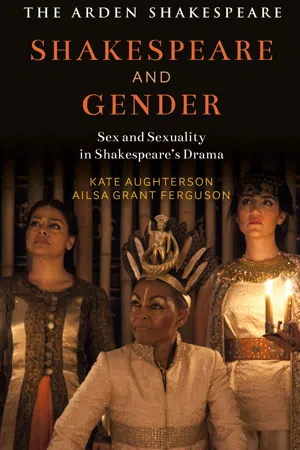
Shakespeare and Gender guides students, educators, practitioners and researchers through the complexities of the representation of gender and sexuality in Shakespeare's work. Informed by contemporary and early modern debates and insights into gender and sexuality, including intersectionality, feminist geography, queer and performance studies and fourth-wave feminism, this book provides a lucid and lively discussion of how gender and sexual identity are debated, contested and displayed in Shakespeare's plays and sonnets. Using close textual analysis hand-in- hand with diverse contextual materials, the book offers an accessible and intelligent introduction to how gender debates are integral to the plays and poems, and why we continue to read and perform them with this in mind.
Topics and themes discussed include gendering madness, paternity and the patriarchy, sexuality, anxious masculinity, maternal bodies, gender transgression, and kingship and the male body politic.
eBook - ePub
Shakespeare and Gender
Sex and Sexuality in Shakespeare’s Drama
- 288 pages
- English
- ePUB (mobile friendly)
- Available on iOS & Android
eBook - ePub
About this book
Information
CHAPTER 1
THE WOMAN’S VOICE
Key Text: Much Ado About Nothing with The Winter’s Tale
J.K. Rowling, the most commercially successful female author of our times, identifies the double bind of women speaking in the public sphere: ‘every woman I know who has dared express an opinion publically has endured … abuse at least once, rooted in an apparent determination to humiliate or intimidate her on the basis that she is female’.1 As public and private speech is increasingly blurred by online communication, female voices have both greater access to the public ear and greater exposure to censure. It is timely, then, to explore what Shakespeare’s women tell us about how the female voice functioned in their early modern context and in production today. This chapter holds a lens over one character, Much Ado About Nothing’s Beatrice, to explore both contextual and theatrical expectations of women and the power wielded by speech and voice on the early modern stage.
From her first appearance in the opening scene of the play Beatrice demonstrates a female voice resounding outside of archetypal expectations, both disrupting and flouting them. Fatherless, brotherless and unmarried, Beatrice is freer of patriarchal control than her peers and deeply reluctant to be forced into constraint via marriage. It is her verbal proficiency and unchecked loquacity that allows her to transgress hierarchical structures within Much Ado About Nothing’s play world. As Gina Bloom writes, ‘female characters who embrace, instead of attempting to overcome, their unpredictable vocal flows are able to elude patriarchal regulation’ (2007: 11). Beatrice’s only patriarch, her uncle, Leonato, gives mere lip service to controlling his niece, yet exhibits an unyielding attitude towards his own daughter, Hero, later in the play, wishing her rather dead than dishonoured (4.1.116–17). Beatrice’s apparently unchecked freedom of speech, often in public, provides us with a fascinating model of female verbosity from an age when many texts have it that the unequivocal ideal of womanhood was located in silent acquiescence.
We meet Beatrice very early in Much Ado, when she speaks, both publicly and critically, of a man of power and influence, Benedick. The play’s opening conversation is between men, Leonato and a messenger, discussing the victorious outcome of a military campaign. This constitutes a conventional inaugural scene, functioning to establish the context and characters for the play. However, Beatrice interrupts – and disrupts – this patriarchal convention. Shakespeare inserts a female voice into his standard opening and, specifically, one that questions the masculine narrative. Beatrice interjects with ridicule, not only of Benedick himself (whom we are yet to meet) but, more broadly, of the male spheres of public discourse and military knowledge. Specifically, she exposes to mockery the masculine language of prowess in battle and male camaraderie, the effect of her humour heightened by the deadpan messenger:
LEONATO
What is he that you ask for, niece?
HERO
My cousin means Signior Benedick of Padua.
MESSENGER
O, he’s returned; and as pleasant as ever he was.
BEATRICE
He set up his bills here in Messina and
challenged Cupid at the flight; and my uncle’s fool,
reading the challenge, subscribed for Cupid, and challenged
him at the bird-bolt. I pray you, how many
hath he killed and eaten in these wars? But how many
hath he killed? For indeed I promised to eat all of his
killing.
LEONATO
Faith, niece, you tax Signor Benedick too
much; but he’ll be meet with you, I doubt it not.
MESSENGER
He hath done good service, lady, in these wars.
BEATRICE
You had musty victual, and he hath holp to
eat it: he is a very valiant trencherman; he hath an
excellent stomach.
MESSENGER
And a good soldier too, lady.
BEATRICE
And a good soldier to a lady: but what is he
to a lord?
MESSENGER
A lord to a lord, a man to a man; stuffed with
all honourable virtues.
BEATRICE
It is so, indeed; he is no less than a stuffed man:
but for the stuffing, – well, we are all mortal.
(1.1.30–56)
Beatrice’s raillery attacks Benedick’s masculinity in line with archetypal standards. First, she challenges his martial ability (39–42), undermining his reputation as a ‘good soldier’, re-asserting, instead, her own confident challenge to his status. The messenger’s apparent confusion and obliviousness to Beatrice’s wordplay places her at the advantage at every point in this conversation with a man. She becomes more daring in her assassination of Benedick’s masculinity when she hints at a lack of sexual prowess, in the double entendre of ‘but for the stuffing, – well, we are all mortal’ (55–6). On the surface this serves as a basic truism of mortality but the comment also heavily implies the ‘stuffing’ (a common sexual euphemism) is under par, via the elliptic aphorism ‘well, we are all mortal’ replacing a more brazen attack.
So how can we read Beatrice’s bold voice in the play in the context of the silent female archetype of the early modern period? The ideal of a chaste, silent, obedient woman permeates many writings of the early modern period and is widely explored in scholarship of women’s representation in the drama and literature of the time. Poetic expressions of female perfection idealize chastity of body and of speech: in effect, the less speech the better. Sidney’s blazon, ‘What Tongue Can Her Perfections Tell?’ (1590), for instance, effects an exhaustive geographical exploration of the female body as object of male gaze and desire. The ‘perfections’ do not, however, include movement or sound and the effect is the presentation of a feminine perfection predicated in stillness and silence. Indeed, the subject’s silence, or at least a sort of chaste taciturnity, is clearly a great virtue – or rather, a positive attraction:
But who those ruddy lips can miss,
Which blessed still themselves do kiss?
Rubies, cherries, and roses new,
In worth, in taste, in perfect hue,
Which never part but that they show
Of precious pearl the double row,
The second sweetly-fenced ward
Her heav’nly-dewed tongue to guard,
Whence never word in vain did flow.
Sidney eulogizes silence, or at least the bare minimum of speech among the ‘perfections’. The visceral eroticism of Sidney’s description of the subject’s ‘ruddy lips’ contrasts immediately with the chastity to be found within her mouth, both figuratively and literally. Her ‘precious pearl’ teeth act as pure white jailers to her tongue, which never moves ‘in vain’. While we may read here a simple praise of the discernment of the woman’s speech, the language of restraint and imprisonment (‘ward’, ‘guard’) cannot be ignored. Such literary presentations of the desirability of self-enforced female silence and the more forthright instruction that women must stay quiet and avoid public speech (see Resource 1.a) contextualize Beatrice’s verbosity and Shakespeare’s response to these ideals.
Shakespeare’s mockery of the blazon tradition itself and the standards of female perfection it peddles, can be found scattered across several texts. In Twelfth Night, for instance, Olivia expresses her exasperation at the constant pestering praise sent by Count Orsino by providing ‘divers schedules of my beauty: it shall be inventoried, and every particle and utensil labelled to my will: as, item, two lips, indifferent red; item, two grey eyes, with lids to them; item, one neck, one chin, and so forth’ (1.5.236–40). Olivia’s ‘inventory’ though, will not be set out by a man’s pen: it will be ‘labelled to my will’, reclaiming ownership of her own body and voice. Most famously and openly, however, the blazon convention is mocked in Sonnet 130, ‘My mistress’ eyes are nothing like the sun …’, in which Shakespeare takes a clear swipe not only at the absurdity and literary limitations of the convention, but in the very standards of beauty and attraction it expounds, notably female silence (‘I love to hear her speak …’; see Introduction). In Much Ado About Nothing, it is Beatrice who, in a festive moment of reversal, is identified as the female creator, not the female subject of a blazon, when she employs comic conceit and witty punning to describe sulky young Claudio as ‘civil as an orange, and something of that jealous complexion’. ‘I’faith Lady,’ replies the prince, ‘I think your blazon to be true’ (2.1.270–2). In Beatrice, the witty, speaking woman, not the ‘guard[ed]’ tongue of chaste silence, is presented as desirable.
When Beatrice first encounters her adversary, Benedick, it is to pick up what has already been framed as an ongoing battle of words and wits that has begun long before the action of the play:
BEATRICE
I wonder that you will still be talking, Signior
Benedick: nobody marks you.
BENEDICK
What, my dear Lady Disdain! are you yet
living?
BEATRICE
Is it possible disdain should die, while she
hath such meet food to feed it as Signior Benedick?
Courtesy itself must convert to disdain, if you come in
her presence.
BENEDICK
Then is courtesy a turncoat. But it is certain
I am loved of all ladies, only you excepted: and I would
I could find in my heart that I had not a hard heart; for,
truly, I love none.
BEATRICE
A dear happiness to women: they would else
have been troubled with a pernicious suitor. I thank
God and my cold blood, I am of your humour for that:
I had rather hear my dog bark at a crow than a man
swear he loves me.
BENEDICK
God keep your ladyship still in that mind!
so some gentleman or other shall ’scape a predestinate
scratched face.
BEATRICE
Scratching could not make it worse, an ’twere
such a face as yours were.
BENEDICK
Well, you are a rare parrot-teacher.
BEATRICE
A bird of my tongue is better than a beast of
yours.
BENEDICK
I would my horse had the speed of your
tongue, and so good a continuer. But keep your way,
o’ God’s name; I have done.
BEATRICE
You always end with a jade’s trick: I know you
of old.
(1.1.110–39)
Beatrice’s first remark to Benedick is to suggest he talks without audience, that his speech is inconsequential to his male companions: ‘nobody marks you’. Her first attack, therefore, is both on his speech and his status among men. Rhetorical skills, as well as physical vocal control, were important tools in establishing men’s authority and position, as Gina Bloom writes:
Whereas early modern women and children were discouraged and even barred from certain forms of vocal expression, men were often coached from an early age in the skill of oratory in an effort to prepare them to speak effectively.
(Bloom, 2007: 9)
The evenness of the verbal and vocal battle between Beatrice and Benedick, then, and her suggestion that his fellow men do not attend to his speech, undermines his accomplishment and power as a man among me...
Table of contents
- Cover
- Halftitle
- Title Page
- Dedication Page
- Contents
- List of Illustrations
- Acknowledgements
- Introduction
- 1 The Woman’s Voice
- 2 The Male Body, Kingship and the Body Politic
- 3 Testing the Marriage Plot: Form, Violence and Gender
- 4 Cross-Dressing and Gender Transgression(s)
- 5 Gendering Madness
- 6 Paternity and Patriarchy
- 7 Sexual Excess: Space, Sex and Gender
- 8 Anxious Masculinity
- 9 Maternal Bodies: Female Powers
- Bibliography
- Index
- Imprint
Trusted by 375,005 students
Access to over 1.5 million titles for a fair monthly price.
Study more efficiently using our study tools.
Frequently asked questions
Yes, you can cancel anytime from the Subscription tab in your account settings on the Perlego website. Your subscription will stay active until the end of your current billing period. Learn how to cancel your subscription
No, books cannot be downloaded as external files, such as PDFs, for use outside of Perlego. However, you can download books within the Perlego app for offline reading on mobile or tablet. Learn how to download books offline
Perlego offers two plans: Essential and Complete
- Essential is ideal for learners and professionals who enjoy exploring a wide range of subjects. Access the Essential Library with 800,000+ trusted titles and best-sellers across business, personal growth, and the humanities. Includes unlimited reading time and Standard Read Aloud voice.
- Complete: Perfect for advanced learners and researchers needing full, unrestricted access. Unlock 1.5M+ books across hundreds of subjects, including academic and specialized titles. The Complete Plan also includes advanced features like Premium Read Aloud and Research Assistant.
We are an online textbook subscription service, where you can get access to an entire online library for less than the price of a single book per month. With over 1.5 million books across 990+ topics, we’ve got you covered! Learn about our mission
Look out for the read-aloud symbol on your next book to see if you can listen to it. The read-aloud tool reads text aloud for you, highlighting the text as it is being read. You can pause it, speed it up and slow it down. Learn more about Read Aloud
Yes! You can use the Perlego app on both iOS and Android devices to read anytime, anywhere — even offline. Perfect for commutes or when you’re on the go.
Please note we cannot support devices running on iOS 13 and Android 7 or earlier. Learn more about using the app
Please note we cannot support devices running on iOS 13 and Android 7 or earlier. Learn more about using the app
Yes, you can access Shakespeare and Gender by Kate Aughterson,Ailsa Grant Ferguson in PDF and/or ePUB format, as well as other popular books in Literature & Shakespeare Drama. We have over 1.5 million books available in our catalogue for you to explore.