- 2,496 pages
- English
- ePUB (mobile friendly)
- Available on iOS & Android
eBook - ePub
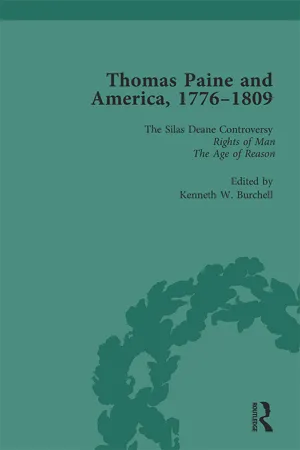
Thomas Paine and America, 1776-1809 Vol 2
About this book
From his migration to America in 1774 to his death in New York City in 1809, Thomas Paine's ideology was at the centre of American political and social debate. This six-volume facsimile edition brings together rare texts from books, periodicals and newspaper contributions to unearth the contemporary American response to Thomas Paine.
[RODNEY], THE ORACLE OF LIBERTY
Hermes [Caesar Augustus Rodney], The Oracle of Liberty and mode of Establishing a Free Government (Philadelphia, PA: Parry Hall, 1791), pp. 23-5. Reset.
The anonymous author of The Oracle of Liberty was the young partisan of the Jeffersonian Democratic-Republicans Caesar Augustus Rodney, a 1789 graduate of the University of Pennsylvania who was elected to the Eighth Congress of the United States of America in 1803. Rodney was named after his uncle, a delegate to the Continental Congress, signatory of the Declaration of Independence and President of Delaware throughout most of the American Revolution. Noticed for loyalty to the Jeffersonian Republican cause, his familial connection and for his legal acumen, Rodney was one of the key officers appointed to oversee the impeachment trials of Judge John J. Pickering (1737-1805) and Associate Justice of the Supreme Court Samuel Chase (1741-1811), the only Supreme Court justice ever tried under a bill of impeachment. Thomas Jefferson named Rodney Attorney General of the United States of America in 1807 and President James Madison asked him to continue in that post, at which he served until 1811. Rodney commanded a company of volunteers in defence of Baltimore, Maryland, during the War of 1812 and later returned to the United States House of Representatives in 1821 and the Senate in 1822. The following year he resigned to accept an appointment as United States Minister to the five-year-old Argentine Republic, where his extraordinary career ended with his death in 1824.1
Rodney authored this pamphlet in the context of the appearance of Thomas Paine's Rights of Man and the rebuttal of Paine in John Quincy Adams's 'Publicola' letters published in the Columbian Sentinel (Boston) between 8 June and 2 July 1791.2 The text reproduced here is taken from the endnotes of Rodneys own plan of government, which constitutes the body of his pamphlet. Though Rodneys plan was concerned, like Paine, with the 'natural rights' of man, he made no mention of Paine in the main body of his work because 'This essay came to my hands since compleating the plan that I have proposed' (below, p. 67).
While there is no reliable data on distribution and influence, given Rodney's own status and notoriety and the presence of this work in a number of key American historical libraries, it appears likely that it was at least modestly read and noticed.
THE ORACLE OF LIBERTY, AND MODE OF ESTABLISHING A FREE GOVERNMENT.
Hermes.
PHILADELPHIA – PRINTED BY PARRY HALL, NO 149. in CHESTNUT STREET, NEAR FOURTH STREET. MDCC XCI.
B
NOTE. – Mr. Paine, (the author of Common Sense) in his Essay on the rights of man, says, 'A constitution is a thing antecedent to a government; and a government is only the creature of a constitution. Hie constitution of a country is not the act of its government, but of a people constituting a government. It is the body of elements to which you can refer, and quote article by article; and which contains the principles on which the government shall be established, the manner in which it shall be organized, the powers it shall have, the mode of elections, the duration of parliaments, or by what other name such bodies may be called; the powers which the executive part of the government shall have; and in fine, every thing that relates to the complete organization of a civil government, and the principles on which it shall act, and by which it shall be bound. A constitution therefore is to a government, what the laws, made afterwards by that government, are to a court of judicature. Hie court of judicature does not make the laws, neither can it alter them; it only acts in conformity to the laws made, and the government is in like manner governed by the constitution.' /
This essay came to my hands since compleating the plan that I have proposed; but I see nothing in Mr. Paines reasoning, or in his definition of a constitution, to induce me to alter my opinion: It may be well to designate the superior courts of judicature, as well as the superior executive, and determine their powers; and if it is admitted only, that the inferior parts of the government which will require to be accommodated to the varying circumstances of the community, should be left to the legislature to organize and controul, agreeably to the established principle of the government, I freely admit all the rest of Mr. Paine's definition. But I am persuaded every judicious man, who understands any thing of government, must see the necessity of accommodating the inferior parts of government to the varying circumstances of the community; and more especially those departments and offices which are connected with the ministerial part or operations of government; nor can there be any danger in subjecting these to the controul and organization of a legislature, in which the interest of government and the interest of the people are equally balanced.
C
NOTE. – The author who writes under the signature of Publicola, says, 'That except the American constitutions, Mr. Paine would not find in ail history a government which will come within his definition – that the constitution of a country is not the paper or parchment on which it is written, it is the system of fundamental laws, by which the people have consented to be governed – The constitution of Great-Britain is a constitution of principles, not of articles – The people of England are therefore bound by a social compact now existing – They have, delegated their whole collective power to a legislature consisting of a king, lords, and commons.'
This essay also came to my hands since finishing the plan I have proposed. But I see nothing in it to induce any alteration, from the principles or plan I have pursued. Nor does it seem very clear wherein these two great men differ in principle about a constitution. They both appear by other parts of their essays, to agree that a people have a right to constitute their own government, and that they have a right, when they see cause, to dissolve their government, and constitute a new one. Mr. Paine, beside enumerating several particulars, says, 'a constitution ought to contain, in fine, every thing that relates to the complete organization of a civil government, and the principles on which it shall act, and. by which it shall be bound.' Publicola says, 'the constitution of a country is the system of fundamental laws, by which the people has consented to be governed.' Where is the difference of these two assertions? They are both indefinite, both comprehend more than is expressed, and for aught appears, may both have the same meaning. Yet it seems these two great men are opposed in argument about the British constitution. Mr. Paine has asserted that the British have no constitution; and Publicola contends that they have one. But the real question seems to be, whether it is not necessary for the people of / Great Britain to form a new constitution? And it seems agreed, by the avowed principles of both these authors, that this must be determined by the people of Great Britain themselves. There is one observation occurs on this occasion, that is, that it seems to reflect no small degree of honour on America, that the people of Great Britain should appeal to, or at least rely on having this question discussed by two gentlemen who made a distinguished figure in the American revolution. But unfortunately for Publicola, the side he has taken is unpopular in America. For they that love liberty and know the value of it, wish to extend it to all mankind; and it is well known in America, that millions of the inhabitants of Great Britain are deprived of the enjoyment of their equal rights: they are not only excluded from many civil rights, but many of them are deprived in a great degree of the sacred rights of religion. Yet I am inclined to think, that Publicola has taken that side of the question out of regard to his own country, rather than from a desire of continuing the bonds of oppression in Great Britain. But as all this is foreign to my present purpose, I leave these great men to pursue their own views; always wishing success to the divine spirit of liberty, let who will oppose it.
Notes
1. G. H. Ryden, Biographical Sketches of Casear Rodney (the Signer), Thomas Rodney and Casear A. Rodney (Dover, DE: Public Archives Commissiqn, 1943). See also. W. Read, Biographical Sketch of Casear August Rodney, read before the Grand Lodge of Delaware, June 27th, 1853 (n.p. Grand Lodge, 1853).
2. Adams, An Answer to Pan's Rights of Man (1793), below, pp. 69-118. See also Howes, R-396; arid Sab in, 72493. which traces the evidence of its authorship to a manuscript notation in Rodneys own handwriting.
ADAMS, AN ANSWER TO PAIN’S RIGHTS OF MAN
John Quincy Adams, An Answer to Pain's Rights of Man (London: John Stockdale, 1793). British Library, shelfmark 116.i.48.
The 'John Adams, Esq.' of the title page of this work was John Quincy Adams (1767-1848), the son of the second President and himself sixth President of the United States of America (1825-9). Adams was, like his father, something of a unique character. His family connections were valuable for him; President George Washington appointed him Minister to the Netherlands at 26 years of age and his father appointed him Minister to Prussia. As the sixth Secretary of State of the United States under James Monroe, he was instrumental in the formation of the Monroe Doctrine. He was variously a member of the Federalist, Democratic-Republican, National Republican – which he co-founded with John C. Calhoun – and later the Anti-Masonic and Whigparties. His own political philosophy is perhaps best described as cautious rather than ideological. The bitterness and legislative opposition that grew out of the 'corrupt bargain of the 1824-5 election marred his presidential term.
Perhaps uniquely in American presidential history, Adams played an arguably greater role in American political life after his term as president. Elected to the Congress of the United States in 1830, he served seventeen years as an anti-slavery advocate so effective that his opponents passed the infamous 'gag law' to silence the debates of Adams and his allies. On 21 February 1848, while debating the merits of military decorations for veterans of the Mexican-American War, Adams collapsed on the floor of the House of Representatives and died two days later in the Office of the Speaker of the House.1
John Quincy Adams was, throughout his life, prone to bouts of deep depression. The text presented here grew out of one bout that occurred very early in his life. Immediately after his 1788 graduation from Harvard University, Adams apprenticed to attorney and fellow Harvard graduate Theophilus Parsons (1749-1813) in Newburyport, Massachusetts, where he worked until admitted to the bar in 1791. Adams moved to Boston and began the practice of law. The depression from which this particular writing emerged was precipitated by two events: the breakup of his first marriage engagement and the loss of his first case at law. One of his biographers, historian Robert Remini, wrote 'he survived these trying days ... by immersing himself in literature, science, the theater, and music'.2 The highest profile political and social issue of the day was the French Revolution – then beginning seriously to percolate – and Thomas Paine had recently published Rights of Man, in which Paine recommended that the British follow the French with the expulsion of their king and repudiation of monarchy.
Adams's reply Co Paine was along classic conservative lines. Paine's Rights of Man had envisioned an unlimited and virtuous democracy that would, albeit with struggle and bloodshed along the way, inevitably find its natural level of liberty, equality and justice, Adams was, like his father, not as sanguine about the prospects of democracy and warned of the pitfalls of demagoguery and the danger to individual freedom presented by an unchained democracy. Democracy must be, he argued, limited and balanced in a just republic. Federalists and other conservative forces, both in America and Great Britain, were delighted with the riposte and the best of the letters were reprinted in the book form presented here.
Adams's eleven original 'Publicola Letters' seven of which were republished as An Answer to Pain's Rights of Man, appeared in the Columbian Centinel (Boston) from 8 June to 27 July 1791.3 Signed pseudonymously as 'Publicola' they were considered so artful and elegant that they were long ascribed to his father; the very reason the imprint reproduced here was published with 'John Adams, Esq.' listed as author. John Adams, the father, wrote to his wife Abigail that
The Viscount Noailles called on me ... He seemed, very critical in his inquiries concerning die letters printed as mine in England. I told him candidly that I did not write them, and as frankly, in confidence, who did. He says they made a great impression upon die people of England.4
While the newspaper letters were reprinted in contemporary papers, they cannot have had nearly the life and impact of this tremendously popular book, which flooded the American market in numbers greater than its country of origin, Great Britain.5
AN ANSWER TO PAIN's RIGHTS OF MAN,
BY JOHN ADAMS, Esq.
It is not a mechanical horror against the name of a King, or of Ariftocracy, nor a physical antipathy to the found of an extravagant title, or Co the fight of an innocent riband, that can authorise a people to lay violent hands upon the Constitution.
LETTER IV.
LONDON: PRINTED FOR JOHN STOCKDALE, PICCADILLY.
1793.
[Price One Shilling and Six-Pence.]
THE following Letters were originally published in a Boston newspaper, called the COLUMBIAN SENTINEL, afterwards in the New York and other American papers. They are now republished here, and recommended to the serious attention of those who, with Mr. Pain and others, think Revolutions in Government so easily effected.
Letter I
MR. RUSSEL,
Boston, 1791.
SIR,
THE late Revolution in France has opened an extensive field of speculation to the philosopher and to the politician. An event so astonishing and unexpected in its nature, and so important in its consequences, naturally arrested the peculiar attention of the whole civilized world. The friends of liberty and of man have seen with pleasure the temples of despotism levelled with the ground, and the Genius of Freedom rising suddenly in his collected and irresistible strength, and snapping in an instant all the cords with which, for centuries, he had been bound. Upon the downfal of the arbitrary system of government in France, there appears to have been but one sentiment, and that a sentiment of exultation ; but while the friends of humanity have rejoiced at the emancipation of so many millions of their fellow creatures, they have waited with an anxious expectation to see upon what foundations they would attempt to establish their newly-acq uired liberty. The proceedings of their Representative Assembly have been contemplated in very different points of view, by men of names equally illustrious, and of characters equally favourable to the cause of liberty. Among the publications which have appeared upon the subject, two pamphlets, founded upon very different principles, appear to have been received with the greatest avidity, and seem calculated to leave the deepest impression. The one written by Mr. Burke, which is one continued invective upon almost all the proceedings of the National Assembly since the Revolution, and which passes a severe and indiscriminating censure upon almost all their transactions: The other the production of Mr. Pain, containing a defence of the Assembly, and approving every thing they have done, with applause as undistinguishing as is the censure of Mr. Burke.—We are told, that the copy from which an edition of this work was reprinted at Philadelphia, was furnished by the Secretary of State, and was accompanied by a letter, from which the following extract has been published in most of our newspapers. ''I am ex''tremely pleased to find that it is to be re-printed '' here, and that something is at length to be publicly said, against the political herefies which have " sprung up among' us. I have no doubt our citi''zens will rally a second time round the standard of " Common Sense."
I confess, Sir, I am somewhat at a loss to determine, what this very respectable gentleman means by political heresies. Does he confider this pamphlet of, Mr. Pain's as the canonical book of political, scripture? As containing the true doctrine of popular infallibility, from which it would be heretical to depart in one single point. The expressions, indeed, imply more; they seem, like the Arabian prophet, to call upon all true believers in the Islam of democracy, to draw their swords, and, in the fervour of their devotion, to compel all their countrymen to cry out, " There is but one Goddess of Liberty, and Common " Sense is her prophet."
" I have always understood, Sir, that the citizens of these States were possessed...
Table of contents
- Cover
- Half Title
- Title
- Copyright
- Contents
- The Silas Dearie Controversy
- Rights of Man
- The Age of Reason
- Editorial Notes
Trusted by 375,005 students
Access to over 1.5 million titles for a fair monthly price.
Study more efficiently using our study tools.
Frequently asked questions
Yes, you can cancel anytime from the Subscription tab in your account settings on the Perlego website. Your subscription will stay active until the end of your current billing period. Learn how to cancel your subscription
No, books cannot be downloaded as external files, such as PDFs, for use outside of Perlego. However, you can download books within the Perlego app for offline reading on mobile or tablet. Learn how to download books offline
Perlego offers two plans: Essential and Complete
- Essential is ideal for learners and professionals who enjoy exploring a wide range of subjects. Access the Essential Library with 800,000+ trusted titles and best-sellers across business, personal growth, and the humanities. Includes unlimited reading time and Standard Read Aloud voice.
- Complete: Perfect for advanced learners and researchers needing full, unrestricted access. Unlock 1.5M+ books across hundreds of subjects, including academic and specialized titles. The Complete Plan also includes advanced features like Premium Read Aloud and Research Assistant.
We are an online textbook subscription service, where you can get access to an entire online library for less than the price of a single book per month. With over 1.5 million books across 990+ topics, we’ve got you covered! Learn about our mission
Look out for the read-aloud symbol on your next book to see if you can listen to it. The read-aloud tool reads text aloud for you, highlighting the text as it is being read. You can pause it, speed it up and slow it down. Learn more about Read Aloud
Yes! You can use the Perlego app on both iOS and Android devices to read anytime, anywhere — even offline. Perfect for commutes or when you’re on the go.
Please note we cannot support devices running on iOS 13 and Android 7 or earlier. Learn more about using the app
Please note we cannot support devices running on iOS 13 and Android 7 or earlier. Learn more about using the app
Yes, you can access Thomas Paine and America, 1776-1809 Vol 2 by Kenneth W Burchell in PDF and/or ePUB format, as well as other popular books in History & Early American History. We have over 1.5 million books available in our catalogue for you to explore.