- 240 pages
- English
- ePUB (mobile friendly)
- Available on iOS & Android
eBook - ePub
About this book
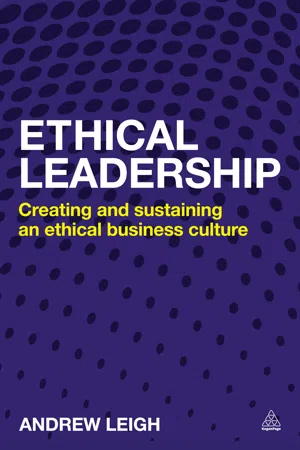
Ethical Leadership shines a light on the role of both culture and ethics in organizations by making the issues more transparent, accessible and above all, connected. Business leaders are now accountable for showing that they have the correct ethical policies and culture in place. Andrew Leigh focuses on the fact that ethical culture is manifest in the actual behaviour and attitudes of all staff, rather than in policy documents. His book is full of practical strategies, case studies and action points which will help leaders to improve and manage ethical culture and climate in their organizations.
Information
PART ONE
Making sense of ethical leadership
01
Making sense of culture
EXECUTIVE SUMMARY
- Time spent on cultural issues is far more productive than any amount of strategic discussions and forward planning.
- Senior executives are more willing these days to talk publicly about culture.
- A study of over 200 companies found that those working on changing their culture improved revenue by over 500 per cent and stock prices by over 800 per cent.
- Culture now takes centre stage in many organizations.
- Aligning culture to strategy can create a language and route map for how to bring a leader’s vision alive.
- When leaders invest their energies in culture, it can inspire a whole workforce.
- Though culture is a bit of an enigma, it’s no excuse for ignoring it or giving it little attention.
- Culture is the personality of the organization and it’s where values reveal themselves through behaviours, attitudes and decisions.
- A culture shift is often the only way a company can renew itself, find a fresh purpose or redirect its collective energies.
- To achieve a culture shift requires those leading it to avoid their own behavioural bias: inertia and natural resistance to change; everybody’s doing it; overconfidence; halo effect; hero syndrome.
Mention culture and, until recently, you could expect managers to ‘reach for their sick bags’.1 For many of them, based not just in the UK but around the world, culture seemed excessively vague and frankly irrelevant. Yet there are encouraging signs that the sick bags are being replaced with yellow pads. On these appear careful calculations showing the extraordinary value of culture to the bottom line. Quite simply, culture is money.
Ignoring culture’s potential to make a difference to company performance is therefore to wilfully bury one’s head in the sand. Meanwhile others, often competitors, are busily figuring out how best to put it to profitable use.
In earlier decades, top executives devoted precious thinking time to working on strategy. Today, in the memorable aphorism of Merck’s then CEO: ‘Culture eats strategy for lunch!’ Translating this into ordinary speak, time devoted to culture issues is far more productive than any amount of strategic discussions and forward planning.
As the same CEO elaborated: ‘You can have a good strategy in place, but if you don’t have the culture and the enabling systems that allow you to successfully implement that strategy, the culture of the organization will defeat the strategy.’2 Yet for many organizations and those in senior positions, culture remains something of a ‘hidden persuader’ – a critical and underrated influence.
So what is changing? First, there is more awareness, among both executives and those who study organizations, of how it impacts on company success. For example, a detailed study by Professors John Kotter and James Heskett of Harvard Business School produced startling evidence that showed the extent to which focusing on culture makes a positive difference (see box below).
The cultural payoff
Quite simply, companies that pay attention to their culture outperform those that don’t. The advantage of paying attention to more than just profits to stockholders can produce an enormous payoff.
In a study reported by John Kotter, a world expert on leadership, over an 11-year period, firms focusing on culture increased revenues by an average of 682 per cent, versus 166 per cent for the ones that did not.
Culture-minded companies expanded their workforces by 282 per cent while those less focused on culture only increased their workforce by 36 per cent. Similarly, the culture-minded companies grew their stock prices by 901 per cent versus 74 per cent for the non-focused companies. They also increased their net incomes by 756 per cent versus 1 per cent.
SOURCE: Kotter, J and Heskett, J (1992) Corporate Culture and Performance, Free Press, New York
Second, a bruising succession of corporate and even whole industry failures, such as the financial crisis of 2008, has involved unacceptable and reputation-destroying behaviours. This has triggered widespread demands for altering current cultures, along with questions about the best way of achieving this. Thirdly, and partly because of these failures, senior executives seem more willing to talk publicly about culture.
Talking about corporate culture is relatively easy. However, transforming one can be extremely challenging. Soon other priorities crowd in, shouldering aside the sustained efforts needed to affect change. Yet for those willing to stick with it, the metrics of culture offer an alluring prospect. For example, it can have a demonstrable impact on a commercial organization’s bottom line. One 11-year study of just over 200 companies, for instance, found that those working on changing their culture improved revenue by a staggering 516 per cent, net income by a huge 755 per cent and their stock prices by a lucrative 827 per cent.3 Fortune 100 Best Companies have similarly shown a higher return than the S&P 500 over seven years, with a positive relationship between a strong affirming culture and performance.4 Nor is culture’s positive impact restricted solely to financial return. It reaches far and wide, affecting risk, strategy, reputation, performance and customers.
When things go seriously wrong with how an organization, or even an entire industry, operates, urgent demands for culture change soon surface. Invariably, someone important emerges to talk of the inevitability of cultural transformation or to describe the intention to initiate significant change. For example, Mervyn King, then Bank of England Governor, perhaps stating the obvious, told members of parliament in August 2012: ‘Barclays needs a new culture.’5 And following the Libor scandal an independent director at RBS was tasked to conduct a significant ‘review of the culture and values’ of the bank.6
Apart from financial services, revelations of damaging behaviours have engulfed numerous society sectors in recent years. These have included the police, MPs and their expenses, certain pharmaceutical companies, engineering firms bribing their way to exports, and of course the media. Some have generated intense shock and dismay. Only the promise of cultural change and, in some cases, renewed ethical standards seems an acceptable form of response. For example, the UK media phone-hacking saga precipitated widespread demands for cultural and ethical change across an entire industry. And faced with the uphill struggle of reforming the culture at the News of the World and rescuing a soiled brand, its owners simply abandoned it as a lost cause, shutting down the paper. It was a sobering and expensive demonstration of the price of ignoring the role of culture in day-to-day management.
Culture now takes centre stage in many organizations because this is such a powerful way of making a positive difference. It influences, for example, whether people use their full potential and go the extra mile on behalf of the organization. By aligning culture to strategy, leaders can create a language and a route map for how they want to bring their version of the future alive. And when leaders invest their personal energies in building and pursuing a particular cultural approach, it can inspire an entire workforce.
What is culture?
On a day of slow business in the early 2000s, two traders at Merrill Lynch in New York undertook a bet: that neither could consume the entire contents of a vending machine. The rest of the trading floor ground to a halt. Everyone watched and wagered as the two traders gorged themselves to the point of sickness.7 You would hardly expect this type of behaviour in the offices of a top management consultancy or a law firm. Apparently harmless, it was a vivid example of the prevailing culture associated with financial traders:
Culture is not a fluffy ...
Table of contents
- Cover page
- Title page
- Imprint
- Dedication
- Table of contents
- Introduction
- Part one: Making sense of ethical leadership
- Part two: Organizational requirements
- Part three: Individual requirements
- Part four: Sustaining the shift
- Resources
- The Ethical Leadership Litmus Test
- Index
- Full imprint
Trusted by 375,005 students
Access to over 1.5 million titles for a fair monthly price.
Study more efficiently using our study tools.
Frequently asked questions
Yes, you can cancel anytime from the Subscription tab in your account settings on the Perlego website. Your subscription will stay active until the end of your current billing period. Learn how to cancel your subscription
No, books cannot be downloaded as external files, such as PDFs, for use outside of Perlego. However, you can download books within the Perlego app for offline reading on mobile or tablet. Learn how to download books offline
Perlego offers two plans: Essential and Complete
- Essential is ideal for learners and professionals who enjoy exploring a wide range of subjects. Access the Essential Library with 800,000+ trusted titles and best-sellers across business, personal growth, and the humanities. Includes unlimited reading time and Standard Read Aloud voice.
- Complete: Perfect for advanced learners and researchers needing full, unrestricted access. Unlock 1.5M+ books across hundreds of subjects, including academic and specialized titles. The Complete Plan also includes advanced features like Premium Read Aloud and Research Assistant.
We are an online textbook subscription service, where you can get access to an entire online library for less than the price of a single book per month. With over 1.5 million books across 990+ topics, we’ve got you covered! Learn about our mission
Look out for the read-aloud symbol on your next book to see if you can listen to it. The read-aloud tool reads text aloud for you, highlighting the text as it is being read. You can pause it, speed it up and slow it down. Learn more about Read Aloud
Yes! You can use the Perlego app on both iOS and Android devices to read anytime, anywhere — even offline. Perfect for commutes or when you’re on the go.
Please note we cannot support devices running on iOS 13 and Android 7 or earlier. Learn more about using the app
Please note we cannot support devices running on iOS 13 and Android 7 or earlier. Learn more about using the app
Yes, you can access Ethical Leadership by Andrew Leigh in PDF and/or ePUB format, as well as other popular books in Business & Etica aziendale. We have over 1.5 million books available in our catalogue for you to explore.